Questões de Vestibular
Sobre vocabulário | vocabulary em inglês
Foram encontradas 574 questões


How things have changed.
Now disagreements feel deadly serious. Like when your colleague pronounces that wearing a face mask in public is a threat to his liberty. Or when you see that one of your friends has just tweeted that, actually, all lives matter. Before you know it, you’re feeling angry and forming harsh new judgments about your colleagues and friends. Let’s take a collective pause and breathe: there are some ways we can all try to have more civil disagreements in this febrile age of culture wars.
1. ‘Coupling’ and ‘decoupling’
The first is to consider how inclined people are to ‘couple’ or ‘decouple’ topics involving wider political and social factors. Swedish data analyst John Nerst has used the terms to describe the contrasting ways in which people approach contentious issues. Those of us more inclined to ‘couple’ see them as inextricably related to a broader matrix of factors, whereas those more predisposed to ‘decouple’ prefer to consider an issue in isolation. To take a crude example, a decoupler might consider in isolation the question of whether a vaccine provides a degree of immunity to a virus; a coupler, by contrast, would immediately see the issue as inextricably entangled in a mesh of factors, such as pharmaceutical industry power and parental choice.
2.____________________
A study at Arizona State University, U.S., analysed more than 100,000 comments on a forum where users post their views on an issue and invite others to persuade them to change their mind. The researchers found that regardless of the kind of topic, people were more likely to change their mind when confronted with more evidence-based arguments. “Our work may suggest that while attitude change is hard-won, providing facts, statistics and citations for one’s arguments can convince people to change their minds,” they concluded.
3. Just be nicer?
Finally, it’s easier said than done, but let’s all try to be more respectful of and attentive to each other’s positions. We should do this not just for virtuous reasons, but because the more we create that kind of a climate, the more open-minded and intellectually flexible we will all be inclined to be. And then hopefully, collectively, we can start having more constructive disagreements — even in our present very difficult times.


Text 2
Home

No one leaves
home unless home is the mouth of a shark
you only run for the border
when you see the whole city running as well
Your neighbors running faster than you
breath bloody in their throats
the boy you went to school with
who kissed you dizzy behind the old tin factory
is holding a gun bigger than his body
you only leave homewhen
home won‘t let you stay.
No one leaves home unless home chases you
fire under feet
hot blood in your belly
it‘s not something you ever thought of doing
until the blade burnt threats into
your neck
and even then you carried the anthem under
your breath
only tearing up your passport in an airport toilet
sobbing as each mouthful of paper
made it clear that you wouldn‘t be going back.
You have to understand,
that no one puts their children in a boat
unless the water is safer than the land
no one burns their palms
under trains
beneath carriages (…)

I want to go home,
but home is the mouth of a shark
home is the barrel of the gun
and no one would leave home
unless home chased you to the shore
unless home told you to quicken your legs
leave your clothes behind
crawl through the desert
wade through the oceans (…)
No one leaves home until home is a sweaty voice in your ear
saying –
leave,
run away from me now
I dont know what I‘ve become
but I know that anywhere
is safer than here.
By Warsan Shire. Disponível em: https://www.facinghistory.org/educator-resources/current-events/many-faces-global-migration#8 Excertos.
Acesso em: set. 2020.

No livro Sapiens: A brief history of humankind, do autor Yuval Noah Harari, há o seguinte trecho:
Like it or not, we are members of a large and particularly noisy family called the great apes. Our closest living relatives include chimpanzees, gorillas and orangutans. The chimpanzees are the closest. Just 6 million years ago, a single female ape had two daughters. One became the ancestor of all chimpanzees, the other is our own grandmother.
(Sapiens: A brief history of humankind, 2014.)
Em trecho anterior, o autor indica que o surgimento de organismos vivos data de 3,8 bilhões de anos atrás. Comparada a essa informação anterior, a expressão “Just 6 million years ago”, presente no trecho transcrito, justifica-se por indicar que a origem da espécie humana é ____________ , pois corresponde a __________ do período do surgimento dos organismos vivos.
Os termos que completam as lacunas da frase são, respectivamente:

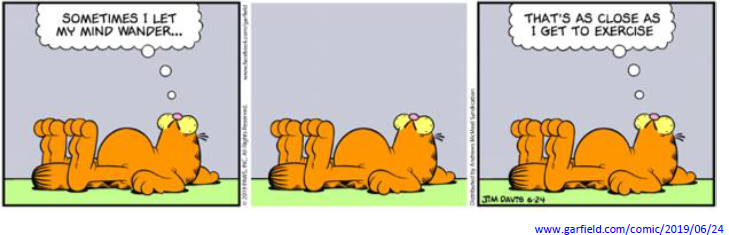
De acordo com a tirinha, qual o significado de WANDER?
Don’t drink coffee
Our bodies naturally produce a hormone called cortisol, which makes us feel more awake. But the caffeine in coffee can interfere with our body’s cortisol production, and over time this can lead us to become more dependent on caffeine and produce less cortisol naturally — so save it until after around 10 a.m.
Don’t stay in bed Exercise is always part of the answer when the question is about being healthier/happier/more productive. But more specifically, pre-breakfast exercise can have its own benefits. A study in Belgium found that exercising before breakfast can help you lose weight by burning more fat than you would later on in the day.
...but do eat cake
Saving the best until last: eat cake: a study of 193 obese adults found that eating cookies or chocolate as part of breakfast stems craving sweet foods later on in the day. In other words, incorporating cake into your morning routine can actually make you healthier for the rest of the day. It’s science; don’t question it.
Disponível em: www.indy100.com. Acesso em: nov. 2016 (adaptado).
No trecho “stems craving sweet foods”, o termo “stems” significa


Read the text and answer question
How to Make Friends While Traveling Solo
Even in the best cases, traveling alone can get lonely. Here’s how to connect safely with the people you meet along the way.
Select the alternative that gives the correct meanings for these words from the text:
A – Feature
B – Nearby
C – Environment
Doctor: Have you ever fainted before? Patient: Yes, the last time you told me your fees.
(Available in:https://pages2cool.blogspot.com.)
Mark the item that does NOT match the dialogue:


I - Content still comes first regardless of whether we conceive of the work of an art on the model of a picture or on the model of a statement. II - Content, whether conceived on the model of a picture ar on the model of a statement, still comes first. III - Whether being conceived the work of art on the model of a picture or on the model of a statement, content still comes first.
If applied to the text, which ones would be correct and keep the literal meaning?

 Conheça nossos planos