Questões de Vestibular
Sobre tradução | translation em inglês
Foram encontradas 170 questões


Numere a segunda coluna de acordo com a primeira, de forma a obter a tradução dos vocábulos.
(1) trade (linha 02)
(2) devices ((linha 02)
(3) cross-pollinate (linha 03)
(4) swamps (linha 04)
(5) fast-reproducing weed (linha 04)
( ) influenciam-se mutuamente
( ) comércio
( ) abafa
( ) erva daninha
( ) aparelhos
A sequência correta de preenchimento dos parênteses, de cima para baixo, é

Leia o texto para responder à questão.
The Institute for Supply Management’s (ISM) manufacturing index rose to 53.2 from 51.3 in January. A reading above 50 indicates expansion. Separate data showed construction spending rose slightly in January, helped by residential construction.
Manufacturing and construction are key to the US economy and there were fears that severe weather across many parts of the US may have hurt the sectors. Bradley Holcomb, chair of ISM’s survey committee, said that while several manufacturers said severe weather was impacting their business, “other comments reflect optimism in terms of demand and growth in the near term”. Meanwhile, data released by the US Department of Commerce, showed that construction spending rose 0.1% in January, from December. Compared to the same month last year, construction spending was up 9.3%.
However, the bad weather conditions impacted car sales in February with General Motors, Toyota and Ford all posting declines in their deliveries. But the drop in sales was less than expected and manufacturers were upbeat about the prospects in the coming months. “February auto sales emerged from a chill in the second half of the month, positioning the industry for a strong March,” said Bill Fay, general manager at Toyota, which saw a fall in deliveries of 4% during the month. General Motors’ sales fell 1%, compared to analysts’ forecast of a 6% drop. Chrysler and Nissan Motors beat the trend with sales increases of 11% and 16% respectively.
Analysts said that overall car sales during the month had been helped by incentives and discounts offered by dealers to lure customers to showrooms in an attempt to cushion the impact of the severe weather conditions. However, as weather conditions improve, the discounts will reduce.
(www.bbc.com. Adaptado.)
Leia o texto para responder à questão.
The Institute for Supply Management’s (ISM) manufacturing index rose to 53.2 from 51.3 in January. A reading above 50 indicates expansion. Separate data showed construction spending rose slightly in January, helped by residential construction.
Manufacturing and construction are key to the US economy and there were fears that severe weather across many parts of the US may have hurt the sectors. Bradley Holcomb, chair of ISM’s survey committee, said that while several manufacturers said severe weather was impacting their business, “other comments reflect optimism in terms of demand and growth in the near term”. Meanwhile, data released by the US Department of Commerce, showed that construction spending rose 0.1% in January, from December. Compared to the same month last year, construction spending was up 9.3%.
However, the bad weather conditions impacted car sales in February with General Motors, Toyota and Ford all posting declines in their deliveries. But the drop in sales was less than expected and manufacturers were upbeat about the prospects in the coming months. “February auto sales emerged from a chill in the second half of the month, positioning the industry for a strong March,” said Bill Fay, general manager at Toyota, which saw a fall in deliveries of 4% during the month. General Motors’ sales fell 1%, compared to analysts’ forecast of a 6% drop. Chrysler and Nissan Motors beat the trend with sales increases of 11% and 16% respectively.
Analysts said that overall car sales during the month had been helped by incentives and discounts offered by dealers to lure customers to showrooms in an attempt to cushion the impact of the severe weather conditions. However, as weather conditions improve, the discounts will reduce.
(www.bbc.com. Adaptado.)
World Cup 2014 kicks off with colourful ceremony.
Disponível em: <http://www.bbc.com/sport/0/football/27779059> . Acesso em: 12 jun. 2014
June 26, 2014
By Amy Graff

Reading Go Dog Go to your 6 month old might seem like wasted time because she’s more likely to eat the book than help you turn the pages, but a statement released by the American Academy of Pediatrics (AAP) this week says reading in the early years is essential. Reading out loud gets parents talking to their babies and the sound of an adult’s voice stimulates that tiny yet rapidly growing brain. In the statement, the academy advises pediatricians to tell parents to read books to their children from birth.
Reading regularly with young children stimulates optimal patterns of brain development and strengthens parent-child relationships at a critical time in child development, which, in turn, builds language, literacy, and social-emotional skills that last a lifetime. Research shows that a child’s brain develops faster between 0 and 3 than at any other time in life, making the early years a critical time for babies to hear rich oral language. The more words children hear directed at them by parents and caregivers, the more they learn.
While many babies are read Goodnight Moon and The Very Hungry Caterpillar every night before bed, others never get a chance to “pat the bunny.” Studies reveal that children from low-income, less-educated families have significantly fewer books than their more affluent peers. By age 4, children in poverty hear 30 million fewer words than those in higher-income households. These dramatic gaps result in significant learning disadvantages that persist into adulthood. The AAP hopes the new guidelines will encourage all parents to start reading from day one.
Research shows that when pediatricians talk with parents about reading, moms and dads are more likely to fill their home with books and read. Also, to help get more parents reading, the AAP is partnering with organizations such as Scholastic and Too Small to Fail to help get reading materials to new families who need books the most.
This is the first time the AAP has made a recommendation on children’s literary education and it seems the timing might be just right as more and more parents are leaning on screens and electronic gadget to occupy their babies. “The reality of today’s world is that we’re competing with portable digital media,” Dr. Alanna Levine, a pediatrician in Orangeburg, N.Y., told The New York Times. “So you really want to arm parents with tools and rationale behind it about why it’s important to stick to the basics of things like books.”
(http://blog.seattlepi.com. Adaptado.)
June 26, 2014
By Amy Graff
Reading Go Dog Go to your 6 month old might seem like wasted time because she’s more likely to eat the book than help you turn the pages, but a statement released by the American Academy of Pediatrics (AAP) this week says reading in the early years is essential. Reading out loud gets parents talking to their babies and the sound of an adult’s voice stimulates that tiny yet rapidly growing brain. In the statement, the academy advises pediatricians to tell parents to read books to their children from birth.
Reading regularly with young children stimulates optimal patterns of brain development and strengthens parent-child relationships at a critical time in child development, which, in turn, builds language, literacy, and social-emotional skills that last a lifetime. Research shows that a child’s brain develops faster between 0 and 3 than at any other time in life, making the early years a critical time for babies to hear rich oral language. The more words children hear directed at them by parents and caregivers, the more they learn.
While many babies are read Goodnight Moon and The Very Hungry Caterpillar every night before bed, others never get a chance to “pat the bunny.” Studies reveal that children from low-income, less-educated families have significantly fewer books than their more affluent peers. By age 4, children in poverty hear 30 million fewer words than those in higher-income households. These dramatic gaps result in significant learning disadvantages that persist into adulthood. The AAP hopes the new guidelines will encourage all parents to start reading from day one.
Research shows that when pediatricians talk with parents about reading, moms and dads are more likely to fill their home with books and read. Also, to help get more parents reading, the AAP is partnering with organizations such as Scholastic and Too Small to Fail to help get reading materials to new families who need books the most.
This is the first time the AAP has made a recommendation on children’s literary education and it seems the timing might be just right as more and more parents are leaning on screens and electronic gadget to occupy their babies. “The reality of today’s world is that we’re competing with portable digital media,” Dr. Alanna Levine, a pediatrician in Orangeburg, N.Y., told The New York Times. “So you really want to arm parents with tools and rationale behind it about why it’s important to stick to the basics of things like books.”
(http://blog.seattlepi.com. Adaptado.)
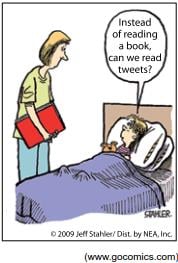
A expressão “instead of” equivale, em português, a

(Disponível em http://www.lifebuzz.com/funny-texts/#!SsbFU. Acessado em 02/02/2014.)
Depreende-se dessa troca de mensagens que

Brazil wants to count trees in the Amazon rainforest
By Channtal Fleischfresser
February 11, 2013

Photo: Flickr/Nico Crisafulli
Brazil is home to roughly 60 percent of the Amazon, about half of what remains of the world’s tropical rainforests. And now, the country has plans to count its trees. A vast undertaking, the new National Forest Inventory hopes to gain “a broad panorama of the quality and the conditions in the forest cover”, according to Brazil’s Forestry Minister Antonio Carlos Hummel.
The census, set to take place over the next four years, will scour 3,288,000 square miles, sampling 20,000 points at 20 kilometer intervals and registering the number, height, diameter, and species of the trees, among other data.
The initiative, aimed to better allocate resources to the country’s forests, is part of a large-scale turnaround in Brazil’s relationship to its forests. While it once had one of the worst rates of deforestation in the world, last year only 1,797 square miles of the Amazon were destroyed – a reduction of nearly 80% compared to 2004.
(www.smartplanet.com. Adaptado.)
Instrução: Leia a tira para responder à questão.

(www.hagardunor.net)

although the lyrics didn't make much sense to me: (l. 10)
His clever lyrics were often approved by the censors, (l. 24-25)
Nowadays, the lyrics are explicit (l. 34)
Based on these examples, lyrics is translated as:

Sebastião Salgado’s blue eyes have seen a bit of everything in this world - and this might not even be an exaggeration. For the past eight years in particular, the 69yearold Brazilian photographer has travelled to more than 30 isolated regions of the world, collecting images of dozens of remote tribes, endangered animals and unusual landscapes.
The Genesis project is a singular photographic journey that began in 2004 and ended in 2012, at a cost of one million Euros a year. The result will be shown in magazines, books, a documentary by Wim Wenders and a series of exhibitions around the world, each displaying some 250 blackandwhite photos.
The first exhibition will open in London on April 11, with former Brazilian President Lula - Salgado’s longtime friend - as special guest. “We want to create a little movement around these photos to provoke a debate on what we need to preserve,” he says. Salgado defends environmental causes through his organization, Instituto Terra. Even after travelling to so many exotic places, Salgado, now living in Paris, still takes vacations in Brazil. Here are excerpts from a conversation Salgado had with Folha, with new details about his travels, photographic techniques and new environmental projects.
• Coldest trip I visited the Nenets, in the Yamal peninsula, in northern Siberia, Russia. They are a nomadic tribe who raise reindeer in extreme Arctic conditions. When I went there it was spring and weather ranged between 35ºC and 45ºC. I didn’t wash myself for 45 days. They don’t take baths because there is no water. The only way to get water is to break off a piece of ice and warm it in a pot.
• Frozen equipment I used a Canon, an EOS1 Mark III, a very powerful machine. The problem was the batteries. In the Siberian temperatures, they quickly lost power. On average, I take 2,500 shots per battery, but this time I could only take 300400 photos before the battery stopped working. I would put it inside my clothes, my assistant would give me another one, I would take 300 more pictures and, when that battery ran out energy, I would take out the other one and it would work again.
• Going digital for the first time I started Genesis with film and changed to digital. The airport XRay scanners degrade the quality of film, and so I decided to change to digital and was quite surprised. Quality was better than the one I had with negatives in medium format. I turned off the screen on the back of the camera, and used my camera as I have always done. When I came back to Paris, I printed contact sheets and edited the photos using a magnifying glass, because I don’t know how to do it in the computer.
• Stone Ages I met tribes that are still living in the Stone Ages, with working tools such as stone hammers. There were clans of about 10 people living in treetops. They had already seen white people before. They looked towards the direction I had come from and the chief asked me whether I was part of the white people clan that usually came from that direction. Because, for them, the world is all made of clans
• Brazilian arrows I met the Zo’e tribe, in Brazil, who were first discovered 15 years ago and live in a state of total purity. You see the guy working with an arrow. He warms it, put some weight on it, a straight feather if he wants a quicker arrow, a rounder one to have it slower. It is the same science as for rockets. And he’s got the same problem as in Cape Canaveral, to recover his rockets. If his ballistic calculations are wrong, he loses his arrow. He takes only 10 arrows with him when he goes hunting, no more than that
• Activist or photographer? Photography is my life. When I am taking photos, I am in a deep trance. When I have my camera and am travelling with the Nenets, it’s my life, morning to night. I have taken incredible photos, but my life is also the environment and Instituto Terra.



 Conheça nossos planos