Questões de Vestibular
Sobre tradução | translation em inglês
Foram encontradas 170 questões



Leia o texto a seguir para responder à questão.
The voluminous literature dealing with the idea of human progress is decidedly a mixed bag. While some of these writings are impressive and even inspiring, many of them are superficial, perhaps even ridiculous, in their reiteration (especially during the nineteenth century) of the comforting prospect that every day in every way we are growing better and better.
This kind of foolishness is manifested especially in discussions of such matters as economic, political, and moral progress, and of progress in art. [...]
From time to time, there seems to be real and measurable improvement in these areas. At other times the opposite seems equally to be the case. Thus the fervent belief of writers like the French sociophilosopher Auguste Comte in the inevitability of progress in all fields of human endeavor must be viewed as insupportable. We cannot accept it any longer, even if we once thought it was true.
Progress in human knowledge is another matter. Here it is possible to argue cogently that progress is in the nature of things. “Not only does each individual progress from day to day”, wrote French philosopher, mathematician, and mystic Blaise Pascal, “but mankind as a whole constantly progresses... in proportion as the universe grows older.” The essence of man as a rational being, as a later historian would put it, is that he develops his potential capacities by accumulating the experience of past generations.
Just as in our individual lives we learn more and more from day to day and from year to year because we remember some at least of what we have learned and add our new knowledge to it, so in the history of the race the collective memory retains at least some knowledge from the past to which is added every new discovery.
The memories of individuals fail and the persons die, but the memory of the race is eternal, or at least it can be expected to endure as long as human beings continue to write books and read them, or — which becomes more and more common — store up their knowledge in other mediums for the use of future generations.
Fonte: VAN DOREN, Charles. A History of Knowledge: Past, Present and Future. New York: The Random House Publishing Group, 1991, p. XV–XVI.
Leia o texto a seguir para responder à questão.
“It’s all we’ve been talking about since November,” says Patrick Franzen, publishing director for SPIE, the international society for optics and photonics. He’s referring to ChatGPT, the artificial intelligence (AI)-powered chatbot unveiled that month. In response to a prompt, ChatGPT can spin out fluent and seemingly well-informed reports, essays — and scientific manuscripts. Worried about the ethics and accuracy of such content, Franzen and managers at other journals are scrambling to protect the scholarly literature from a potential flood of manuscripts written in whole or part by computer programs.
Some publishers have not yet formulated policies. Most of those that have avoid an outright ban on AI-generated text, but ask authors to disclose their use of the automated tools, as SPIE is likely to do. For now, editors and peer reviewers have few alternatives, as they lack enforcement tools. No software so far can consistently detect the synthetic text the majority of the time. [...]
In some cases, the resulting text is indistinguishable from what people would write. For example, researchers who read medical journal abstracts generated by ChatGPT failed to identify one-third of them as written by machine, according to a December 2022 preprint. AI developers are expected to create even more powerful versions, including ones trained specifically on scientific literature — a prospect that has sent a shock wave through the scholarly publishing industry.
So far, scientists report playing around with ChatGPT to explore its capabilities, and a few have listed ChatGPT as a co-author on manuscripts. Publishing experts worry such limited use could morph into a spike of manuscripts containing substantial chunks of AI-written text.
Fonte: BRAINARD, Jeffrey. As scientists explore AI-written text, journals hammer out policies. Science, v. 379, n. 6634, p. 740–741, 22 feb. 2023. Disponível em: https://www.science.org/content/article/scientists-explore-ai-written-text-journals-hammer-policies.
“In recent years, no more than a week goes by without news of a cosmic discovery worthy of banner headlines. While media gatekeepers may have developed an interest in the universe, this rise in coverage likely comes from a genuine increase in the public’s appetite for science. Evidence for this abounds, from hit television shows inspired or informed by science, to the success of science fiction films starring marquee actors, and brought to the screens by celebrated producers and directors. And lately, theatrical release biopics featuring important scientists have become a genre unto itself. There´s also widespread interest around the world in science festivals, science fiction conventions, and documentaries for television.
Leia o texto e examine o gráfico para responder à questão.
When Tinder (a mobile dating app) was launched on college campuses in America in 2012, it quickly became a hit. Although online dating had been around since Match.com, a website for lonely hearts, launched in 1995, it had long struggled to shed1 an image of desperation. But Tinder, by letting users sift through photos of countless potential dates with a simple swipe, made it easy and fun.
Soon Tinder and its rivals had transformed dating. A report found that 30% of American adults had used an online dating service, including more than half of those aged between 18 and 29. One in five couples of that age had met through such a service. Usage surged during the pandemic, as lonely locked- -down singles searched for partners. The market capitalisation of Bumble, a rival to Tinder, surged to $13 billion on its first day of trading2 in February 2021. Later that year the value of Match Group, which owns Tinder, Hinge and scores of other dating services, reached nearly $50 billion.
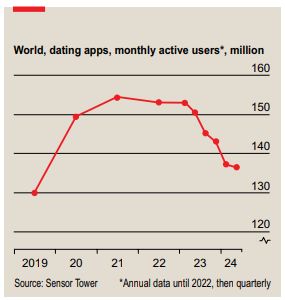
Today roughly 350 million people around the world have a dating app on their phone, up from 250 million in 2018, according to a research firm. In June 2024 Tokyo’s government even said it would launch a matchmaking app of its own to pair up singles in the city. Yet lately online dating has lost its spark. The apps were downloaded 237 million times globally in 2023, down from 287 million in 2020. According to a research firm, the number of people who use them at least once a month has dwindled from 154 million in 2021 to 137 million in the second quarter of 2024.
(www.economist.com, 08.08.2024. Adaptado.)
1 to shed: to get rid of something that is no longer wanted.
2 trading: the activity of buying and selling things.
Adaptado de: O’DONOGHUE, C. The Rachel Incident. New York: Knopf Publishing Group, 2023. p. 10-11.
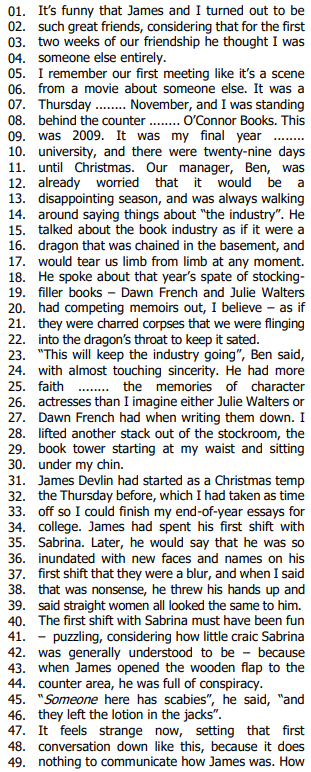
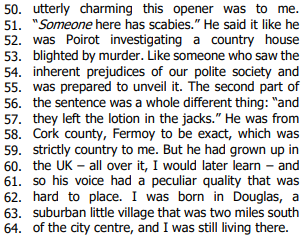
( ) charred (l. 21) ( ) sated (l. 22) ( ) blighted (l. 53)
1. saciado 2. iluminado 3. carbonizado 4. satisfeito 5. destruído 6. arruinado
A sequência correta de preenchimento dos parênteses, de cima para baixo, é
Son of a chief, Nelson Mandela studied law and became one of South Africa's first black lawyers. Early in the 1950s he was elected leader of the youth wing of the ANC (African National Congress) liberation movement. When the country's white minority government prohibited the ANC in 1960, Mandela became convinced that armed struggle was inevitable. Inspired by the guerrilla wars in Algeria and Cuba, he organized a military underground movement that engaged in sabotage. In 1962 he was arrested and sentenced to life imprisonment for high treason and conspiracy against the state.
From 1964 to 1982 he was confined to the notorious prison island Robben Island, together with several other resistance leaders. He was then moved to prison on the mainland until his release in 1990. During his imprisonment, Mandela became a rallying point for South Africa's oppressed, and the world's most famous political prisoner.
Nelson Mandela shared the Peace Prize with the man who had released him, President Frederik Willem de Klerk, because they had agreed on a peaceful transition to majority rule.
Disponible in: https://www.nobelprize.org/prizes/peace/1993/mandela/facts/. Access in: May, 24 2023 (adapted).
Choose the best translation for the statement.
I - Son of a chief, Nelson Mandela studied law and became one of south Africa’s first black lawyers.
II - In 1962 he was arrested and sentenced to life imprisonment for high treason and conspiracy against the state.
III - From 1964 to 1982 he was confined to the notorious prison island Robben Island, together with several other resistance leaders.
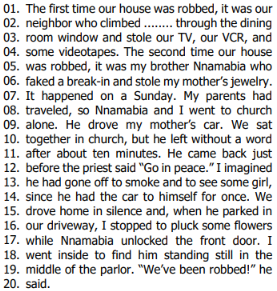
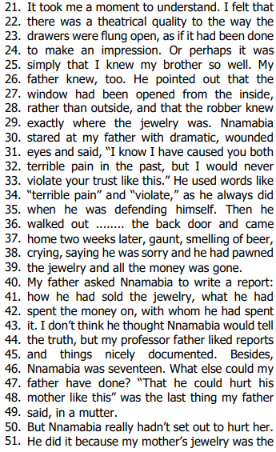
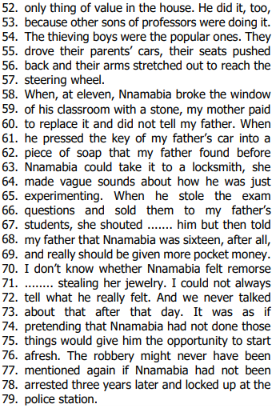
( ) gaunt (l. 37)
( ) mutter (l. 49)
( ) pretending (l. 74)
1. resmungo
2. magro
3. pretender
4. queixa
5. fingir
6. altivo
A sequência correta de preenchimento dos parênteses, de cima para baixo, é
“Acabamos de concluir o relatório de orçamento para a implementação da área de tecnologia da informação em nossa filial aqui no Brasil. Como poderá ser observado, o relatório, que segue anexo, apresenta tanto os valores para os recursos tecnológicos como para os recursos humanos.
Aguardamos o seu breve parecer para darmos continuidade ao processo.”
Nessa situação, assinale a opção que apresenta a versão correta para o texto citado.
Text
Volunteering is fun!


Disponível em: https://learnenglishteens.britishcouncil.org/magazine/life-around-world/volunteering-fun. Texto
adaptado. Acesso em: ago. 2020.

“The old believe everything; the middle-aged suspect everything; the young know everything.”
Oscar Wilde (Ireland, 1854 – 1900)
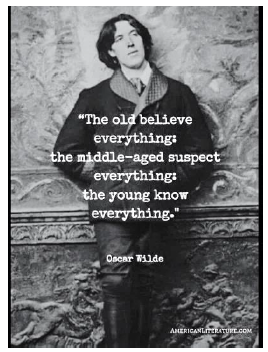
Extracted from https://americanliterature.com/author/oscar-wilde



 Conheça nossos planos