Questões de Vestibular
Sobre tradução | translation em inglês
Foram encontradas 170 questões


Leia o texto para responder à questão.
Dying to defend the planet: why Latin America
is the deadliest place for environmentalists

February 11, 2017
Defending nature is a dangerous occupation, especially in Latin America. According to a recent report by Global Witness, an NGO, 185 environmental activists were murdered worldwide in 2015, an increase of 59% from the year before. More than half the killings were in Latin America. In Brazil 50 green campaigners died in 2015. Honduras is especially dangerous: 123 activists have died there since 2010, the highest number of any country relative to its population. Berta Cáceres, an indigenous leader who was a prominent campaigner against dams and plantations, was murdered there.
Why is Latin America so deadly? One reason is its abundant natural resources, which attract enterprises of all sorts, from multinationals to mafias. When prices are low, as they are now, the most rapacious do not go away; to maintain their profits they become more aggressive, says David Kaimowitz of the Ford Foundation, which gives money to good causes. New technologies open up new battlefronts. Soya beans bred to grow in tropical conditions have encouraged farmers to displace cattle ranchers, who in turn have advanced into the rainforest. Small prospectors can now extract gold from soil rather than just hunting around. That opens up new areas for exploitation, such as San Rafael de Flores in south-eastern Guatemala, where activists have been murdered.
The odds of finding the criminals are greater if the victim is foreign. Dorothy Stang, an American nun who fought to protect the Amazon rainforest, was killed in Brazil 12 years ago. Both the gunman and a rancher who had hired him eventually went to jail. But that is an exception.
(https://www.economist.com/the-americas/2017/02/11/
why-latin-america-is-the-deadliest-place-for-environmentalists. Adaptado)


Shares in the music streaming firm Spotify will be publicly traded for the first time when the firm debuts on the New York market.
The flotation marks a turning point for the firm that after 12 years has not yet made a profit. Spotify's listing, which could value it at $20billion (£14 billion), is unconventional: it is not issuing any new shares. Instead, shares held by the firm's private investors will be made available.
What was once an small upstart Swedish music platform, has grown rapidly in recent years, adding millions of users to its free-to-use ad-funded service, and converting many of them to its more lucrative subscription service. It's used in 61 countries, has 159 million active users and a library of 35 million songs. They developed the platform in 2006 as a response to the growing piracy problem the music industry was facing. It is now the global leader among music streaming companies, boasting 71 million paying customers, twice as many as runner-up Apple.
What Spotify must do to survive? So far costs and fees to recording companies for the rights to play their music, have exceeded Spotify's revenues. And some analysts predict the listing will speed-up Spotify's race towards profitability. "When that's done we'll see a bit of a shift in strategy and direction." says Mark Mulligan at MIDia Research. The firm made a commitment to investors who backed it as the company was growing, that they would be given the chance to cash in their investment. The streaming giant has filed for paperwork to start trading its shares publicly on the New York Stock Exchange.
What will Spotify look like in the future? So what will change? "So far they've been treading a very fine line between being the dramatic new future of the music business but simultaneously being the biggest friend of the old music industry by giving record labels a platform to build out of decline," says Mr Mulligan.
"To go to the next phase [Spotify] will have to stop being so friendly to the record companies." More than half of Spotify's revenue goes directly to the record companies. Chris Hayes expects Spotify to evolve. "I think over time they're going to have to diversify their offering." he says, helping to set them apart from a sea of rival streaming services. They have already moved into podcasts and producing original music. They may well start to offer more original content like Taylor Swift's recent video which was only made available on the platform, says Chris Hayes.
So can Spotify make money? The firm's first operating profit (not including debt financing) is on the horizon for 2019 based on current trends, according to Mr Hayes. "The strategy has always been the free tier, but it is a funnel through which to persuade free users to upgrade to the subscription tier which is lucrative.
"As long as subscriptions continue to grow it should eventually become profitable. "Spotify's rivals are the biggest companies in the world with bottomless pockets," he says, and they are using music as a way to sell their core products, not as a business proposition in itself.
Apple, Amazon and Google are also in the streaming game and - unlike Spotify - all sell devices on which consumers can listen to music. And while Spotify has signed deals with all the "big three" record labels - Warner, Universal and Sony - it is the music executives that still hold the bargaining chips.
Adapted from: http://www.bbc.com/news/business-43613398. Acesso em: 03 abr. 2018.

Leia os cartuns 1 e 2 para responder à questão.

TEXTO
Brazil has declared an end to its public health emergency over the Zika virus, 18 months after a surge in cases drew headlines around the world.
The mosquito-borne virus was not considered a major health threat until the 2015 outbreak revealed that Zika can lead to severe birth defects. One of those defects, microcephaly, causes babies to be born with skulls much smaller than expected.
Photos of babies with the defect spread panic around the globe as the virus was reported in dozens of countries. Many would-be travellers cancelled their trips to Zika-infected places. The concern spread even more widely when health officials said it could also be transmitted through sexual contact with an infected person.
The health scare came just as Brazil, the epicentre of the outbreak, was preparing to host the 2016 Olympics, fuelling concerns the Games could help spread the virus. One athlete, a Spanish wind surfer, said she got Zika while training in Brazil ahead of the Games.
In response to the outbreak, Brazil launched a mosquito-eradication campaign. The health ministry said those efforts have helped to dramatically reduce cases of Zika. Between January and mid-April, 95% fewer cases were recorded than during the same period last year. The incidence of microcephaly has fallen as well.
The World Health Organization (WHO) lifted its own international emergency in November, even while saying the virus remained a threat.
“The end of the emergency doesn’t mean the end of surveillance or assistance” to affected families, said Adeilson Cavalcante, the secretary for health surveillance at Brazil’s health ministry. “The health ministry and other organisations involved in this area will maintain a policy of fighting Zika, dengue and chikungunya.”
All three diseases are carried by the Aedes aegypti mosquito.
But the WHO has warned that Zika is “here to stay,” even when cases of it fall off, and that fighting the disease will be an ongoing battle.
(Fonte: Associated Press, Friday 12 May 2017 10.18 BST.
Last modified on Friday 12 May 2017 22.00 BST)
Match the words with their correct definitions.
( 1 ) surge
( 2 ) headlines
( 3 ) threat
( 4 ) disease
( ) ameaça
( ) surto
( ) manchetes
( ) ameaça
The correct sequence from the top to the
bottom is:
Texto 1

US President Donald Trump has defended his use of social media in a series of tweets, following a row over comments he made about two MSNBC TV presenters.
"My use of social media is not presidential – it's modern day presidential," he tweeted on Saturday.
His tweets are condemned by Democrats and Republicans alike, despite the White House springing to his defence.
Mr Trump's aides have previously expressed concern over his tweets.
But the president said on Saturday that social media gave him the opportunity to connect directly to the public, bypassing the mainstream media, whose content Mr Trump regularly labels as "fake news".
"The FAKE & FRAUDULENT NEWS MEDIA is working hard to convince Republicans and others I should not use social media," he tweeted, adding: "But remember, I won the 2016 election with interviews, speeches and social media."
Mr Trump also stepped up his attack on CNN after the US news network retracted an article alleging that one of the president's aides was under investigation by Congress.
"I am extremely pleased to see that @CNN has finally been exposed as #FakeNews and garbage journalism. It's about time!"
The story that caused the upset, which was later removed from the website following an internal investigation, resulted in the resignations of three CNN journalists: Thomas Frank, investigative unit editor and Pulitzer Prize winner Eric Lictblau and Lex Harris, who oversaw the investigations unit.
Disponível em: http://www.bbc.com/news/world-us-canada-40471536.

A New Zealand pizza chain aims to become the world's first company to offer a commercial drone delivery service, a milestone in the onceunthinkable quest to save time and money with an air-borne supply chain dispensing with people. Domino's Pizza Enterprises Ltd conducted a demonstration pizza delivery by drone in the New Zealand city of Auckland on Thursday, and afterwards said it aimed to be the first company to launch a regular drone service, late this year, despite the fact that Domino's Chief Executive Officer Don Meij had said in a statement "We've always said that it doesn't make sense to have a 2-tonne machine delivering a 2-kilogram order."
Even though Domino’s Pizza used in its test drones provided by U.S.-headquarted Australian drone company Flirtey, Philip Solaris, director of a New Zealand based drone company called X-craft Enterprises, said that while New Zealand has accommodating regulations on drones, Domino’s would be held back by a rule requiring drones to be kept in sight at all times, and added “I can't truly see how commercially viable that idea is because you would have to literally have somebody walking along to keep it in the line of sight, watching it at all times.” Other than that, he warned that “Domino’s service would still need to overcome random hazards (like) power lines, moving vehicles, children in the backyard playing”.
http://www.reuters.com/article/us-newzealand-drones-food-idUSKCN1100H0
Acessado 12/01/2017. Adaptado para fins educacionais
A questão referem-se ao quadrinho
abaixo.
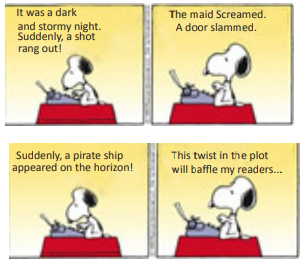
A questao refere-se ao texto abaixo.

Pseudoscientific claims that music helps plants grow have been made for decades, despite evidence that is shaky at best. Yet new research suggests some flora may be capable of sensing sounds, such as the gurgle of water through a pipe or the buzzing of insects.
In a recent study, Monica Gagliano, an evolutionary biologist at the University of Western Australia, and her colleagues placed pea seedlings in pots shaped like an upside-down Y. One arm of each pot was placed in either a tray of water or a coiled plastic tube through which water flowed; the other arm had dry soil. The roots grew toward the arm of the pipe with the fluid, regardless of whether it was easily accessible or hidden inside the tubing. “They just knew the water was there, even if the only thing to detect was the sound of it flowing inside the pipe,” Gagliano says. Yet when the seedlings were given a choice between the water tube and some moistened soil, their roots favored the latter. She hypothesizes that these plants use sound waves to detect water at a distance but follow moisture gradients to home in on their target when it is closer.
The research, reported earlier this year in Oecologia, is not the first to suggest flora can detect and interpret sounds. A 2014 study showed the rock cress Arabidopsis can distinguish between caterpillar chewing sounds and wind vibrations – the plant produced more chemical toxins after “hearing” a recording of feeding insects. “We tend to underestimate plants because their responses are usually less visible to us. But leaves turn out to be extremely sensitive vibration detectors,” says lead study author Heidi M. Appel, an environmental scientist now at the University of Toledo.
TEXTO I
HOW TO TRICK YOUR BRAIN INTO HEALTHY EATING
Charles Spence and Jozef Youssef

“And yet and yet. Whatever accommodation he reached with his first wife in life hasn't survived her death. Diana haunts Charles”.
Uma tradução para o termo grifado “Whatever” no context da frase seria:
Texto 1
BRAZILIAN TEEN WITH CANCER CELEBRATES TURBAN ON SOCIAL MEDIA
By plus55 on Feb 13, 2017
Thauane Cordeiro never thought she’d face accusations of cultural appropriation after posting a selfie with a turban. Diagnosed with cancer, the treatments left this Brazilian teen bald. So she styles up her baldness with colorful turbans when she heads out of the house. However, after one picture of herself wearing a turban on Facebook, she faced unexpected backlash.
While most turban-wearers in Brazil are black, Cordeiro is white. But instead of letting her haters put her down, Cordeiro explained just why she wore a turban that day. And it wasn’t about stealing black culture.
Here’s a translation of her post: Turban love
I’ll explain what happened yesterday so you know why I’m so angry with this whole cultural appropriation thing. I was at the station with this pretty turban, feeling like a diva. And I started to notice that there were a lot of black women around, beautiful by the way, who were looking at me funny, like “look over there the little white girl appropriating our culture”. Anyway, one of them came over to tell me I shouldn’t use a turban because I’m white. I took off the turban and said “are you seeing this bald head, this is called cancer, so I use what I want! Bye.” I grabbed my turban and walked off leaving her in shock. #EverybodyWearsTurbans
The post went up last week and already has 104,000 likes and 30,000 shares.
Fonte: <http://plus55.com/brazil-culture/2017/02/brazilian-teen-cancer-turba>.
Irma and Harvey lay the costs of climate change denial at Trump’s door
The president’s dismissal of scientific research is doing nothing to protect the livelihoods of ordinary Americans.
Bob Ward - Sunday 10 September 2017

As the US comes to terms with its second major weather disaster within a month, an important question is whether the devastation caused by hurricanes Harvey and Irma will convince Donald Trump and his administration of the reality of climate change.
The president’s luxurious Mar-a-Lago estate in Florida may escape Irma’s wrath, but with the deaths of so many Americans, and billions of dollars in damage to homes and businesses, the costs of climate change denial are beginning to pile up at the door of the White House.
Just days before Harvey formed in the Atlantic last month, Trump signed an executive order to overturn a policy, introduced by his predecessor Barack Obama, to help American communities and businesses become more resilient against the risks of flooding, which are rising because of climate change.
But the merciless assault on the US mainland by Harvey and Irma should be forcing the president to recognise the consequences of his arrogance and complacency in dismissing the research and analysis carried out by scientists.
The flooded streets of Houston and the wind-ravaged homes of south Florida bear the
unmistakable fingerprint of extreme weather made worse by manmade greenhouse gas
emissions.
A hurricane is a huge, rotating cluster of thunderstorms that forms above a sea surface that has a temperature of at least 26.5C. It is like a giant engine, transferring heat from the sea surface up into the atmosphere and generating strong winds and heavy rain in the process.
Climate change cannot be blamed for the hurricane count in any single season, nor for the occurrence of any single storm, but there are some ways in which it is making the consequences worse.
Adapted from: <https://www.theguardian.com/world/2017/sep/10/hurricane-irma-harvey-climate-change-trump>. Acesso em: 17 set 2017.

BRITISH researchers... Disponível em:<http//www.nutraingredients.com /research/ Post-exercise-protein-…-Study>

 Conheça nossos planos