Questões de Vestibular Sobre inglês

Foram encontradas 6.367 questões

Ano: 2017 Banca: UFRR Órgão: UFRR Prova: UFRR - 2017 - UFRR - Vestibular |
Q1266901 Inglês

TEXT VI

Music Appreciation


Taken from <http://beingfive.blogspot.com.br/>. Accessed on August 21st, 2017


In text VI the words HUGE, BIG, SPECIAL and COOL indicate the characterization of the ideas they refer to. They could be respectively replaced without changing the original meaning by
Alternativas
Ano: 2017 Banca: UFRR Órgão: UFRR Prova: UFRR - 2017 - UFRR - Vestibular |
Q1266900 Inglês

TEXT V 

They call it ‘tourism-phobia’ but that’s not what’s happening in Barcelona

Jordi Rabassa, Barcelona en Comú District Councilor for the

Old City in Barcelona


   There‘s a new word that‘s taken over the local political debate in Barcelona: tourism-phobia. For months now, political and media personalities have been using accusations of tourism-phobia to attack the social movements and political parties that are questioning the so-called ‗tourism industry‘ and its repercussions on the right to the city.

   The use of ―tourism-phobia‖ seeks to criminalize this criticism, painting it as a form of racism against people who visit the city in the popular imagination. But this attempt to compare, even at a subconscious level, ―tourism-phobia‖ and racism is not just irresponsible, it‘s a sign of defeat by those who have invented the word. Because these are the same people who warned us that regulating tourism would paralyze economic activity and employment in the city. This argument, based on the supposedly unquestionable logic of the productive economy, hasn‘t gone anywhere; it‘s the same old neoliberal discourse that tourism is a harmless and friendly activity. They‘ve just pushed it aside temporarily to make room for the related idea of tourism-phobia, which aims to appeal to people‘s emotions.

   They call it tourism-phobia but they probably don‘t know what they really want to say. They use the concept of tourism-phobia to camouflage their support for business interests that are putting the right to the city of the people of Barcelona at risk. They call it tourism-phobia to weaken the city government, to criminalize the most active and radical social movements, and to patronize unorganized citizens. They call it tourism-phobia to inject a meme that can be launched on social media and vomited up on TV and the radio.

   Those of us in Barcelona who criticize, problematize or reject an economic model based on the liberalization of the tourism industry are not filled with hate. We‘re defending human rights, principally the right to housing and the right to the city.

  Those who criticize the hegemony of tourism as an economic model are calling for a fair and inclusive city, a city with neighborhoods where people can live. We‘re demanding rent caps and denouncing speculation with commercial premises and licenses. We‘re condemning the black market of tourist apartments that is pushing low-income families out of their homes. We‘re saying, loud and clear, that we want public, affordable housing. We‘re working to make sure that our streets and squares aren‘t overwhelmed by visitors. We‘re grieving for the men and women who‘ve been expelled from our neighborhoods.

   They call it tourism-phobia but that‘s not what it is: it‘s a conscious demand for the right to the city.


Translation of an article published in eldiario.es on 27/06/2017

Disponível em: https://medium.com/@BComuGlobal/they-call-ittourism-phobia-but-that-s-not-what-s-happening-in-barcelonacb56b02da97b Acesso em: 07 ago. 2017.

O trecho do texto V que constrói e enfatiza a ideia de que a turismofobia vem circulando há algum tempo e continua assim no presente é:
Alternativas
Ano: 2017 Banca: UFRR Órgão: UFRR Prova: UFRR - 2017 - UFRR - Vestibular |
Q1266899 Inglês


JACKSON, M. Disponível em: https://www.vagalume.com.br/. Acesso em: 07 ago. 2017.

Sentences in lines 13 and 14 contribute to the general meaning of the song by indicating
Alternativas
Ano: 2017 Banca: UFRR Órgão: UFRR Prova: UFRR - 2017 - UFRR - Vestibular |
Q1266898 Inglês

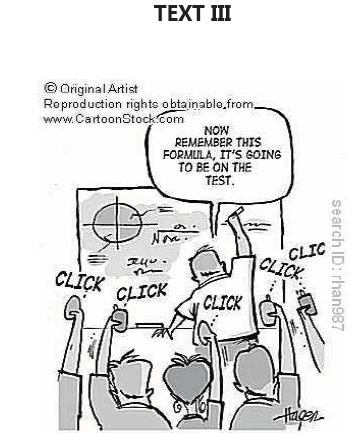
Imagem associada para resolução da questão HAGEN, R. Cartoonstock. Disponível em: https://www.cartoonstock.com/directory/m/memorize.asp.Acesso em: 07 ago. 2017. 
Text III shows a teacher talking to students in a class. The teacher‘s sentences express both: 
Alternativas
Ano: 2017 Banca: UFRR Órgão: UFRR Prova: UFRR - 2017 - UFRR - Vestibular |
Q1266897 Inglês
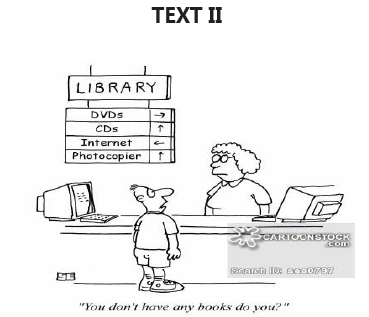
Imagem associada para resolução da questão EALES, S. Cartoonstock. Disponível em: https://www.cartoonstock.com/directory/l/library_books.asp. Acesso em: 07 ago. 2017. 


Text II presents an interaction between a boy and a library attendant in which the boy asks her a question. The word which indicates the idea of quantity in the boy‘s sentence is:
Alternativas
Ano: 2017 Banca: UFRR Órgão: UFRR Prova: UFRR - 2017 - UFRR - Vestibular |
Q1266896 Inglês
Imagem associada para resolução da questão EALES, S. Cartoonstock. Disponível em: https://www.cartoonstock.com/directory/l/library_books.asp. Acesso em: 07 ago. 2017.
A charge, no texto acima, caracterizada por utilizar linguagem verbal e não verbal, geralmente apresenta uma crítica com humor e ironia. Esse efeito na situação entre o menino e a atendente da biblioteca ocorre porque 
Alternativas
Ano: 2017 Banca: UFRR Órgão: UFRR Prova: UFRR - 2017 - UFRR - Vestibular |
Q1266895 Inglês
TEXT I

The Amazon Rainforest: The World's Largest Rainforest

  The Amazon River Basin is home to the largest rainforest on Earth. The basin – roughly the size of the forty-eight contiguous United States – covers some 40 percent of the South American continent and includes parts of eight South American countries: Brazil, Bolivia, Peru, Ecuador, Colombia, Venezuela, Guyana, and Suriname, as well as French Guiana, a department of France.
  Reflecting environmental conditions as well as past human influence, the Amazon is made up of a mosaic of ecosystems and vegetation types including rainforests, seasonal forests, deciduous forests, flooded forests, and savannas. The basin is drained by the Amazon River, the world's largest river in terms of discharge, and the second longest river in the world after the Nile. The river is made up of over 1,100 tributaries, 17 of which are longer than 1000 miles, and two of which (the Negro and the Madeira) are larger, in terms of volume, than the Congo (formerly the Zaire) river. The river system is the lifeline of the forest and its history plays an important part in the development of its rainforests. […]

Disponível em: http://rainforests.mongabay.com/amazon/. Acesso em: 07 ago. 2017.  
Descrita no texto como a maior do mundo, a floresta tropical Amazônica está localizada em uma bacia hidrográfica cujo tamanho pode ser comparado
Alternativas
Ano: 2017 Banca: IF-PE Órgão: IF-PE Prova: IF-PE - 2017 - IF-PE - Vestibular - Segundo Semestre |
Q1266706 Inglês

Disponível em: https://townhall.com/political-cartoons/2017/06/02/150775. Acesso em 01/06/2017. Adaptado.
Tone is the attitude a cartoonist takes towards a subject. Which pair of words best describes the tone of this cartoon?
Alternativas
Ano: 2017 Banca: IF-PE Órgão: IF-PE Prova: IF-PE - 2017 - IF-PE - Vestibular - Segundo Semestre |
Q1266705 Inglês

Disponível em: https://townhall.com/political-cartoons/2017/06/02/150775. Acesso em 01/06/2017. Adaptado.
According to this cartoon,
Alternativas
Ano: 2017 Banca: IF-PE Órgão: IF-PE Prova: IF-PE - 2017 - IF-PE - Vestibular - Segundo Semestre |
Q1266704 Inglês

TEXT 7

1.png (482×256)

Disponível em: http://www.100resilientcities.org/#/-_/. Acesso em: 10/05/2017. Texto adaptado.

According to TEXT
Alternativas
Ano: 2017 Banca: IF-PE Órgão: IF-PE Prova: IF-PE - 2017 - IF-PE - Vestibular - Segundo Semestre |
Q1266703 Inglês

TEXT 7

1.png (482×256)

Disponível em: http://www.100resilientcities.org/#/-_/. Acesso em: 10/05/2017. Texto adaptado.

According to TEXT, Urban Resilience refers to
Alternativas
Ano: 2017 Banca: IF-PE Órgão: IF-PE Prova: IF-PE - 2017 - IF-PE - Vestibular - Segundo Semestre |
Q1266702 Inglês

TEXT 7

1.png (482×256)

Disponível em: http://www.100resilientcities.org/#/-_/. Acesso em: 10/05/2017. Texto adaptado.

Choose the only option that summarizes the purpose of TEXT.
Alternativas
Ano: 2017 Banca: FATEC Órgão: FATEC Prova: FATEC - 2017 - FATEC - Vestibular |
Q1266170 Inglês
Leia o texto para responder a questão.

Here’s how long you can work before your brain 1shuts down

    I’m having a hard time starting this article. According to research out of the University of Melbourne, that might be because I’m middle-aged and work too much. Economists determined that burning the midnight oil makes you, well, dumber.” Our study highlights that too much work can have adverse effects on cognitive functioning,” they conclude.
    Tell us something we didn’t know. Who hasn’t, at the end of a seemingly endless workweek, found themselves staring blankly at their computer screen or into space unable to remember what they had for lunch, let alone form a coherent thought about the task at hand?
      For some employees, of course – the average resident 2 physician or, these days, that “3 gig economy” worker who makes ends meet by banging away at multiple projects – long hours are a fact of modern working life. And there’s a cost. Medical researchers have shown that working too much can affect employees’ physical and mental health.
      So how much is too much? For people age 40 and older, working up to roughly 25 hours per week boosts memory, the ability to quickly process information and other aspects of cognitive function, according to the study, which drew on a longitudinal survey that tracks the well-being of 6,000 Australians. Beyond 25 hours a week, the middle-aged brain doesn’t work as well, the study indicates, noting that the findings apply to both men and women.
<http://tinyurl.com/j4os8ck> Acesso em: 24.08.2016. Adaptado.

Glossário
1to shut down: parar de operar/funcionar.
2physician: médico.
3gig economy: ambiente de trabalho baseado em empregos temporários e contratos de curta duração.
O pronome relativo that, em “that tracks the well-being of 6,000 Australians”, pode ser corretamente substituído, sem alteração do sentido original, por
Alternativas
Ano: 2017 Banca: FATEC Órgão: FATEC Prova: FATEC - 2017 - FATEC - Vestibular |
Q1266169 Inglês
Leia o texto para responder a questão.

Here’s how long you can work before your brain 1shuts down

    I’m having a hard time starting this article. According to research out of the University of Melbourne, that might be because I’m middle-aged and work too much. Economists determined that burning the midnight oil makes you, well, dumber.” Our study highlights that too much work can have adverse effects on cognitive functioning,” they conclude.
    Tell us something we didn’t know. Who hasn’t, at the end of a seemingly endless workweek, found themselves staring blankly at their computer screen or into space unable to remember what they had for lunch, let alone form a coherent thought about the task at hand?
      For some employees, of course – the average resident 2 physician or, these days, that “3 gig economy” worker who makes ends meet by banging away at multiple projects – long hours are a fact of modern working life. And there’s a cost. Medical researchers have shown that working too much can affect employees’ physical and mental health.
      So how much is too much? For people age 40 and older, working up to roughly 25 hours per week boosts memory, the ability to quickly process information and other aspects of cognitive function, according to the study, which drew on a longitudinal survey that tracks the well-being of 6,000 Australians. Beyond 25 hours a week, the middle-aged brain doesn’t work as well, the study indicates, noting that the findings apply to both men and women.
<http://tinyurl.com/j4os8ck> Acesso em: 24.08.2016. Adaptado.

Glossário
1to shut down: parar de operar/funcionar.
2physician: médico.
3gig economy: ambiente de trabalho baseado em empregos temporários e contratos de curta duração.
Afirma-se, no terceiro parágrafo, que
Alternativas
Ano: 2017 Banca: FATEC Órgão: FATEC Prova: FATEC - 2017 - FATEC - Vestibular |
Q1266168 Inglês
Leia o texto para responder a questão.

Here’s how long you can work before your brain 1shuts down

    I’m having a hard time starting this article. According to research out of the University of Melbourne, that might be because I’m middle-aged and work too much. Economists determined that burning the midnight oil makes you, well, dumber.” Our study highlights that too much work can have adverse effects on cognitive functioning,” they conclude.
    Tell us something we didn’t know. Who hasn’t, at the end of a seemingly endless workweek, found themselves staring blankly at their computer screen or into space unable to remember what they had for lunch, let alone form a coherent thought about the task at hand?
      For some employees, of course – the average resident 2 physician or, these days, that “3 gig economy” worker who makes ends meet by banging away at multiple projects – long hours are a fact of modern working life. And there’s a cost. Medical researchers have shown that working too much can affect employees’ physical and mental health.
      So how much is too much? For people age 40 and older, working up to roughly 25 hours per week boosts memory, the ability to quickly process information and other aspects of cognitive function, according to the study, which drew on a longitudinal survey that tracks the well-being of 6,000 Australians. Beyond 25 hours a week, the middle-aged brain doesn’t work as well, the study indicates, noting that the findings apply to both men and women.
<http://tinyurl.com/j4os8ck> Acesso em: 24.08.2016. Adaptado.

Glossário
1to shut down: parar de operar/funcionar.
2physician: médico.
3gig economy: ambiente de trabalho baseado em empregos temporários e contratos de curta duração.
Considere a afirmação: “Our study highlights that too much work can have adverse effects on cognitive functioning.”
Um dos efeitos adversos do trabalho excessivo apresentado pelo autor é
Alternativas
Ano: 2017 Banca: FATEC Órgão: FATEC Prova: FATEC - 2017 - FATEC - Vestibular |
Q1266167 Inglês
Leia o texto para responder a questão.

Here’s how long you can work before your brain 1shuts down

    I’m having a hard time starting this article. According to research out of the University of Melbourne, that might be because I’m middle-aged and work too much. Economists determined that burning the midnight oil makes you, well, dumber.” Our study highlights that too much work can have adverse effects on cognitive functioning,” they conclude.
    Tell us something we didn’t know. Who hasn’t, at the end of a seemingly endless workweek, found themselves staring blankly at their computer screen or into space unable to remember what they had for lunch, let alone form a coherent thought about the task at hand?
      For some employees, of course – the average resident 2 physician or, these days, that “3 gig economy” worker who makes ends meet by banging away at multiple projects – long hours are a fact of modern working life. And there’s a cost. Medical researchers have shown that working too much can affect employees’ physical and mental health.
      So how much is too much? For people age 40 and older, working up to roughly 25 hours per week boosts memory, the ability to quickly process information and other aspects of cognitive function, according to the study, which drew on a longitudinal survey that tracks the well-being of 6,000 Australians. Beyond 25 hours a week, the middle-aged brain doesn’t work as well, the study indicates, noting that the findings apply to both men and women.
<http://tinyurl.com/j4os8ck> Acesso em: 24.08.2016. Adaptado.

Glossário
1to shut down: parar de operar/funcionar.
2physician: médico.
3gig economy: ambiente de trabalho baseado em empregos temporários e contratos de curta duração.
A respeito do autor, o primeiro parágrafo nos informa que ele
Alternativas
Ano: 2017 Banca: FATEC Órgão: FATEC Prova: FATEC - 2017 - FATEC - Vestibular |
Q1266166 Inglês
Leia o texto para responder a questão.

Here’s how long you can work before your brain 1shuts down

    I’m having a hard time starting this article. According to research out of the University of Melbourne, that might be because I’m middle-aged and work too much. Economists determined that burning the midnight oil makes you, well, dumber.” Our study highlights that too much work can have adverse effects on cognitive functioning,” they conclude.
    Tell us something we didn’t know. Who hasn’t, at the end of a seemingly endless workweek, found themselves staring blankly at their computer screen or into space unable to remember what they had for lunch, let alone form a coherent thought about the task at hand?
      For some employees, of course – the average resident 2 physician or, these days, that “3 gig economy” worker who makes ends meet by banging away at multiple projects – long hours are a fact of modern working life. And there’s a cost. Medical researchers have shown that working too much can affect employees’ physical and mental health.
      So how much is too much? For people age 40 and older, working up to roughly 25 hours per week boosts memory, the ability to quickly process information and other aspects of cognitive function, according to the study, which drew on a longitudinal survey that tracks the well-being of 6,000 Australians. Beyond 25 hours a week, the middle-aged brain doesn’t work as well, the study indicates, noting that the findings apply to both men and women.
<http://tinyurl.com/j4os8ck> Acesso em: 24.08.2016. Adaptado.

Glossário
1to shut down: parar de operar/funcionar.
2physician: médico.
3gig economy: ambiente de trabalho baseado em empregos temporários e contratos de curta duração.
Ao escrever, no início do texto, “I’m having a hard time starting this article”, o autor
Alternativas
Ano: 2017 Banca: FATEC Órgão: FATEC Prova: FATEC - 2017 - FATEC - Vestibular |
Q1266146 Inglês
Considere o cartum.
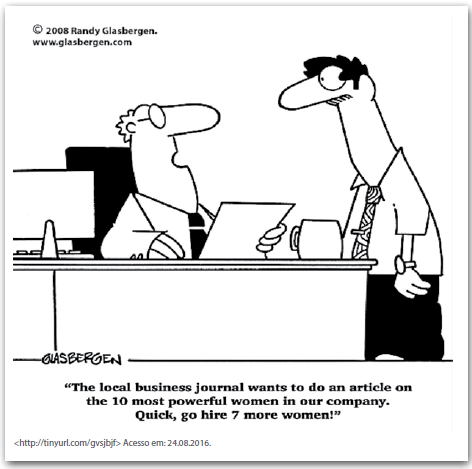
Imagem associada para resolução da questão
De acordo com o texto do cartum,
Alternativas
Ano: 2017 Banca: FATEC Órgão: FATEC Prova: FATEC - 2017 - FATEC - Vestibular - Segundo Semestre |
Q1265882 Inglês
     Eu, Robô (I, Robot) é uma coletânea de contos escritos por Isaac Asimov que procura descrever, sob o ponto de vista do autor, o hipotético aumento da presença e da atuação dos robôs na sociedade.
    Leia o texto, que apresenta uma entrevista com a personagem Susan Calvin, uma “robopsicóloga”, e responda à questão.

Susan Calvin had been born in the year 1982, they said, which made her seventy five now. Everyone knew that. Appropriately enough, U. S. Robot and Mechanical Men, Inc. was seventy-five also, since it had been in the year of Dr. Calvin’s birth that Lawrence Robertson had first taken out incorporation papers for what eventually became the strangest industrial giant in man’s history. Well, everyone knew that, too. (…)

She went back to her desk and sat down. She didn’t need expression on her face to look sad, somehow.

“How old are you?” she wanted to know.

“Thirty-two,” I said. 

“Then you don’t remember a world without robots. There was a time when humanity faced the universe alone and without a friend. Now he has creatures to help him; stronger creatures than himself, more faithful, more useful, and absolutely devoted to him. Mankind is no longer alone. Have you ever thought of it that way?”

“I’m afraid I haven’t. May I quote you?”

“You may. To you, a robot is a robot. Gears and metal; electricity and positrons. Mind and iron! Human-made! If necessary, human-destroyed! But you haven’t worked with them, so you don’t know them. They’re a cleaner, better breed than we are.”

(ASIMOV, I. I, Robot. Greenwich, Conn: Fawcett Publications,1950. p. 2-3.)
O termo may em May I quote you? expressa a ideia de
Alternativas
Ano: 2017 Banca: FATEC Órgão: FATEC Prova: FATEC - 2017 - FATEC - Vestibular - Segundo Semestre |
Q1265881 Inglês
     Eu, Robô (I, Robot) é uma coletânea de contos escritos por Isaac Asimov que procura descrever, sob o ponto de vista do autor, o hipotético aumento da presença e da atuação dos robôs na sociedade.
    Leia o texto, que apresenta uma entrevista com a personagem Susan Calvin, uma “robopsicóloga”, e responda à questão.

Susan Calvin had been born in the year 1982, they said, which made her seventy five now. Everyone knew that. Appropriately enough, U. S. Robot and Mechanical Men, Inc. was seventy-five also, since it had been in the year of Dr. Calvin’s birth that Lawrence Robertson had first taken out incorporation papers for what eventually became the strangest industrial giant in man’s history. Well, everyone knew that, too. (…)

She went back to her desk and sat down. She didn’t need expression on her face to look sad, somehow.

“How old are you?” she wanted to know.

“Thirty-two,” I said. 

“Then you don’t remember a world without robots. There was a time when humanity faced the universe alone and without a friend. Now he has creatures to help him; stronger creatures than himself, more faithful, more useful, and absolutely devoted to him. Mankind is no longer alone. Have you ever thought of it that way?”

“I’m afraid I haven’t. May I quote you?”

“You may. To you, a robot is a robot. Gears and metal; electricity and positrons. Mind and iron! Human-made! If necessary, human-destroyed! But you haven’t worked with them, so you don’t know them. They’re a cleaner, better breed than we are.”

(ASIMOV, I. I, Robot. Greenwich, Conn: Fawcett Publications,1950. p. 2-3.)
Na visão de Susan Calvin, e segundo as informações presentes no texto, os robôs
Alternativas
Respostas
2441: A
2442: E
2443: C
2444: D
2445: A
2446: E
2447: D
2448: D
2449: E
2450: C
2451: A
2452: B
2453: E
2454: D
2455: A
2456: B
2457: C
2458: B
2459: A
2460: E