Questões de Vestibular
Sobre interpretação de texto | reading comprehension em inglês
Foram encontradas 5.175 questões


Ano: 2025
Banca:
VUNESP
Órgão:
FAMERP
Prova:
VUNESP - 2025 - FAMERP - Vestibular - Conhecimentos Gerais |
Q4143784
Inglês
Read the quote from basketball player Michael Jordan.
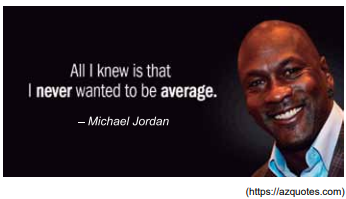
According to the quote, Michael Jordan
Ano: 2025
Banca:
VUNESP
Órgão:
FAMERP
Prova:
VUNESP - 2025 - FAMERP - Vestibular - Conhecimentos Gerais |
Q4143783
Inglês
Texto associado
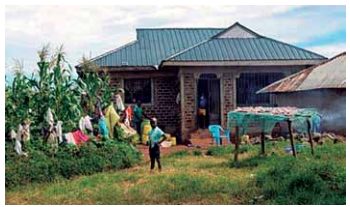
Leia o texto para responder à questão.
Of every 1,000 children born in Kenya, a country in East
Africa, 32 don’t make it to their first birthdays. Study after study
has explored how to improve those impressive numbers, in
Kenya and elsewhere. But a decade-long study on alleviating
poverty found a simple solution. Giving $1,000 to poor families
lowered infant mortality rates by nearly half, and deaths
in children under 5 by 45 percent. Those are much bigger
drops than have been credited to routine immunizations, for
example, or bed nets to prevent malaria.
“This is easily the biggest impact on child survival that
I’ve seen from an intervention that was designed to alleviate
poverty,” said Harsha Thirumurthy, an economist at the
University of Pennsylvania who was not involved in the work.
The decline in infant mortality is a “showstopping result,”
he said.
The outcomes suggest that delivering even smaller
amounts of money to families — especially those that live
near a hospital — immediately before or after the birth
of a child might allow women to seek medical care and
drastically improve their children’s chances of survival. More
than 100 low- and middle-income countries have explored
so-called cash transfers, especially after the pandemic
began. Generally, the experiments have found that giving
money to poor families improves school attendance, nutrition
and use of health services.
(Apoorva Mandavilli. www.nytimes.com, 18.08.2025. Adaptado.)
De acordo com o texto, o subsídio financeiro destinado a pessoas em situação de vulnerabilidade econômica no Quênia
demonstrou ter um impacto para além da redução no índice
de mortalidade infantil. O trecho do texto que confirma essa
afirmação é:
Ano: 2025
Banca:
VUNESP
Órgão:
FAMERP
Prova:
VUNESP - 2025 - FAMERP - Vestibular - Conhecimentos Gerais |
Q4143782
Inglês
Texto associado
Leia o texto para responder à questão.
Of every 1,000 children born in Kenya, a country in East
Africa, 32 don’t make it to their first birthdays. Study after study
has explored how to improve those impressive numbers, in
Kenya and elsewhere. But a decade-long study on alleviating
poverty found a simple solution. Giving $1,000 to poor families
lowered infant mortality rates by nearly half, and deaths
in children under 5 by 45 percent. Those are much bigger
drops than have been credited to routine immunizations, for
example, or bed nets to prevent malaria.
“This is easily the biggest impact on child survival that
I’ve seen from an intervention that was designed to alleviate
poverty,” said Harsha Thirumurthy, an economist at the
University of Pennsylvania who was not involved in the work.
The decline in infant mortality is a “showstopping result,”
he said.
The outcomes suggest that delivering even smaller
amounts of money to families — especially those that live
near a hospital — immediately before or after the birth
of a child might allow women to seek medical care and
drastically improve their children’s chances of survival. More
than 100 low- and middle-income countries have explored
so-called cash transfers, especially after the pandemic
began. Generally, the experiments have found that giving
money to poor families improves school attendance, nutrition
and use of health services.
(Apoorva Mandavilli. www.nytimes.com, 18.08.2025. Adaptado.)
In the excerpt from the third paragraph “The outcomes suggest
that delivering even smaller amounts of money to families
— especially those that live near a hospital — immediately
before or after the birth of a child might allow women to seek
medical care and drastically improve their children’s chances
of survival”, the underlined word expresses a
Ano: 2025
Banca:
VUNESP
Órgão:
FAMERP
Prova:
VUNESP - 2025 - FAMERP - Vestibular - Conhecimentos Gerais |
Q4143781
Inglês
Texto associado
Leia o texto para responder à questão.
Of every 1,000 children born in Kenya, a country in East
Africa, 32 don’t make it to their first birthdays. Study after study
has explored how to improve those impressive numbers, in
Kenya and elsewhere. But a decade-long study on alleviating
poverty found a simple solution. Giving $1,000 to poor families
lowered infant mortality rates by nearly half, and deaths
in children under 5 by 45 percent. Those are much bigger
drops than have been credited to routine immunizations, for
example, or bed nets to prevent malaria.
“This is easily the biggest impact on child survival that
I’ve seen from an intervention that was designed to alleviate
poverty,” said Harsha Thirumurthy, an economist at the
University of Pennsylvania who was not involved in the work.
The decline in infant mortality is a “showstopping result,”
he said.
The outcomes suggest that delivering even smaller
amounts of money to families — especially those that live
near a hospital — immediately before or after the birth
of a child might allow women to seek medical care and
drastically improve their children’s chances of survival. More
than 100 low- and middle-income countries have explored
so-called cash transfers, especially after the pandemic
began. Generally, the experiments have found that giving
money to poor families improves school attendance, nutrition
and use of health services.
(Apoorva Mandavilli. www.nytimes.com, 18.08.2025. Adaptado.)
No trecho do segundo parágrafo “The decline in infant
mortality is a ‘showstopping result,’ he said”, o termo sublinhado pode ser substituído, sem alteração de sentido para
o texto, por:
Ano: 2025
Banca:
VUNESP
Órgão:
FAMERP
Prova:
VUNESP - 2025 - FAMERP - Vestibular - Conhecimentos Gerais |
Q4143780
Inglês
Texto associado
Leia o texto para responder à questão.
Of every 1,000 children born in Kenya, a country in East
Africa, 32 don’t make it to their first birthdays. Study after study
has explored how to improve those impressive numbers, in
Kenya and elsewhere. But a decade-long study on alleviating
poverty found a simple solution. Giving $1,000 to poor families
lowered infant mortality rates by nearly half, and deaths
in children under 5 by 45 percent. Those are much bigger
drops than have been credited to routine immunizations, for
example, or bed nets to prevent malaria.
“This is easily the biggest impact on child survival that
I’ve seen from an intervention that was designed to alleviate
poverty,” said Harsha Thirumurthy, an economist at the
University of Pennsylvania who was not involved in the work.
The decline in infant mortality is a “showstopping result,”
he said.
The outcomes suggest that delivering even smaller
amounts of money to families — especially those that live
near a hospital — immediately before or after the birth
of a child might allow women to seek medical care and
drastically improve their children’s chances of survival. More
than 100 low- and middle-income countries have explored
so-called cash transfers, especially after the pandemic
began. Generally, the experiments have found that giving
money to poor families improves school attendance, nutrition
and use of health services.
(Apoorva Mandavilli. www.nytimes.com, 18.08.2025. Adaptado.)
In the excerpt from the first paragraph “Those are much
bigger drops than have been credited”, the underlined word
refers to
Ano: 2025
Banca:
VUNESP
Órgão:
FAMERP
Prova:
VUNESP - 2025 - FAMERP - Vestibular - Conhecimentos Gerais |
Q4143779
Inglês
Texto associado
Leia o texto para responder à questão.
Of every 1,000 children born in Kenya, a country in East
Africa, 32 don’t make it to their first birthdays. Study after study
has explored how to improve those impressive numbers, in
Kenya and elsewhere. But a decade-long study on alleviating
poverty found a simple solution. Giving $1,000 to poor families
lowered infant mortality rates by nearly half, and deaths
in children under 5 by 45 percent. Those are much bigger
drops than have been credited to routine immunizations, for
example, or bed nets to prevent malaria.
“This is easily the biggest impact on child survival that
I’ve seen from an intervention that was designed to alleviate
poverty,” said Harsha Thirumurthy, an economist at the
University of Pennsylvania who was not involved in the work.
The decline in infant mortality is a “showstopping result,”
he said.
The outcomes suggest that delivering even smaller
amounts of money to families — especially those that live
near a hospital — immediately before or after the birth
of a child might allow women to seek medical care and
drastically improve their children’s chances of survival. More
than 100 low- and middle-income countries have explored
so-called cash transfers, especially after the pandemic
began. Generally, the experiments have found that giving
money to poor families improves school attendance, nutrition
and use of health services.
(Apoorva Mandavilli. www.nytimes.com, 18.08.2025. Adaptado.)
The main purpose of the text is to
Q4130709
Inglês
Texto associado
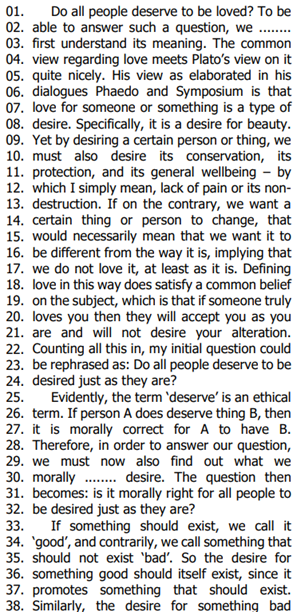
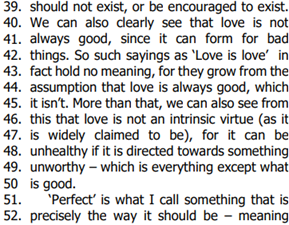
Instrução: A questão está relacionada ao texto abaixo.
Adapted from: TANASĂ, Matei. The Unlovable Parts of a Loving Society. 2022. Retrieved from: .
Accessed: 18 Sep. 2025.
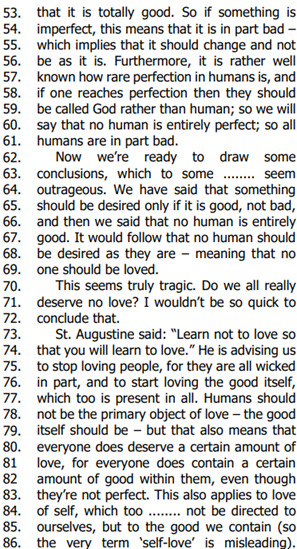
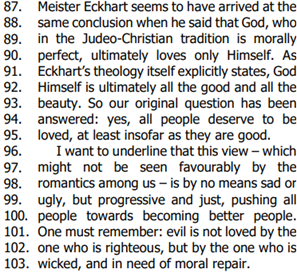
Consider the following propositions for rephrasing the sentence Furthermore, it is rather well
known how rare perfection in humans is, and if one reaches perfection then they should
be called God rather than human; so we will say that no human is entirely perfect; so all
humans are in part bad (l. 56-61).
I - Moreover, everyone knows human perfection is rare. If someone were perfect, they would be our God, not human. So, no human is completely perfect, and all people have some flaws.
II - Aditionally, because perfection in humans is so rare that anyone who attains it would be more God than human, we can say that all humans are at least partly imperfect.
III- Furthermore, most people believe human perfection is rare. Still, some people come close to it and may be compared to God; so, not all humans are bad.
If applied to the text, which ones would be correct and keep the original meaning?
I - Moreover, everyone knows human perfection is rare. If someone were perfect, they would be our God, not human. So, no human is completely perfect, and all people have some flaws.
II - Aditionally, because perfection in humans is so rare that anyone who attains it would be more God than human, we can say that all humans are at least partly imperfect.
III- Furthermore, most people believe human perfection is rare. Still, some people come close to it and may be compared to God; so, not all humans are bad.
If applied to the text, which ones would be correct and keep the original meaning?
Q4130707
Inglês
Texto associado
Instrução: A questão está relacionada ao texto abaixo.
Adapted from: TANASĂ, Matei. The Unlovable Parts of a Loving Society. 2022. Retrieved from: .
Accessed: 18 Sep. 2025.
Select the alternative that adequately replaces the expression Counting all this in (l. 22) without
altering the sentence’s original meaning.
Q4130706
Inglês
Texto associado
Instrução: A questão está relacionada ao texto abaixo.
Adapted from: TANASĂ, Matei. The Unlovable Parts of a Loving Society. 2022. Retrieved from: .
Accessed: 18 Sep. 2025.
Select the sequence of phrasal verbs that replaces the single verbs satisfy (l. 18), promotes (l. 37),
and arrived at (l. 87) adequately and without changes in meaning.
Q4130705
Inglês
Texto associado
Instrução: A questão está relacionada ao texto abaixo.
Adapted from: TANASĂ, Matei. The Unlovable Parts of a Loving Society. 2022. Retrieved from: .
Accessed: 18 Sep. 2025.
Mark the statements below with T (true) or F (false), according to the text.
( ) The phrase ‘Love is love’ is based on the assumption that love is always good, so it does not make sense because it might be bad.
( ) The term ‘self-love’ is deceiving because it suggests one should love oneself instead of the good that is within one.
( ) Love, as an intrinsic virtue, may be harmful when directed to something or someone undeserving.
( ) If someone enjoys evil, it is a sign that they are morally flawed and in need of change.
The sequence should read, from top to bottom, is
( ) The phrase ‘Love is love’ is based on the assumption that love is always good, so it does not make sense because it might be bad.
( ) The term ‘self-love’ is deceiving because it suggests one should love oneself instead of the good that is within one.
( ) Love, as an intrinsic virtue, may be harmful when directed to something or someone undeserving.
( ) If someone enjoys evil, it is a sign that they are morally flawed and in need of change.
The sequence should read, from top to bottom, is
Q4130704
Inglês
Texto associado
Instrução: A questão está relacionada ao texto abaixo.
Adapted from: TANASĂ, Matei. The Unlovable Parts of a Loving Society. 2022. Retrieved from: .
Accessed: 18 Sep. 2025.
Consider the statements below.
I - In Phaedo and Symposium, Plato suggests that love is a desire for beauty and that when we love something or someone we want it as it is.
II - St. Augustine suggests we should not love people, but instead love the good that is in each person.
III- Meister Eckhart suggests that God contains all the good and all the beauty and thus loves us all.
Which ones are correct according to the text?
I - In Phaedo and Symposium, Plato suggests that love is a desire for beauty and that when we love something or someone we want it as it is.
II - St. Augustine suggests we should not love people, but instead love the good that is in each person.
III- Meister Eckhart suggests that God contains all the good and all the beauty and thus loves us all.
Which ones are correct according to the text?
Q4130703
Inglês
Texto associado
Instrução: A questão está relacionada ao texto abaixo.
Adapted from: TANASĂ, Matei. The Unlovable Parts of a Loving Society. 2022. Retrieved from: .
Accessed: 18 Sep. 2025.
Select the alternative that adequately fills in the blanks in lines 02, 30, 63 and 84.
Q4130701
Inglês
Texto associado
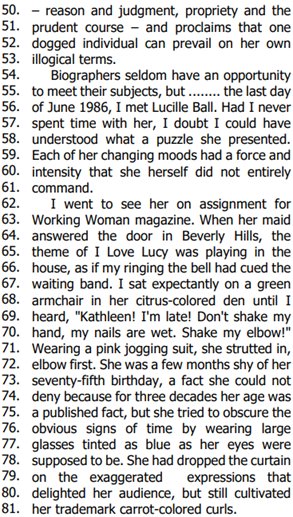
Instrução: A questão está relacionada ao texto abaixo.
Extraído de: BRADY, Kathleen. Lucille: The
Life of Lucille Ball. Hyperion, 1994.
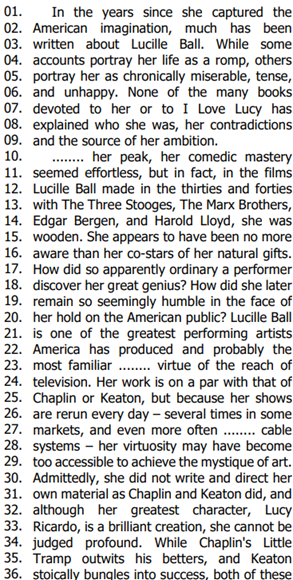
Considere as seguintes possibilidades de reescrita da frase How did so apparently ordinary a
performer discover her great genius? (l. 17-18).
I - How did a performer who seemed to be so ordinary discover her great genius?
II - How did a performer of so ordinary appearance discover her genius?
III- How did a performer whose ordinary work was so apparent discover her great genius?
Quais poderiam substituir a frase, sem prejuízo do sentido original e da correção gramatical?
I - How did a performer who seemed to be so ordinary discover her great genius?
II - How did a performer of so ordinary appearance discover her genius?
III- How did a performer whose ordinary work was so apparent discover her great genius?
Quais poderiam substituir a frase, sem prejuízo do sentido original e da correção gramatical?
Q4130700
Inglês
Texto associado
Instrução: A questão está relacionada ao texto abaixo.
Extraído de: BRADY, Kathleen. Lucille: The
Life of Lucille Ball. Hyperion, 1994.
Assinale a alternativa que apresenta termos que, conforme empregados no texto, operam como
adjetivos.
Q4130699
Inglês
Texto associado
Instrução: A questão está relacionada ao texto abaixo.
Extraído de: BRADY, Kathleen. Lucille: The
Life of Lucille Ball. Hyperion, 1994.
Associe as palavras da coluna da esquerda às suas respectivas traduções, na coluna da direita, de
acordo com o sentido que têm no texto.
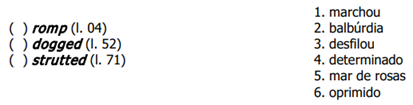
A sequência correta de preenchimento dos parênteses, de cima para baixo, é
A sequência correta de preenchimento dos parênteses, de cima para baixo, é
Q4130698
Inglês
Texto associado
Instrução: A questão está relacionada ao texto abaixo.
Extraído de: BRADY, Kathleen. Lucille: The
Life of Lucille Ball. Hyperion, 1994.
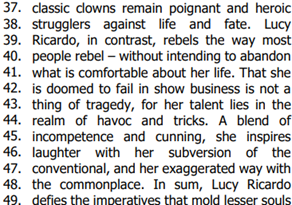
Assinale com V (verdadeiro) ou F (falso) as afirmações abaixo, acerca do texto.
( ) As palavras she (l. 01), she (l. 45), her (l. 57) e herself (l. 60) têm o mesmo referente.
( ) A palavra did (l. 30) substitui o segmento direct her own material (l. 30-31), evitando portanto a repetição desse segmento.
( ) O pronome his (l. 35) refere-se a Chaplin’s Little Tramp (l. 34-35).
( ) O segmento reason and judgment, propriety and the prudent course (l. 50-51) é um aposto que se refere à palavra imperatives (l. 49).
A sequência correta de preenchimento dos parênteses, de cima para baixo, é
( ) As palavras she (l. 01), she (l. 45), her (l. 57) e herself (l. 60) têm o mesmo referente.
( ) A palavra did (l. 30) substitui o segmento direct her own material (l. 30-31), evitando portanto a repetição desse segmento.
( ) O pronome his (l. 35) refere-se a Chaplin’s Little Tramp (l. 34-35).
( ) O segmento reason and judgment, propriety and the prudent course (l. 50-51) é um aposto que se refere à palavra imperatives (l. 49).
A sequência correta de preenchimento dos parênteses, de cima para baixo, é
Ano: 2025
Banca:
VUNESP
Órgão:
EINSTEIN
Prova:
VUNESP - 2025 - EINSTEIN - Vestibular - Prova I - 1º Semestre 2026 |
Q4116344
Inglês
Read the informational guide provided by Biosphere 2.
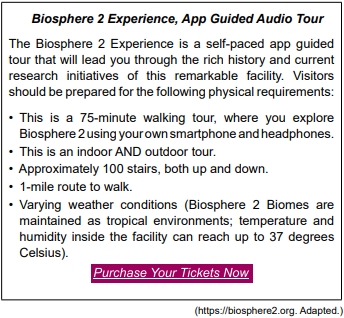
The guide informs potential visitors to the Biosphere 2 project about
Ano: 2025
Banca:
VUNESP
Órgão:
EINSTEIN
Prova:
VUNESP - 2025 - EINSTEIN - Vestibular - Prova I - 1º Semestre 2026 |
Q4116343
Inglês
Texto associado
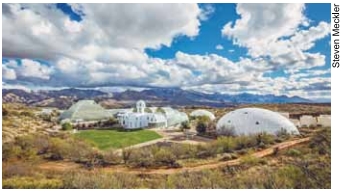
In the middle of the vast Arizona desert, in the United
States, there’s a structure that seems taken straight out of the
pages of science fiction. Inside a massive complex of glass
pyramids and towers, spread across 1.2 hectares, stands
a tropical rainforest topped by a 7.6-meter-high waterfall, a
savannah and a fog desert. It’s seemingly a little capsule of
Earth, which is why the structure is called Biosphere 2 —
named after our own planet, Biosphere 1.
The scenery forms the perfect background for the
futuristic experiment that once took place here. In the early
1990s, eight people locked themselves inside, sealed off from
the outside world for two years, to explore the challenges of
living in a self-contained system — a prerequisite for building
colonies in outer space. They fed themselves from the crops
they grew, they recycled their own wastewater and they cared
for the plants that produced their oxygen.
In terms of sustaining human life, the experiment did not
go well. Oxygen levels fell significantly, making the inhabitants
sick, while carbon dioxide (CO2) levels increased. Countless
animals died, including the pollinators the plants needed to
reproduce. And although the “biospherians” did survive on
their homegrown food, they lost weight to the point where
they became a case study for calorie restriction. When
supplementary oxygen needed to be brought in, commentators
blamed the project as a failure, calling it a “new-age silliness
masquerading as science”. In recent years, however, many
experts have come to see the Biosphere 2 experiment in a
new light, with valuable lessons about ecology, atmospheric
science and importantly, the irreplaceability of our own planet.
(Katarina Zimmer. www.bbc.com, 05.07.2025. Adapted.)
According to the third paragraph, one major ecological
imbalance that compromised human habitability in Biosphere 2
was the
Ano: 2025
Banca:
VUNESP
Órgão:
EINSTEIN
Prova:
VUNESP - 2025 - EINSTEIN - Vestibular - Prova I - 1º Semestre 2026 |
Q4116342
Inglês
Texto associado
In the middle of the vast Arizona desert, in the United
States, there’s a structure that seems taken straight out of the
pages of science fiction. Inside a massive complex of glass
pyramids and towers, spread across 1.2 hectares, stands
a tropical rainforest topped by a 7.6-meter-high waterfall, a
savannah and a fog desert. It’s seemingly a little capsule of
Earth, which is why the structure is called Biosphere 2 —
named after our own planet, Biosphere 1.
The scenery forms the perfect background for the
futuristic experiment that once took place here. In the early
1990s, eight people locked themselves inside, sealed off from
the outside world for two years, to explore the challenges of
living in a self-contained system — a prerequisite for building
colonies in outer space. They fed themselves from the crops
they grew, they recycled their own wastewater and they cared
for the plants that produced their oxygen.
In terms of sustaining human life, the experiment did not
go well. Oxygen levels fell significantly, making the inhabitants
sick, while carbon dioxide (CO2) levels increased. Countless
animals died, including the pollinators the plants needed to
reproduce. And although the “biospherians” did survive on
their homegrown food, they lost weight to the point where
they became a case study for calorie restriction. When
supplementary oxygen needed to be brought in, commentators
blamed the project as a failure, calling it a “new-age silliness
masquerading as science”. In recent years, however, many
experts have come to see the Biosphere 2 experiment in a
new light, with valuable lessons about ecology, atmospheric
science and importantly, the irreplaceability of our own planet.
(Katarina Zimmer. www.bbc.com, 05.07.2025. Adapted.)
In the excerpt from the second paragraph “The scenery forms
the perfect background for the futuristic experiment that once
took place here”, the underlined term refers to
Ano: 2025
Banca:
VUNESP
Órgão:
EINSTEIN
Prova:
VUNESP - 2025 - EINSTEIN - Vestibular - Prova I - 1º Semestre 2026 |
Q4116341
Inglês
Texto associado
In the middle of the vast Arizona desert, in the United
States, there’s a structure that seems taken straight out of the
pages of science fiction. Inside a massive complex of glass
pyramids and towers, spread across 1.2 hectares, stands
a tropical rainforest topped by a 7.6-meter-high waterfall, a
savannah and a fog desert. It’s seemingly a little capsule of
Earth, which is why the structure is called Biosphere 2 —
named after our own planet, Biosphere 1.
The scenery forms the perfect background for the
futuristic experiment that once took place here. In the early
1990s, eight people locked themselves inside, sealed off from
the outside world for two years, to explore the challenges of
living in a self-contained system — a prerequisite for building
colonies in outer space. They fed themselves from the crops
they grew, they recycled their own wastewater and they cared
for the plants that produced their oxygen.
In terms of sustaining human life, the experiment did not
go well. Oxygen levels fell significantly, making the inhabitants
sick, while carbon dioxide (CO2) levels increased. Countless
animals died, including the pollinators the plants needed to
reproduce. And although the “biospherians” did survive on
their homegrown food, they lost weight to the point where
they became a case study for calorie restriction. When
supplementary oxygen needed to be brought in, commentators
blamed the project as a failure, calling it a “new-age silliness
masquerading as science”. In recent years, however, many
experts have come to see the Biosphere 2 experiment in a
new light, with valuable lessons about ecology, atmospheric
science and importantly, the irreplaceability of our own planet.
(Katarina Zimmer. www.bbc.com, 05.07.2025. Adapted.)
In the fragment from the first paragraph “It’s seemingly a little
capsule of Earth”, the underlined expression means

 Conheça nossos planos