According to the third paragraph, one major ecological imba...
Próximas questões
Com base no mesmo assunto
Ano: 2025
Banca:
VUNESP
Órgão:
EINSTEIN
Prova:
VUNESP - 2025 - EINSTEIN - Vestibular - Prova I - 1º Semestre 2026 |
Q4116343
Inglês
Texto associado
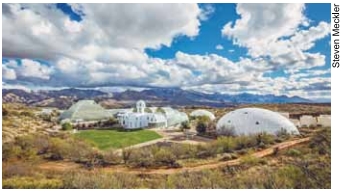
In the middle of the vast Arizona desert, in the United
States, there’s a structure that seems taken straight out of the
pages of science fiction. Inside a massive complex of glass
pyramids and towers, spread across 1.2 hectares, stands
a tropical rainforest topped by a 7.6-meter-high waterfall, a
savannah and a fog desert. It’s seemingly a little capsule of
Earth, which is why the structure is called Biosphere 2 —
named after our own planet, Biosphere 1.
The scenery forms the perfect background for the
futuristic experiment that once took place here. In the early
1990s, eight people locked themselves inside, sealed off from
the outside world for two years, to explore the challenges of
living in a self-contained system — a prerequisite for building
colonies in outer space. They fed themselves from the crops
they grew, they recycled their own wastewater and they cared
for the plants that produced their oxygen.
In terms of sustaining human life, the experiment did not
go well. Oxygen levels fell significantly, making the inhabitants
sick, while carbon dioxide (CO2) levels increased. Countless
animals died, including the pollinators the plants needed to
reproduce. And although the “biospherians” did survive on
their homegrown food, they lost weight to the point where
they became a case study for calorie restriction. When
supplementary oxygen needed to be brought in, commentators
blamed the project as a failure, calling it a “new-age silliness
masquerading as science”. In recent years, however, many
experts have come to see the Biosphere 2 experiment in a
new light, with valuable lessons about ecology, atmospheric
science and importantly, the irreplaceability of our own planet.
(Katarina Zimmer. www.bbc.com, 05.07.2025. Adapted.)
According to the third paragraph, one major ecological
imbalance that compromised human habitability in Biosphere 2
was the
 Conheça nossos planos