Questões de Vestibular
Comentadas sobre interpretação de texto | reading comprehension em inglês
Foram encontradas 2.293 questões


TEXT 2
The first step in establishing a cyber ethical culture is to ask the really tough questions, the answer to which may be politically incorrect. HR (Human resources), legal, security and top management need to work together to set the tone they wish to flow through gaming; other times off-site meetings will work.
The second step is to include cyber ethical components in corporate security awareness campaigns to keep employees clued in.
The last but most important step is to be ready to make changes rapidly when cyber ethics becomes a component of information security efforts. We cannot predict how they will change tomorrow or next year – but we need to be prepared.
(MARINOTTO, Demóstene. Reading on Info Tech (Inglês para Informática). São Paulo, Novatec, 2007.)
TEXT 1
These days, when our slow recovery from recession seems like a full-employment program for pessimistic pundits, it’s great to have a new book from Chris Anderson, an indefatigable cheerleader for the unlimited potential of the digital economy. Anderson, the departing editor in chief of Wired magazine, has already written two important books exploring the impact of the Web on commerce. In “The Long Tail,” he argued that companies like Amazon that faced distribution challenges arising from having large quantities of the same kind of product would thrive by “selling less of more.” Corporations didn’t have to chase blockbusters if they had a mass of small sales. In “Free: The Future of a Radical Price,” he argued that giving stuff away to attract a multitude of users might be the best way eventually to make money from loyal customers. Anderson has also helped found a Web site, Geekdad, and an aerial robotics company. From his vantage point, in the future more and more people can get involved in making things they really enjoy and can connect with others who share their passions and their products. These connections, he claims, are creating a new Industrial Revolution.
In a 2010 Wired article entitled “In the Next Industrial Revolution, Atoms Are the New Bits,” Anderson described how the massive changes in our relations with information have altered how we relate to things. Now that the power of information-sharing has been unleashed through technology and social networks, makers are able to collaborate on design and production in ways that facilitate the connection of producers to markets. By sharing information “bits” in a creative commons, entrepreneurs are making new things (reshaping “atoms”) more cheaply and quickly. The new manufacturing is a powerful economic force not because any one business becomes gigantic, but because technology makes it possible for tens of thousands of businesses to find their customers, to form their communities.
Anderson begins his new book, “Makers,” with the story of his grandfather Fred Hauser, who invented a sprinkler system. He licensed his invention to a company that turned ideas into things that could be built and sold. Although Hauser loved translating ideas into things, he needed a company with resources to make enough of his sprinklers to turn a profit. Inventing and making were separate. With the advent of the personal computer and of sophisticated but user-friendly design tools, that separation has become increasingly irrelevant. As a child, Anderson loved making things with his grandfather, and he still loves creating new stuff and getting it into the marketplace. “Makers” describes how today technology has liberated the inventor from a dependence on the big manufacturer. “The beauty of the Web is that it democratized the tools both of invention and production,” Anderson writes. “We are all designers now. It’s time to get good at it.”
(Fragment from “Makers: The New Industrial Revolution by
Chris Anderson”, by Michael S. Roth. Online since 24
November 2012.
URL:https://www.washingtonpost.com/opinions/makers-thenew-industrial-revolution)
TEXT 1
These days, when our slow recovery from recession seems like a full-employment program for pessimistic pundits, it’s great to have a new book from Chris Anderson, an indefatigable cheerleader for the unlimited potential of the digital economy. Anderson, the departing editor in chief of Wired magazine, has already written two important books exploring the impact of the Web on commerce. In “The Long Tail,” he argued that companies like Amazon that faced distribution challenges arising from having large quantities of the same kind of product would thrive by “selling less of more.” Corporations didn’t have to chase blockbusters if they had a mass of small sales. In “Free: The Future of a Radical Price,” he argued that giving stuff away to attract a multitude of users might be the best way eventually to make money from loyal customers. Anderson has also helped found a Web site, Geekdad, and an aerial robotics company. From his vantage point, in the future more and more people can get involved in making things they really enjoy and can connect with others who share their passions and their products. These connections, he claims, are creating a new Industrial Revolution.
In a 2010 Wired article entitled “In the Next Industrial Revolution, Atoms Are the New Bits,” Anderson described how the massive changes in our relations with information have altered how we relate to things. Now that the power of information-sharing has been unleashed through technology and social networks, makers are able to collaborate on design and production in ways that facilitate the connection of producers to markets. By sharing information “bits” in a creative commons, entrepreneurs are making new things (reshaping “atoms”) more cheaply and quickly. The new manufacturing is a powerful economic force not because any one business becomes gigantic, but because technology makes it possible for tens of thousands of businesses to find their customers, to form their communities.
Anderson begins his new book, “Makers,” with the story of his grandfather Fred Hauser, who invented a sprinkler system. He licensed his invention to a company that turned ideas into things that could be built and sold. Although Hauser loved translating ideas into things, he needed a company with resources to make enough of his sprinklers to turn a profit. Inventing and making were separate. With the advent of the personal computer and of sophisticated but user-friendly design tools, that separation has become increasingly irrelevant. As a child, Anderson loved making things with his grandfather, and he still loves creating new stuff and getting it into the marketplace. “Makers” describes how today technology has liberated the inventor from a dependence on the big manufacturer. “The beauty of the Web is that it democratized the tools both of invention and production,” Anderson writes. “We are all designers now. It’s time to get good at it.”
(Fragment from “Makers: The New Industrial Revolution by
Chris Anderson”, by Michael S. Roth. Online since 24
November 2012.
URL:https://www.washingtonpost.com/opinions/makers-thenew-industrial-revolution)
TEXT 1
These days, when our slow recovery from recession seems like a full-employment program for pessimistic pundits, it’s great to have a new book from Chris Anderson, an indefatigable cheerleader for the unlimited potential of the digital economy. Anderson, the departing editor in chief of Wired magazine, has already written two important books exploring the impact of the Web on commerce. In “The Long Tail,” he argued that companies like Amazon that faced distribution challenges arising from having large quantities of the same kind of product would thrive by “selling less of more.” Corporations didn’t have to chase blockbusters if they had a mass of small sales. In “Free: The Future of a Radical Price,” he argued that giving stuff away to attract a multitude of users might be the best way eventually to make money from loyal customers. Anderson has also helped found a Web site, Geekdad, and an aerial robotics company. From his vantage point, in the future more and more people can get involved in making things they really enjoy and can connect with others who share their passions and their products. These connections, he claims, are creating a new Industrial Revolution.
In a 2010 Wired article entitled “In the Next Industrial Revolution, Atoms Are the New Bits,” Anderson described how the massive changes in our relations with information have altered how we relate to things. Now that the power of information-sharing has been unleashed through technology and social networks, makers are able to collaborate on design and production in ways that facilitate the connection of producers to markets. By sharing information “bits” in a creative commons, entrepreneurs are making new things (reshaping “atoms”) more cheaply and quickly. The new manufacturing is a powerful economic force not because any one business becomes gigantic, but because technology makes it possible for tens of thousands of businesses to find their customers, to form their communities.
Anderson begins his new book, “Makers,” with the story of his grandfather Fred Hauser, who invented a sprinkler system. He licensed his invention to a company that turned ideas into things that could be built and sold. Although Hauser loved translating ideas into things, he needed a company with resources to make enough of his sprinklers to turn a profit. Inventing and making were separate. With the advent of the personal computer and of sophisticated but user-friendly design tools, that separation has become increasingly irrelevant. As a child, Anderson loved making things with his grandfather, and he still loves creating new stuff and getting it into the marketplace. “Makers” describes how today technology has liberated the inventor from a dependence on the big manufacturer. “The beauty of the Web is that it democratized the tools both of invention and production,” Anderson writes. “We are all designers now. It’s time to get good at it.”
(Fragment from “Makers: The New Industrial Revolution by
Chris Anderson”, by Michael S. Roth. Online since 24
November 2012.
URL:https://www.washingtonpost.com/opinions/makers-thenew-industrial-revolution)
TEXT 1
These days, when our slow recovery from recession seems like a full-employment program for pessimistic pundits, it’s great to have a new book from Chris Anderson, an indefatigable cheerleader for the unlimited potential of the digital economy. Anderson, the departing editor in chief of Wired magazine, has already written two important books exploring the impact of the Web on commerce. In “The Long Tail,” he argued that companies like Amazon that faced distribution challenges arising from having large quantities of the same kind of product would thrive by “selling less of more.” Corporations didn’t have to chase blockbusters if they had a mass of small sales. In “Free: The Future of a Radical Price,” he argued that giving stuff away to attract a multitude of users might be the best way eventually to make money from loyal customers. Anderson has also helped found a Web site, Geekdad, and an aerial robotics company. From his vantage point, in the future more and more people can get involved in making things they really enjoy and can connect with others who share their passions and their products. These connections, he claims, are creating a new Industrial Revolution.
In a 2010 Wired article entitled “In the Next Industrial Revolution, Atoms Are the New Bits,” Anderson described how the massive changes in our relations with information have altered how we relate to things. Now that the power of information-sharing has been unleashed through technology and social networks, makers are able to collaborate on design and production in ways that facilitate the connection of producers to markets. By sharing information “bits” in a creative commons, entrepreneurs are making new things (reshaping “atoms”) more cheaply and quickly. The new manufacturing is a powerful economic force not because any one business becomes gigantic, but because technology makes it possible for tens of thousands of businesses to find their customers, to form their communities.
Anderson begins his new book, “Makers,” with the story of his grandfather Fred Hauser, who invented a sprinkler system. He licensed his invention to a company that turned ideas into things that could be built and sold. Although Hauser loved translating ideas into things, he needed a company with resources to make enough of his sprinklers to turn a profit. Inventing and making were separate. With the advent of the personal computer and of sophisticated but user-friendly design tools, that separation has become increasingly irrelevant. As a child, Anderson loved making things with his grandfather, and he still loves creating new stuff and getting it into the marketplace. “Makers” describes how today technology has liberated the inventor from a dependence on the big manufacturer. “The beauty of the Web is that it democratized the tools both of invention and production,” Anderson writes. “We are all designers now. It’s time to get good at it.”
(Fragment from “Makers: The New Industrial Revolution by
Chris Anderson”, by Michael S. Roth. Online since 24
November 2012.
URL:https://www.washingtonpost.com/opinions/makers-thenew-industrial-revolution)

Shares in the music streaming firm Spotify will be publicly traded for the first time when the firm debuts on the New York market.
The flotation marks a turning point for the firm that after 12 years has not yet made a profit. Spotify's listing, which could value it at $20billion (£14 billion), is unconventional: it is not issuing any new shares. Instead, shares held by the firm's private investors will be made available.
What was once an small upstart Swedish music platform, has grown rapidly in recent years, adding millions of users to its free-to-use ad-funded service, and converting many of them to its more lucrative subscription service. It's used in 61 countries, has 159 million active users and a library of 35 million songs. They developed the platform in 2006 as a response to the growing piracy problem the music industry was facing. It is now the global leader among music streaming companies, boasting 71 million paying customers, twice as many as runner-up Apple.
What Spotify must do to survive? So far costs and fees to recording companies for the rights to play their music, have exceeded Spotify's revenues. And some analysts predict the listing will speed-up Spotify's race towards profitability. "When that's done we'll see a bit of a shift in strategy and direction." says Mark Mulligan at MIDia Research. The firm made a commitment to investors who backed it as the company was growing, that they would be given the chance to cash in their investment. The streaming giant has filed for paperwork to start trading its shares publicly on the New York Stock Exchange.
What will Spotify look like in the future? So what will change? "So far they've been treading a very fine line between being the dramatic new future of the music business but simultaneously being the biggest friend of the old music industry by giving record labels a platform to build out of decline," says Mr Mulligan.
"To go to the next phase [Spotify] will have to stop being so friendly to the record companies." More than half of Spotify's revenue goes directly to the record companies. Chris Hayes expects Spotify to evolve. "I think over time they're going to have to diversify their offering." he says, helping to set them apart from a sea of rival streaming services. They have already moved into podcasts and producing original music. They may well start to offer more original content like Taylor Swift's recent video which was only made available on the platform, says Chris Hayes.
So can Spotify make money? The firm's first operating profit (not including debt financing) is on the horizon for 2019 based on current trends, according to Mr Hayes. "The strategy has always been the free tier, but it is a funnel through which to persuade free users to upgrade to the subscription tier which is lucrative.
"As long as subscriptions continue to grow it should eventually become profitable. "Spotify's rivals are the biggest companies in the world with bottomless pockets," he says, and they are using music as a way to sell their core products, not as a business proposition in itself.
Apple, Amazon and Google are also in the streaming game and - unlike Spotify - all sell devices on which consumers can listen to music. And while Spotify has signed deals with all the "big three" record labels - Warner, Universal and Sony - it is the music executives that still hold the bargaining chips.
Adapted from: http://www.bbc.com/news/business-43613398. Acesso em: 03 abr. 2018.
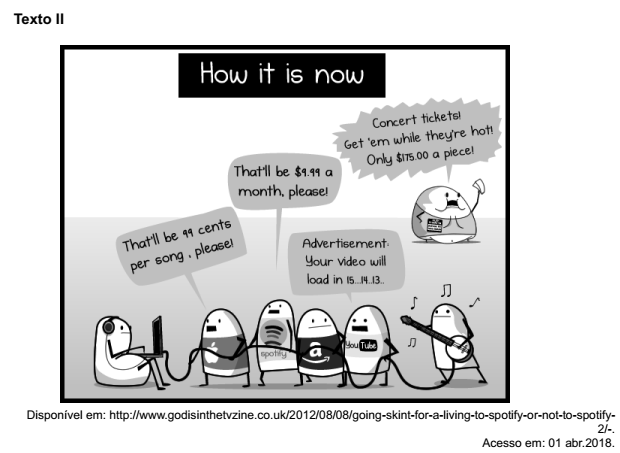
Após a leitura do texto I, “Spotify braces for $20billion US share market listing”, e da charge
acima, marque a alternativa INCORRETA:
TEXTO 01
CAN TECH DELIVER A SUSTAINABLE FUTURE FOR PLANET EARTH?
Sustainability means many things to many people, but it boils down to this: saving Planet Earth.
Mankind1 , as a species, has been too successful for its own good – the global population is estimate to top nine billion by 2050, according to the United Nations Department of Economic and Social Affairs.
As a result, there is already a strain2 on the planet’s essential natural resources, particularly food and water, which population growth can only aggravate.
Meanwhile, our demand for energy has directed to the plundering3 of the earth’s hydrocarbons oil, gas and coal, producing a catastrophic climate change. In a month-long series of features on the theme of sustainability, Technology of Business will be examining the main challenges facing businesses and asking whether technology – which got us into this mess in the first place – can help get us out.
Global megatrends are affecting the business environment
Most companies are already being affected by climate change today, directly or indirectly, says *CDP, a global not-for-profit organization specializing in measuring business environmental impact.
Extreme weather, drought and flooding can disrupt production capacity and affect supply chains for a whole range of businesses. For example, in a CDP survey of 70 European companies, 83% said they had operations in “water-stressed” regions, while 73% said water shortages posed risks to their own operations or those of their suppliers.
Considering an increasingly globalised economy, few businesses can isolate themselves from the impacts of climate change, population growth and resource reduction, says Emma Price-Thomas, head of sustainability strategy at charity Business in the Community.
“The world is changing very fast. Global megatrends are markedly affecting the business environment. If companies don’t address these and think longer-term, they may end up putting themselves out of business,” she argues.
A lot of technology and research is being directed towards reducing water usage an industrial processes and designing products that need less water to work, she says.
*CDP - Carbon Disclosure Project é uma organização que opera o sistema global de divulgação para que investidores, gerenciem seus impactos ambientais
Fonte: WALL, Matthew, BBC NEWS, 2 May 2014. Disponível em: http://www.bbc.com/news/business27208569. Adaptado. Acesso em: 6 abr. 2018.
1 ManKind: Humanidade
2 Strain:Tensão
3 Plundering: Pilhagem
TEXTO 01
CAN TECH DELIVER A SUSTAINABLE FUTURE FOR PLANET EARTH?
Sustainability means many things to many people, but it boils down to this: saving Planet Earth.
Mankind1 , as a species, has been too successful for its own good – the global population is estimate to top nine billion by 2050, according to the United Nations Department of Economic and Social Affairs.
As a result, there is already a strain2 on the planet’s essential natural resources, particularly food and water, which population growth can only aggravate.
Meanwhile, our demand for energy has directed to the plundering3 of the earth’s hydrocarbons oil, gas and coal, producing a catastrophic climate change. In a month-long series of features on the theme of sustainability, Technology of Business will be examining the main challenges facing businesses and asking whether technology – which got us into this mess in the first place – can help get us out.
Global megatrends are affecting the business environment
Most companies are already being affected by climate change today, directly or indirectly, says *CDP, a global not-for-profit organization specializing in measuring business environmental impact.
Extreme weather, drought and flooding can disrupt production capacity and affect supply chains for a whole range of businesses. For example, in a CDP survey of 70 European companies, 83% said they had operations in “water-stressed” regions, while 73% said water shortages posed risks to their own operations or those of their suppliers.
Considering an increasingly globalised economy, few businesses can isolate themselves from the impacts of climate change, population growth and resource reduction, says Emma Price-Thomas, head of sustainability strategy at charity Business in the Community.
“The world is changing very fast. Global megatrends are markedly affecting the business environment. If companies don’t address these and think longer-term, they may end up putting themselves out of business,” she argues.
A lot of technology and research is being directed towards reducing water usage an industrial processes and designing products that need less water to work, she says.
*CDP - Carbon Disclosure Project é uma organização que opera o sistema global de divulgação para que investidores, gerenciem seus impactos ambientais
Fonte: WALL, Matthew, BBC NEWS, 2 May 2014. Disponível em: http://www.bbc.com/news/business27208569. Adaptado. Acesso em: 6 abr. 2018.
1 ManKind: Humanidade
2 Strain:Tensão
3 Plundering: Pilhagem
TEXTO 01
CAN TECH DELIVER A SUSTAINABLE FUTURE FOR PLANET EARTH?
Sustainability means many things to many people, but it boils down to this: saving Planet Earth.
Mankind1 , as a species, has been too successful for its own good – the global population is estimate to top nine billion by 2050, according to the United Nations Department of Economic and Social Affairs.
As a result, there is already a strain2 on the planet’s essential natural resources, particularly food and water, which population growth can only aggravate.
Meanwhile, our demand for energy has directed to the plundering3 of the earth’s hydrocarbons oil, gas and coal, producing a catastrophic climate change. In a month-long series of features on the theme of sustainability, Technology of Business will be examining the main challenges facing businesses and asking whether technology – which got us into this mess in the first place – can help get us out.
Global megatrends are affecting the business environment
Most companies are already being affected by climate change today, directly or indirectly, says *CDP, a global not-for-profit organization specializing in measuring business environmental impact.
Extreme weather, drought and flooding can disrupt production capacity and affect supply chains for a whole range of businesses. For example, in a CDP survey of 70 European companies, 83% said they had operations in “water-stressed” regions, while 73% said water shortages posed risks to their own operations or those of their suppliers.
Considering an increasingly globalised economy, few businesses can isolate themselves from the impacts of climate change, population growth and resource reduction, says Emma Price-Thomas, head of sustainability strategy at charity Business in the Community.
“The world is changing very fast. Global megatrends are markedly affecting the business environment. If companies don’t address these and think longer-term, they may end up putting themselves out of business,” she argues.
A lot of technology and research is being directed towards reducing water usage an industrial processes and designing products that need less water to work, she says.
*CDP - Carbon Disclosure Project é uma organização que opera o sistema global de divulgação para que investidores, gerenciem seus impactos ambientais
Fonte: WALL, Matthew, BBC NEWS, 2 May 2014. Disponível em: http://www.bbc.com/news/business27208569. Adaptado. Acesso em: 6 abr. 2018.
1 ManKind: Humanidade
2 Strain:Tensão
3 Plundering: Pilhagem
T E X T
EL TIGRE, Venezuela — Thousands of workers are fleeing Venezuela’s state-owned oil company, abandoning once-coveted jobs made worthless by the worst inflation in the world. And now the hemorrhaging is threatening the nation’s chances of overcoming its long economic collapse.
Desperate oil workers and criminals are also stripping the oil company of vital equipment, vehicles, pumps and copper wiring, carrying off whatever they can to make money. The double drain — of people and hardware — is further crippling a company that has been teetering for years yet remains the country’s most important source of income.
The timing could not be worse for Venezuela’s increasingly authoritarian president, Nicolás Maduro, who was re-elected last month in a vote that has been widely condemned by leaders across the hemisphere. Prominent opposition politicians were either barred from competing in the election, imprisoned or in exile.
But while Mr. Maduro has firm control over the country, Venezuela is on its knees economically, buckled by hyperinflation and a history of mismanagement. Widespread hunger, political strife, devastating shortages of medicine and an exodus of well over a million people in recent years have turned this country, once the economic envy of many of its neighbors, into a crisis that is spilling over international borders.
If Mr. Maduro is going to find a way out of the mess, the key will be oil: virtually the only source of hard currency for a nation with the world’s largest estimated petroleum reserves. But each month Venezuela produces less of it. Offices at the state oil company are emptying out, crews in the field are at half strength, pickup trucks are stolen and vital materials vanish. All of this is adding to the severe problems at the company that were already acute because of corruption, poor maintenance, crippling debts, the loss of professionals and even a lack of spare parts.
Now workers at all levels are walking away in large numbers, sometimes literally taking pieces of the company with them, union leaders, oil executives and workers say.
A job with Petróleos de Venezuela, known as Pdvsa, used to be a ticket to the Venezuelan Dream. No more.
Inflation in Venezuela is projected to reach an astounding 13,000 percent this year, according to the International Monetary Fund. When The New York Times interviewed Mr. Navas in May, the monthly salary for a worker like him was barely enough to buy a whole chicken or two pounds of beef. But with prices going up so quickly, it buys even less now.
Junior Martínez, 28, who has worked in the oil industry for eight years, is assembling papers, including his diploma as a chemical engineer. His wife and her daughter left three months ago to earn money in Brazil. “I get 1,400,000 bolívars a week and it isn’t even enough to buy a carton of eggs or a tube of toothpaste,”Mr. Martínez said of his salary in bolívars, Venezuela’s currency.
Mr. Martínez’s father, Ovidio Martínez, 55, recalled growing up here when the oil boom began. He cried as he spoke of his son’s determination to leave the country. “You watch your children leave and you can’t stop them,” the elder Mr. Martínez said, fighting back tears. “In this country, they don’t have a future.”
In El Tigre, hundreds of people stood in line one recent morning outside a supermarket, many waiting since the evening before to buy whatever food they could.
From: www.nytimes.com/June 14, 2018. Adapted.
T E X T
EL TIGRE, Venezuela — Thousands of workers are fleeing Venezuela’s state-owned oil company, abandoning once-coveted jobs made worthless by the worst inflation in the world. And now the hemorrhaging is threatening the nation’s chances of overcoming its long economic collapse.
Desperate oil workers and criminals are also stripping the oil company of vital equipment, vehicles, pumps and copper wiring, carrying off whatever they can to make money. The double drain — of people and hardware — is further crippling a company that has been teetering for years yet remains the country’s most important source of income.
The timing could not be worse for Venezuela’s increasingly authoritarian president, Nicolás Maduro, who was re-elected last month in a vote that has been widely condemned by leaders across the hemisphere. Prominent opposition politicians were either barred from competing in the election, imprisoned or in exile.
But while Mr. Maduro has firm control over the country, Venezuela is on its knees economically, buckled by hyperinflation and a history of mismanagement. Widespread hunger, political strife, devastating shortages of medicine and an exodus of well over a million people in recent years have turned this country, once the economic envy of many of its neighbors, into a crisis that is spilling over international borders.
If Mr. Maduro is going to find a way out of the mess, the key will be oil: virtually the only source of hard currency for a nation with the world’s largest estimated petroleum reserves. But each month Venezuela produces less of it. Offices at the state oil company are emptying out, crews in the field are at half strength, pickup trucks are stolen and vital materials vanish. All of this is adding to the severe problems at the company that were already acute because of corruption, poor maintenance, crippling debts, the loss of professionals and even a lack of spare parts.
Now workers at all levels are walking away in large numbers, sometimes literally taking pieces of the company with them, union leaders, oil executives and workers say.
A job with Petróleos de Venezuela, known as Pdvsa, used to be a ticket to the Venezuelan Dream. No more.
Inflation in Venezuela is projected to reach an astounding 13,000 percent this year, according to the International Monetary Fund. When The New York Times interviewed Mr. Navas in May, the monthly salary for a worker like him was barely enough to buy a whole chicken or two pounds of beef. But with prices going up so quickly, it buys even less now.
Junior Martínez, 28, who has worked in the oil industry for eight years, is assembling papers, including his diploma as a chemical engineer. His wife and her daughter left three months ago to earn money in Brazil. “I get 1,400,000 bolívars a week and it isn’t even enough to buy a carton of eggs or a tube of toothpaste,”Mr. Martínez said of his salary in bolívars, Venezuela’s currency.
Mr. Martínez’s father, Ovidio Martínez, 55, recalled growing up here when the oil boom began. He cried as he spoke of his son’s determination to leave the country. “You watch your children leave and you can’t stop them,” the elder Mr. Martínez said, fighting back tears. “In this country, they don’t have a future.”
In El Tigre, hundreds of people stood in line one recent morning outside a supermarket, many waiting since the evening before to buy whatever food they could.
From: www.nytimes.com/June 14, 2018. Adapted.
T E X T
EL TIGRE, Venezuela — Thousands of workers are fleeing Venezuela’s state-owned oil company, abandoning once-coveted jobs made worthless by the worst inflation in the world. And now the hemorrhaging is threatening the nation’s chances of overcoming its long economic collapse.
Desperate oil workers and criminals are also stripping the oil company of vital equipment, vehicles, pumps and copper wiring, carrying off whatever they can to make money. The double drain — of people and hardware — is further crippling a company that has been teetering for years yet remains the country’s most important source of income.
The timing could not be worse for Venezuela’s increasingly authoritarian president, Nicolás Maduro, who was re-elected last month in a vote that has been widely condemned by leaders across the hemisphere. Prominent opposition politicians were either barred from competing in the election, imprisoned or in exile.
But while Mr. Maduro has firm control over the country, Venezuela is on its knees economically, buckled by hyperinflation and a history of mismanagement. Widespread hunger, political strife, devastating shortages of medicine and an exodus of well over a million people in recent years have turned this country, once the economic envy of many of its neighbors, into a crisis that is spilling over international borders.
If Mr. Maduro is going to find a way out of the mess, the key will be oil: virtually the only source of hard currency for a nation with the world’s largest estimated petroleum reserves. But each month Venezuela produces less of it. Offices at the state oil company are emptying out, crews in the field are at half strength, pickup trucks are stolen and vital materials vanish. All of this is adding to the severe problems at the company that were already acute because of corruption, poor maintenance, crippling debts, the loss of professionals and even a lack of spare parts.
Now workers at all levels are walking away in large numbers, sometimes literally taking pieces of the company with them, union leaders, oil executives and workers say.
A job with Petróleos de Venezuela, known as Pdvsa, used to be a ticket to the Venezuelan Dream. No more.
Inflation in Venezuela is projected to reach an astounding 13,000 percent this year, according to the International Monetary Fund. When The New York Times interviewed Mr. Navas in May, the monthly salary for a worker like him was barely enough to buy a whole chicken or two pounds of beef. But with prices going up so quickly, it buys even less now.
Junior Martínez, 28, who has worked in the oil industry for eight years, is assembling papers, including his diploma as a chemical engineer. His wife and her daughter left three months ago to earn money in Brazil. “I get 1,400,000 bolívars a week and it isn’t even enough to buy a carton of eggs or a tube of toothpaste,”Mr. Martínez said of his salary in bolívars, Venezuela’s currency.
Mr. Martínez’s father, Ovidio Martínez, 55, recalled growing up here when the oil boom began. He cried as he spoke of his son’s determination to leave the country. “You watch your children leave and you can’t stop them,” the elder Mr. Martínez said, fighting back tears. “In this country, they don’t have a future.”
In El Tigre, hundreds of people stood in line one recent morning outside a supermarket, many waiting since the evening before to buy whatever food they could.
From: www.nytimes.com/June 14, 2018. Adapted.
T E X T
EL TIGRE, Venezuela — Thousands of workers are fleeing Venezuela’s state-owned oil company, abandoning once-coveted jobs made worthless by the worst inflation in the world. And now the hemorrhaging is threatening the nation’s chances of overcoming its long economic collapse.
Desperate oil workers and criminals are also stripping the oil company of vital equipment, vehicles, pumps and copper wiring, carrying off whatever they can to make money. The double drain — of people and hardware — is further crippling a company that has been teetering for years yet remains the country’s most important source of income.
The timing could not be worse for Venezuela’s increasingly authoritarian president, Nicolás Maduro, who was re-elected last month in a vote that has been widely condemned by leaders across the hemisphere. Prominent opposition politicians were either barred from competing in the election, imprisoned or in exile.
But while Mr. Maduro has firm control over the country, Venezuela is on its knees economically, buckled by hyperinflation and a history of mismanagement. Widespread hunger, political strife, devastating shortages of medicine and an exodus of well over a million people in recent years have turned this country, once the economic envy of many of its neighbors, into a crisis that is spilling over international borders.
If Mr. Maduro is going to find a way out of the mess, the key will be oil: virtually the only source of hard currency for a nation with the world’s largest estimated petroleum reserves. But each month Venezuela produces less of it. Offices at the state oil company are emptying out, crews in the field are at half strength, pickup trucks are stolen and vital materials vanish. All of this is adding to the severe problems at the company that were already acute because of corruption, poor maintenance, crippling debts, the loss of professionals and even a lack of spare parts.
Now workers at all levels are walking away in large numbers, sometimes literally taking pieces of the company with them, union leaders, oil executives and workers say.
A job with Petróleos de Venezuela, known as Pdvsa, used to be a ticket to the Venezuelan Dream. No more.
Inflation in Venezuela is projected to reach an astounding 13,000 percent this year, according to the International Monetary Fund. When The New York Times interviewed Mr. Navas in May, the monthly salary for a worker like him was barely enough to buy a whole chicken or two pounds of beef. But with prices going up so quickly, it buys even less now.
Junior Martínez, 28, who has worked in the oil industry for eight years, is assembling papers, including his diploma as a chemical engineer. His wife and her daughter left three months ago to earn money in Brazil. “I get 1,400,000 bolívars a week and it isn’t even enough to buy a carton of eggs or a tube of toothpaste,”Mr. Martínez said of his salary in bolívars, Venezuela’s currency.
Mr. Martínez’s father, Ovidio Martínez, 55, recalled growing up here when the oil boom began. He cried as he spoke of his son’s determination to leave the country. “You watch your children leave and you can’t stop them,” the elder Mr. Martínez said, fighting back tears. “In this country, they don’t have a future.”
In El Tigre, hundreds of people stood in line one recent morning outside a supermarket, many waiting since the evening before to buy whatever food they could.
From: www.nytimes.com/June 14, 2018. Adapted.
T E X T
EL TIGRE, Venezuela — Thousands of workers are fleeing Venezuela’s state-owned oil company, abandoning once-coveted jobs made worthless by the worst inflation in the world. And now the hemorrhaging is threatening the nation’s chances of overcoming its long economic collapse.
Desperate oil workers and criminals are also stripping the oil company of vital equipment, vehicles, pumps and copper wiring, carrying off whatever they can to make money. The double drain — of people and hardware — is further crippling a company that has been teetering for years yet remains the country’s most important source of income.
The timing could not be worse for Venezuela’s increasingly authoritarian president, Nicolás Maduro, who was re-elected last month in a vote that has been widely condemned by leaders across the hemisphere. Prominent opposition politicians were either barred from competing in the election, imprisoned or in exile.
But while Mr. Maduro has firm control over the country, Venezuela is on its knees economically, buckled by hyperinflation and a history of mismanagement. Widespread hunger, political strife, devastating shortages of medicine and an exodus of well over a million people in recent years have turned this country, once the economic envy of many of its neighbors, into a crisis that is spilling over international borders.
If Mr. Maduro is going to find a way out of the mess, the key will be oil: virtually the only source of hard currency for a nation with the world’s largest estimated petroleum reserves. But each month Venezuela produces less of it. Offices at the state oil company are emptying out, crews in the field are at half strength, pickup trucks are stolen and vital materials vanish. All of this is adding to the severe problems at the company that were already acute because of corruption, poor maintenance, crippling debts, the loss of professionals and even a lack of spare parts.
Now workers at all levels are walking away in large numbers, sometimes literally taking pieces of the company with them, union leaders, oil executives and workers say.
A job with Petróleos de Venezuela, known as Pdvsa, used to be a ticket to the Venezuelan Dream. No more.
Inflation in Venezuela is projected to reach an astounding 13,000 percent this year, according to the International Monetary Fund. When The New York Times interviewed Mr. Navas in May, the monthly salary for a worker like him was barely enough to buy a whole chicken or two pounds of beef. But with prices going up so quickly, it buys even less now.
Junior Martínez, 28, who has worked in the oil industry for eight years, is assembling papers, including his diploma as a chemical engineer. His wife and her daughter left three months ago to earn money in Brazil. “I get 1,400,000 bolívars a week and it isn’t even enough to buy a carton of eggs or a tube of toothpaste,”Mr. Martínez said of his salary in bolívars, Venezuela’s currency.
Mr. Martínez’s father, Ovidio Martínez, 55, recalled growing up here when the oil boom began. He cried as he spoke of his son’s determination to leave the country. “You watch your children leave and you can’t stop them,” the elder Mr. Martínez said, fighting back tears. “In this country, they don’t have a future.”
In El Tigre, hundreds of people stood in line one recent morning outside a supermarket, many waiting since the evening before to buy whatever food they could.
From: www.nytimes.com/June 14, 2018. Adapted.
T E X T
EL TIGRE, Venezuela — Thousands of workers are fleeing Venezuela’s state-owned oil company, abandoning once-coveted jobs made worthless by the worst inflation in the world. And now the hemorrhaging is threatening the nation’s chances of overcoming its long economic collapse.
Desperate oil workers and criminals are also stripping the oil company of vital equipment, vehicles, pumps and copper wiring, carrying off whatever they can to make money. The double drain — of people and hardware — is further crippling a company that has been teetering for years yet remains the country’s most important source of income.
The timing could not be worse for Venezuela’s increasingly authoritarian president, Nicolás Maduro, who was re-elected last month in a vote that has been widely condemned by leaders across the hemisphere. Prominent opposition politicians were either barred from competing in the election, imprisoned or in exile.
But while Mr. Maduro has firm control over the country, Venezuela is on its knees economically, buckled by hyperinflation and a history of mismanagement. Widespread hunger, political strife, devastating shortages of medicine and an exodus of well over a million people in recent years have turned this country, once the economic envy of many of its neighbors, into a crisis that is spilling over international borders.
If Mr. Maduro is going to find a way out of the mess, the key will be oil: virtually the only source of hard currency for a nation with the world’s largest estimated petroleum reserves. But each month Venezuela produces less of it. Offices at the state oil company are emptying out, crews in the field are at half strength, pickup trucks are stolen and vital materials vanish. All of this is adding to the severe problems at the company that were already acute because of corruption, poor maintenance, crippling debts, the loss of professionals and even a lack of spare parts.
Now workers at all levels are walking away in large numbers, sometimes literally taking pieces of the company with them, union leaders, oil executives and workers say.
A job with Petróleos de Venezuela, known as Pdvsa, used to be a ticket to the Venezuelan Dream. No more.
Inflation in Venezuela is projected to reach an astounding 13,000 percent this year, according to the International Monetary Fund. When The New York Times interviewed Mr. Navas in May, the monthly salary for a worker like him was barely enough to buy a whole chicken or two pounds of beef. But with prices going up so quickly, it buys even less now.
Junior Martínez, 28, who has worked in the oil industry for eight years, is assembling papers, including his diploma as a chemical engineer. His wife and her daughter left three months ago to earn money in Brazil. “I get 1,400,000 bolívars a week and it isn’t even enough to buy a carton of eggs or a tube of toothpaste,”Mr. Martínez said of his salary in bolívars, Venezuela’s currency.
Mr. Martínez’s father, Ovidio Martínez, 55, recalled growing up here when the oil boom began. He cried as he spoke of his son’s determination to leave the country. “You watch your children leave and you can’t stop them,” the elder Mr. Martínez said, fighting back tears. “In this country, they don’t have a future.”
In El Tigre, hundreds of people stood in line one recent morning outside a supermarket, many waiting since the evening before to buy whatever food they could.
From: www.nytimes.com/June 14, 2018. Adapted.
T E X T
EL TIGRE, Venezuela — Thousands of workers are fleeing Venezuela’s state-owned oil company, abandoning once-coveted jobs made worthless by the worst inflation in the world. And now the hemorrhaging is threatening the nation’s chances of overcoming its long economic collapse.
Desperate oil workers and criminals are also stripping the oil company of vital equipment, vehicles, pumps and copper wiring, carrying off whatever they can to make money. The double drain — of people and hardware — is further crippling a company that has been teetering for years yet remains the country’s most important source of income.
The timing could not be worse for Venezuela’s increasingly authoritarian president, Nicolás Maduro, who was re-elected last month in a vote that has been widely condemned by leaders across the hemisphere. Prominent opposition politicians were either barred from competing in the election, imprisoned or in exile.
But while Mr. Maduro has firm control over the country, Venezuela is on its knees economically, buckled by hyperinflation and a history of mismanagement. Widespread hunger, political strife, devastating shortages of medicine and an exodus of well over a million people in recent years have turned this country, once the economic envy of many of its neighbors, into a crisis that is spilling over international borders.
If Mr. Maduro is going to find a way out of the mess, the key will be oil: virtually the only source of hard currency for a nation with the world’s largest estimated petroleum reserves. But each month Venezuela produces less of it. Offices at the state oil company are emptying out, crews in the field are at half strength, pickup trucks are stolen and vital materials vanish. All of this is adding to the severe problems at the company that were already acute because of corruption, poor maintenance, crippling debts, the loss of professionals and even a lack of spare parts.
Now workers at all levels are walking away in large numbers, sometimes literally taking pieces of the company with them, union leaders, oil executives and workers say.
A job with Petróleos de Venezuela, known as Pdvsa, used to be a ticket to the Venezuelan Dream. No more.
Inflation in Venezuela is projected to reach an astounding 13,000 percent this year, according to the International Monetary Fund. When The New York Times interviewed Mr. Navas in May, the monthly salary for a worker like him was barely enough to buy a whole chicken or two pounds of beef. But with prices going up so quickly, it buys even less now.
Junior Martínez, 28, who has worked in the oil industry for eight years, is assembling papers, including his diploma as a chemical engineer. His wife and her daughter left three months ago to earn money in Brazil. “I get 1,400,000 bolívars a week and it isn’t even enough to buy a carton of eggs or a tube of toothpaste,”Mr. Martínez said of his salary in bolívars, Venezuela’s currency.
Mr. Martínez’s father, Ovidio Martínez, 55, recalled growing up here when the oil boom began. He cried as he spoke of his son’s determination to leave the country. “You watch your children leave and you can’t stop them,” the elder Mr. Martínez said, fighting back tears. “In this country, they don’t have a future.”
In El Tigre, hundreds of people stood in line one recent morning outside a supermarket, many waiting since the evening before to buy whatever food they could.
From: www.nytimes.com/June 14, 2018. Adapted.
T E X T
EL TIGRE, Venezuela — Thousands of workers are fleeing Venezuela’s state-owned oil company, abandoning once-coveted jobs made worthless by the worst inflation in the world. And now the hemorrhaging is threatening the nation’s chances of overcoming its long economic collapse.
Desperate oil workers and criminals are also stripping the oil company of vital equipment, vehicles, pumps and copper wiring, carrying off whatever they can to make money. The double drain — of people and hardware — is further crippling a company that has been teetering for years yet remains the country’s most important source of income.
The timing could not be worse for Venezuela’s increasingly authoritarian president, Nicolás Maduro, who was re-elected last month in a vote that has been widely condemned by leaders across the hemisphere. Prominent opposition politicians were either barred from competing in the election, imprisoned or in exile.
But while Mr. Maduro has firm control over the country, Venezuela is on its knees economically, buckled by hyperinflation and a history of mismanagement. Widespread hunger, political strife, devastating shortages of medicine and an exodus of well over a million people in recent years have turned this country, once the economic envy of many of its neighbors, into a crisis that is spilling over international borders.
If Mr. Maduro is going to find a way out of the mess, the key will be oil: virtually the only source of hard currency for a nation with the world’s largest estimated petroleum reserves. But each month Venezuela produces less of it. Offices at the state oil company are emptying out, crews in the field are at half strength, pickup trucks are stolen and vital materials vanish. All of this is adding to the severe problems at the company that were already acute because of corruption, poor maintenance, crippling debts, the loss of professionals and even a lack of spare parts.
Now workers at all levels are walking away in large numbers, sometimes literally taking pieces of the company with them, union leaders, oil executives and workers say.
A job with Petróleos de Venezuela, known as Pdvsa, used to be a ticket to the Venezuelan Dream. No more.
Inflation in Venezuela is projected to reach an astounding 13,000 percent this year, according to the International Monetary Fund. When The New York Times interviewed Mr. Navas in May, the monthly salary for a worker like him was barely enough to buy a whole chicken or two pounds of beef. But with prices going up so quickly, it buys even less now.
Junior Martínez, 28, who has worked in the oil industry for eight years, is assembling papers, including his diploma as a chemical engineer. His wife and her daughter left three months ago to earn money in Brazil. “I get 1,400,000 bolívars a week and it isn’t even enough to buy a carton of eggs or a tube of toothpaste,”Mr. Martínez said of his salary in bolívars, Venezuela’s currency.
Mr. Martínez’s father, Ovidio Martínez, 55, recalled growing up here when the oil boom began. He cried as he spoke of his son’s determination to leave the country. “You watch your children leave and you can’t stop them,” the elder Mr. Martínez said, fighting back tears. “In this country, they don’t have a future.”
In El Tigre, hundreds of people stood in line one recent morning outside a supermarket, many waiting since the evening before to buy whatever food they could.
From: www.nytimes.com/June 14, 2018. Adapted.

The time has gone, the song is over (ℓ. 22)
The expression has gone refers to an action that can be described as:
Plans that either come to naught (ℓ. 19)
Or half a page of scribbled lines (ℓ. 20)
The underlined expressions associate the plans mentioned by the poet to the following idea:

 Conheça nossos planos