Foram encontradas 31.244 questões

Resolva questões gratuitamente!

Junte-se a mais de 4 milhões de concurseiros!

Q3637107 Psicologia

Os alunos podem possuir alguns transtornos que apresentam alterações no desenvolvimento neuropsicomotor, comprometimento nas relações sociais, na comunicação ou estereotipias motoras. Dentre desse quadro, podemos citar:


I. autismo clássico;


II. síndrome de Asperger;


III. síndrome de Rett;


IV. transtorno desintegrativo da infância (psicoses);


V. transtornos invasivos sem outra especificação.


Analisando a exemplificação dos transtornos acima, em conformidade com resolução nº 4, de 2 de outubro de 2009, correspondem transtornos globais do desenvolvimento os itens:

Alternativas
Q3637106 Pedagogia

Sobre a Educação Inclusiva do Sistema Municipal de Ensino de Tubarão, analise as afirmativas:


I – O sistema municipal garantirá adequações curriculares para contemplar a diversidade, promovendo acesso e permanência com qualidade dos estudantes na rede regular de ensino e estas adequações curriculares deverão constar no Projeto Político Pedagógico das unidades escolares.


II – O atendimento educacional especializado será realizado prioritariamente nas salas de recursos multifuncionais da própria escola ou em outra de ensino regular no mesmo turno ao da escolarização.


III – O professor bilíngue pode assumir ou ser designado para outra função na escola que não seja aquela para a qual foi contratado na eventual ausência do estudante.  


Está(ão) correta(s) a(s): 

Alternativas
Q3637105 Pedagogia

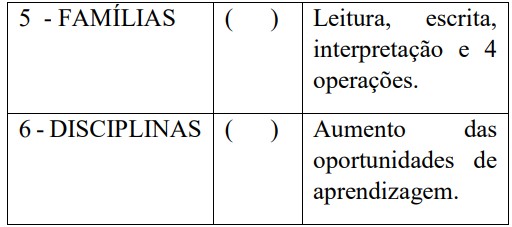
A Fundação Municipal de Educação de Tubarão fez a seleção dos principais fatores que influenciam a aprendizagem no documento denominado de Sucesso Na Escola, Na Vida e No Trabalho. Nesse sentido, relacione tais fatores com as suas respectivas características. 
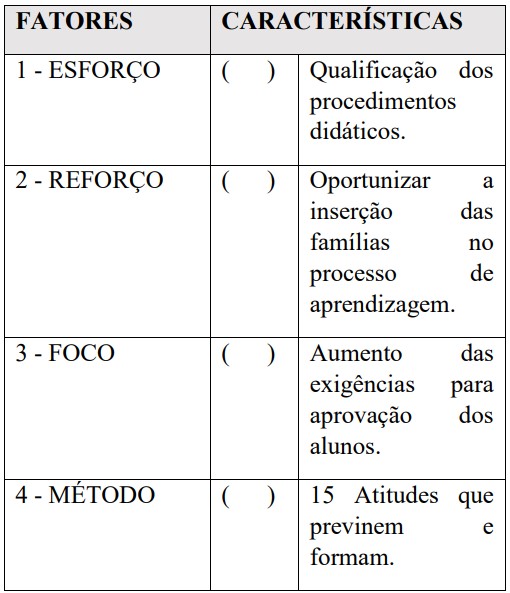


Imagem associada para resolução da questão

Imagem associada para resolução da questão


Assinale a alternativa que apresenta a correta correlação de cima para baixo. 


Alternativas
Q3637104 Direito da Criança e do Adolescente - Estatuto da Criança e do Adolescente (ECA) - Lei nº 8.069 de 1990

O marido de Aparecida é alcoólatra. Quando está sob efeito de álcool agride fisicamente ela e o filho do casal de dez anos. Cansada dessa situação familiar, ela resolve procurar o conselho tutelar a fim de orientação. 


Analisando a situação e a relacionando com o Estatuto da Criança e do Adolescente, é correto afirmar que:

Alternativas
Q3637103 Estatuto da Pessoa com Deficiência - Lei nº 13.146 de 2015
A educação constitui direito da pessoa com deficiência, assegurado sistema educacional inclusivo em todos os níveis e aprendizado ao longo de toda a vida. Sobre o direito à educação previsto na lei nº 13.146/2015, assinale a alternativa correta.
Alternativas
Q3637102 Direito Constitucional

A educação, direito de todos e dever do Estado e da família, será promovida e incentivada com a colaboração da sociedade, visando ao pleno desenvolvimento da pessoa, seu preparo para o exercício da cidadania e sua qualificação para o trabalho. Nesse sentido, acerca dos ditames previstos sobre a educação na Constituição Federal. Julgue os itens como V para aqueles que são verdadeiros e F para os que são falsos.


( ) O dever do Estado com a educação será efetivado mediante a garantia de educação básica obrigatória e gratuita dos 4 (quatro) aos 17 (dezessete) anos de idade, assegurada inclusive sua oferta gratuita para todos os que a ela não tiveram acesso na idade própria.


( ) Serão fixados conteúdos mínimos para o ensino fundamental, de maneira a assegurar formação básica comum e respeito aos valores culturais e artísticos, nacionais e regionais.


( ) Os Municípios atuarão exclusivamente no ensino fundamental e na educação infantil.


( ) A educação básica pública terá como fonte adicional de financiamento a contribuição social do salário-educação, recolhida pelas empresas na forma da lei, inclusive para pagamento de aposentadorias e pensões.


( ) Os recursos públicos serão destinados exclusivamente para escolas públicas.


( ) O dever do Estado com a educação será efetivado mediante a garantia de acesso aos níveis mais elevados do ensino, da pesquisa e da criação artística, segundo a capacidade de cada um.


( ) O não-oferecimento do ensino obrigatório pelo Poder Público, ou sua oferta irregular, importa responsabilidade da autoridade competente. 


( ) O acesso ao ensino obrigatório e gratuito é direito público subjetivo e objetivo.


A sequência correta é respectivamente:

Alternativas
Q3635465 Pedagogia
Qual é a principal crítica ao uso exclusivo de avaliações somativas no processo educacional?
Alternativas
Q3635464 Pedagogia
No que concerne à principal diferença entre o planejamento curricular de sentido amplo e o planejamento curricular de sentido específico, assinale a alternativa CORRETA.
Alternativas
Q3635463 Inglês
What is the primary purpose of the AI-powered app Remini and its competitors mentioned in the text?
Alternativas
Q3635462 Pedagogia
Sobre a principal diferença entre a Educação Básica e a Educação Superior, de acordo com a Lei nº 9.394/96 − Lei de Diretrizes e Base da Educação Nacional, assinale a alternativa CORRET
Alternativas
Q3635461 Pedagogia
Na perspectiva da Teoria da Atividade, como são definidas as contradições em um contexto educacional?
Alternativas
Q3635460 Inglês
Como a interculturalidade pode influenciar a tradução de textos entre diferentes idiomas?
Alternativas
Q3635459 Direito da Criança e do Adolescente - Estatuto da Criança e do Adolescente (ECA) - Lei nº 8.069 de 1990
Assinale a alternativa que apresenta o princípio fundamental da Lei nº 8.069/90 − Estatuto da Criança e do Adolescente (ECA) que assegura o direito à convivência familiar e comunitária, garantindo a proteção contra negligência e discriminação? 
Alternativas
Q3635458 Pedagogia
O Plano Nacional de Educação (PNE) estabelece metas específicas para a Educação Infantil, visando a universalização do atendimento a crianças de 0 a 5 anos. Qual é um dos objetivos principais dessa meta?
Alternativas
Q3635457 Pedagogia
Acerca da Base Nacional Comum Curricular (BNCC), julgue as frases abaixo.

I.O papel dos professores na implementação eficaz da BNCC é adaptar e contextualizar o currículo de acordo com as necessidades e contextos locais dos estudantes.
II.A BNCC aborda a diversidade cultural e étnica na educação padronizando o currículo para evitar conflitos culturais.
III.A BNCC garante que os estudantes com deficiência tenham acesso às mesmas aprendizagens que os demais, bem como propõe financiamento adicional para escolas inclusivas.

Está (ão) CORRETA (S) a (s) seguinte (s) proposição (ões). 
Alternativas
Q3635456 Inglês
O texto seguinte servirá de base para responder à questão.


(1º§) Over the summer a video went viral on TikTok. It was captioned "using this trend to get a new LinkedIn headshot". In the short clip, a young woman shows both how she looks in real life, and the professional-looking headshot photos that she created using an AI-powered app called Remini. The video has now been watched 52.3 million times, and a host of similar ones from other TikTokers have also been extensively viewed. Remini, and competitors such as Try It On AI and AI Suit Up, use AI-based software to create slick profile photos that aim to look as if they were taken by an expert photographer. With Remini you are asked to upload eight to 10 selfies, preferably taken from different angles, and all in good lighting. The AI uses those pictures to learn about the way you look.


(2º§) Then just a few minutes later it will start creating artificial photos of you looking very smart and even glamorous, with your hair in different styles or positions, and you wearing different clothes while sitting in perfect lighting. It also gives you faultless skin, and improves your make-up. Plus, you get different backdrops. And some users find that it makes them look thinner.


(3º§) The results are somewhat in the eye of the beholder - some say they are realistic, while others find that the images look artificial. But while previous online image manipulation trends, such as drastically changing your hair or eye colour, have been about having fun on social media, this one is very much focused on LinkedIn and other job hunting websites.


(4º§) For some the attraction of the AI services is that they are cheap. Divya Shishodia, 24, a digital marketer, from Australia, says that while AI headshots "are obviously generated, some people might not have the budget to go and get a professional headshot taken". While going to a professional photographer can cost more than £100, Remini and the other providers will generally give you free trials lasting a few days. "I'm not saying they're the most realistic, but for the amount of time and effort you have to put in... the output is worth it," says Ms Shishodia. She adds that, by contrast, if you try to take a decent profile photo yourself it can be very difficult. "You need angles, lighting, you are trying to avoid shadows... only actual photographers can do it." 


(5º§) For Michelle Genobisa, 26, from Aalborg, Denmark, it is the low to no cost of the AI generated profile photos that she is on board with. "I quite often change my looks, like my hair colour... so it was an easy way to collect some pictures with the effect of a professional photoshoot," she says. "To get that kind of photo taken, professionally, it's very expensive."


(6º§) Others are less impressed by the technology, such as Molly McCrann, a 25-year-old actor from Australia. "I just think it looks so fake, you can tell that it looks heavily edited, or it looks like AI," she says. "When I posted mine it made me look so skinny, and I don't look McCrann adds that she thinks it is probably better to show prospective employers what you actually look like.


(7º§) However, she is also prepared to see the other side of the argument. "Someone wrote a comment that I actually agree with - if this company is going to base off looks, I want to get in the room. And if this is going to get me in the room, then I am going to use AI headshots to get the interview." But what about the potential impact that AI-improved images can have on our self-esteem? Consumer psychologist Dr Paul Marsden says there are two sides to the issue. "On one hand it could allow us to put our best self forward, and the image of ourselves that we want to project to the world, and in turn motivate us to be that way inclined in real life," he tells the BBC. "The psychology of first impressions is how we make snap decisions based on initial impressions, and by using AI people can put themselves in the running to potentially be considered for an opportunity. On the other hand it could affect people's self-worth and beliefs that they themselves are not good enough comparatively to their AI generation resulting in low confidence.


(8º§) Do recruiters care? Tristan Barthel from London-based Tate Recruitment has seen a big rise in the number of people using AI to improve their photos. He says that it makes no difference in how he deals with a person's application. "I can see if a picture has been AI generated, and it wouldn't affect my decision, for me it's about the qualifications."


https://www.bbc.com/news/business-67054382


What is the verb tense of the sentence below?


(1º§) "Over the summer a video went viral on TikTok." 

Alternativas
Q3635455 Inglês
O texto seguinte servirá de base para responder à questão.


(1º§) Over the summer a video went viral on TikTok. It was captioned "using this trend to get a new LinkedIn headshot". In the short clip, a young woman shows both how she looks in real life, and the professional-looking headshot photos that she created using an AI-powered app called Remini. The video has now been watched 52.3 million times, and a host of similar ones from other TikTokers have also been extensively viewed. Remini, and competitors such as Try It On AI and AI Suit Up, use AI-based software to create slick profile photos that aim to look as if they were taken by an expert photographer. With Remini you are asked to upload eight to 10 selfies, preferably taken from different angles, and all in good lighting. The AI uses those pictures to learn about the way you look.


(2º§) Then just a few minutes later it will start creating artificial photos of you looking very smart and even glamorous, with your hair in different styles or positions, and you wearing different clothes while sitting in perfect lighting. It also gives you faultless skin, and improves your make-up. Plus, you get different backdrops. And some users find that it makes them look thinner.


(3º§) The results are somewhat in the eye of the beholder - some say they are realistic, while others find that the images look artificial. But while previous online image manipulation trends, such as drastically changing your hair or eye colour, have been about having fun on social media, this one is very much focused on LinkedIn and other job hunting websites.


(4º§) For some the attraction of the AI services is that they are cheap. Divya Shishodia, 24, a digital marketer, from Australia, says that while AI headshots "are obviously generated, some people might not have the budget to go and get a professional headshot taken". While going to a professional photographer can cost more than £100, Remini and the other providers will generally give you free trials lasting a few days. "I'm not saying they're the most realistic, but for the amount of time and effort you have to put in... the output is worth it," says Ms Shishodia. She adds that, by contrast, if you try to take a decent profile photo yourself it can be very difficult. "You need angles, lighting, you are trying to avoid shadows... only actual photographers can do it." 


(5º§) For Michelle Genobisa, 26, from Aalborg, Denmark, it is the low to no cost of the AI generated profile photos that she is on board with. "I quite often change my looks, like my hair colour... so it was an easy way to collect some pictures with the effect of a professional photoshoot," she says. "To get that kind of photo taken, professionally, it's very expensive."


(6º§) Others are less impressed by the technology, such as Molly McCrann, a 25-year-old actor from Australia. "I just think it looks so fake, you can tell that it looks heavily edited, or it looks like AI," she says. "When I posted mine it made me look so skinny, and I don't look McCrann adds that she thinks it is probably better to show prospective employers what you actually look like.


(7º§) However, she is also prepared to see the other side of the argument. "Someone wrote a comment that I actually agree with - if this company is going to base off looks, I want to get in the room. And if this is going to get me in the room, then I am going to use AI headshots to get the interview." But what about the potential impact that AI-improved images can have on our self-esteem? Consumer psychologist Dr Paul Marsden says there are two sides to the issue. "On one hand it could allow us to put our best self forward, and the image of ourselves that we want to project to the world, and in turn motivate us to be that way inclined in real life," he tells the BBC. "The psychology of first impressions is how we make snap decisions based on initial impressions, and by using AI people can put themselves in the running to potentially be considered for an opportunity. On the other hand it could affect people's self-worth and beliefs that they themselves are not good enough comparatively to their AI generation resulting in low confidence.


(8º§) Do recruiters care? Tristan Barthel from London-based Tate Recruitment has seen a big rise in the number of people using AI to improve their photos. He says that it makes no difference in how he deals with a person's application. "I can see if a picture has been AI generated, and it wouldn't affect my decision, for me it's about the qualifications."


https://www.bbc.com/news/business-67054382


Consider the excerpt below:

(2º§) "It also gives you faultless skin, and improves your make-up. Plus, you get different backdrops."

In this context, the word "backdrops" can be translated as:

Alternativas
Q3635454 Inglês
O texto seguinte servirá de base para responder à questão.


(1º§) Over the summer a video went viral on TikTok. It was captioned "using this trend to get a new LinkedIn headshot". In the short clip, a young woman shows both how she looks in real life, and the professional-looking headshot photos that she created using an AI-powered app called Remini. The video has now been watched 52.3 million times, and a host of similar ones from other TikTokers have also been extensively viewed. Remini, and competitors such as Try It On AI and AI Suit Up, use AI-based software to create slick profile photos that aim to look as if they were taken by an expert photographer. With Remini you are asked to upload eight to 10 selfies, preferably taken from different angles, and all in good lighting. The AI uses those pictures to learn about the way you look.


(2º§) Then just a few minutes later it will start creating artificial photos of you looking very smart and even glamorous, with your hair in different styles or positions, and you wearing different clothes while sitting in perfect lighting. It also gives you faultless skin, and improves your make-up. Plus, you get different backdrops. And some users find that it makes them look thinner.


(3º§) The results are somewhat in the eye of the beholder - some say they are realistic, while others find that the images look artificial. But while previous online image manipulation trends, such as drastically changing your hair or eye colour, have been about having fun on social media, this one is very much focused on LinkedIn and other job hunting websites.


(4º§) For some the attraction of the AI services is that they are cheap. Divya Shishodia, 24, a digital marketer, from Australia, says that while AI headshots "are obviously generated, some people might not have the budget to go and get a professional headshot taken". While going to a professional photographer can cost more than £100, Remini and the other providers will generally give you free trials lasting a few days. "I'm not saying they're the most realistic, but for the amount of time and effort you have to put in... the output is worth it," says Ms Shishodia. She adds that, by contrast, if you try to take a decent profile photo yourself it can be very difficult. "You need angles, lighting, you are trying to avoid shadows... only actual photographers can do it." 


(5º§) For Michelle Genobisa, 26, from Aalborg, Denmark, it is the low to no cost of the AI generated profile photos that she is on board with. "I quite often change my looks, like my hair colour... so it was an easy way to collect some pictures with the effect of a professional photoshoot," she says. "To get that kind of photo taken, professionally, it's very expensive."


(6º§) Others are less impressed by the technology, such as Molly McCrann, a 25-year-old actor from Australia. "I just think it looks so fake, you can tell that it looks heavily edited, or it looks like AI," she says. "When I posted mine it made me look so skinny, and I don't look McCrann adds that she thinks it is probably better to show prospective employers what you actually look like.


(7º§) However, she is also prepared to see the other side of the argument. "Someone wrote a comment that I actually agree with - if this company is going to base off looks, I want to get in the room. And if this is going to get me in the room, then I am going to use AI headshots to get the interview." But what about the potential impact that AI-improved images can have on our self-esteem? Consumer psychologist Dr Paul Marsden says there are two sides to the issue. "On one hand it could allow us to put our best self forward, and the image of ourselves that we want to project to the world, and in turn motivate us to be that way inclined in real life," he tells the BBC. "The psychology of first impressions is how we make snap decisions based on initial impressions, and by using AI people can put themselves in the running to potentially be considered for an opportunity. On the other hand it could affect people's self-worth and beliefs that they themselves are not good enough comparatively to their AI generation resulting in low confidence.


(8º§) Do recruiters care? Tristan Barthel from London-based Tate Recruitment has seen a big rise in the number of people using AI to improve their photos. He says that it makes no difference in how he deals with a person's application. "I can see if a picture has been AI generated, and it wouldn't affect my decision, for me it's about the qualifications."


https://www.bbc.com/news/business-67054382


Considering the context, select the alternative that presents a synonym for the word "beholder" (3º§).
Alternativas
Q3635453 Inglês
O texto seguinte servirá de base para responder à questão.


(1º§) Over the summer a video went viral on TikTok. It was captioned "using this trend to get a new LinkedIn headshot". In the short clip, a young woman shows both how she looks in real life, and the professional-looking headshot photos that she created using an AI-powered app called Remini. The video has now been watched 52.3 million times, and a host of similar ones from other TikTokers have also been extensively viewed. Remini, and competitors such as Try It On AI and AI Suit Up, use AI-based software to create slick profile photos that aim to look as if they were taken by an expert photographer. With Remini you are asked to upload eight to 10 selfies, preferably taken from different angles, and all in good lighting. The AI uses those pictures to learn about the way you look.


(2º§) Then just a few minutes later it will start creating artificial photos of you looking very smart and even glamorous, with your hair in different styles or positions, and you wearing different clothes while sitting in perfect lighting. It also gives you faultless skin, and improves your make-up. Plus, you get different backdrops. And some users find that it makes them look thinner.


(3º§) The results are somewhat in the eye of the beholder - some say they are realistic, while others find that the images look artificial. But while previous online image manipulation trends, such as drastically changing your hair or eye colour, have been about having fun on social media, this one is very much focused on LinkedIn and other job hunting websites.


(4º§) For some the attraction of the AI services is that they are cheap. Divya Shishodia, 24, a digital marketer, from Australia, says that while AI headshots "are obviously generated, some people might not have the budget to go and get a professional headshot taken". While going to a professional photographer can cost more than £100, Remini and the other providers will generally give you free trials lasting a few days. "I'm not saying they're the most realistic, but for the amount of time and effort you have to put in... the output is worth it," says Ms Shishodia. She adds that, by contrast, if you try to take a decent profile photo yourself it can be very difficult. "You need angles, lighting, you are trying to avoid shadows... only actual photographers can do it." 


(5º§) For Michelle Genobisa, 26, from Aalborg, Denmark, it is the low to no cost of the AI generated profile photos that she is on board with. "I quite often change my looks, like my hair colour... so it was an easy way to collect some pictures with the effect of a professional photoshoot," she says. "To get that kind of photo taken, professionally, it's very expensive."


(6º§) Others are less impressed by the technology, such as Molly McCrann, a 25-year-old actor from Australia. "I just think it looks so fake, you can tell that it looks heavily edited, or it looks like AI," she says. "When I posted mine it made me look so skinny, and I don't look McCrann adds that she thinks it is probably better to show prospective employers what you actually look like.


(7º§) However, she is also prepared to see the other side of the argument. "Someone wrote a comment that I actually agree with - if this company is going to base off looks, I want to get in the room. And if this is going to get me in the room, then I am going to use AI headshots to get the interview." But what about the potential impact that AI-improved images can have on our self-esteem? Consumer psychologist Dr Paul Marsden says there are two sides to the issue. "On one hand it could allow us to put our best self forward, and the image of ourselves that we want to project to the world, and in turn motivate us to be that way inclined in real life," he tells the BBC. "The psychology of first impressions is how we make snap decisions based on initial impressions, and by using AI people can put themselves in the running to potentially be considered for an opportunity. On the other hand it could affect people's self-worth and beliefs that they themselves are not good enough comparatively to their AI generation resulting in low confidence.


(8º§) Do recruiters care? Tristan Barthel from London-based Tate Recruitment has seen a big rise in the number of people using AI to improve their photos. He says that it makes no difference in how he deals with a person's application. "I can see if a picture has been AI generated, and it wouldn't affect my decision, for me it's about the qualifications."


https://www.bbc.com/news/business-67054382


Which statement best summarizes Molly McCrann's opinion about AI-generated headshots, as mentioned in the text?
Alternativas
Q3635452 Inglês
O texto seguinte servirá de base para responder à questão.


(1º§) Over the summer a video went viral on TikTok. It was captioned "using this trend to get a new LinkedIn headshot". In the short clip, a young woman shows both how she looks in real life, and the professional-looking headshot photos that she created using an AI-powered app called Remini. The video has now been watched 52.3 million times, and a host of similar ones from other TikTokers have also been extensively viewed. Remini, and competitors such as Try It On AI and AI Suit Up, use AI-based software to create slick profile photos that aim to look as if they were taken by an expert photographer. With Remini you are asked to upload eight to 10 selfies, preferably taken from different angles, and all in good lighting. The AI uses those pictures to learn about the way you look.


(2º§) Then just a few minutes later it will start creating artificial photos of you looking very smart and even glamorous, with your hair in different styles or positions, and you wearing different clothes while sitting in perfect lighting. It also gives you faultless skin, and improves your make-up. Plus, you get different backdrops. And some users find that it makes them look thinner.


(3º§) The results are somewhat in the eye of the beholder - some say they are realistic, while others find that the images look artificial. But while previous online image manipulation trends, such as drastically changing your hair or eye colour, have been about having fun on social media, this one is very much focused on LinkedIn and other job hunting websites.


(4º§) For some the attraction of the AI services is that they are cheap. Divya Shishodia, 24, a digital marketer, from Australia, says that while AI headshots "are obviously generated, some people might not have the budget to go and get a professional headshot taken". While going to a professional photographer can cost more than £100, Remini and the other providers will generally give you free trials lasting a few days. "I'm not saying they're the most realistic, but for the amount of time and effort you have to put in... the output is worth it," says Ms Shishodia. She adds that, by contrast, if you try to take a decent profile photo yourself it can be very difficult. "You need angles, lighting, you are trying to avoid shadows... only actual photographers can do it." 


(5º§) For Michelle Genobisa, 26, from Aalborg, Denmark, it is the low to no cost of the AI generated profile photos that she is on board with. "I quite often change my looks, like my hair colour... so it was an easy way to collect some pictures with the effect of a professional photoshoot," she says. "To get that kind of photo taken, professionally, it's very expensive."


(6º§) Others are less impressed by the technology, such as Molly McCrann, a 25-year-old actor from Australia. "I just think it looks so fake, you can tell that it looks heavily edited, or it looks like AI," she says. "When I posted mine it made me look so skinny, and I don't look McCrann adds that she thinks it is probably better to show prospective employers what you actually look like.


(7º§) However, she is also prepared to see the other side of the argument. "Someone wrote a comment that I actually agree with - if this company is going to base off looks, I want to get in the room. And if this is going to get me in the room, then I am going to use AI headshots to get the interview." But what about the potential impact that AI-improved images can have on our self-esteem? Consumer psychologist Dr Paul Marsden says there are two sides to the issue. "On one hand it could allow us to put our best self forward, and the image of ourselves that we want to project to the world, and in turn motivate us to be that way inclined in real life," he tells the BBC. "The psychology of first impressions is how we make snap decisions based on initial impressions, and by using AI people can put themselves in the running to potentially be considered for an opportunity. On the other hand it could affect people's self-worth and beliefs that they themselves are not good enough comparatively to their AI generation resulting in low confidence.


(8º§) Do recruiters care? Tristan Barthel from London-based Tate Recruitment has seen a big rise in the number of people using AI to improve their photos. He says that it makes no difference in how he deals with a person's application. "I can see if a picture has been AI generated, and it wouldn't affect my decision, for me it's about the qualifications."


https://www.bbc.com/news/business-67054382


How did the experience of using an artificial intelligence photo editing service impact the confidence of the users mentioned in the text?
Alternativas
Respostas
13641: D
13642: A
13643: C
13644: B
13645: D
13646: A
13647: B
13648: A
13649: D
13650: C
13651: B
13652: C
13653: B
13654: D
13655: D
13656: D
13657: C
13658: B
13659: D
13660: D