Questões de Concurso Para prefeitura de tauá - ce

Foram encontradas 765 questões

Resolva questões gratuitamente!

Junte-se a mais de 4 milhões de concurseiros!

Q3768227 Português
Quanto ao estudo dos gêneros textuais em sala de aula, atente para as seguintes afirmações:

I. Considerando que toda ação verbal só ocorre sob a forma de algum gênero de texto, significa que explorar um texto em sala de aula é, necessariamente, trabalhar com gêneros textuais.

II. Dada a recorrência do estudo de gêneros em sala de aula, é importante converter o tópico “gênero do texto” em mais um conteúdo programático com definições, classificações, nomenclaturas etc. para posteriormente serem cobradas e avaliadas em atividades e provas.

III. As principais características dos gêneros textuais a serem exploradas na análise de um texto em sala de aula são: os propósitos comunicativos, sua forma de composição, as opções linguísticas, as relações entre oralidade e escrita, o registro de linguagem, entre outras.

IV. O ensino dos gêneros restringe-se aos seus aspectos estruturais e deve-se atentar para estabelecer a supremacia dos gêneros escritos sobre os gêneros da oralidade.

É correto o que se afirma em
Alternativas
Q3768226 Português
Considerando a noção de tipologia textual, é correto afirmar que os tipos textuais são 
Alternativas
Q3768225 Português
Considerando a intertextualidade nas reflexões de Bakhtin e na linguística textual, é correto afirmar que
Alternativas
Q3768224 Português

Considere os seguintes exemplos de escrita:
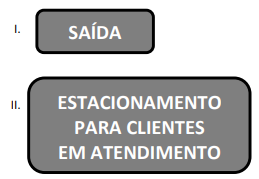

Imagem associada para resolução da questão


Escreva V ou F conforme seja verdadeiro ou falso o que se afirma a seguir sobre os exemplos apresentados.


( ) São, respectivamente, “palavra” e “frase”, logo não constituem textos, pois ninguém se comunica segundo esses modelos; nessas condições, pratica-se a não linguagem e exercita-se a não textualidade da língua.


( ) Cumprem uma função comunicativa claramente identificável e inserem-se num determinado contexto social, em consonância com o que prescreve cada espaço cultural, fazendo, assim, parte da memória cultural de cada grupo.


( ) São exemplos de frases soltas, sem interlocutores, sem qualquer dependência contextual explícita e sem um propósito comunicativo qualquer, pois não importa o que cada exemplo diz nem como é dito.


( ) São exemplos do tipo de palavras ou frases que devem ser ensinadas desde as primeiras experiências de escrita, uma vez que são formadas de uma ou poucas mensagens, mas com intenções comunicativas claras e facilmente identificadas.


Está correta, de cima para baixo, a seguinte sequência: 

Alternativas
Q3768223 Português
No tocante ao estudo do texto visando a uma educação linguística mais ampla, mais discursiva na educação básica, é correto esperar 
Alternativas
Q3768222 Português
Atente para os fragmentos a seguir:
I. “Meu poema é um tumulto:  a fala  que nele fala outras vozes arrasta em alarido.” (Ferreira Gullar)
II. “Um discurso não vem ao mundo numa inocente  solitude, mas constrói-se através de um já-dito  em relação ao qual toma posição.”  (Dominique Maingueneau)
III. “Chega mais perto e contempla as palavras.  Cada uma  tem mil faces secretas sob a face neutra  e te pergunta, sem interesse pela resposta,  pobre ou terrível, que lhe deres:  Trouxeste a chave?”  (Carlos Drummond de Andrade)
IV. “Cada enunciado é um elo da cadeia muito complexa de outros enunciados.” (Mikhail Bakhtin)


A pressuposição da existência do fenômeno da intertextualidade está corretamente ilustrada somente em
Alternativas
Q3768221 Português
Sobre os tópicos texto e intertextualidade, considere as seguintes afirmações:

I. A concepção dialógica de texto implica três universos constitutivamente articulados: o da materialidade, o da singularidade do texto e o da condição advinda dessa combinatória.

II. O fato de um texto só ter vida em contato com outro texto (contexto) significa dizer que a intertextualidade é a única característica implicada na concepção dialógica do texto.

III. Na perspectiva dialógica, o texto ganha existência e realiza-se, com pelo menos dois interlocutores, em conjunção com discursos situados histórica, cultural e socialmente.

IV. O texto, em uma concepção dialógica, pode ser compreendido como entidade autônoma, passível de ser lido e analisado exclusivamente por sua constituição material.

É correto o que se afirma em
Alternativas
Q3768220 Português
Atente para as seguintes afirmações:

I. A leitura nada mais é do que uma decodificação de sinais, com reprodução mecânica de informações ou com respostas convergentes a estímulos escritos pré-elaborados.
II. O ato de ler envolve apreensão, apropriação e transformação de significados a partir de um documento escrito.
III. A leitura sem compreensão e sem recriação do significado é pseudoleitura, é um empreendimento puramente superficial.
IV. A leitura facilita o surgimento da reflexão e da “tomada de posição”, ou seja, do confronto dos significados desvelados e da participação na busca da verdade.

Está correto o que se afirma somente em
Alternativas
Q3768219 Português
Considerando o papel do leitor competente, é correto se esperar, na prática de ensino, que este 
Alternativas
Q3768218 Português
Tomando como base a concepção de leitura presente nos atuais documentos oficiais, é correto afirmar que a leitura deve ser uma atividade
Alternativas
Q3768182 Inglês
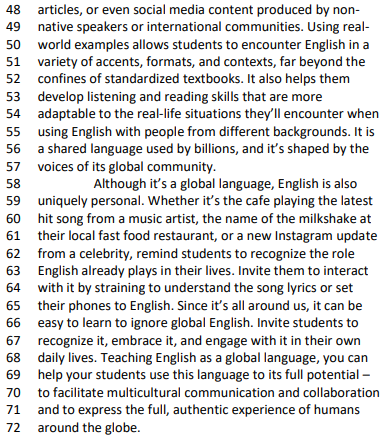
T E X T 1

Teaching English as a Global Language


Adapted from: https://bridge.edu/tefl/March 21, 2025


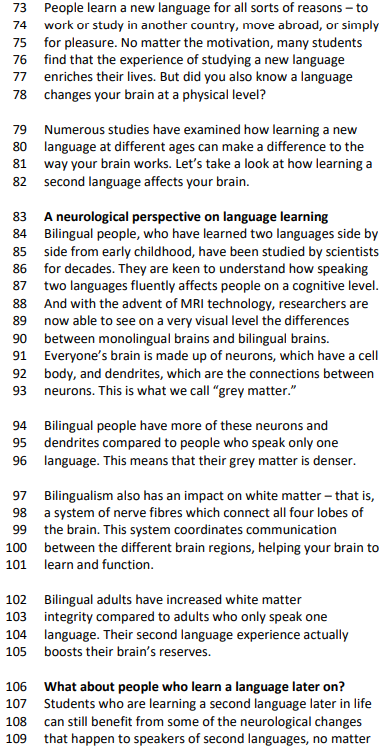
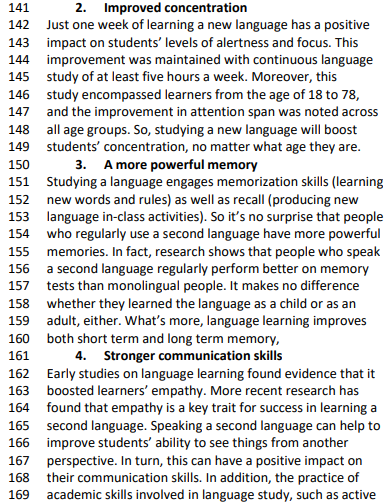
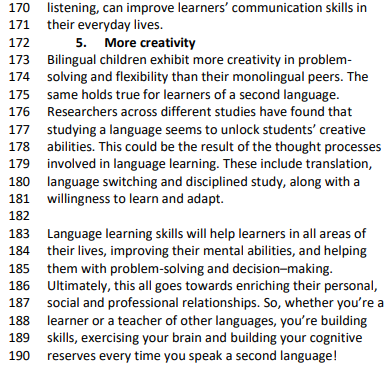
T E X T 2

How learning a new language changes your brain


Adapted from: https://www.cambridge.org/elt/blog/2022/04/29. 
Mark the alternative that correctly fills in the blanks of the quote below according to the following indication: simple past of the verb TO LOOK1 , the past perfect of the verb TO MEET2 , the past perfect of the verb TO APPRECIATE3 , and the past perfect of the verb TO GO4 .
“Now that I think of it, she _________ 1 splendid. I wish I _________ 2 her somewhere else. I wish I _________ 3 her as she deserved. I wish that everything _________ 4 differently.”
Alice Munro
Alternativas
Q3768181 Inglês
T E X T 1

Teaching English as a Global Language


Adapted from: https://bridge.edu/tefl/March 21, 2025


T E X T 2

How learning a new language changes your brain


Adapted from: https://www.cambridge.org/elt/blog/2022/04/29. 
In the sentences “All the world's a stage, and all the men and women merely players. They have their exits and their entrances; And one man in his time plays many parts.” (William Shakespeare), all the verbs are in the 
Alternativas
Q3768180 Inglês
T E X T 1

Teaching English as a Global Language


Adapted from: https://bridge.edu/tefl/March 21, 2025


T E X T 2

How learning a new language changes your brain


Adapted from: https://www.cambridge.org/elt/blog/2022/04/29. 
Mark the alternative that correctly fills in the blanks of the quote below according to the following indication: the present perfect of the verb TO BE1 , the comparative form of the adjective STRONG2 , the present perfect of the verb TO TEACH3 , and the comparative form of the adjective GOOD4 .
“Suffering _________ 1_________ 2 than all other teaching, and _________ 3 me to understand what your heart used to be. I have been bent and broken, but - I hope - into a _________ 4 shape.”
Charles Dickens
Alternativas
Q3768179 Inglês
T E X T 1

Teaching English as a Global Language


Adapted from: https://bridge.edu/tefl/March 21, 2025


T E X T 2

How learning a new language changes your brain


Adapted from: https://www.cambridge.org/elt/blog/2022/04/29. 
Mark the alternative that correctly fills in the blanks of the quote below according to the following indication: the simple past of the verb TO COME1 , the simple past of verb THERE TO BE2 , the superlative form of the adjective HAPPY3 , and the simple past of the verb TO KNOW4 .
“When spring _________ 1 , even the false spring, _________ 2 no problems except where to be _________ 3 .” “By then I _________ 4 that everything good and bad left an emptiness when it stopped.”
Ernest Hemingway
Alternativas
Q3768178 Inglês
T E X T 1

Teaching English as a Global Language


Adapted from: https://bridge.edu/tefl/March 21, 2025


T E X T 2

How learning a new language changes your brain


Adapted from: https://www.cambridge.org/elt/blog/2022/04/29. 
Mark the alternative that correctly fills in the blanks of the quotes below with the appropriate reflexive pronoun. “Could we change our attitude, we should not only see life differently, but life _________ 1would come to be different. Life would undergo a change of appearance because we _________ 2 had undergone a change of attitude.” Katherine Mansfield
“I saw _________ 3 driving through Eternity in a timeless taxi.” Katherine Mansfield
“The fool doth think he is wise, but the wise man knows _________ 4 to be a fool.” 

Alternativas
Q3768177 Inglês
T E X T 1

Teaching English as a Global Language


Adapted from: https://bridge.edu/tefl/March 21, 2025


T E X T 2

How learning a new language changes your brain


Adapted from: https://www.cambridge.org/elt/blog/2022/04/29. 
In the sentences “Language learning skills will help learners in all areas of their lives.” (lines 183-184) and “Ultimately, this all goes towards enriching their personal, social and professional relationships.” (lines 186-187), the tenses of the verbs in bold are respectively
Alternativas
Q3768176 Inglês
T E X T 1

Teaching English as a Global Language


Adapted from: https://bridge.edu/tefl/March 21, 2025


T E X T 2

How learning a new language changes your brain


Adapted from: https://www.cambridge.org/elt/blog/2022/04/29. 
The forms of the adjectives in bold used in the sentences “Language learning is arguably one of the most complex mental activities you can do.” (lines 123-124) and “Language learning is such an effective brain workout and protects older learners against dementia and other degenerative neurological conditions.” (lines 118-121) are respectively
Alternativas
Q3768175 Inglês
T E X T 1

Teaching English as a Global Language


Adapted from: https://bridge.edu/tefl/March 21, 2025


T E X T 2

How learning a new language changes your brain


Adapted from: https://www.cambridge.org/elt/blog/2022/04/29. 
The sentences “Through the study of a new language, students learn new words and grammatical constructs and build on their previous knowledge as part of the learning process.” (lines 115-117) and “When researchers analyzed 20 studies on language learning and its impact on academic performance, they observed a better performance of language learners across a range of academic subjects” (lines 133-136) are respectively
Alternativas
Q3768174 Inglês
T E X T 1

Teaching English as a Global Language


Adapted from: https://bridge.edu/tefl/March 21, 2025


T E X T 2

How learning a new language changes your brain


Adapted from: https://www.cambridge.org/elt/blog/2022/04/29. 
The pronouns in bold used in the sentences “Everyone’s brain is made up of neurons, which have a cell body, and dendrites, the connections between neurons.” (lines 91-93) and “Bilingual people have more of these neurons and dendrites compared to people who speak only one language.” (94-96) are respectively 
Alternativas
Q3768173 Inglês
T E X T 1

Teaching English as a Global Language


Adapted from: https://bridge.edu/tefl/March 21, 2025


T E X T 2

How learning a new language changes your brain


Adapted from: https://www.cambridge.org/elt/blog/2022/04/29. 
In the sentence “Bilingual people, who have learned two languages side by side from early childhood, have been studied by scientists for decades.” (lines 84-86) the verb tenses are, respectively,
Alternativas
Respostas
141: A
142: C
143: D
144: A
145: C
146: B
147: C
148: A
149: D
150: D
151: B
152: D
153: D
154: C
155: A
156: B
157: C
158: B
159: A
160: C