Foram encontradas 10.374 questões
Resolva questões gratuitamente!
Junte-se a mais de 4 milhões de concurseiros!


A vigilância sanitária de determinado estado possui um programa de monitoramento da qualidade dos alimentos comercializados nesse estado. Para esse monitoramento, coletam-se principalmente amostras mensais de alimentos comumente envolvidos em surtos e(ou) considerados de risco.
Resultados das análises, tendo como referência a RDC 12/2001 ANVISA.

A partir das informações apresentadas na tabela anterior, julgue o item que se segue.
A presença do S. aureus na torta de carne tornaria esse alimento um perigo potencial, embora essa bactéria esteja presente no trato
respiratório superior, especialmente nas narinas e em secreções purulentas no organismo humano. O perigo, nesse caso, relaciona-se
à produção de toxinas por esse microrganismo.
A vigilância sanitária de determinado estado possui um programa de monitoramento da qualidade dos alimentos comercializados nesse estado. Para esse monitoramento, coletam-se principalmente amostras mensais de alimentos comumente envolvidos em surtos e(ou) considerados de risco.
Resultados das análises, tendo como referência a RDC 12/2001 ANVISA.
A partir das informações apresentadas na tabela anterior, julgue o item que se segue.
A presença de Salmonella no sanduíche natural de frango poderia ocasionar uma toxi-infecção alimentar no consumidor, com um
período de incubação da bactéria por cerca de três a quatro horas.
A vigilância sanitária de determinado estado possui um programa de monitoramento da qualidade dos alimentos comercializados nesse estado. Para esse monitoramento, coletam-se principalmente amostras mensais de alimentos comumente envolvidos em surtos e(ou) considerados de risco.
Resultados das análises, tendo como referência a RDC 12/2001 ANVISA.
A partir das informações apresentadas na tabela anterior, julgue o item que se segue.
Considera-se perigo em potencial a presença, no quibe, de coliformes a 35 ºC acima do limite permitido pela legislação, o que é um
indicativo de condições higiênico-sanitárias insatisfatórias na sua produção.
A vigilância sanitária de determinado estado possui um programa de monitoramento da qualidade dos alimentos comercializados nesse estado. Para esse monitoramento, coletam-se principalmente amostras mensais de alimentos comumente envolvidos em surtos e(ou) considerados de risco.
Resultados das análises, tendo como referência a RDC 12/2001 ANVISA.
A partir das informações apresentadas na tabela anterior, julgue o item que se segue.
Considerando-se que os microrganismos apresentados na tabela são termófilos com temperatura ótima de multiplicação na faixa de
35 ºC, recomenda-se evitar o armazenamento dos alimentos nessa faixa de temperatura.
A vigilância sanitária de determinado estado possui um programa de monitoramento da qualidade dos alimentos comercializados nesse estado. Para esse monitoramento, coletam-se principalmente amostras mensais de alimentos comumente envolvidos em surtos e(ou) considerados de risco.
Resultados das análises, tendo como referência a RDC 12/2001 ANVISA.
A partir das informações apresentadas na tabela anterior, julgue o item que se segue.
A adoção de medidas de controle simples, como a prevenção da contaminação cruzada, o aquecimento do recheio de frango
a temperatura de 70 ºC, e a manutenção desse alimento, depois de pronto, a temperaturas inferiores a 5 ºC, poderiam ter evitado
a contaminação por Salmonella no sanduíche natural.
A vigilância sanitária de determinado estado possui um programa de monitoramento da qualidade dos alimentos comercializados nesse estado. Para esse monitoramento, coletam-se principalmente amostras mensais de alimentos comumente envolvidos em surtos e(ou) considerados de risco.
Resultados das análises, tendo como referência a RDC 12/2001 ANVISA.
A partir das informações apresentadas na tabela anterior, julgue o item que se segue.
As colunas A, B, e C na referida tabela apresentam exemplos de microrganismos indicadores.
Com relação à situação hipotética apresentada e aos múltiplos aspectos a ela relacionados, julgue o próximo item.
Para a definição do cardápio, é importante o planejamento
sistemático, que inclui o respeito às peculiaridades dos hábitos
alimentares, a oferta e a produção de gêneros alimentícios da
região e a estrutura da cozinha para a preparação dos
alimentos, mas não inclui as preparações especiais para alunos
com restrições alimentares.
Com relação à situação hipotética apresentada e aos múltiplos aspectos a ela relacionados, julgue o próximo item.
A existência de restos no plantão A está associada ao
planejamento inadequado do número de refeições, devendo
esses restos ser contabilizados como desperdício.
Com relação à situação hipotética apresentada e aos múltiplos aspectos a ela relacionados, julgue o próximo item.
Alimentação institucional consiste na produção de refeições em
grande escala para populações específicas, devendo seu
cardápio ser elaborado para atender às necessidades
nutricionais dessa população, respeitando-se os hábitos
regionais de alimentação.
Com relação à situação hipotética apresentada e aos múltiplos aspectos a ela relacionados, julgue o próximo item.
Para resolver o problema das frequentes alterações de cardápio
é suficiente estabelecer o estoque mínimo, também chamado de
estoque de segurança, considerando-se o cardápio previamente
elaborado, sendo irrelevante, para as compras, a ficha técnica
na unidade de alimentação e nutrição.
Com relação à situação hipotética apresentada e aos múltiplos aspectos a ela relacionados, julgue o próximo item.
A implementação da ficha técnica de preparo (FTP) e o
treinamento dos manipuladores para a elaboração dos pratos
está diretamente relacionada à solução dos problemas
observados nos plantões A e B.
Com relação à situação hipotética apresentada e aos múltiplos aspectos a ela relacionados, julgue o próximo item.
Os procedimentos para o controle de qualidade da alimentação
servida aos escolares incluem a aplicação de testes de
aceitabilidade, nas seguintes circunstâncias: sempre que
ocorrer a introdução de alimento atípico ao hábito alimentar
local no cardápio; sempre que houver alterações inovadoras no
que diz respeito ao preparo; e no caso de ser necessário avaliar,
frequentemente, a aceitação dos cardápios praticados.
fatores associados à hipovitaminose A em crianças menores que cinco anos de idade

A tabela precedente apresenta os resultados de um estudo
epidemiológico que teve como objetivo identificar os fatores
associados à hipovitaminose A, em amostras de crianças menores
de cinco anos de idade da região semiárida de Alagoas. Nesse
estudo, os autores relataram uma prevalência de hipovitaminose A
em 45,4% das crianças estudadas. A análise estatística empregada
permitiu o cálculo da razão de prevalência (RP) e o respectivo
intervalo de confiança em 95% (IC95%).
Considerando as informações apresentadas bem como os resultados do estudo em apreço, julgue o próximo item, com relação à vitamina A e sua deficiência.
Embora nesse estudo não tenha sido observada associação
significativa entre tempo de aleitamento materno e prevalência
de hipovitaminose A, sabe-se que o teor de vitamina A no leite
depende do status materno desse nutriente.
fatores associados à hipovitaminose A em crianças menores que cinco anos de idade
A tabela precedente apresenta os resultados de um estudo
epidemiológico que teve como objetivo identificar os fatores
associados à hipovitaminose A, em amostras de crianças menores
de cinco anos de idade da região semiárida de Alagoas. Nesse
estudo, os autores relataram uma prevalência de hipovitaminose A
em 45,4% das crianças estudadas. A análise estatística empregada
permitiu o cálculo da razão de prevalência (RP) e o respectivo
intervalo de confiança em 95% (IC95%).
Considerando as informações apresentadas bem como os resultados do estudo em apreço, julgue o próximo item, com relação à vitamina A e sua deficiência.
Os resultados apresentados na tabela não incluem níveis de
ingestão de vitamina A pré-formada, a qual, no que se refere
a suas fontes, é encontrada apenas em alimentos de origem
animal, seja em áreas de armazenamento tais como o fígado ou
na gordura de leite e ovos.
fatores associados à hipovitaminose A em crianças menores que cinco anos de idade
A tabela precedente apresenta os resultados de um estudo
epidemiológico que teve como objetivo identificar os fatores
associados à hipovitaminose A, em amostras de crianças menores
de cinco anos de idade da região semiárida de Alagoas. Nesse
estudo, os autores relataram uma prevalência de hipovitaminose A
em 45,4% das crianças estudadas. A análise estatística empregada
permitiu o cálculo da razão de prevalência (RP) e o respectivo
intervalo de confiança em 95% (IC95%).
Considerando as informações apresentadas bem como os resultados do estudo em apreço, julgue o próximo item, com relação à vitamina A e sua deficiência.
Em relação às categorias de referência do estudo, as chances
de uma criança apresentar baixo nível sérico de vitamina A
foram, respectivamente, 66% maiores quando a mãe tinha
baixa escolaridade, 41% quando a criança nasceu com baixo
peso e 45% em crianças com idade entre 12,1 meses
e 24 meses.
fatores associados à hipovitaminose A em crianças menores que cinco anos de idade
A tabela precedente apresenta os resultados de um estudo
epidemiológico que teve como objetivo identificar os fatores
associados à hipovitaminose A, em amostras de crianças menores
de cinco anos de idade da região semiárida de Alagoas. Nesse
estudo, os autores relataram uma prevalência de hipovitaminose A
em 45,4% das crianças estudadas. A análise estatística empregada
permitiu o cálculo da razão de prevalência (RP) e o respectivo
intervalo de confiança em 95% (IC95%).
Considerando as informações apresentadas bem como os resultados do estudo em apreço, julgue o próximo item, com relação à vitamina A e sua deficiência.
De acordo com os critérios da Organização Mundial de Saúde,
os resultados da prevalência de hipovitaminose A em Alagoas
são insuficientes para concluir que essa condição clínica
caracteriza um problema de saúde pública nessa região.
esquema alimentar para crianças amamentadas
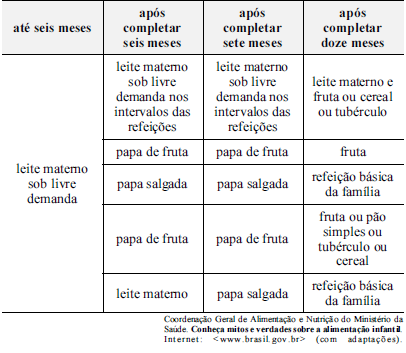
Com referência aos dados fornecidos no quadro precedente, julgue o item que se segue.
Em função do risco de contaminação do alimento por
Salmonella sp., que pode causar doenças de origem alimentar,
deve-se evitar ao máximo o consumo de aves na refeição
básica de uma família que tenha criança com doze meses de
vida
esquema alimentar para crianças amamentadas
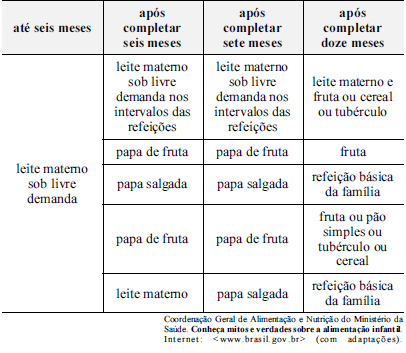
Com referência aos dados fornecidos no quadro precedente, julgue o item que se segue.
Após o sétimo mês de vida do bebê, deve-se evitar o consumo
de carne e priorizar no cardápio infantil as frutas e verduras,
consideradas fontes de vitaminas e minerais.
esquema alimentar para crianças amamentadas
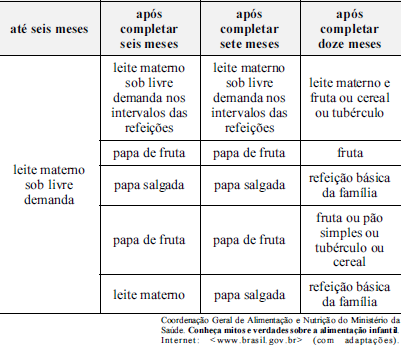
Com referência aos dados fornecidos no quadro precedente, julgue o item que se segue.
Após o sexto mês de vida, a criança, se estiver em aleitamento
materno, deve receber alimentos complementares três vezes ao
dia.
Um homem de sessenta e cinco anos de idade compareceu ao hospital apresentando o seguinte quadro clínico: inapetência, anuria, hiperpotassemia, desnutrição moderada e doença renal crônica. Diante desse quadro clínico, foi indicada hemodiálise ao paciente.
Nessa situação hipotética, o nutricionista deverá
orientar o paciente a consumir apenas hortaliças cozidas, pois
o processo no cozimento promove perda significativa de
potássio.

 Conheça nossos planos