Questões de Concurso
Para prefeitura de cuiabá - mt
Foram encontradas 5.493 questões
Resolva questões gratuitamente!
Junte-se a mais de 4 milhões de concurseiros!


Num condomínio empresarial, as águas pluviais, bem como a drenagem das vias, são conduzidas através de canaletas e dutos, após passarem por caixas de areia, até uma caixa subterrânea em concreto devidamente estanque, com dimensões de 10 m x 12 m x 6 m (altura), ou seja, 720 m3 de volume, para o armazenamento da água destinada a limpeza das vias, rega de plantas e outros fins que não necessitem de água potável.
No último verão, observou-se, durante uma chuva torrencial, que o nível da água no referido reservatório elevou-se em 10 cm durante o período de uma hora. Nesse caso, a vazão de enchimento foi de:
A tabela a seguir apresenta a capacidade de condução de corrente e a queda de tensão por unidade de corrente, para condutores com 100 m de comprimento.
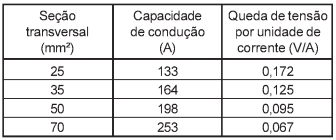
Um circuito bifásico, com tensão 220 V e corrente de
100 A é alimentado com um condutor por fase, com 100 m
de comprimento cada. Considerando-se uma queda de
tensão máxima de 11 V, o menor valor de área de seção
transversal admissível para condutores Fase adequados
a esse circuito é o seguinte:
A figura a seguir apresenta um esquema de comando elétrico, em fase de teste, que se destina à energização de uma carga trifásica.
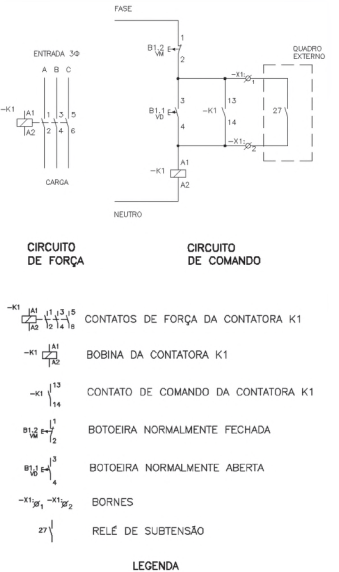
Caso seja detectada pelo relé 27 uma subtensão no
Quadro Externo, ocorrerá nesses circuitos:
A tabela a seguir relaciona a área de seção transversal interna com o diâmetro nominal de cada eletroduto.
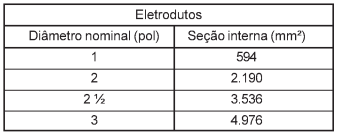
Um circuito elétrico é alimentado por três cabos que,
juntos, ocupam uma área de seção transversal 800 mm2
aproximadamente. Tendo em vista uma ocupação máxima
de 40%, o menor diâmetro nominal de eletroduto para
acomodar esses cabos é:
Na figura a seguir, as plantas 1 e 2 representam, respectivamente, duas versões da planta de instalações elétricas de um cômodo: uma sem a distribuição dos circuitos e outra com essa distribuição.
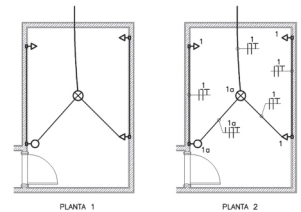
As duas versões foram desenhadas com o programa
Autocad, utilizando-se o teclado para digitar cada
comando. Digitando-se TE, C, L, CO ou M, obtém-se,
respectivamente, os comandos: text (texto), circle (círculo),
line (linha), copy (copiar) ou move (mover). Dada a Planta 1, é possível desenhar a Planta 2 sem utilizar o seguinte
comando:
A figura a seguir representa um diagrama unifilar de uma instalação elétrica que sofreu curto-circuito.
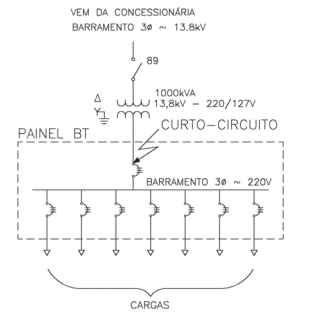
As impedâncias de sequência positiva e negativa
do transformador podem ser representadas,
respectivam ente, por Z1 e Z2. No momento do
curto-circuito, a rede a montante do transformador pode
ser representada por uma fonte de tensão Vrede em
série com uma impedância Zrede e os cabos entre o
transformador e o Painel BT possuem impedância Zcabo.
Considerando-se que o curto-circuito em referência é
trifásico e que as cargas alimentadas pelo Painel BT
são resistivas, o diagrama unifilar correspondente é
apresentado na alternativa:
TEXTO II
It has become more or less a cliché these days to refer to English as a world language. At the 1984 conference to celebrate the SOth anniversary of the British Council there was a debate between Sir Randolph Quirk and Professor Braj Kachru on the (literally) million dollar question of 'who owns English’, and hence whose English must be adopted as the model for teaching the language worldwide (Quirk and Widdowson 198S). Since then, much has been written on the role of English as a language of international communication, and the desirability or otherwise of adopting one of the Inner Circle varieties of English (to all intents and purposes, either British or American) as the canonical model for teaching it as a second or foreign language. The position vigorously defended by Quirk in that debate— succinctly captured in the phrase 'a single monochrome standard’ (Quirk 198S: 6)— no longer appeals to the majority of those who are involved in the ELT enterprise in one way or another. Instead, Kachru’s equally spirited insistence that 'the native speakers [of English] seem to have lost the exclusive prerogative to control its standardisation’ (Kachru 198S: 3O), and his plea for a paradigm shift in linguistic and pedagogical research so as to bring it more in tune with the changing landscape, have continued to strike a favourable chord with most ELT professionals. And the idea that English belongs to everyone who speaks it has been steadily gaining ground.
Though still resisted in some quarters, the very idea of World English (henceforward, W E) makes the whole question of the 'ownership’ of English problematic, not to say completely anachronistic. Widdowson expressed the idea in a very telling manner when he wrote 'It is a matter of considerable pride and satisfaction for native speakers of English that their language is an international means of communication. But the point is that it is only international to the extent that it is not their language.’ (italics mine) (Widdowson 1994: 38S).
(...)
Lest I should be misunderstood here, please note what it is that I am not claiming. I am not saying that there are no native speakers of English any more— if by native speakers we mean persons who were born and brought up in monolingual households with no contact with other languages. Indeed, that would be an absurd thing to say. As with every other language, there will— for the immediately foreseeable future at least— continue to be children born into monolingual English-speaking households who will, under the familiar criteria established for the purpose (Davies 1991), qualify as native speakers of English. But what we are interested in at the moment is W E, not the English language as it is spoken in Englishspeaking households, or the Houses of Parliament in Britain. W E is a language (for want of a better term, that is) spoken across the world— routinely at the check-in desks and in the corridors and departure lounges of some of the world’s busiest airports, typically during multinational business encounters, periodically during the Olympics or World Cup Football seasons, international trade fairs, academic conferences, and so on [...].
RAJAGOPALAN, K. The concept of ‘World English’ and its
implications for ELT. ELT Journal Volume S8I2 April 2004.
TEXTO II
It has become more or less a cliché these days to refer to English as a world language. At the 1984 conference to celebrate the SOth anniversary of the British Council there was a debate between Sir Randolph Quirk and Professor Braj Kachru on the (literally) million dollar question of 'who owns English’, and hence whose English must be adopted as the model for teaching the language worldwide (Quirk and Widdowson 198S). Since then, much has been written on the role of English as a language of international communication, and the desirability or otherwise of adopting one of the Inner Circle varieties of English (to all intents and purposes, either British or American) as the canonical model for teaching it as a second or foreign language. The position vigorously defended by Quirk in that debate— succinctly captured in the phrase 'a single monochrome standard’ (Quirk 198S: 6)— no longer appeals to the majority of those who are involved in the ELT enterprise in one way or another. Instead, Kachru’s equally spirited insistence that 'the native speakers [of English] seem to have lost the exclusive prerogative to control its standardisation’ (Kachru 198S: 3O), and his plea for a paradigm shift in linguistic and pedagogical research so as to bring it more in tune with the changing landscape, have continued to strike a favourable chord with most ELT professionals. And the idea that English belongs to everyone who speaks it has been steadily gaining ground.
Though still resisted in some quarters, the very idea of World English (henceforward, W E) makes the whole question of the 'ownership’ of English problematic, not to say completely anachronistic. Widdowson expressed the idea in a very telling manner when he wrote 'It is a matter of considerable pride and satisfaction for native speakers of English that their language is an international means of communication. But the point is that it is only international to the extent that it is not their language.’ (italics mine) (Widdowson 1994: 38S).
(...)
Lest I should be misunderstood here, please note what it is that I am not claiming. I am not saying that there are no native speakers of English any more— if by native speakers we mean persons who were born and brought up in monolingual households with no contact with other languages. Indeed, that would be an absurd thing to say. As with every other language, there will— for the immediately foreseeable future at least— continue to be children born into monolingual English-speaking households who will, under the familiar criteria established for the purpose (Davies 1991), qualify as native speakers of English. But what we are interested in at the moment is W E, not the English language as it is spoken in Englishspeaking households, or the Houses of Parliament in Britain. W E is a language (for want of a better term, that is) spoken across the world— routinely at the check-in desks and in the corridors and departure lounges of some of the world’s busiest airports, typically during multinational business encounters, periodically during the Olympics or World Cup Football seasons, international trade fairs, academic conferences, and so on [...].
RAJAGOPALAN, K. The concept of ‘World English’ and its
implications for ELT. ELT Journal Volume S8I2 April 2004.
TEXTO II
It has become more or less a cliché these days to refer to English as a world language. At the 1984 conference to celebrate the SOth anniversary of the British Council there was a debate between Sir Randolph Quirk and Professor Braj Kachru on the (literally) million dollar question of 'who owns English’, and hence whose English must be adopted as the model for teaching the language worldwide (Quirk and Widdowson 198S). Since then, much has been written on the role of English as a language of international communication, and the desirability or otherwise of adopting one of the Inner Circle varieties of English (to all intents and purposes, either British or American) as the canonical model for teaching it as a second or foreign language. The position vigorously defended by Quirk in that debate— succinctly captured in the phrase 'a single monochrome standard’ (Quirk 198S: 6)— no longer appeals to the majority of those who are involved in the ELT enterprise in one way or another. Instead, Kachru’s equally spirited insistence that 'the native speakers [of English] seem to have lost the exclusive prerogative to control its standardisation’ (Kachru 198S: 3O), and his plea for a paradigm shift in linguistic and pedagogical research so as to bring it more in tune with the changing landscape, have continued to strike a favourable chord with most ELT professionals. And the idea that English belongs to everyone who speaks it has been steadily gaining ground.
Though still resisted in some quarters, the very idea of World English (henceforward, W E) makes the whole question of the 'ownership’ of English problematic, not to say completely anachronistic. Widdowson expressed the idea in a very telling manner when he wrote 'It is a matter of considerable pride and satisfaction for native speakers of English that their language is an international means of communication. But the point is that it is only international to the extent that it is not their language.’ (italics mine) (Widdowson 1994: 38S).
(...)
Lest I should be misunderstood here, please note what it is that I am not claiming. I am not saying that there are no native speakers of English any more— if by native speakers we mean persons who were born and brought up in monolingual households with no contact with other languages. Indeed, that would be an absurd thing to say. As with every other language, there will— for the immediately foreseeable future at least— continue to be children born into monolingual English-speaking households who will, under the familiar criteria established for the purpose (Davies 1991), qualify as native speakers of English. But what we are interested in at the moment is W E, not the English language as it is spoken in Englishspeaking households, or the Houses of Parliament in Britain. W E is a language (for want of a better term, that is) spoken across the world— routinely at the check-in desks and in the corridors and departure lounges of some of the world’s busiest airports, typically during multinational business encounters, periodically during the Olympics or World Cup Football seasons, international trade fairs, academic conferences, and so on [...].
RAJAGOPALAN, K. The concept of ‘World English’ and its
implications for ELT. ELT Journal Volume S8I2 April 2004.
TEXTO II
It has become more or less a cliché these days to refer to English as a world language. At the 1984 conference to celebrate the SOth anniversary of the British Council there was a debate between Sir Randolph Quirk and Professor Braj Kachru on the (literally) million dollar question of 'who owns English’, and hence whose English must be adopted as the model for teaching the language worldwide (Quirk and Widdowson 198S). Since then, much has been written on the role of English as a language of international communication, and the desirability or otherwise of adopting one of the Inner Circle varieties of English (to all intents and purposes, either British or American) as the canonical model for teaching it as a second or foreign language. The position vigorously defended by Quirk in that debate— succinctly captured in the phrase 'a single monochrome standard’ (Quirk 198S: 6)— no longer appeals to the majority of those who are involved in the ELT enterprise in one way or another. Instead, Kachru’s equally spirited insistence that 'the native speakers [of English] seem to have lost the exclusive prerogative to control its standardisation’ (Kachru 198S: 3O), and his plea for a paradigm shift in linguistic and pedagogical research so as to bring it more in tune with the changing landscape, have continued to strike a favourable chord with most ELT professionals. And the idea that English belongs to everyone who speaks it has been steadily gaining ground.
Though still resisted in some quarters, the very idea of World English (henceforward, W E) makes the whole question of the 'ownership’ of English problematic, not to say completely anachronistic. Widdowson expressed the idea in a very telling manner when he wrote 'It is a matter of considerable pride and satisfaction for native speakers of English that their language is an international means of communication. But the point is that it is only international to the extent that it is not their language.’ (italics mine) (Widdowson 1994: 38S).
(...)
Lest I should be misunderstood here, please note what it is that I am not claiming. I am not saying that there are no native speakers of English any more— if by native speakers we mean persons who were born and brought up in monolingual households with no contact with other languages. Indeed, that would be an absurd thing to say. As with every other language, there will— for the immediately foreseeable future at least— continue to be children born into monolingual English-speaking households who will, under the familiar criteria established for the purpose (Davies 1991), qualify as native speakers of English. But what we are interested in at the moment is W E, not the English language as it is spoken in Englishspeaking households, or the Houses of Parliament in Britain. W E is a language (for want of a better term, that is) spoken across the world— routinely at the check-in desks and in the corridors and departure lounges of some of the world’s busiest airports, typically during multinational business encounters, periodically during the Olympics or World Cup Football seasons, international trade fairs, academic conferences, and so on [...].
RAJAGOPALAN, K. The concept of ‘World English’ and its
implications for ELT. ELT Journal Volume S8I2 April 2004.
TEXTO I
The English for Specific Purpose Myths in Brazil
The most prevailing myth associated to ESP in Brazil, and created because of the Brazilian ESP Project, is that “ESP is reading”. [...] Reading was the only skill that deserved special attention in the Project. Thus, on one hand, ESP is to be understood as synonymous with reading and, on the other hand, any reading course is to be understood as ESP. As a consequence of this current myth another one comes together: “ESP is monoskill” as any teaching action that is related to its design and implementation is devoted exclusively to one ability. However, the point to stress here is that this myth may be deconstructed easily when the reasons why the Brazilian Project concentrated on reading are made apparent: this was the paramount ability identified during the needs analysis conducted in the late I9 70 's as needed by most target groups. [...] These should be recognizable arguments for teaching reading comprehension and, thus, making of this course a truly ESP course. Unfortunately, there are still many professionals in Brazil who still think that if you need to teach any other skill or more than one skill you are not teaching ESP.
Another recurrent myth is: “ESP is technical English”. One of the reasons that may explain such a misconception may have stemmed from the I970's and early 1980's when many materials on the market focusing on the language of sciences, a well-established idea among ESP practitioners in many parts of the world, were produced. [...] In addition to that, many efforts were made to characterize the language of science, and for a long time, this was broken down into domains: the language of chemistry, the language of medicine, etc. [...] Turning back to the argument, such domain-specific breakdown materials may have contributed to an understanding that these specific Englishes were sufficiently different for a course to be based on them, with specific vocabulary being one of the chief features, and consequently creating such a misconception. Another explanation but this time rooted in “local” reasons may be found in the fact that subject matters of students' disciplines were (and still are in some places) brought to compose part of the syllabuses of many ESP courses. Third, the fact that the Technical Schools, now upgraded as Technological Centres for Higher Education (CEFETs), joined the Brazilian ESP Project in the mid-eighties may have strongly contributed to this association.
Other current myths aligned with ESP Reading Courses due to the adopted methodology and the specific contents that were developed during the implementation of the ESP Project in the country are: “the use of the dictionary is not allowed”, “grammar is not taught”, and “Portuguese has to be used in the classroom”. In order to better understand these misconceptions it is necessary to briefly explain the underlying principles adopted to teach reading. Some of the procedures put into work in the classroom were based on the belief that cognitive and linguistic difficulties should be eased and/or balanced during the learning process by making up the most of students' previous knowledge. So, the use of the dictionary during the initial classes was avoided to make students explore other areas of knowledge and resources rather than those, which were believed to be very familiar (the dictionary, translation of word by word, for example). The same applies to the teaching of grammar: strategies were emphasized over grammar at the beginning of the course and the teaching of grammar, in turn, concentrated on discourse grammar rather than traditional (structural) teaching of grammar. The same underlying principle was attributed to the use of Portuguese by teacher and students in the classroom, as well as in the written instructions of activities [...].
RAMOS, R. C.G ESP in Brazil: history, new trends and challenges. In: KRZANOWSKI, M. (Ed.). English for academic and specific purposes in developing, emerging and least developed countries. IATEFL, 2008. p. 68-83.
TEXTO I
The English for Specific Purpose Myths in Brazil
The most prevailing myth associated to ESP in Brazil, and created because of the Brazilian ESP Project, is that “ESP is reading”. [...] Reading was the only skill that deserved special attention in the Project. Thus, on one hand, ESP is to be understood as synonymous with reading and, on the other hand, any reading course is to be understood as ESP. As a consequence of this current myth another one comes together: “ESP is monoskill” as any teaching action that is related to its design and implementation is devoted exclusively to one ability. However, the point to stress here is that this myth may be deconstructed easily when the reasons why the Brazilian Project concentrated on reading are made apparent: this was the paramount ability identified during the needs analysis conducted in the late I9 70 's as needed by most target groups. [...] These should be recognizable arguments for teaching reading comprehension and, thus, making of this course a truly ESP course. Unfortunately, there are still many professionals in Brazil who still think that if you need to teach any other skill or more than one skill you are not teaching ESP.
Another recurrent myth is: “ESP is technical English”. One of the reasons that may explain such a misconception may have stemmed from the I970's and early 1980's when many materials on the market focusing on the language of sciences, a well-established idea among ESP practitioners in many parts of the world, were produced. [...] In addition to that, many efforts were made to characterize the language of science, and for a long time, this was broken down into domains: the language of chemistry, the language of medicine, etc. [...] Turning back to the argument, such domain-specific breakdown materials may have contributed to an understanding that these specific Englishes were sufficiently different for a course to be based on them, with specific vocabulary being one of the chief features, and consequently creating such a misconception. Another explanation but this time rooted in “local” reasons may be found in the fact that subject matters of students' disciplines were (and still are in some places) brought to compose part of the syllabuses of many ESP courses. Third, the fact that the Technical Schools, now upgraded as Technological Centres for Higher Education (CEFETs), joined the Brazilian ESP Project in the mid-eighties may have strongly contributed to this association.
Other current myths aligned with ESP Reading Courses due to the adopted methodology and the specific contents that were developed during the implementation of the ESP Project in the country are: “the use of the dictionary is not allowed”, “grammar is not taught”, and “Portuguese has to be used in the classroom”. In order to better understand these misconceptions it is necessary to briefly explain the underlying principles adopted to teach reading. Some of the procedures put into work in the classroom were based on the belief that cognitive and linguistic difficulties should be eased and/or balanced during the learning process by making up the most of students' previous knowledge. So, the use of the dictionary during the initial classes was avoided to make students explore other areas of knowledge and resources rather than those, which were believed to be very familiar (the dictionary, translation of word by word, for example). The same applies to the teaching of grammar: strategies were emphasized over grammar at the beginning of the course and the teaching of grammar, in turn, concentrated on discourse grammar rather than traditional (structural) teaching of grammar. The same underlying principle was attributed to the use of Portuguese by teacher and students in the classroom, as well as in the written instructions of activities [...].
RAMOS, R. C.G ESP in Brazil: history, new trends and challenges. In: KRZANOWSKI, M. (Ed.). English for academic and specific purposes in developing, emerging and least developed countries. IATEFL, 2008. p. 68-83.
TEXTO I
The English for Specific Purpose Myths in Brazil
The most prevailing myth associated to ESP in Brazil, and created because of the Brazilian ESP Project, is that “ESP is reading”. [...] Reading was the only skill that deserved special attention in the Project. Thus, on one hand, ESP is to be understood as synonymous with reading and, on the other hand, any reading course is to be understood as ESP. As a consequence of this current myth another one comes together: “ESP is monoskill” as any teaching action that is related to its design and implementation is devoted exclusively to one ability. However, the point to stress here is that this myth may be deconstructed easily when the reasons why the Brazilian Project concentrated on reading are made apparent: this was the paramount ability identified during the needs analysis conducted in the late I9 70 's as needed by most target groups. [...] These should be recognizable arguments for teaching reading comprehension and, thus, making of this course a truly ESP course. Unfortunately, there are still many professionals in Brazil who still think that if you need to teach any other skill or more than one skill you are not teaching ESP.
Another recurrent myth is: “ESP is technical English”. One of the reasons that may explain such a misconception may have stemmed from the I970's and early 1980's when many materials on the market focusing on the language of sciences, a well-established idea among ESP practitioners in many parts of the world, were produced. [...] In addition to that, many efforts were made to characterize the language of science, and for a long time, this was broken down into domains: the language of chemistry, the language of medicine, etc. [...] Turning back to the argument, such domain-specific breakdown materials may have contributed to an understanding that these specific Englishes were sufficiently different for a course to be based on them, with specific vocabulary being one of the chief features, and consequently creating such a misconception. Another explanation but this time rooted in “local” reasons may be found in the fact that subject matters of students' disciplines were (and still are in some places) brought to compose part of the syllabuses of many ESP courses. Third, the fact that the Technical Schools, now upgraded as Technological Centres for Higher Education (CEFETs), joined the Brazilian ESP Project in the mid-eighties may have strongly contributed to this association.
Other current myths aligned with ESP Reading Courses due to the adopted methodology and the specific contents that were developed during the implementation of the ESP Project in the country are: “the use of the dictionary is not allowed”, “grammar is not taught”, and “Portuguese has to be used in the classroom”. In order to better understand these misconceptions it is necessary to briefly explain the underlying principles adopted to teach reading. Some of the procedures put into work in the classroom were based on the belief that cognitive and linguistic difficulties should be eased and/or balanced during the learning process by making up the most of students' previous knowledge. So, the use of the dictionary during the initial classes was avoided to make students explore other areas of knowledge and resources rather than those, which were believed to be very familiar (the dictionary, translation of word by word, for example). The same applies to the teaching of grammar: strategies were emphasized over grammar at the beginning of the course and the teaching of grammar, in turn, concentrated on discourse grammar rather than traditional (structural) teaching of grammar. The same underlying principle was attributed to the use of Portuguese by teacher and students in the classroom, as well as in the written instructions of activities [...].
RAMOS, R. C.G ESP in Brazil: history, new trends and challenges. In: KRZANOWSKI, M. (Ed.). English for academic and specific purposes in developing, emerging and least developed countries. IATEFL, 2008. p. 68-83.
TEXTO I
The English for Specific Purpose Myths in Brazil
The most prevailing myth associated to ESP in Brazil, and created because of the Brazilian ESP Project, is that “ESP is reading”. [...] Reading was the only skill that deserved special attention in the Project. Thus, on one hand, ESP is to be understood as synonymous with reading and, on the other hand, any reading course is to be understood as ESP. As a consequence of this current myth another one comes together: “ESP is monoskill” as any teaching action that is related to its design and implementation is devoted exclusively to one ability. However, the point to stress here is that this myth may be deconstructed easily when the reasons why the Brazilian Project concentrated on reading are made apparent: this was the paramount ability identified during the needs analysis conducted in the late I9 70 's as needed by most target groups. [...] These should be recognizable arguments for teaching reading comprehension and, thus, making of this course a truly ESP course. Unfortunately, there are still many professionals in Brazil who still think that if you need to teach any other skill or more than one skill you are not teaching ESP.
Another recurrent myth is: “ESP is technical English”. One of the reasons that may explain such a misconception may have stemmed from the I970's and early 1980's when many materials on the market focusing on the language of sciences, a well-established idea among ESP practitioners in many parts of the world, were produced. [...] In addition to that, many efforts were made to characterize the language of science, and for a long time, this was broken down into domains: the language of chemistry, the language of medicine, etc. [...] Turning back to the argument, such domain-specific breakdown materials may have contributed to an understanding that these specific Englishes were sufficiently different for a course to be based on them, with specific vocabulary being one of the chief features, and consequently creating such a misconception. Another explanation but this time rooted in “local” reasons may be found in the fact that subject matters of students' disciplines were (and still are in some places) brought to compose part of the syllabuses of many ESP courses. Third, the fact that the Technical Schools, now upgraded as Technological Centres for Higher Education (CEFETs), joined the Brazilian ESP Project in the mid-eighties may have strongly contributed to this association.
Other current myths aligned with ESP Reading Courses due to the adopted methodology and the specific contents that were developed during the implementation of the ESP Project in the country are: “the use of the dictionary is not allowed”, “grammar is not taught”, and “Portuguese has to be used in the classroom”. In order to better understand these misconceptions it is necessary to briefly explain the underlying principles adopted to teach reading. Some of the procedures put into work in the classroom were based on the belief that cognitive and linguistic difficulties should be eased and/or balanced during the learning process by making up the most of students' previous knowledge. So, the use of the dictionary during the initial classes was avoided to make students explore other areas of knowledge and resources rather than those, which were believed to be very familiar (the dictionary, translation of word by word, for example). The same applies to the teaching of grammar: strategies were emphasized over grammar at the beginning of the course and the teaching of grammar, in turn, concentrated on discourse grammar rather than traditional (structural) teaching of grammar. The same underlying principle was attributed to the use of Portuguese by teacher and students in the classroom, as well as in the written instructions of activities [...].
RAMOS, R. C.G ESP in Brazil: history, new trends and challenges. In: KRZANOWSKI, M. (Ed.). English for academic and specific purposes in developing, emerging and least developed countries. IATEFL, 2008. p. 68-83.

 Conheça nossos planos