Questões de Concurso Público IF-SC 2026 para Professor EBTT - Inglês
Foram encontradas 23 questões


Ano: 2026
Banca:
FAURGS
Órgão:
IF-SC
Provas:
FAURGS - 2026 - IF-SC - Professor EBTT - Administração
|
FAURGS - 2026 - IF-SC - Professor EBTT - Artes Cênicas |
FAURGS - 2026 - IF-SC - Professor EBTT - Eletrônica Geral |
FAURGS - 2026 - IF-SC - Professor EBTT - Artes Visuais |
FAURGS - 2026 - IF-SC - Professor EBTT - Enologia |
FAURGS - 2026 - IF-SC - Professor EBTT - Automação Industrial |
FAURGS - 2026 - IF-SC - Professor EBTT - Física |
FAURGS - 2026 - IF-SC - Professor EBTT - Educação Física |
FAURGS - 2026 - IF-SC - Professor EBTT - Geotécnica |
FAURGS - 2026 - IF-SC - Professor EBTT - Geografia |
FAURGS - 2026 - IF-SC - Professor EBTT - História |
FAURGS - 2026 - IF-SC - Professor EBTT - Espanhol |
FAURGS - 2026 - IF-SC - Professor EBTT - Fabricação Mecânica |
FAURGS - 2026 - IF-SC - Professor EBTT - Informática |
FAURGS - 2026 - IF-SC - Professor EBTT - Projetos Mecânicos |
FAURGS - 2026 - IF-SC - Professor EBTT - Inglês |
FAURGS - 2026 - IF-SC - Professor EBTT - Instalações e Acionamentos |
FAURGS - 2026 - IF-SC - Professor EBTT - Química Geral |
FAURGS - 2026 - IF-SC - Professor EBTT - Matemática |
FAURGS - 2026 - IF-SC - Professor EBTT - Segurança e Higiene do Trabalho |
FAURGS - 2026 - IF-SC - Professor EBTT - Sistema de Energia |
FAURGS - 2026 - IF-SC - Professor EBTT - Processos Têxteis |
FAURGS - 2026 - IF-SC - Professor EBTT - Produção Animal |
FAURGS - 2026 - IF-SC - Professor EBTT - Sociologia |
Q4341890
Pedagogia
Nos termos do art. 6º da Lei nº 11.892/2008, além de
ofertar educação profissional e tecnológica em todos os
seus níveis e modalidades, formando e qualificando
cidadãos com vistas à atuação profissional nos diversos
setores da economia, com ênfase no desenvolvimento
socioeconômico local, regional e nacional, constitui
também finalidade dos Institutos Federais
Ano: 2026
Banca:
FAURGS
Órgão:
IF-SC
Provas:
FAURGS - 2026 - IF-SC - Professor EBTT - Administração
|
FAURGS - 2026 - IF-SC - Professor EBTT - Artes Cênicas |
FAURGS - 2026 - IF-SC - Professor EBTT - Eletrônica Geral |
FAURGS - 2026 - IF-SC - Professor EBTT - Artes Visuais |
FAURGS - 2026 - IF-SC - Professor EBTT - Enologia |
FAURGS - 2026 - IF-SC - Professor EBTT - Automação Industrial |
FAURGS - 2026 - IF-SC - Professor EBTT - Física |
FAURGS - 2026 - IF-SC - Professor EBTT - Educação Física |
FAURGS - 2026 - IF-SC - Professor EBTT - Geotécnica |
FAURGS - 2026 - IF-SC - Professor EBTT - Geografia |
FAURGS - 2026 - IF-SC - Professor EBTT - História |
FAURGS - 2026 - IF-SC - Professor EBTT - Espanhol |
FAURGS - 2026 - IF-SC - Professor EBTT - Fabricação Mecânica |
FAURGS - 2026 - IF-SC - Professor EBTT - Informática |
FAURGS - 2026 - IF-SC - Professor EBTT - Projetos Mecânicos |
FAURGS - 2026 - IF-SC - Professor EBTT - Inglês |
FAURGS - 2026 - IF-SC - Professor EBTT - Instalações e Acionamentos |
FAURGS - 2026 - IF-SC - Professor EBTT - Química Geral |
FAURGS - 2026 - IF-SC - Professor EBTT - Matemática |
FAURGS - 2026 - IF-SC - Professor EBTT - Segurança e Higiene do Trabalho |
FAURGS - 2026 - IF-SC - Professor EBTT - Sistema de Energia |
FAURGS - 2026 - IF-SC - Professor EBTT - Processos Têxteis |
FAURGS - 2026 - IF-SC - Professor EBTT - Produção Animal |
FAURGS - 2026 - IF-SC - Professor EBTT - Sociologia |
Q4341893
Pedagogia
No curso Superior de Tecnologia em Fabricação Mecânica
do IFSC – Câmpus Jaraguá do Sul-Rau, ofertado no
período noturno a um público majoritariamente já
inserido na indústria da região, um professor planeja
suas aulas a partir do perfil profissional de conclusão
do curso e dos conhecimentos que os estudantes
trazem de sua experiência profissional. Ele articula
teoria e prática em bancadas de trabalho colaborativo
e ajusta o planejamento ao longo do semestre
conforme as demandas trazidas pela turma.
Considerando os fundamentos da didática, da formação docente e do planejamento pedagógico, é INCORRETO afirmar que essa prática
Considerando os fundamentos da didática, da formação docente e do planejamento pedagógico, é INCORRETO afirmar que essa prática
Ano: 2026
Banca:
FAURGS
Órgão:
IF-SC
Provas:
FAURGS - 2026 - IF-SC - Professor EBTT - Administração
|
FAURGS - 2026 - IF-SC - Professor EBTT - Artes Cênicas |
FAURGS - 2026 - IF-SC - Professor EBTT - Eletrônica Geral |
FAURGS - 2026 - IF-SC - Professor EBTT - Artes Visuais |
FAURGS - 2026 - IF-SC - Professor EBTT - Enologia |
FAURGS - 2026 - IF-SC - Professor EBTT - Automação Industrial |
FAURGS - 2026 - IF-SC - Professor EBTT - Física |
FAURGS - 2026 - IF-SC - Professor EBTT - Educação Física |
FAURGS - 2026 - IF-SC - Professor EBTT - Geotécnica |
FAURGS - 2026 - IF-SC - Professor EBTT - Geografia |
FAURGS - 2026 - IF-SC - Professor EBTT - História |
FAURGS - 2026 - IF-SC - Professor EBTT - Espanhol |
FAURGS - 2026 - IF-SC - Professor EBTT - Fabricação Mecânica |
FAURGS - 2026 - IF-SC - Professor EBTT - Informática |
FAURGS - 2026 - IF-SC - Professor EBTT - Projetos Mecânicos |
FAURGS - 2026 - IF-SC - Professor EBTT - Inglês |
FAURGS - 2026 - IF-SC - Professor EBTT - Instalações e Acionamentos |
FAURGS - 2026 - IF-SC - Professor EBTT - Química Geral |
FAURGS - 2026 - IF-SC - Professor EBTT - Matemática |
FAURGS - 2026 - IF-SC - Professor EBTT - Segurança e Higiene do Trabalho |
FAURGS - 2026 - IF-SC - Professor EBTT - Sistema de Energia |
FAURGS - 2026 - IF-SC - Professor EBTT - Processos Têxteis |
FAURGS - 2026 - IF-SC - Professor EBTT - Produção Animal |
FAURGS - 2026 - IF-SC - Professor EBTT - Sociologia |
Q4341894
Pedagogia
Sobre a relação entre avaliação da aprendizagem e
gestão da aprendizagem em sala de aula, assinale a
alternativa correta.
Ano: 2026
Banca:
FAURGS
Órgão:
IF-SC
Provas:
FAURGS - 2026 - IF-SC - Professor EBTT - Administração
|
FAURGS - 2026 - IF-SC - Professor EBTT - Artes Cênicas |
FAURGS - 2026 - IF-SC - Professor EBTT - Eletrônica Geral |
FAURGS - 2026 - IF-SC - Professor EBTT - Artes Visuais |
FAURGS - 2026 - IF-SC - Professor EBTT - Enologia |
FAURGS - 2026 - IF-SC - Professor EBTT - Automação Industrial |
FAURGS - 2026 - IF-SC - Professor EBTT - Física |
FAURGS - 2026 - IF-SC - Professor EBTT - Educação Física |
FAURGS - 2026 - IF-SC - Professor EBTT - Geotécnica |
FAURGS - 2026 - IF-SC - Professor EBTT - Geografia |
FAURGS - 2026 - IF-SC - Professor EBTT - História |
FAURGS - 2026 - IF-SC - Professor EBTT - Espanhol |
FAURGS - 2026 - IF-SC - Professor EBTT - Fabricação Mecânica |
FAURGS - 2026 - IF-SC - Professor EBTT - Informática |
FAURGS - 2026 - IF-SC - Professor EBTT - Projetos Mecânicos |
FAURGS - 2026 - IF-SC - Professor EBTT - Inglês |
FAURGS - 2026 - IF-SC - Professor EBTT - Instalações e Acionamentos |
FAURGS - 2026 - IF-SC - Professor EBTT - Química Geral |
FAURGS - 2026 - IF-SC - Professor EBTT - Matemática |
FAURGS - 2026 - IF-SC - Professor EBTT - Segurança e Higiene do Trabalho |
FAURGS - 2026 - IF-SC - Professor EBTT - Sistema de Energia |
FAURGS - 2026 - IF-SC - Professor EBTT - Processos Têxteis |
FAURGS - 2026 - IF-SC - Professor EBTT - Produção Animal |
FAURGS - 2026 - IF-SC - Professor EBTT - Sociologia |
Q4341895
Pedagogia
Sobre a articulação entre ensino, pesquisa e extensão
na Educação Profissional, Técnica e Tecnológica (EPT),
à luz da compreensão histórica e sociológica da educação
como fenômeno social, assinale a alternativa correta.
Ano: 2026
Banca:
FAURGS
Órgão:
IF-SC
Provas:
FAURGS - 2026 - IF-SC - Professor EBTT - Administração
|
FAURGS - 2026 - IF-SC - Professor EBTT - Artes Cênicas |
FAURGS - 2026 - IF-SC - Professor EBTT - Eletrônica Geral |
FAURGS - 2026 - IF-SC - Professor EBTT - Artes Visuais |
FAURGS - 2026 - IF-SC - Professor EBTT - Enologia |
FAURGS - 2026 - IF-SC - Professor EBTT - Automação Industrial |
FAURGS - 2026 - IF-SC - Professor EBTT - Física |
FAURGS - 2026 - IF-SC - Professor EBTT - Educação Física |
FAURGS - 2026 - IF-SC - Professor EBTT - Geotécnica |
FAURGS - 2026 - IF-SC - Professor EBTT - Geografia |
FAURGS - 2026 - IF-SC - Professor EBTT - História |
FAURGS - 2026 - IF-SC - Professor EBTT - Espanhol |
FAURGS - 2026 - IF-SC - Professor EBTT - Fabricação Mecânica |
FAURGS - 2026 - IF-SC - Professor EBTT - Informática |
FAURGS - 2026 - IF-SC - Professor EBTT - Projetos Mecânicos |
FAURGS - 2026 - IF-SC - Professor EBTT - Inglês |
FAURGS - 2026 - IF-SC - Professor EBTT - Instalações e Acionamentos |
FAURGS - 2026 - IF-SC - Professor EBTT - Química Geral |
FAURGS - 2026 - IF-SC - Professor EBTT - Matemática |
FAURGS - 2026 - IF-SC - Professor EBTT - Segurança e Higiene do Trabalho |
FAURGS - 2026 - IF-SC - Professor EBTT - Sistema de Energia |
FAURGS - 2026 - IF-SC - Professor EBTT - Processos Têxteis |
FAURGS - 2026 - IF-SC - Professor EBTT - Produção Animal |
FAURGS - 2026 - IF-SC - Professor EBTT - Sociologia |
Q4341896
Pedagogia
No âmbito da Educação Profissional, Científica e
Tecnológica (EPT), a efetivação da Educação para as
Relações Étnico-Raciais (ERER) sob uma abordagem
decolonial exige superar a mera democratização do
acesso. Para que a inclusão seja plena, o currículo e as
práticas pedagógicas devem
Ano: 2026
Banca:
FAURGS
Órgão:
IF-SC
Provas:
FAURGS - 2026 - IF-SC - Professor EBTT - Administração
|
FAURGS - 2026 - IF-SC - Professor EBTT - Artes Cênicas |
FAURGS - 2026 - IF-SC - Professor EBTT - Eletrônica Geral |
FAURGS - 2026 - IF-SC - Professor EBTT - Artes Visuais |
FAURGS - 2026 - IF-SC - Professor EBTT - Enologia |
FAURGS - 2026 - IF-SC - Professor EBTT - Automação Industrial |
FAURGS - 2026 - IF-SC - Professor EBTT - Física |
FAURGS - 2026 - IF-SC - Professor EBTT - Educação Física |
FAURGS - 2026 - IF-SC - Professor EBTT - Geotécnica |
FAURGS - 2026 - IF-SC - Professor EBTT - Geografia |
FAURGS - 2026 - IF-SC - Professor EBTT - História |
FAURGS - 2026 - IF-SC - Professor EBTT - Espanhol |
FAURGS - 2026 - IF-SC - Professor EBTT - Fabricação Mecânica |
FAURGS - 2026 - IF-SC - Professor EBTT - Informática |
FAURGS - 2026 - IF-SC - Professor EBTT - Projetos Mecânicos |
FAURGS - 2026 - IF-SC - Professor EBTT - Inglês |
FAURGS - 2026 - IF-SC - Professor EBTT - Instalações e Acionamentos |
FAURGS - 2026 - IF-SC - Professor EBTT - Química Geral |
FAURGS - 2026 - IF-SC - Professor EBTT - Matemática |
FAURGS - 2026 - IF-SC - Professor EBTT - Segurança e Higiene do Trabalho |
FAURGS - 2026 - IF-SC - Professor EBTT - Sistema de Energia |
FAURGS - 2026 - IF-SC - Professor EBTT - Processos Têxteis |
FAURGS - 2026 - IF-SC - Professor EBTT - Produção Animal |
FAURGS - 2026 - IF-SC - Professor EBTT - Sociologia |
Q4341897
Pedagogia
Sobre a relação entre currículo prescrito e currículo
praticado, e sobre a adaptação curricular à realidade
local na perspectiva freiriana, assinale a alternativa
correta.
Ano: 2026
Banca:
FAURGS
Órgão:
IF-SC
Provas:
FAURGS - 2026 - IF-SC - Professor EBTT - Administração
|
FAURGS - 2026 - IF-SC - Professor EBTT - Artes Cênicas |
FAURGS - 2026 - IF-SC - Professor EBTT - Eletrônica Geral |
FAURGS - 2026 - IF-SC - Professor EBTT - Artes Visuais |
FAURGS - 2026 - IF-SC - Professor EBTT - Enologia |
FAURGS - 2026 - IF-SC - Professor EBTT - Automação Industrial |
FAURGS - 2026 - IF-SC - Professor EBTT - Física |
FAURGS - 2026 - IF-SC - Professor EBTT - Educação Física |
FAURGS - 2026 - IF-SC - Professor EBTT - Geotécnica |
FAURGS - 2026 - IF-SC - Professor EBTT - Geografia |
FAURGS - 2026 - IF-SC - Professor EBTT - História |
FAURGS - 2026 - IF-SC - Professor EBTT - Espanhol |
FAURGS - 2026 - IF-SC - Professor EBTT - Fabricação Mecânica |
FAURGS - 2026 - IF-SC - Professor EBTT - Informática |
FAURGS - 2026 - IF-SC - Professor EBTT - Projetos Mecânicos |
FAURGS - 2026 - IF-SC - Professor EBTT - Inglês |
FAURGS - 2026 - IF-SC - Professor EBTT - Instalações e Acionamentos |
FAURGS - 2026 - IF-SC - Professor EBTT - Química Geral |
FAURGS - 2026 - IF-SC - Professor EBTT - Matemática |
FAURGS - 2026 - IF-SC - Professor EBTT - Segurança e Higiene do Trabalho |
FAURGS - 2026 - IF-SC - Professor EBTT - Sistema de Energia |
FAURGS - 2026 - IF-SC - Professor EBTT - Processos Têxteis |
FAURGS - 2026 - IF-SC - Professor EBTT - Produção Animal |
FAURGS - 2026 - IF-SC - Professor EBTT - Sociologia |
Q4341898
Pedagogia
O gráfico abaixo, elaborado com base em dados da Plataforma Nilo Peçanha (PNP), publicados em 2026, com ano-base
2025, apresenta a taxa de evasão anual por tipo de curso na Rede Federal de Educação Profissional, Científica e
Tecnológica.
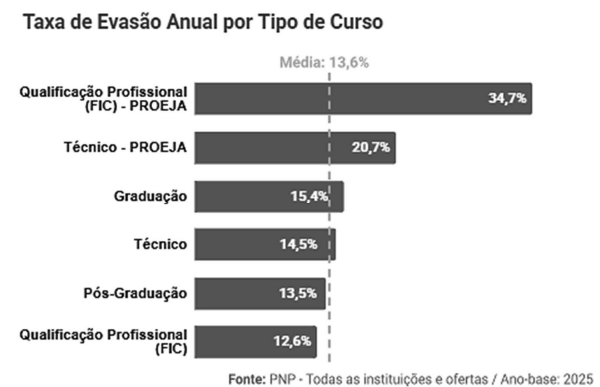
Considerando os dados apresentados e os fundamentos normativos e pedagógicos relacionados à democratização do acesso, à garantia de permanência e êxito escolar e à Educação de Jovens e Adultos (EJA), analise as afirmativas a seguir.
I - O público da EJA é formado, em geral, por pessoas que não puderam concluir os estudos na idade esperada e que hoje conciliam a retomada da vida escolar com o trabalho. Esse perfil ajuda a entender por que o TécnicoPROEJA registrou, em 2025, uma taxa de evasão aproximadamente 40% maior do que a do Técnico regular.
II - Com base nos dados da Rede Federal do ano-base 2025, observa-se que a taxa de evasão do Técnico-PROEJA e a da Qualificação Profissional (FIC) vinculada ao PROEJA mostram que a maior carga horária dos cursos técnicos amplia a evasão.
III - O cumprimento do percentual mínimo de dez por cento de vagas destinado ao PROEJA é suficiente para garantir a formação dos estudantes da EJA na Rede Federal, uma vez que assegura seu ingresso nos cursos técnicos integrados a essa modalidade.
IV - A permanência e o êxito do estudante do PROEJA dependem de ações institucionais como assistência estudantil, organização curricular, horários compatíveis com a rotina de quem trabalha e acolhimento pedagógico ao longo do curso.
V - Mesmo diante de grandes desafios, as ofertas do PROEJA são estratégicas para a melhoria social, e cabe à instituição atuar nesse sentido por meio de busca ativa e de ações de apoio à conclusão dos estudos e à qualificação profissional desses estudantes.
Quais estão corretas?
Ano: 2026
Banca:
FAURGS
Órgão:
IF-SC
Provas:
FAURGS - 2026 - IF-SC - Professor EBTT - Administração
|
FAURGS - 2026 - IF-SC - Professor EBTT - Artes Cênicas |
FAURGS - 2026 - IF-SC - Professor EBTT - Eletrônica Geral |
FAURGS - 2026 - IF-SC - Professor EBTT - Artes Visuais |
FAURGS - 2026 - IF-SC - Professor EBTT - Enologia |
FAURGS - 2026 - IF-SC - Professor EBTT - Automação Industrial |
FAURGS - 2026 - IF-SC - Professor EBTT - Física |
FAURGS - 2026 - IF-SC - Professor EBTT - Educação Física |
FAURGS - 2026 - IF-SC - Professor EBTT - Geotécnica |
FAURGS - 2026 - IF-SC - Professor EBTT - Geografia |
FAURGS - 2026 - IF-SC - Professor EBTT - História |
FAURGS - 2026 - IF-SC - Professor EBTT - Espanhol |
FAURGS - 2026 - IF-SC - Professor EBTT - Fabricação Mecânica |
FAURGS - 2026 - IF-SC - Professor EBTT - Informática |
FAURGS - 2026 - IF-SC - Professor EBTT - Projetos Mecânicos |
FAURGS - 2026 - IF-SC - Professor EBTT - Inglês |
FAURGS - 2026 - IF-SC - Professor EBTT - Instalações e Acionamentos |
FAURGS - 2026 - IF-SC - Professor EBTT - Química Geral |
FAURGS - 2026 - IF-SC - Professor EBTT - Matemática |
FAURGS - 2026 - IF-SC - Professor EBTT - Segurança e Higiene do Trabalho |
FAURGS - 2026 - IF-SC - Professor EBTT - Sistema de Energia |
FAURGS - 2026 - IF-SC - Professor EBTT - Processos Têxteis |
FAURGS - 2026 - IF-SC - Professor EBTT - Produção Animal |
FAURGS - 2026 - IF-SC - Professor EBTT - Sociologia |
Q4341899
Pedagogia
Em um curso superior de Tecnologia do IFSC, durante
uma aula prática de Microbiologia, os estudantes
cultivaram microrganismos em meios de cultura. Ao
final da atividade, todo o material biológico contaminado
(placas de Petri, meios de cultura e utensílios) precisou
ser autoclavado antes do descarte ou higienização,
para eliminar o risco biológico e evitar a contaminação
ambiental e sanitária. A professora se propôs a aproveitar
esse momento para trabalhar, com a turma, os temas
transversais ambiental e de saúde relacionados ao
descarte de resíduos biológicos, à luz das relações
entre Ciência, Tecnologia e Sociedade (CTS) e da
interdisciplinaridade. Assinale a alternativa que NÃO
representa uma forma adequada de a professora conduzir
essa discussão.
Ano: 2026
Banca:
FAURGS
Órgão:
IF-SC
Provas:
FAURGS - 2026 - IF-SC - Professor EBTT - Administração
|
FAURGS - 2026 - IF-SC - Professor EBTT - Artes Cênicas |
FAURGS - 2026 - IF-SC - Professor EBTT - Eletrônica Geral |
FAURGS - 2026 - IF-SC - Professor EBTT - Artes Visuais |
FAURGS - 2026 - IF-SC - Professor EBTT - Enologia |
FAURGS - 2026 - IF-SC - Professor EBTT - Automação Industrial |
FAURGS - 2026 - IF-SC - Professor EBTT - Física |
FAURGS - 2026 - IF-SC - Professor EBTT - Educação Física |
FAURGS - 2026 - IF-SC - Professor EBTT - Geotécnica |
FAURGS - 2026 - IF-SC - Professor EBTT - Geografia |
FAURGS - 2026 - IF-SC - Professor EBTT - História |
FAURGS - 2026 - IF-SC - Professor EBTT - Espanhol |
FAURGS - 2026 - IF-SC - Professor EBTT - Fabricação Mecânica |
FAURGS - 2026 - IF-SC - Professor EBTT - Informática |
FAURGS - 2026 - IF-SC - Professor EBTT - Projetos Mecânicos |
FAURGS - 2026 - IF-SC - Professor EBTT - Inglês |
FAURGS - 2026 - IF-SC - Professor EBTT - Instalações e Acionamentos |
FAURGS - 2026 - IF-SC - Professor EBTT - Química Geral |
FAURGS - 2026 - IF-SC - Professor EBTT - Matemática |
FAURGS - 2026 - IF-SC - Professor EBTT - Segurança e Higiene do Trabalho |
FAURGS - 2026 - IF-SC - Professor EBTT - Sistema de Energia |
FAURGS - 2026 - IF-SC - Professor EBTT - Processos Têxteis |
FAURGS - 2026 - IF-SC - Professor EBTT - Produção Animal |
FAURGS - 2026 - IF-SC - Professor EBTT - Sociologia |
Q4341900
Pedagogia
A articulação entre a Lei de Diretrizes e Bases da
Educação Nacional (LDB – Lei nº 9.394/1996) e o Plano
Nacional de Educação (PNE 2026-2036) estabelece os
parâmetros normativos e as metas estratégicas para o
desenvolvimento da Educação Profissional e Tecnológica
(EPT) no país. Considerando essa articulação, analise
as afirmativas a seguir.
I - A LDB organiza a EPT em cursos de qualificação profissional, técnicos de nível médio e tecnológicos de nível superior; o PNE (2026-2036), de forma complementar, estabelece a meta de expandir as matrículas de educação profissional técnica de nível médio, integrada ou concomitante, até atingir metade dos estudantes matriculados no Ensino Médio, assegurando que, no mínimo, metade dessa expansão ocorra no segmento público.
II - De acordo com as diretrizes de flexibilização da LDB, o PNE (2026-2036) desvincula a oferta de formação técnica do Ensino Médio regular, determinando que as metas de expansão da EPT sejam atingidas exclusivamente por meio de cursos subsequentes (pós-médio) e de programas de educação a distância (EAD).
III - A LDB prevê a possibilidade de aproveitamento de estudos e de conhecimentos adquiridos no trabalho para a organização dos cursos de EPT; em consonância, o PNE (2026-2036) estabelece meta de expansão da Educação de Jovens e Adultos articulada à educação profissional.
IV - A LDB permite a oferta de cursos subsequentes de EPT a quem já concluiu o Ensino Médio; o PNE (2026-2036) estabelece meta de expandir essas matrículas, assegurando a qualidade da oferta e a permanência dos estudantes.
Quais estão corretas?
Ano: 2026
Banca:
FAURGS
Órgão:
IF-SC
Provas:
FAURGS - 2026 - IF-SC - Professor EBTT - Administração
|
FAURGS - 2026 - IF-SC - Professor EBTT - Artes Cênicas |
FAURGS - 2026 - IF-SC - Professor EBTT - Eletrônica Geral |
FAURGS - 2026 - IF-SC - Professor EBTT - Artes Visuais |
FAURGS - 2026 - IF-SC - Professor EBTT - Enologia |
FAURGS - 2026 - IF-SC - Professor EBTT - Automação Industrial |
FAURGS - 2026 - IF-SC - Professor EBTT - Física |
FAURGS - 2026 - IF-SC - Professor EBTT - Educação Física |
FAURGS - 2026 - IF-SC - Professor EBTT - Geotécnica |
FAURGS - 2026 - IF-SC - Professor EBTT - Geografia |
FAURGS - 2026 - IF-SC - Professor EBTT - História |
FAURGS - 2026 - IF-SC - Professor EBTT - Espanhol |
FAURGS - 2026 - IF-SC - Professor EBTT - Fabricação Mecânica |
FAURGS - 2026 - IF-SC - Professor EBTT - Informática |
FAURGS - 2026 - IF-SC - Professor EBTT - Projetos Mecânicos |
FAURGS - 2026 - IF-SC - Professor EBTT - Inglês |
FAURGS - 2026 - IF-SC - Professor EBTT - Instalações e Acionamentos |
FAURGS - 2026 - IF-SC - Professor EBTT - Química Geral |
FAURGS - 2026 - IF-SC - Professor EBTT - Matemática |
FAURGS - 2026 - IF-SC - Professor EBTT - Segurança e Higiene do Trabalho |
FAURGS - 2026 - IF-SC - Professor EBTT - Sistema de Energia |
FAURGS - 2026 - IF-SC - Professor EBTT - Processos Têxteis |
FAURGS - 2026 - IF-SC - Professor EBTT - Produção Animal |
FAURGS - 2026 - IF-SC - Professor EBTT - Sociologia |
Q4341901
Pedagogia
Ao reformular a proposta pedagógica de um curso
técnico integrado ao Ensino Médio, a equipe de um
câmpus do IFSC revisou a articulação entre a Base
Nacional Comum Curricular (BNCC) e as Diretrizes
Curriculares Nacionais para o Ensino Médio (DCNEM –
Resolução CNE/CEB nº 2/2024) na organização da
Formação Geral Básica (FGB) e dos Itinerários Formativos (IFs). Assinale a alternativa correta sobre esse
tema.
Ano: 2026
Banca:
FAURGS
Órgão:
IF-SC
Provas:
FAURGS - 2026 - IF-SC - Professor EBTT - Administração
|
FAURGS - 2026 - IF-SC - Professor EBTT - Artes Cênicas |
FAURGS - 2026 - IF-SC - Professor EBTT - Eletrônica Geral |
FAURGS - 2026 - IF-SC - Professor EBTT - Artes Visuais |
FAURGS - 2026 - IF-SC - Professor EBTT - Enologia |
FAURGS - 2026 - IF-SC - Professor EBTT - Automação Industrial |
FAURGS - 2026 - IF-SC - Professor EBTT - Física |
FAURGS - 2026 - IF-SC - Professor EBTT - Educação Física |
FAURGS - 2026 - IF-SC - Professor EBTT - Geotécnica |
FAURGS - 2026 - IF-SC - Professor EBTT - Geografia |
FAURGS - 2026 - IF-SC - Professor EBTT - História |
FAURGS - 2026 - IF-SC - Professor EBTT - Espanhol |
FAURGS - 2026 - IF-SC - Professor EBTT - Fabricação Mecânica |
FAURGS - 2026 - IF-SC - Professor EBTT - Informática |
FAURGS - 2026 - IF-SC - Professor EBTT - Projetos Mecânicos |
FAURGS - 2026 - IF-SC - Professor EBTT - Inglês |
FAURGS - 2026 - IF-SC - Professor EBTT - Instalações e Acionamentos |
FAURGS - 2026 - IF-SC - Professor EBTT - Química Geral |
FAURGS - 2026 - IF-SC - Professor EBTT - Matemática |
FAURGS - 2026 - IF-SC - Professor EBTT - Segurança e Higiene do Trabalho |
FAURGS - 2026 - IF-SC - Professor EBTT - Sistema de Energia |
FAURGS - 2026 - IF-SC - Professor EBTT - Processos Têxteis |
FAURGS - 2026 - IF-SC - Professor EBTT - Produção Animal |
FAURGS - 2026 - IF-SC - Professor EBTT - Sociologia |
Q4341902
Pedagogia
Ao planejar o componente curricular de Modelagem do
Curso Técnico em Têxtil de um câmpus do IFSC, o
professor adotou a metodologia de sala de aula invertida: antes do encontro presencial, os estudantes
exploram, em ambiente virtual de aprendizagem, tutoriais
e simulações digitais sobre softwares de modelagem
têxtil assistida por computador, reservando o tempo
em sala para a resolução de problemas práticos e a
discussão orientada pelo docente. Trata-se de uma
prática de educação mediada por tecnologias digitais
dentro de um curso ofertado na modalidade presencial,
construída em articulação com as diretrizes da
Política Nacional de Educação Digital (PNED – Lei nº
14.533/2023). Assinale a alternativa correta sobre essa
situação.
Q4348444
Pedagogia
A teacher adopts a communicative language teaching
(CLT) textbook published in the United States of America.
After one semester, the teacher observes that students
are struggling because the textbook’s dialogues assume
prior knowledge of American cultural practices (e.g.,
making snowmen, trick-or-treating, having a sandwich
for lunch). The teacher decides to abandon the textbook
and design their own materials based on local cultural
practices.
Which of Kumaravadivelu’s (2001) three core Postmethod parameters best explains the teacher’s decision?
Which of Kumaravadivelu’s (2001) three core Postmethod parameters best explains the teacher’s decision?
Q4348452
Pedagogia
Match each English as an Additional Language (EAL)
methodology/approach with its corresponding
description.
( ) Communicative Language Teaching
( ) Audio-Lingual
( ) Grammar-Translation Method
( ) Critical Pedagogy in EAL
( ) The Direct Method
a. Bans the use of the student’s native language, and focuses on teaching vocabulary and concepts directly through visuals, context, and demonstration rather than translation.
b. Based on behavioral psychology (conditioning). It views language learning as habit formation. Correct verbal habits are reinforced, and mistakes are corrected immediately to prevent bad habits.
c. Examines how language intersects with power, identity, and social justice. It encourages learners to critically analyze socio-political issues and use English to challenge inequality.
d. Prioritizes meaningful interaction, real-world communication, and fluency over grammatical perfection. Classrooms rely heavily on role-playing and authentic materials.
e. Focuses heavily on the explicit study of grammatical rules, vocabulary memorization, and translating literary texts between the native language and English.
Which sequence is correct from top to bottom?
Q4348457
Pedagogia
According to Rajagopalan (2009), up to three-quarters
of global English users are non-native speakers.
Therefore, pedagogical practices must reject the
"native speaker myth" and the pursuit of a "perfect
pronunciation" - concepts that reinforce unequal power
relations. Instead, additional-language classrooms
should value multiple linguistic varieties, prioritizing
intelligibility, identity, and the negotiation of meaning.
Considering pedagogical practices aimed at valuing different linguistic varieties in the classroom, choose the alternative that presents an activity aligned with this perspective.
Considering pedagogical practices aimed at valuing different linguistic varieties in the classroom, choose the alternative that presents an activity aligned with this perspective.
Q4348458
Pedagogia
According to Vygotsky (1987), conceptual development
relies on the dialectical integration between scientific
concepts (formal school instruction) and everyday
concepts (informal social interaction). Therefore,
teaching language rules in isolation does not lead to
development; instead, formal knowledge must connect
to students’ empirical experiences and real-world
applications. Analyze the three statements below
regarding how language learners develop and integrate
scientific and everyday concepts in the classroom.
I - Scientific concepts are not learned through mere words or rote memory; rather, their genuine assimilation by the student depends on their convergence with everyday concepts, which provide real-world meaning to formal structures.
II - Language instruction that isolates scientific concepts from the student’s reality leads to mechanical learning and empty verbalism, producing abstract knowledge that the student is usually unable to apply or connect to real-world situations.
III - Language teaching that relies on everyday concepts allows students to easily transfer their linguistic knowledge to new, unexperienced contexts, as spontaneous learning automatically grants conscious and voluntary control over abstract grammatical rules.
Which statements are aligned with Vygotsky’s view?
Q4348459
Pedagogia
Teaching a foreign language involves providing students with interpretative procedures for meaning-making and distinct world perceptions, regardless of their
level of proficiency. Within this framework, the
teacher acts as an intercultural mediator, encouraging
students to critically reflect on how cultures and identities are socially constructed within unequal power
structures.
Considering the concept of intercultural mediation, choose the alternative that presents a pedagogical practice aligned with this critical perspective.
Considering the concept of intercultural mediation, choose the alternative that presents a pedagogical practice aligned with this critical perspective.
Q4348460
Pedagogia
From a sociocultural perspective (Vygotsky, 1978),
human cognition is a dynamic phenomenon that
originates in social activity and is deeply situated in
physical and social contexts. Within this framework,
learning an additional language is not viewed as the
simple internalization of grammatical rules transmitted
from the outside into the learner’s mind. Instead, it is
conceived as an interpsychological phenomenon before
it can become intrapsychological. In other words,
intersubjectivity must necessarily precede intrasubjectivity
in the language learning process.
Considering this sociocultural approach to language acquisition, choose the alternative that correctly characterizes how students learn English in the classroom.
Considering this sociocultural approach to language acquisition, choose the alternative that correctly characterizes how students learn English in the classroom.
Q4348461
Pedagogia
Schools have a social function in contributing to
citizenship education, meaning that ready-made
methodologies cannot address the complex reality of
basic education. Graham Crookes (2013) explains that
while there is no single recipe for teaching, specific
principles can help teachers develop strategies to
promote a critical, democratic, and emancipatory
perspective in the additional language classroom.
Associate the key concepts from Critical Pedagogy listed in the first column with their respective descriptions in the second column.
(1) Context
(2) Negotiated Curriculum
(3) Dialogue
(4) Students’ Reality
( ) The educational practice of bringing elements of the learners’ daily lives and lived experiences into the classroom, ensuring that they find personal meaning and can establish active connections with what they are learning.
( ) The pedagogical understanding of who the learners are, including the specific social backgrounds and environments they are embedded in both inside and outside school, which is fundamental for planning and developing lessons.
( ) The practice of knowledge construction in which speaking and listening are exercised by both teachers and students to understand different perspectives, expand their worldviews, and foster critical reflection through non-hierarchical relations.
( ) The process through which educational content is not established in advance or in isolation from the class, but is instead co-constructed, discussed, and balanced in collaboration with the learners during the educational journey.
Choose the alternative that presents the correct sequence from top to bottom.
Q4348462
Pedagogia
The integration of digital technologies into contemporary
classrooms requires an educational model that goes
beyond technical skills. Within this scenario, Media
Literacy and the strategic use of DICTs (Digital
Information and Communication Technologies) aim to
empower students not only as functional users of
digital technologies, but as active, critical, and ethical
participants in the global information ecosystem.
Considering the learning objectives of media literacy and the pedagogical use of DICTs, it is correct to state that these practices should enable students to
Considering the learning objectives of media literacy and the pedagogical use of DICTs, it is correct to state that these practices should enable students to
Q4348465
Pedagogia
From a critical perspective on educational technology
and digital literacy in language education, Large
Language Models (LLMs) are often promoted under the
premise of "personalized learning." However, their
implementation within the classroom carries significant
socio-ideological and pedagogical implications that
redefine the role of the language teacher.
Considering the impact of Artificial Intelligence (AI) on language variation, textual standardization, and material curation, the language teacher must act as a
Considering the impact of Artificial Intelligence (AI) on language variation, textual standardization, and material curation, the language teacher must act as a

 Conheça nossos planos