Questões de Concurso Sobre não definido
Foram encontradas 10.737 questões


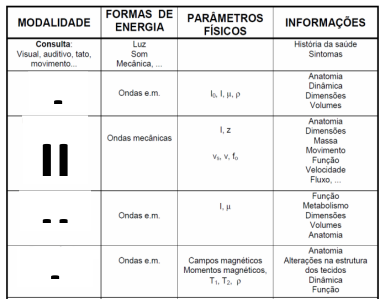
No quadro seguinte, encontre a opção que correlaciona corretamente a modalidade de exames de imagens conforme as informações descritas.
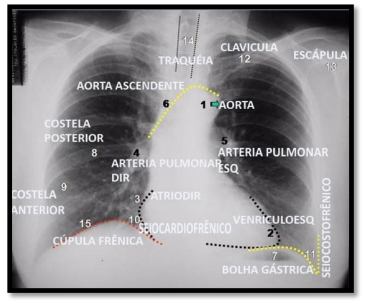
Observe a imagem radiológica com estruturas diversas e identifique qual das afirmativas está correta em relação a estrutura e função das mesmas.
O sistema digestório se encontra, em sua maior parte, no abdome, sendo constituído pelo tubo digestivo e alguns órgãos acessórios. Possui como função primordial a digestão e absorção de nutrientes dos alimentos ingeridos e eliminação de produtos sólidos do catabolismo. Os exames radiológicos do sistema digestório necessitam de meios de contraste, para que se tenha uma boa visualização das estruturas de interesse. Na imagem que segue, são mostrados alguns detalhes anatômicos. Os números 1, 2 e 3 revelam, respectivamente:

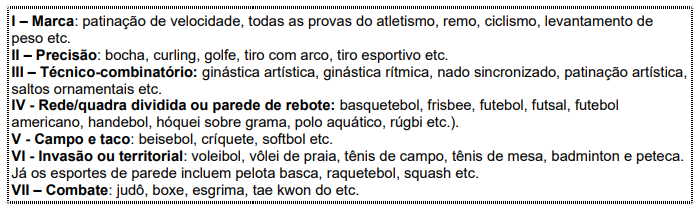
Quais dos esportes citados acima não confere com o enunciado:
Assinale a alternativa incorreta.
a) Aplicar os conhecimentos sobre o mundo para compreender a realidade e construir uma sociedade mais justa, democrática e inclusiva. b) Promover pensamento científico, crítico e criativo para encontrar e solucionar problemas de diferentes áreas. c) Valorizar e participar de manifestações artísticas e culturais do Brasil e do mundo. d) Utilizar diferentes linguagens (verbal, corporal, sonora, digital…) para produzir e compartilhar conhecimento. e) Compreender, utilizar e criar tecnologias digitais nas diversas práticas sociais para compartilhar e produzir conhecimento, resolver problemas e exercer protagonismo. f) Valorizar a diversidade e apropriar-se de conhecimentos que colaborem no mundo do trabalho, exercício da cidadania e projeto de vida. g) Promover os direitos humanos, consciência socioambiental e o consumo responsável com base em informações confiáveis. h) Conhecer e preservar a própria saúde física e emocional. i) Exercitar a empatia, o diálogo, a resolução de conflitos e a cooperação, valorizando a pluralidade sociocultural sem preconceitos. j) Agir pessoal e coletivamente com autonomia, responsabilidade, flexibilidade, resiliência e determinação, em defesa da ética, democracia, inclusão, sustentabilidade e solidariedade.
As alternativas/competências CORRETAS são:
TEXTV- Text for question.
What is blended learning and how does it work?
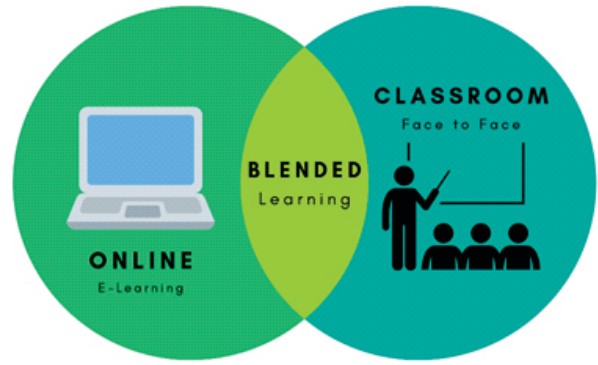
Image: https://www.tp.edu.sg/sii/individuals/blended-learning
Blended learning as an approach is not new. Indeed, the practice of combining (blending) different learning approaches and strategies is not new. Distance learning courses have long combined blended learning through a mix of self-access content (print/video/TV/ radio) and face-to-face/telephone support. 'Traditional' courses have always combined (and some still do) a variety of delivery modes that combine content such as lectures, seminars, tutorials, workshops and group work to give learners a range of learning opportunities. And of course, 'good teachers will always use more than one method or approach in their teaching, and good learners will always combine different strategies in their learning' (Marsh, 2012:3*).
So we could say that the term 'blended learning' refers to every time teachers mix different media (e.g. print, audio, and video) with classroom interaction, maximising authentic input in order to support learners' output and skills development. As such, blended learning has more or less always existed, although the term itself is a mere 15 years old at most, and is now understood to mean a rich, supportive learner-centred learning environment where the 'right blend' is synonymous with effective learning (and teaching).
What is new is that today, technology combines all the different media within one environment: online. The online space facilitates learner–learner interaction, encourages incidental and exploratory learning and allows learners and teachers to stay connected outside the classroom, if they so wish. Learners can benefit from the fact that space and distance do not matter any more. Teachers and educationalists are now understanding more and more that, with the 'right blend', teachers can offer a much richer, supportive learning environment, learning opportunities increase, learning becomes more effective and the learning process becomes more enjoyable.
There are many definitions for blended learning, but they all have the following in common: they refer to two different learning environments — face-to-face (synchronous) and online (asynchronous); and they refer to combining those two learning environments in a complementary way to deliver a programme of study so that learners can be supported both within the classroom environment and outside of it. In other words, the term blended learning refers to any programme of study that is delivered by appropriately combining both synchronous interactive study (usually face-to-face) and asynchronous (individual) study (usually online).
We could go further and say, 'It's in the blend!' That is, the key to a successful blended learning approach is to use the strengths of each medium appropriately, combining the two different learning environments in an integrated way so that each medium complements one another: the classroom environment being used for what it does best, such as introducing new topics, explaining important language points or for meaningful communicative activities, and the online environment being used for what it does best, such as preparing for the next topic (by watching a video/reading a text, etc.), and/or practising and consolidating what has been learnt in class or for extra practice. Both modes of delivery put the learner at the centre of the learning process.
(...)
*Marsh, D. Blended Learning: Creating Learning Opportunities for Language Learners. Cambridge: Cambridge University Press, 2012. (Adapted from: KING, A. Blended language learning: Part of the Cambridge Papers in ELTseries. [pdf] Cambridge: Cambridge University Press, 2016, p. 2.Available st at: http://languageresearch.cambridge.org/cambridge-papers-in-elt Accessed on October 31 , 2019).
In the first paragraph of the text, the verb tenses used are:
TEXTV- Text for question.
What is blended learning and how does it work?
Image: https://www.tp.edu.sg/sii/individuals/blended-learning
Blended learning as an approach is not new. Indeed, the practice of combining (blending) different learning approaches and strategies is not new. Distance learning courses have long combined blended learning through a mix of self-access content (print/video/TV/ radio) and face-to-face/telephone support. 'Traditional' courses have always combined (and some still do) a variety of delivery modes that combine content such as lectures, seminars, tutorials, workshops and group work to give learners a range of learning opportunities. And of course, 'good teachers will always use more than one method or approach in their teaching, and good learners will always combine different strategies in their learning' (Marsh, 2012:3*).
So we could say that the term 'blended learning' refers to every time teachers mix different media (e.g. print, audio, and video) with classroom interaction, maximising authentic input in order to support learners' output and skills development. As such, blended learning has more or less always existed, although the term itself is a mere 15 years old at most, and is now understood to mean a rich, supportive learner-centred learning environment where the 'right blend' is synonymous with effective learning (and teaching).
What is new is that today, technology combines all the different media within one environment: online. The online space facilitates learner–learner interaction, encourages incidental and exploratory learning and allows learners and teachers to stay connected outside the classroom, if they so wish. Learners can benefit from the fact that space and distance do not matter any more. Teachers and educationalists are now understanding more and more that, with the 'right blend', teachers can offer a much richer, supportive learning environment, learning opportunities increase, learning becomes more effective and the learning process becomes more enjoyable.
There are many definitions for blended learning, but they all have the following in common: they refer to two different learning environments — face-to-face (synchronous) and online (asynchronous); and they refer to combining those two learning environments in a complementary way to deliver a programme of study so that learners can be supported both within the classroom environment and outside of it. In other words, the term blended learning refers to any programme of study that is delivered by appropriately combining both synchronous interactive study (usually face-to-face) and asynchronous (individual) study (usually online).
We could go further and say, 'It's in the blend!' That is, the key to a successful blended learning approach is to use the strengths of each medium appropriately, combining the two different learning environments in an integrated way so that each medium complements one another: the classroom environment being used for what it does best, such as introducing new topics, explaining important language points or for meaningful communicative activities, and the online environment being used for what it does best, such as preparing for the next topic (by watching a video/reading a text, etc.), and/or practising and consolidating what has been learnt in class or for extra practice. Both modes of delivery put the learner at the centre of the learning process.
(...)
*Marsh, D. Blended Learning: Creating Learning Opportunities for Language Learners. Cambridge: Cambridge University Press, 2012. (Adapted from: KING, A. Blended language learning: Part of the Cambridge Papers in ELTseries. [pdf] Cambridge: Cambridge University Press, 2016, p. 2.Available st at: http://languageresearch.cambridge.org/cambridge-papers-in-elt Accessed on October 31 , 2019).
To King (2012), a successful blended learning approach mainly entails
TEXTV- Text for question.
What is blended learning and how does it work?
Image: https://www.tp.edu.sg/sii/individuals/blended-learning
Blended learning as an approach is not new. Indeed, the practice of combining (blending) different learning approaches and strategies is not new. Distance learning courses have long combined blended learning through a mix of self-access content (print/video/TV/ radio) and face-to-face/telephone support. 'Traditional' courses have always combined (and some still do) a variety of delivery modes that combine content such as lectures, seminars, tutorials, workshops and group work to give learners a range of learning opportunities. And of course, 'good teachers will always use more than one method or approach in their teaching, and good learners will always combine different strategies in their learning' (Marsh, 2012:3*).
So we could say that the term 'blended learning' refers to every time teachers mix different media (e.g. print, audio, and video) with classroom interaction, maximising authentic input in order to support learners' output and skills development. As such, blended learning has more or less always existed, although the term itself is a mere 15 years old at most, and is now understood to mean a rich, supportive learner-centred learning environment where the 'right blend' is synonymous with effective learning (and teaching).
What is new is that today, technology combines all the different media within one environment: online. The online space facilitates learner–learner interaction, encourages incidental and exploratory learning and allows learners and teachers to stay connected outside the classroom, if they so wish. Learners can benefit from the fact that space and distance do not matter any more. Teachers and educationalists are now understanding more and more that, with the 'right blend', teachers can offer a much richer, supportive learning environment, learning opportunities increase, learning becomes more effective and the learning process becomes more enjoyable.
There are many definitions for blended learning, but they all have the following in common: they refer to two different learning environments — face-to-face (synchronous) and online (asynchronous); and they refer to combining those two learning environments in a complementary way to deliver a programme of study so that learners can be supported both within the classroom environment and outside of it. In other words, the term blended learning refers to any programme of study that is delivered by appropriately combining both synchronous interactive study (usually face-to-face) and asynchronous (individual) study (usually online).
We could go further and say, 'It's in the blend!' That is, the key to a successful blended learning approach is to use the strengths of each medium appropriately, combining the two different learning environments in an integrated way so that each medium complements one another: the classroom environment being used for what it does best, such as introducing new topics, explaining important language points or for meaningful communicative activities, and the online environment being used for what it does best, such as preparing for the next topic (by watching a video/reading a text, etc.), and/or practising and consolidating what has been learnt in class or for extra practice. Both modes of delivery put the learner at the centre of the learning process.
(...)
*Marsh, D. Blended Learning: Creating Learning Opportunities for Language Learners. Cambridge: Cambridge University Press, 2012. (Adapted from: KING, A. Blended language learning: Part of the Cambridge Papers in ELTseries. [pdf] Cambridge: Cambridge University Press, 2016, p. 2.Available st at: http://languageresearch.cambridge.org/cambridge-papers-in-elt Accessed on October 31 , 2019).
Blended learning refers to
TEXT IV-
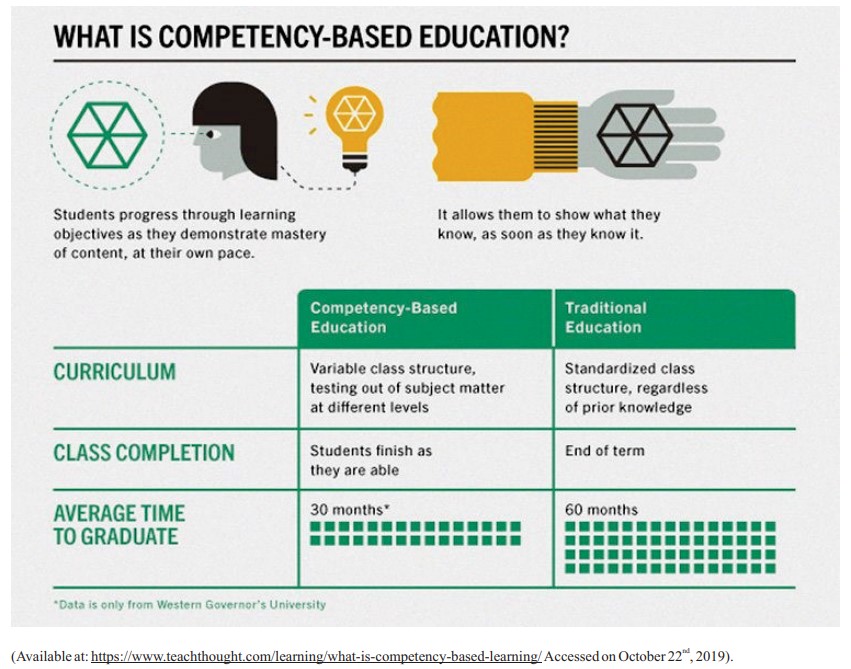
Answer question according to TEXT IV.
In the sentence “It allows them to show what they know, as soon as they know it”, the pronouns “It”, “them”, “they” and “it” (in bold) refer, respectively, to
TEXT IV-
Answer question according to TEXT IV.
According to the infographic, which of the sentences below is the CORRECT one?
TEXTIII - Text forquestion.
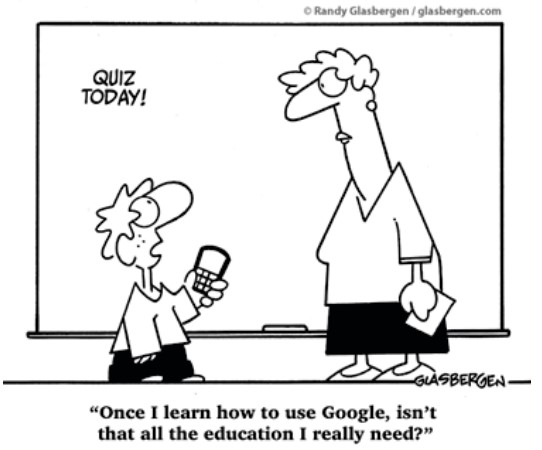
(Available at: https://www.glasbergen.com/gallery-search/?tag=learning. Accessed on October 26 , 2019).
The adverb in the clause “[…] the education I really need” functions as a marker of
TEXTIII - Text forquestion.
(Available at: https://www.glasbergen.com/gallery-search/?tag=learning. Accessed on October 26 , 2019).
Identify, in the options below, a sentence in which the use of the conjunction “once” is the same as in “Once I learn how to use Google […]”.

 Conheça nossos planos