Questões de Concurso
Sobre verbos | verbs em inglês
Foram encontradas 3.096 questões


Ano: 2023
Banca:
FUNDATEC
Órgão:
Prefeitura de Espumoso - RS
Prova:
FUNDATEC - 2023 - Prefeitura de Espumoso - RS - Professor de Séries Finais - Língua Inglesa |
Q2210439
Inglês
Texto associado
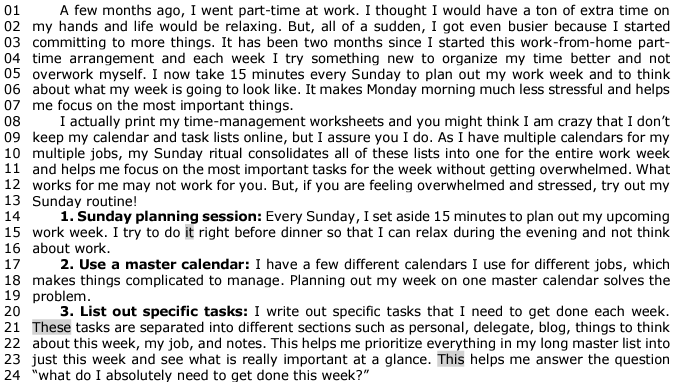

Stop Wasting Time: A 15-minute Planning Session That Will Save You Hours
(Available at: https://www.classycareergirl.com/5-simple-time-management-tips-for-a-great-week/– textespecially adapted for this test).
We can use auxiliary and modal verbs in structures to show interest, avoid repetition,
state differences and similarities, etc. Mark the sentence in which the use of the verb in bold is
INCORRECT.
Ano: 2023
Banca:
FUNDATEC
Órgão:
Prefeitura de Espumoso - RS
Prova:
FUNDATEC - 2023 - Prefeitura de Espumoso - RS - Professor de Séries Finais - Língua Inglesa |
Q2210431
Inglês
Texto associado
Stop Wasting Time: A 15-minute Planning Session That Will Save You Hours
(Available at: https://www.classycareergirl.com/5-simple-time-management-tips-for-a-great-week/– textespecially adapted for this test).
The underlined phrasal verb “figure out” (l. 27) could be replaced by the options
below, with no significative changes in meaning, EXCEPT for:
Ano: 2023
Banca:
FUNDATEC
Órgão:
Prefeitura de Espumoso - RS
Prova:
FUNDATEC - 2023 - Prefeitura de Espumoso - RS - Professor de Séries Finais - Língua Inglesa |
Q2210428
Inglês
Texto associado
Stop Wasting Time: A 15-minute Planning Session That Will Save You Hours
(Available at: https://www.classycareergirl.com/5-simple-time-management-tips-for-a-great-week/– textespecially adapted for this test).
Mark the INCORRECT alternative about the excerpt “Every Sunday, I set aside 15
minutes to plan out my upcoming work week”.
Ano: 2023
Banca:
FUNDATEC
Órgão:
Prefeitura de Espumoso - RS
Prova:
FUNDATEC - 2023 - Prefeitura de Espumoso - RS - Professor de Séries Finais - Língua Inglesa |
Q2210427
Inglês
Texto associado
Stop Wasting Time: A 15-minute Planning Session That Will Save You Hours
(Available at: https://www.classycareergirl.com/5-simple-time-management-tips-for-a-great-week/– textespecially adapted for this test).
Analyze the following sentences below about the excerpt “It has been two months
since I started this work-from-home part-time arrangement”.
I. The structure “it has been two months” is in the past perfect tense. II. The structure used suggests an ongoing action – the author is still working this way. III. The word “since” is connected to the point in the past in which the action started.
Which ones are correct?
I. The structure “it has been two months” is in the past perfect tense. II. The structure used suggests an ongoing action – the author is still working this way. III. The word “since” is connected to the point in the past in which the action started.
Which ones are correct?
Ano: 2023
Banca:
FUNDATEC
Órgão:
Prefeitura de Maçambará - RS
Prova:
FUNDATEC - 2023 - Prefeitura de Maçambara - RS - Professor Anos Finais do Ensino Fundamental – Inglês |
Q2209857
Inglês
The verb “have” can be used both in the infinitive and gerund forms, but not with the
same meaning. It depends on the context, and weather it is the main verb in the sentence or not. In
which of the sentences below the use of the verb “have” is INCORRECT?
Ano: 2023
Banca:
Avança SP
Órgão:
Prefeitura de São Lourenço da Serra - SP
Prova:
Avança SP - 2023 - Prefeitura de São Lourenço da Serra - SP - Professor de Educação Básica II - Língua Inglesa |
Q2209584
Inglês
Identify the correct sentence that demonstrates the correct use of the subjunctive mood:
Ano: 2023
Banca:
Avança SP
Órgão:
Prefeitura de São Lourenço da Serra - SP
Prova:
Avança SP - 2023 - Prefeitura de São Lourenço da Serra - SP - Professor de Educação Básica II - Língua Inglesa |
Q2209583
Inglês
Which of the following sentences demonstrates the correct use of the present perfect continuous tense?
Ano: 2023
Banca:
JVL Concursos
Órgão:
Prefeitura de São José do Piauí - PI
Prova:
JVL Concursos - 2023 - Prefeitura de São José do Piauí - PI - Professor de Anos Finais - Língua Inglesa |
Q2208082
Inglês
Complete the sentence below with the correct verb.
Choose the CORRECT answer.
“Me: I need to tell you something! Italy is my next holiday destination!
My best friend: Really! I'm so excited for you. I _________ to Italy. Can I come with you? Me: Absolutely!”
“Me: I need to tell you something! Italy is my next holiday destination!
My best friend: Really! I'm so excited for you. I _________ to Italy. Can I come with you? Me: Absolutely!”
Ano: 2023
Banca:
JVL Concursos
Órgão:
Prefeitura de São José do Piauí - PI
Prova:
JVL Concursos - 2023 - Prefeitura de São José do Piauí - PI - Professor de Anos Finais - Língua Inglesa |
Q2208081
Inglês
Complete the sentence below with the correct verb. Choose the CORRECT answer.
“A professional soccer player always _________ a lot during a match.”
Ano: 2023
Banca:
JVL Concursos
Órgão:
Prefeitura de São José do Piauí - PI
Prova:
JVL Concursos - 2023 - Prefeitura de São José do Piauí - PI - Professor de Anos Finais - Língua Inglesa |
Q2208080
Inglês
Look at the picture. Based on what you can see, choose the CORRECT answer.

“They _________ the museum.”
Ano: 2023
Banca:
JVL Concursos
Órgão:
Prefeitura de São José do Piauí - PI
Prova:
JVL Concursos - 2023 - Prefeitura de São José do Piauí - PI - Professor de Anos Finais - Língua Inglesa |
Q2208077
Inglês
Complete the sentence below with the correct verbs.
Choose the CORRECT answer.
“Jane _________ along the road when she _________ an old college friend.”
“Jane _________ along the road when she _________ an old college friend.”
Ano: 2023
Banca:
FGV
Órgão:
SEDUC-TO
Prova:
FGV - 2023 - SEDUC-TO - Professor da Educação Básica - Professor Regente Letras - Inglês |
Q2206454
Inglês
Texto associado

Text IV
https://www.macmillanenglish.com/br/
The verb in “Empower your students” is in the
Ano: 2023
Banca:
FGV
Órgão:
SEDUC-TO
Prova:
FGV - 2023 - SEDUC-TO - Professor da Educação Básica - Professor Regente Letras - Inglês |
Q2206453
Inglês
Texto associado
Text IV
https://www.macmillanenglish.com/br/
The past simple and past participle of the verb “to become” are,
respectively,
Ano: 2023
Banca:
FGV
Órgão:
SEDUC-TO
Prova:
FGV - 2023 - SEDUC-TO - Professor da Educação Básica - Professor Regente Letras - Inglês |
Q2206446
Inglês
Texto associado
Text II

The verb “refers” is in the
Ano: 2023
Banca:
Creative Group
Órgão:
Prefeitura de Itá - SC
Prova:
Creative Group - 2023 - Prefeitura de Itá - SC - Professor de Inglês |
Q2206409
Inglês
Which sentence correctly uses a modal verb to
express a lack of obligation?
Ano: 2023
Banca:
FGV
Órgão:
Prefeitura de Jaboatão dos Guararapes - PE
Prova:
FGV - 2023 - Prefeitura de Jaboatão dos Guararapes - PE - Professor 2 - Língua inglesa |
Q2204979
Inglês
Texto associado
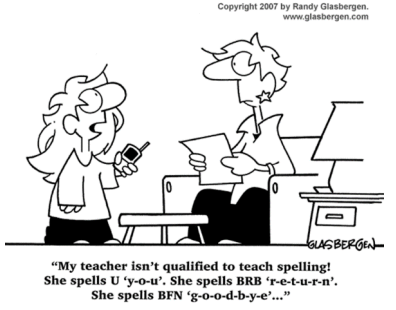
From: https://www.glasbergen.com/teen-cartoons/
The verb “to return” is similar in meaning to
Ano: 2023
Banca:
FGV
Órgão:
Prefeitura de Jaboatão dos Guararapes - PE
Prova:
FGV - 2023 - Prefeitura de Jaboatão dos Guararapes - PE - Professor 2 - Língua inglesa |
Q2204973
Inglês
Texto associado
Text III
Teaching a child to read
Imagery first: the colors primary
Familiar as the sun; the purpose sure –
To hear, to smell, to feel, to taste, to see.
The mind will enter by another door.
The verb is next: we are the rain that falls,
The frog that sees a cricket as it leaps,
The robin that flaps its wings and calls,
The fish that swims, the animal that creeps.
The third is narrative, the moving spell
Of syntax that ad-libs the myths of time.
Alas, we learn before the wishing well
Has dried how words become a hill to climb.
The fourth is symbol: goodness, beauty, love.
This is the time of quarrel, tears and pain.
Sowing the dragons’ teeth, we bob and weave
Until we bring the simple back again.
By Allen Kanfer. Source: https://www.poetryfoundation.org/
poetrymagazine/browse?contentId=28478
Glossary: to ad-lib: If you ad-lib something in a play or a speech, you say something
which has not been planned or written beforehand.
(https://www.collinsdictionary.com/dictionary/english/ad-lib)
The simple past and past participle of the verb “falls” in “we are
the rain that falls” are, respectively,
Ano: 2023
Banca:
FGV
Órgão:
Prefeitura de Jaboatão dos Guararapes - PE
Prova:
FGV - 2023 - Prefeitura de Jaboatão dos Guararapes - PE - Professor 2 - Língua inglesa |
Q2204968
Inglês
Texto associado
Text II

The phrasal verb that can replace “discover” without change of
meaning is
Ano: 2023
Banca:
FGV
Órgão:
Prefeitura de Jaboatão dos Guararapes - PE
Prova:
FGV - 2023 - Prefeitura de Jaboatão dos Guararapes - PE - Professor 2 - Língua inglesa |
Q2204966
Inglês
Texto associado
Text II
The verb “assisting” can be replaced without change in meaning
by
Ano: 2023
Banca:
FGV
Órgão:
Prefeitura de Jaboatão dos Guararapes - PE
Prova:
FGV - 2023 - Prefeitura de Jaboatão dos Guararapes - PE - Professor 2 - Língua inglesa |
Q2204962
Inglês
Texto associado
Text I
What is English as a Lingua Franca?
‘English’, as a language, has for some time been seen as a
global phenomenon and, therefore, as no longer defined by fixed
territorial, cultural and social functions. At the same time, people
using English around the world have been shaping it and adapting
it to their contexts of use and have made it relevant to their
socio-cultural settings. English as a Lingua Franca, or ELF for
short, is a field of research interest that was born out of this
tension between the global and the local, and it originally began
as a ramification of the World Englishes framework in order to
address the international, or, rather, transnational perspective on
English in the world. The field of ELF very quickly took on a nature
of its own in its attempt to address the communication, attitudes,
ideologies in transnational contexts, which go beyond the
national categorisations of World Englishes (such as descriptions
of Nigerian English, Malaysian English and other national
varieties). ELF research, therefore, has built on World Englishes
research by focusing on the diversity of English, albeit from more
transnational, intercultural and multilingual perspectives.
ELF is an intercultural medium of communication used among people from different socio-cultural and linguistic backgrounds,
and usually among people from different first languages.
Although it is possible that many people who use ELF have learnt
it formally as a foreign language, at school or in an educational
institution, the emphasis is on using rather than on learning. And
this is a fundamental difference between ELF and English as a
Foreign Language, or EFL, whereby people learn English to
assimilate to or emulate native speakers. In ELF, instead, speakers
are considered language users in their own right, and not failed
native speakers or deficient learners of English. Some examples
of typical ELF contexts may include communication among a
group of neuroscientists, from, say, Belgium, Brazil and Russia, at
an international conference on neuroscience, discussing their
work in English, or an international call concerning a business
project between Chinese and German business experts, or a
group of migrants from Syria, Ethiopia and Iraq discussing their
migration documents and requirements in English. The use of
English will of course depend on the linguistic profile of the
participants in these contexts, and they may have another
common language at their disposal (other than English), but
today ELF is the most common medium of intercultural
communication, especially in transnational contexts.
So, research in ELF pertains to roughly the same area of
research as English as a contact language and English
sociolinguistics. However, the initial impetus to conducting
research in ELF originated from a pedagogical rationale – it
seemed irrelevant and unrealistic to expect learners of English
around the world to conform to native norms, British or
American, or even to new English national varieties, which would
be only suitable to certain socio-cultural and geographical
locations. So, people from Brazil, France, Russia, Mozambique, or
others around the world, would not need to acquire the norms
originated and relevant to British or American English speakers,
but could orientate themselves towards more appropriate and
relevant ways of using English, or ELF. Researchers called for
“closing a conceptual gap” between descriptions of native English
varieties and new empirical and analytical approaches to English
in the world. With the compilation of a number of corpora, ELF
empirical research started to explore how English is developing,
emerging and changing in its international uses around the world.
Since the empirical corpus work started, research has expanded
beyond the pedagogical aim, to include explorations of
communication in different domains of expertise (professional,
academic, etc.) and in relation to other concepts and research,
such as culture, ideology and identity.
Adapted from https://www.gold.ac.uk/glits-e/
back-issues/english-as-a-lingua-franca/
The modal verb in “they may have another common language at
their disposal” (2nd paragraph) indicates

 Conheça nossos planos