Questões de Concurso
Sobre verbos | verbs em inglês
Foram encontradas 2.952 questões
Text I
Nurturing Multimodalism
[…]
New learning collaborations call on the teacher as learner, and the learner as teacher. The teacher is a lifelong learner; this is simply more apparent in the Information Age. In instances of best practice, collaborative learning partnerships are forged between and among teachers for strategic, bottom-up, in-house professional development. This allows teachers to share in reflective, on-going, contextualized learning, tailored to their collective knowledge. This sharing also includes the learner as teacher. ELT typically employs learner-centered activities: these can include learners sharing their knowledge of strategic digital literacies with others in the classrooms.
The digital universe, so threatening to adult notions of socially sanctioned literacies, is intuitive to children, who have been socialized into it, and for whom digital literacies are exploratory play. Adults may find new ways of communicating digitally to be quite baffling and confronting of our communicative expertise; children do not. Instant messaging systems, such as MSN, AOL, ICQ, for example, provide as natural a medium for communicating to them as telephones did for the baby-boomer generation. It is not fair for the teacher to treat Information and Communication Technologies as auxiliary communication with learners for whom it is mainstream and primary.
Learning spaces are important. Although teachers seldom have much individual say in the layout of teaching spaces, collaborative relationships may help to encourage integrated digitization, where computers are not segregated in laboratories but are interspersed throughout the school environment. In digitally infused curricula, postmodern literacies do not supplant but complement modern literacies, so that access to information is driven by purpose and content rather than by the media available.
Adapted from: LOTHERINGTON, H. From literacy to multiliteracies in ELT. In:
CUMMINS, J.; DAVISON, C. (Eds.) International Handbook of English Language
Teaching. New York: Springer, 2007, p. 820. Available at:
https://www.researchgate.net/publication/226802846_From_Literacy_to_Multiliter
acies_in_ELT
Text 4 (for questions 42, 43, 44, 45, and 46)
Social networks
Going into the small room at the end of the corridor, Roberta sat down _______ 1 the computer. It was the computer she had bought when her old one’s hard disk had started to go wrong. Her new computer was a laptop with a lot of extra features and she needed it for her online work _______ 2 her students. Roberta had started to worry that her students would be bored unless she used modern technology in her teaching.
She turned_______ 3 the switch at the back of her computer. She looked at the email messages waiting for her answer, but she ignored them. Then she looked at the homework posted on a special site she created for the students, but she didn’t feel like correcting it. Instead she went to her favorite social network site and looked at the news about her friends. She sent messages to her favorite people and she had many online conversations _______ 4 teaching and other things. She posted some new messages on her own web page and then watched a film clip on a video site which her friend had told her about.
_______ 5 now, it was late and she realized that she had spent too much time talking to her friends online. She was very tired. She would have to do all her work in the morning.
(HARMER, J. Essential Teacher Knowledge: core concepts in English language teaching, p. 42. Harlow: Pearson Education Limited, 2012.
Adaptado.)
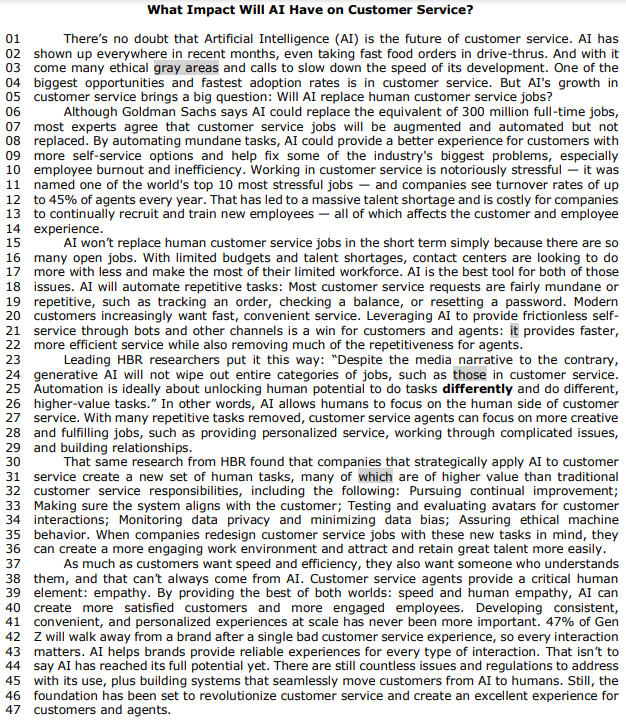
“Then she looked at the homework posted on a special site she created for the students, but she didn’t feel like correcting it.”
The phrasal verb underlined in the excerpt can be translated into Portuguese as

Observe a análise linguística abaixo e responda ao que se pede.
I. Em “Salad dressing, something we never used before, is also popular now. ”, o termo dressing, na expressão sublinhada, é um substantivo e significa, em português, molho.
II. No trecho “I fear our traditional way of doing things will soon be forgotten.”, o termo sublinhado é uma expressão idiomática que corresponde a “Eu confio”.
III. No 1º parágrafo, as palavras affected, restaurants, traditional e ingredients são palavras cognatas, mas popular é falsa cognata.
IV. No trecho “Traditionally Koreans don’t use individual plates for eating main dishes.”, as palavras plates e dishes são substantivos e têm significados semelhantes.
V. Em “Before, we had never rewarded good service with money”, foi empregado o past perfect, e o verbo destacado significa recompensar.
Estão CORRETAS apenas
Instruction: Answer the question based on the following text. The highlighted excerpt from the text is quoted in the question.
How gender bends gender

(Available in: https://www.languagemagazine.com/2022/03/16/how-gender-bends-meaning/ – text especially
adapted for this test).
“The Civil Protection Agency (CPA) urged people to leave flooded homes, for it’s essential that those displaced persons __________________ in shelters, which will keep them away from endangered spots.”

(Available in: https://pixabay.com.)
Fill in the blank above the image with the appropriate verb form:
“Seldom __________________ effective teaching which skips full connection with active research, that is, teaching based on: Planning, Acting, Observing, Reflecting, Replanning.”

(Available in: https://www.dreamstime.com.)
Fill in the blank above the image with the appropriate verb form:
Analyse the syllabuses that follow to answer.
Syllabus A
1. Simple Present Active.
2. Simple Present Passive.
3. Simple Present Active and Passive.
4. ING forms.
5. Present Perfect; Present Continuous.
6. Infinitives.
7. Anomalous Finites.
8. Past Perfect; Conditionals.
Syllabus B
1. Asking about travel.
2. Making travel arrangements.
3. Ordering a meal.
4. Asking the way.
5. Hiring a car.
6. Booking at a hotel.
7. Buying museum tickets.
8. Finding lost baggage.
Consider the assertions below to choose an option.
I. Syllabus A is based on language use.
II. Syllabus A is functional because simpler structures precede more complex ones.
III. Syllabus B is largely organized on pragmatic grounds and might lack systematic conceptual framework.
Avalie as afirmações a seguir tendo o inglês padrão, da língua culta e formal, correct, formal, standard, prescriptive English como base.
I - I have been thought about you.
II - The minibus can hold up until thirteen people.
III - Thank you very much indeed. That is most kind of you.
IV - All of my family likes music. Especially my father goes to as many concerts as he can.
Está correto apenas o que se afirma em
would - where - dinner - find - I - a - restaurant - tonight good - for ?
Choose the alternative that presents the words correctly organized in the sentence:
Identify the bold verbs in the text as regular or irregular and choose the correct alternative.
I. My children always enjoy visiting the sights, and my husband and I enjoy trying different food.
II. I always put everything we're going to do on paper so we can enjoy our trip a lot.
Complete the sentences with the appropriate modal verb and choose de correct alternative.
I. It´s a cloudy day. Do you think it ____ rain later?
II.You _________ lock the door after leaving.
III. Mom says we _______ go out and play after we finish our homework.
O texto seguinte servirá de base para responder à questão.
(1º§) The Maya are probably the best-known of the classical civilizations of Mesoamerica. Originating in the Yucatán around 2600 B.C., they rose to prominence around A.D. 250 in present-day southern Mexico, Guatemala, northern Belize and western Honduras. Building on the inherited inventions and ideas of earlier civilizations such as the Olmec, the Maya developed astronomy, calendrical systems and hieroglyphic writing. The Maya were noted as well for elaborate and highly decorated ceremonial architecture, including temple-pyramids, palaces and observatories, all built without metal tools. They were also skilled farmers, clearing large sections of tropical rain forest and, where groundwater was scarce, building sizeable underground reservoirs for the storage of rainwater. The Maya were equally skilled as weavers and potters, and cleared routes through jungles and swamps to foster extensive trade networks with distant peoples.
(2º§) Around 300 B.C., the Maya adopted a hierarchical system of government with rule by nobles and kings. This civilization developed into highly structured kingdoms during the Classic period, A.D. 200-900. Their society consisted of many independent states, each with a rural farming community and large urban sites built around ceremonial centres. It started to decline around A.D. 900 when - for reasons which are still largely a mystery - the southern Maya abandoned their cities. When the northern Maya were integrated into the Toltec society by A.D. 1200, the Maya dynasty finally came to a close, although some peripheral centres continued to thrive until the Spanish Conquest in the early sixteenth century.
(3º§) Maya history can be characterized as cycles of rise and fall: city-states rose in prominence and fell into decline, only to be replaced by others. It could also be described as one of continuity and change, guided by a religion that remains the foundation of their culture. For those who follow the ancient Maya traditions, the belief in the influence of the cosmos on human lives and the necessity of paying homage to the gods through rituals continues to find expression in a modern hybrid Christian-Maya faith.
https://www.historymuseum.ca/cmc/exhibitions/civil/maya/mmc01eng.html
Consider the first paragraph of the text and the following assertives:
I."Inherited inventions" could be translated as "invenções criadas".
II.The word "rose" is an irregular verb.
III.The word "weavers" could be replaced by "joiners".
Which one(s) is(are) CORRECT?
Choose the right option that best completes the sentences:
I.The boy ___________ to be another person.
II.The school ___________ are very strict.
Choose the right answer after identifying the verb tense of each sentence:
I.She has done several things at the same time.
II.She has the biggest house in town.
III.She`d do me a favor if she could.
IV.She`s put her hand in the dough.
V.She put on her shoes right after breakfast.
TEXTII – Text forquestion.
Foreign Language Teaching in Brazil: interfaces of the CLIL (Content and Language Integrated Learning) approach in remote teaching
(Ana Lúcia Farias da Silva - 01/12/2021)
FINAL CONSIDERATIONS
English Language Teaching, in the modality of remote teaching, with the full use of Virtual Learning Environments (VLE) has advanced and can be efficient with the development of language skills associated with these technological and didactic resources appropriate to each objective in foreign language teaching. However, the teacher should have good planning, carefully reflecting and analyzing the tool that best suited to his/her goal.
Moreover, we postulate as indispensable the teaching of the English Language (EL), as a way of access to universal cultural goods, academic and professional environments of the globalized world, also considering an inclusive formation that leads the student to expand their readings of the world.
Moreover, classes, in real time, help in the cognitive process in relation to playing, dialoguing, in addition to awakening sensitivities such as visual and auditory perceptions, necessary for learning. Despite some flexibility, the use of English contributed to welcoming students in the mother tongue, which did not impair the learning of the proposed contents, on the contrary, it brought the students closer to the teacher-researcher, enabling a better work in language teaching. The results were perceived in the formal evaluations and in the engagement of the students during the classes, corroborating the pedagogical work that goes beyond teaching the contents and also goes through the ability of the educator to welcome and relate to his students.
Despite a pandemic moment, extremely challenging, especially for foreign language teaching, especially English, this research emphasized the need to follow the advancement of digital technologies and transform new challenges into knowledge, to optimize the adaptability of individuals, in view of the emerging educational contexts that have already been configured as a new reality at this time.
It is concluded, therefore, that according to the study presented and the current readings on foreign language teaching, in interface with multiple methods and possibilities in VLE, the new technological resources contribute and stimulate new didactic-pedagogical perspectives, in this panorama of remote teaching, driven by the pandemic. That said, it is possible to offer a teaching of the EL, in bilingual programs, in primary schools in Brazil today, even in elementary school, distance and quality, with priority to the development of all the language skills that an apprentice must activate, for significant and efficient foreign language learning.
(Adapted from: https://www.nucleodoconhecimento.com.br/education/interfaces-of-the-content. th Accessed on April 10 , 2022).
In the sentences “[…] the teacher should have good planning […]” and “[…] with priority to the development of all the language skills that an apprentice must activate […]”, the modal verbs express, respectively,
TEXT IV - Text for question.
A tale of two zooms (by Adrienne)
September 17, 2020
Elementary school teachers: Stop talking!
High school teachers: Please someone talk!

Available from: https://www.hedgerhumor.com/a-tale-of-two-zooms/. Accessed on January 10th, 2022.
Choose the option that best suits this rule:
TEXT III -
My experience: one of the advantages of online tools is that they allow teachers and students to exercise their creativity
Cicinato do Carmo, English teacher that also works with initial and continuing education of teachers in Rio de Janeiro
Sept 20, 2021

I have been an English teacher for about 30 years. During this period, in addition to working in the classroom, both in the public and private sectors, I have also been working with training, education and development of English language teachers at Troika – in continuing and initial education. At the moment, I coordinate an English program in Rio de Janeiro with teachers from kindergarten to high school, and I guide undergraduate interns that will be English teachers.
Lyrics Training - Students are very fond of Lyrics Training. I've had experiences with students from elementary school to high school, each one has its specificity, its degree of difficulty and requirement. For example, high school students are very fond of challenges. For example, they really enjoy it when they select a more challenging level where they need to be quicker with answers. And even more so when they decide to organize themselves into groups and compete with each other singing songs.
Youglish- Youglish is very interesting for vocabulary reinforcement in context, when we are exploring a particular word, which offers greater difficulty in understanding, contextualization and use. In addition to the pronunciation, it manages to bring, through videos and other resources, the context of use of that term. Sometimes teaching only the meaning of a word can give the wrong impression that it can be used in different contexts, but there are subtle meanings that need a more concrete communicative element so that the student can perceive its use.
Wordwall - Wordwall offers a bank with different game format options for the same content. One can create an activity, for example, with specific vocabulary of farm animals, and the website offers game possibilities based on that vocabulary list, such as memory game, train, cards, pac man, spin the wheel. The activities are geared towards secondary education. With the older ones, from the moment they are more used to the platform, we can open up for them to choose the type of game they prefer to do that activity.
Mentimeter - I use Mentimeter for preparing presentations. It's like PowerPoint, only interactive. It is a presentation tool filled with interactive elements with viewers. For example, if I have a question about the subject of the class, I present it on the slide and a code will appear. Then, by cell phone, students access and respond. And those answers can create a word cloud instantly, in real time. From there, we can move towards a discussion. I like to use the tool for warm up activities. For example, I ask “What did you have for breakfast today?”; and, based on the answers (milk, tea), we warm up with a discussion and then move on to the content of the class.
ISLCollective - ISLCollective is very good for creating class material. It is an activity repository that is organized into interactive video sessions, PowerPoint and vocabulary or grammar worksheets. We teachers create content and feed the platform. You can search and use ready-made materials, or do something more customized, as it allows us to change and adapt these materials. It makes a copy of the original content with all rights reserved and assigned, but one can customize, delete or add something to the activity.
Gamilab - It is an educational game bank, which allows us to create very simple games, and whose platform is similar to mobile and video games. It has more gamification elements than many others we use, such as elements of the dynamics, mechanics and components that are part of the gamification process (difficulty level progression, challenges and rewards), with a well-described narrative.
One of the possibilities for creation is a mountain bike competition. As the runner walks the race path, golden boxes with questions (multiple choice) appear that must be answered in order for the player to win prizes. It is a competition like a video game, with great appeal for our students.
It is possible to create games for all levels, from kindergarten on, and it can be used both on computer and mobile. The games can be created individually or collaboratively – there is the ability to add collaborators, so that students can organize themselves into groups, each one at home, develop a game and present it to the class. They can send the link of the game they have created and everyone plays.
Live Worksheets - Live Worksheets website also makes it possible to create interactive exercises. We can create, for example, an exercise of connecting (matching), which can be done on the screen of the computer or cell phone itself, which makes it easier for the student as well.
These platforms are all free and students don't need to have an account, we can just use the link. The only thing is that, if I want to create some activity that can be measured later, I need everyone to be registered and to log in to the platform. Gamilab, ISLCollective and Live Worksheets, for example, generate a report and I can find out which students participated and what difficulties were encountered in relation to the score generated by each one of them.
Adapted from: https://www.inglesnasescolas.org/en/experience/my-experience-one-of-the-advantages-of-online-tools-is-that-they-allow-teachers-andstudents-to-exercise-their-creativity/. Accessed on January 15th, 2022.
Answer question according to TEXTIII.