Questões de Concurso
Sobre verbos | verbs em inglês
Foram encontradas 3.096 questões


Ano: 2023
Banca:
Prefeitura de Bombinhas - SC
Órgão:
Prefeitura de Bombinhas - SC
Prova:
Prefeitura de Bombinhas - SC - 2023 - Prefeitura de Bombinhas - SC - Professor de Ensino Fundamental II - Inglês |
Q2180608
Inglês
Choose the alternative that contains a sentence in the Future:
Ano: 2023
Banca:
OBJETIVA
Órgão:
Prefeitura de Sagrada Família - RS
Prova:
OBJETIVA - 2023 - Prefeitura de Sagrada Família - RS - Professor - Área II - Inglês |
Q2178062
Inglês
Considering the differing between the perfect tenses,
number the 2nd column according to the 1rst and, after
that, check the alternative that presents the CORRECT
sequence:
(1) Present perfect. (2) Past perfect.
(_) Dan hasn’t been sick this year. (_) I’d just have lunch. (_) We hadn’t cleaned it for weeks.
(1) Present perfect. (2) Past perfect.
(_) Dan hasn’t been sick this year. (_) I’d just have lunch. (_) We hadn’t cleaned it for weeks.
Ano: 2023
Banca:
IDESG
Órgão:
Prefeitura de Vila Valério - ES
Prova:
IDESG - 2023 - Prefeitura de Vila Valério - ES - Professor em função de docência - MAPB - EF - ANOS FINAIS - LÍNGUA INGLESA |
Q2174633
Inglês
Complete the sentence below with the modal verb. Choose the CORRECT answer.
“My friend: I was able to watch TV until very late when I was younger.
Me: You were lucky! I _________ do it because I had to get up very early in the mornings.”
“My friend: I was able to watch TV until very late when I was younger.
Me: You were lucky! I _________ do it because I had to get up very early in the mornings.”
Ano: 2023
Banca:
IDESG
Órgão:
Prefeitura de Vila Valério - ES
Prova:
IDESG - 2023 - Prefeitura de Vila Valério - ES - Professor em função de docência - MAPB - EF - ANOS FINAIS - LÍNGUA INGLESA |
Q2174630
Inglês
Complete the sentence below with the correct verb. Choose the CORRECT answer.
‘Talking to a coworker: “I don’t know if we are going to reach our goal this month.
Last month it was amazing as I ________ 10 cars in total.’’
‘Talking to a coworker: “I don’t know if we are going to reach our goal this month.
Last month it was amazing as I ________ 10 cars in total.’’
Ano: 2023
Banca:
UniRV - GO
Órgão:
Prefeitura de Rio Verde - GO
Prova:
UniRV - GO - 2023 - Prefeitura de Rio Verde - GO - Professor de Educação Básica II (PEB II) - Inglês |
Q2170189
Inglês
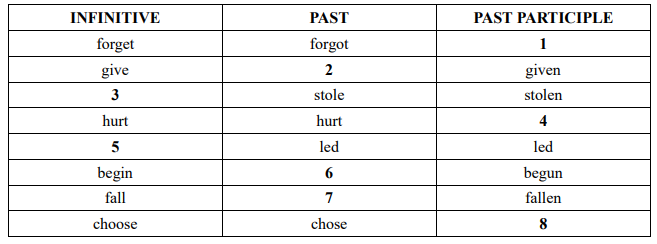
Assinale a alternativa que completa a tabela abaixo com a forma verbal correta:
Ano: 2023
Banca:
UniRV - GO
Órgão:
Prefeitura de Rio Verde - GO
Prova:
UniRV - GO - 2023 - Prefeitura de Rio Verde - GO - Professor de Educação Básica II (PEB II) - Inglês |
Q2170178
Inglês
Leia as orações abaixo e depois assinale a alternativa incorreta:
I – Julia goes to the gym three times a week, but she hates it. II – The baby slept very well last night, after he was breastfed. III – I am going to move to another town after I retire. IV – I have already seen this movie. Let’s choose another one.
I – Julia goes to the gym three times a week, but she hates it. II – The baby slept very well last night, after he was breastfed. III – I am going to move to another town after I retire. IV – I have already seen this movie. Let’s choose another one.
Ano: 2023
Banca:
UniRV - GO
Órgão:
Prefeitura de Rio Verde - GO
Prova:
UniRV - GO - 2023 - Prefeitura de Rio Verde - GO - Professor de Educação Básica II (PEB II) - Inglês |
Q2170175
Inglês
Texto associado
I have always quite irrationally prided myself on my good health, for I have only occasionally had to take
a day off work when I have had a cold.
So I was quite offended by my doctor who, when we ran into each other in the street one day, took
one look at me and told me that I was definitely overweight and that if I did not make an effort to lose some
weight, I could expect to have a heart attack before very long. He added that, like many middle-aged men,
I led a completely sedentary life: I sat behind my office desk during the day and relaxed in my armchair in
the evening with my eyes firmly fixed on the television set.
It was true that I had been getting fatter, but this had not worried me much, for I simply attributed
it to the fact that I was getting older.
My doctor advised me to go on a diet immediately, so I tried cutting down on fattening foods, such as potatoes and butter, but without any visible signs of success, for my trouble is that I am very fond of my
food and besides, my wife is an excellent cook. I then decided that it was all a question of exercise, and for
this year’s holiday, I was determined to go somewhere which was conducive to taking exercise and not to
our usual seaside resort, where one is tempted to simply go down to the beach and lie in the sun. (In other
words – L.G. Alexander and Catherine Wilson).
Observe o trecho abaixo retirado do texto e assinale a alternativa incorreta:
“So I was quite offended by my doctor who, when we ran into each other in the street one day, took one look at me and told me that I was definitely overweight”.
“So I was quite offended by my doctor who, when we ran into each other in the street one day, took one look at me and told me that I was definitely overweight”.
Ano: 2023
Banca:
IF-MG
Órgão:
IF-MG
Prova:
IF-MG - 2023 - IF-MG - Professor EBTT Área/Disciplina: Letras - Língua Inglesa, Linguística e Literatura - Ponte Nova |
Q2169486
Inglês
Choose the best option that completes the context:
“Lost-and-founds citywide are practically overflowing with discarded umbrellas - once the rain stops, many Vancouverites ______ leave them behind than lug them home.”
“Lost-and-founds citywide are practically overflowing with discarded umbrellas - once the rain stops, many Vancouverites ______ leave them behind than lug them home.”
Ano: 2023
Banca:
IF-MG
Órgão:
IF-MG
Prova:
IF-MG - 2023 - IF-MG - Professor EBTT Área/Disciplina: Letras - Língua Inglesa, Linguística e Literatura - Ponte Nova |
Q2169485
Inglês
Choose the best option that fills in the blank:
“If global conditions _____ fraught, they ____ Goldilocks was a fairy tale after all.”
Ano: 2023
Banca:
IF-MG
Órgão:
IF-MG
Prova:
IF-MG - 2023 - IF-MG - Professor EBTT Área/Disciplina: Letras - Língua Inglesa, Linguística e Literatura - Ponte Nova |
Q2169480
Inglês
A. Read the following excerpt from the book The Great Gatsby and complete with the missing
verbs.
“By seven o’clock the orchestra _______________, no thin five-piece affair, but a whole pitful of oboes and trombones and saxophones and viols and cornets and piccolos, and low and high drums. The last swimmers ______________ in from the beach now and _______________ up-stairs; the cars from New York _______________ five deep in the drive […]” (FITZGERALD, 2011, p. 32-33).
Source: https://www.wsfcs.k12.nc.us/cms/lib/NC01001395/Centricity/Domain/7935/Gatsby_PDF_FullText.pdf Access on March, 20th 2023
“By seven o’clock the orchestra _______________, no thin five-piece affair, but a whole pitful of oboes and trombones and saxophones and viols and cornets and piccolos, and low and high drums. The last swimmers ______________ in from the beach now and _______________ up-stairs; the cars from New York _______________ five deep in the drive […]” (FITZGERALD, 2011, p. 32-33).
Source: https://www.wsfcs.k12.nc.us/cms/lib/NC01001395/Centricity/Domain/7935/Gatsby_PDF_FullText.pdf Access on March, 20th 2023
Ano: 2023
Banca:
IF-MG
Órgão:
IF-MG
Prova:
IF-MG - 2023 - IF-MG - Professor EBTT Área/Disciplina: Letras - Língua Inglesa, Linguística e Literatura - Ponte Nova |
Q2169473
Inglês
Texto associado
Read the poem I too below to answer QUESTION.
I, Too
Langston Hughes - 1901-1967
I, too, sing America.
I am the darker brother.
They send me to eat in the kitchen
When company comes,
But I laugh,
And eat well,
And grow strong.
Tomorrow,
I'll be at the table
When company comes.
Nobody'll dare
Say to me,
“Eat in the kitchen,”
Then.
Besides,
They'll see how beautiful I am
And be ashamed —
I, too, am America.
Source: The Collected Poems of Langston Hughes, published by Knopf and Vintage Books.
Copyright © 1994 by the Estate of Langston Hughes. All rights reserved. Used by permission of
Harold Ober Associates Incorporated.
A. Read the stanza below.
“Besides, They'll see how beautiful I am And be ashamed”
B. Which are the verb tenses of the underlined words, respectively? Check the alternative which presents the verb tenses of the underlined words.
“Besides, They'll see how beautiful I am And be ashamed”
B. Which are the verb tenses of the underlined words, respectively? Check the alternative which presents the verb tenses of the underlined words.
Ano: 2023
Banca:
FUNDATEC
Órgão:
Prefeitura de Porto Alegre - RS
Prova:
FUNDATEC - 2023 - Prefeitura de Porto Alegre - RS - Professor - Lingua Inglesa |
Q2166449
Inglês
In the sentence “I stopped ____ with my sister”, it is grammatically correct to fill the
gap with which of the following forms of the verb “talk”?
Ano: 2023
Banca:
FUNDATEC
Órgão:
Prefeitura de Porto Alegre - RS
Prova:
FUNDATEC - 2023 - Prefeitura de Porto Alegre - RS - Professor - Lingua Inglesa |
Q2166447
Inglês
The sentences below are in present perfect tense – simple or continuous. Which one
is INCORRECT?
Ano: 2023
Banca:
FUNDATEC
Órgão:
Prefeitura de Porto Alegre - RS
Prova:
FUNDATEC - 2023 - Prefeitura de Porto Alegre - RS - Professor - Lingua Inglesa |
Q2166445
Inglês
Modal verbs may/might/can/must are often used with present perfect structures to speculate the past, or to make deductions about what possibly happened. The sentences below are all examples of this structure, EXCEPT for:
Ano: 2023
Banca:
FUNDATEC
Órgão:
Prefeitura de Porto Alegre - RS
Prova:
FUNDATEC - 2023 - Prefeitura de Porto Alegre - RS - Professor - Lingua Inglesa |
Q2166444
Inglês
In which of the following sentences “used to” is connected to a past action?
Ano: 2023
Banca:
IGEDUC
Órgão:
Prefeitura de Tupanatinga - PE
Prova:
IGEDUC - 2023 - Prefeitura de Tupanatinga - PE - Professor II Inglês |
Q2163878
Inglês
Texto associado
Julgue o item subsequente.
In the sentence “You should avoid drinking coffee before
going to bed”, the modal verb “should” can be replaced
with “must” without changing the meaning of the
sentence.
Ano: 2023
Banca:
IGEDUC
Órgão:
Prefeitura de Tupanatinga - PE
Prova:
IGEDUC - 2023 - Prefeitura de Tupanatinga - PE - Professor II Inglês |
Q2163845
Inglês
Texto associado
Julgue o item subsequente.
In the sentence “She read the book”, the verb could either
be in the simple present or simple past.
Ano: 2023
Banca:
OBJETIVA
Órgão:
Prefeitura de Ponte Alta - SC
Prova:
OBJETIVA - 2023 - Prefeitura de Ponte Alta - SC - Professor - Língua Inglesa |
Q2160163
Inglês
Considering the verb tenses, number the 2nd column
according to the 1rst and, after that, check the alternative
that presents the CORRECT sequence:
(1) Present simple. (2) Present continuous.
(_) Are you a doctor? (_) She has two cats. (_) I’m cooking chicken for lunch.
(1) Present simple. (2) Present continuous.
(_) Are you a doctor? (_) She has two cats. (_) I’m cooking chicken for lunch.
Ano: 2023
Banca:
Avança SP
Órgão:
Prefeitura de São Miguel Arcanjo - SP
Prova:
Avança SP - 2023 - Prefeitura de São Miguel Arcanjo - SP - Professor Ensino Fundamental (6º ao 9º ano) Língua Portuguesa e Inglesa |
Q2131561
Inglês
Analyze the sentence and choose the correct verb tenses respectively:
“Separatist fighters in Indonesia’s restive Papua region have captured a pilot from New Zealand and are holding him hostage after setting fire to his plane, the group said in a statement.”
“Separatist fighters in Indonesia’s restive Papua region have captured a pilot from New Zealand and are holding him hostage after setting fire to his plane, the group said in a statement.”
Ano: 2023
Banca:
Avança SP
Órgão:
Prefeitura de São Miguel Arcanjo - SP
Prova:
Avança SP - 2023 - Prefeitura de São Miguel Arcanjo - SP - Professor Ensino Fundamental (6º ao 9º ano) Língua Portuguesa e Inglesa |
Q2131560
Inglês
Analyze the sentence and choose the correct verb tenses respectively:
“This time it was Edgardo Greco, 63, who was apprehended in Saint-Etienne, France, where he was working under the alias Paolo Dimitrio as a pizzaiolo at the Caffe Rossini Italian restaurant.”
“This time it was Edgardo Greco, 63, who was apprehended in Saint-Etienne, France, where he was working under the alias Paolo Dimitrio as a pizzaiolo at the Caffe Rossini Italian restaurant.”

 Conheça nossos planos