Questões de Concurso
Sobre verbos | verbs em inglês
Foram encontradas 3.096 questões


“The United States Congress has ___ together bill to cut off funding to the Department of Homeland Security.”
Complete the sentence below with the correct verb. Choose the CORRECT answer.
‘‘Three years ago, I ________ Portuguese to my pupils.’’
1 - I'm sorry, but I ____ to go now. 2 - ____ you ever been to Paris? 3 - Dave ____ passed his driving test. 4 - Can we _____ the bill, please? 5 - My boss never _____ time.
Mark the CORRECT option that completes the sentence below.
Richard _____ a good electrician, Maria and Pamela _____ journalists and Mrs. Watson _____ a pathologist.
Complete the sentence with a modal verb:
“Teacher Paul ___ teach us about Math and Chemistry.”
Sophie: I can't find my wallet anywhere! Have you seen it?
Alex: Did you try looking in your backpack? You might have put it there earlier.
Sophie: Oh, you're right! I just found it inside the front pocket. Thanks!
Which phrasal verb in the dialogue indicates "searching thoroughly to find something"?
I. “What will you have been doing?” is in the simple future and future perfect tense.
II. “I was studying English when you called yesteday” is in the past continuous.
III. “She wrote last night” is in simple past.
IV. “Have they ever been abroad?” is in the past perfect.
V. “What are you doing now?” is in the present continuous.
Which ones are correct?
• Get enough sleep. Good sleep improves your brain performance, mood and overall health. Consistently poor sleep is associated with anxiety, depression, and other mental health conditions.
I - “Mental illnesses are disorders, ranging from mild to severe, that affect a person’s thinking, mood, and/or behavior.”
II - "According to the National Institute of Mental Health, nearly one-in-five adults live with a mental illness."
• Get enough sleep. Good sleep improves your brain performance, mood and overall health. Consistently poor sleep is associated with anxiety, depression, and other mental health conditions.
• Get enough sleep. Good sleep improves your brain performance, mood and overall health. Consistently poor sleep is associated with anxiety, depression, and other mental health conditions.
I. The structure “there are new tools” is in the Simple Past Tense.
II. The structure “evidence-based treatments”is a nominal group connected to “social support systems that help people feel better” and the headnoun is “systems”.
III. The word “pursue” can be replace by “seek”.
IV. In the expression “that help people feel better” it refers to “social support systems”, “evidence-based treatments” and “new tools”.
Which ones are correct?
Julgue o item subsequente.
Verb valency, a syntactic and semantic consideration,
involves understanding the number of arguments a verb
can govern. Proficiency in discerning monovalent,
divalent, and trivalent verbs, as well as recognizing
valency alternations, contributes to constructing precise
and nuanced sentences, reflecting a higher level of
syntactic mastery.
Julgue o item subsequente.
Verbal aspect, a nuanced facet of verb semantics, delves
into the temporal flow and structure of actions.
Distinguishing between perfective and imperfective
aspects requires a deep understanding of how verbs
portray the completion or duration of events, adding
layers of sophistication to the interpretation of narratives.
Choose the verb form that fits in the sentence.
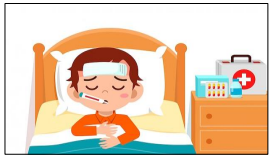
(Available on: https://www.freepik.com/premium-vector.)
“The little boy has a fever, a sore throat, and he is also coughing a lot, so it is recommended that he __________ home.”
Read the text to answer question
Jean Piaget was a Swiss psychologist and genetic epistemologist. You may have heard of Jean Piaget's theory of cognitive development, for which he is famous. This theory looks at how children develop intellectually throughout the course of childhood. Prior to Piaget's theory, children were often thought of simply as mini-adults. Piaget's theory had a tremendous influence on the emergence of developmental psychology as a distinctive subfield within psychology and contributed greatly to the field of education. He is also credited as a pioneer of the constructivist theory, which suggests that people actively construct their knowledge of the world based on the interaction between their ideas and experiences. In a 2002 survey of 1,725 American Psychological Society members, Piaget was named the second most influential psychologist of the 20th century.
(Available on: https://www.verywellmind.com/jean-piaget-biography-1896-1980-2795549.)
The word MAY (L1), is used to indicate:
Analyse the set of sentences to answer question.
1. The police are trying to find the convict who fled jail.
2. Fred or Wilma clean the church windows every now and then.
3. All proceeds from the concert goes to the flood victims.
4. Neither Bob nor James is very congenial and caring with elders.
5. I wish it were Friday because everyone is so exhausted already.
6. If the fumigating guys don’t come soon, the mice is wrecking all wiring.
7. The politician, along with the newsmen, is supposed to come today.
8. It is necessary that he be here on time, or he’ll lose this job.
9. I wouldn’t buy such an expensive gadget if I were you.
10. A lot of useful information is available on the Internet.
Subject-verb agreement, also “subject-verb concord,” concerns to matching subject and verb in tense, aspect, and mood (abbreviated
TAM), which translates to number, person, and gender. The item that points out verb-subject agreement inconsistencies is:
Read the text and answer the following question.
Do you assess your students or do you just test them?
[01] Assessment, evaluation, measurement, grades, tests, marks and so on. Different words to talk about the same issue. But, should they be used as synonyms?
[02] There are some terms that we often use synonymously, but actually they are not. When you assess your students, regardless of whether you use a test or not, you evaluate all the information in order to measure it and grade them.
[03] Let´s make it clear:
-Assessment implies gathering information and observing progress. We can document attitudes, knowledge and skills.
-Evaluation is the organisation of the data obtained during the assessment; for instance, using grids, checklist or diaries.
-Measurement is the scale we decide to use in order to measure the evaluation. We measure by marks, ranks or scores, among others.
-Grade is the number obtained in the measurement.
-Testing is a measuring tool. We can use a test, an examination or a quiz to challenge the student´s ability or knowledge.
[04] If you really want to assess your students and make it an active part of their own learning, promoting autonomy and metacognition, they have to know, from the very beginning, about the assessment, evaluation and grading criteria, as well as about the examinations, if there are going to be some.
[05] Assessment should be a continuous process, gathering information in every lesson and getting to know our students more and more each day, both their personal and academic profile. In order to evaluate this data, we can use simple checklists, a classroom diary, grids or similar instruments, as well as the activities themselves.
[06] When dealing with all of these tools you have to think carefully about how you are going to measure the information and how you are going to award the final grade. Moreover, you have to weigh up the benefits of testing your students with one or more quizzes and examinations.
[07] As we all know, changes are possible, and in many cases necessary, in order to adapt your theory to the actual development of the lessons. Nevertheless, all these aspects should be planned and clear from the very beginning, both for you and for your students. It could also be interesting to make them clear to the families, for instance using a classroom blog in which you can publish your evaluation methods and criteria.
[08] This could be a general example:
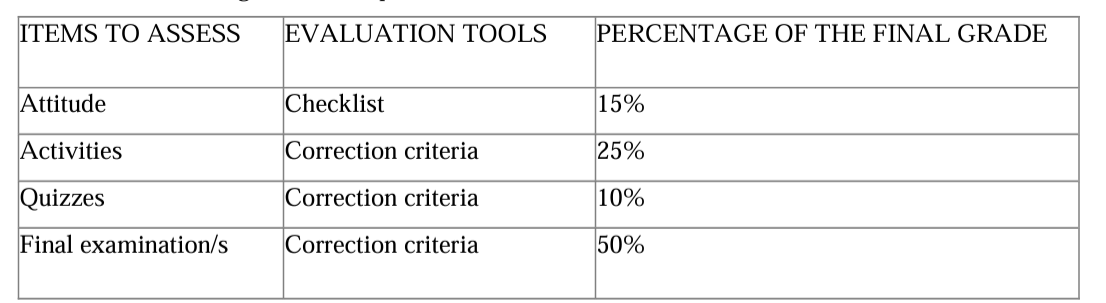
[09] From this general proposal, we would develop a checklist with items relating to attitude: participation, collaboration, deadline accomplishment, attendance, and so on. This is a progressive assessment.
[10] The activities should be corrected using different tools, depending on their nature. For example, it is not the same correcting a writing or a speaking activity (we can create grids for those, alone or with our students) than correcting a grammar exercise or a listening one (we can correct them using more traditional measuring scales or we could use peer evaluation). We would have to make all those criteria clear to our students before using them.
[11] Quizzes can be used in order to prepare our students for the final examination. We can use new technologies in order to introduce them, with tools such as Kahoot, Mentimeter, Socrative or Google Forms, among many others. They can create their own quizzes and games, in groups or individually in order to challenge their classmates.
[12] The final examination could be made up of more than one paper, for instance, we could divide it in two, or even in more items, in order to give them the opportunity to practise and avoid risking their final grade on just one exam.
[13] Apart from the possibility of dividing the final examination in two parts, another option would be to divide it according to different skills, for example, on the one hand, a test having to do with grammar, vocabulary, reading and writing and, on the other hand, another having to do with speaking and listening. Flipgrid could be a very useful tool to carry out your oral examinations in a less stressful way.
[14] Before I finish, although we haven´t given specific solutions to the complex problem of assessment, I would like to sum up with some general tips about the issue: -Necessity of an objective and continuous assessment.
-Necessity of an objective and continuous assessment.
-Use a variety of evaluation tools, not only for the exams, but also for the process: different types of activities, exams and corrections, to respond to every single student. That will make it less subjective.
-Make the evaluation and marking criteria clear to your students. You can make them part of the process, for example creating grids or checklists together.
-Introduce peer evaluation and self-asessment.
-Be prepared to adapt your planning when necessary.
[15] And remember, try to point out the positive aspects of your students´ achievements, don´t give them only feedback about their weak points, tell them about their strong points too and try to be quick in giving them back their exercises or exams results, otherwise they will have completely forgotten what they have written.
[16] The more you get to know your students, the more accurate your assessments will be, enabling them to obtain higher marks in your evaluations, tests, activities or examinations.
(Available at: https://www.teachingenglish.org.uk/professional-development/teachers/assessinglearners/magazine/do-you-assess-your-students-or-do-you Access on September 08, 2023)
Paragraph 15.
“[...]And remember, try to point out the positive aspects of your students´ achievements [...]”
The term POINT (verb) + OUT (preposition) is a/na:
Read the text and answer the following question.
Do you assess your students or do you just test them?
[01] Assessment, evaluation, measurement, grades, tests, marks and so on. Different words to talk about the same issue. But, should they be used as synonyms?
[02] There are some terms that we often use synonymously, but actually they are not. When you assess your students, regardless of whether you use a test or not, you evaluate all the information in order to measure it and grade them.
[03] Let´s make it clear:
-Assessment implies gathering information and observing progress. We can document attitudes, knowledge and skills.
-Evaluation is the organisation of the data obtained during the assessment; for instance, using grids, checklist or diaries.
-Measurement is the scale we decide to use in order to measure the evaluation. We measure by marks, ranks or scores, among others.
-Grade is the number obtained in the measurement.
-Testing is a measuring tool. We can use a test, an examination or a quiz to challenge the student´s ability or knowledge.
[04] If you really want to assess your students and make it an active part of their own learning, promoting autonomy and metacognition, they have to know, from the very beginning, about the assessment, evaluation and grading criteria, as well as about the examinations, if there are going to be some.
[05] Assessment should be a continuous process, gathering information in every lesson and getting to know our students more and more each day, both their personal and academic profile. In order to evaluate this data, we can use simple checklists, a classroom diary, grids or similar instruments, as well as the activities themselves.
[06] When dealing with all of these tools you have to think carefully about how you are going to measure the information and how you are going to award the final grade. Moreover, you have to weigh up the benefits of testing your students with one or more quizzes and examinations.
[07] As we all know, changes are possible, and in many cases necessary, in order to adapt your theory to the actual development of the lessons. Nevertheless, all these aspects should be planned and clear from the very beginning, both for you and for your students. It could also be interesting to make them clear to the families, for instance using a classroom blog in which you can publish your evaluation methods and criteria.
[08] This could be a general example:
[09] From this general proposal, we would develop a checklist with items relating to attitude: participation, collaboration, deadline accomplishment, attendance, and so on. This is a progressive assessment.
[10] The activities should be corrected using different tools, depending on their nature. For example, it is not the same correcting a writing or a speaking activity (we can create grids for those, alone or with our students) than correcting a grammar exercise or a listening one (we can correct them using more traditional measuring scales or we could use peer evaluation). We would have to make all those criteria clear to our students before using them.
[11] Quizzes can be used in order to prepare our students for the final examination. We can use new technologies in order to introduce them, with tools such as Kahoot, Mentimeter, Socrative or Google Forms, among many others. They can create their own quizzes and games, in groups or individually in order to challenge their classmates.
[12] The final examination could be made up of more than one paper, for instance, we could divide it in two, or even in more items, in order to give them the opportunity to practise and avoid risking their final grade on just one exam.
[13] Apart from the possibility of dividing the final examination in two parts, another option would be to divide it according to different skills, for example, on the one hand, a test having to do with grammar, vocabulary, reading and writing and, on the other hand, another having to do with speaking and listening. Flipgrid could be a very useful tool to carry out your oral examinations in a less stressful way.
[14] Before I finish, although we haven´t given specific solutions to the complex problem of assessment, I would like to sum up with some general tips about the issue: -Necessity of an objective and continuous assessment.
-Necessity of an objective and continuous assessment.
-Use a variety of evaluation tools, not only for the exams, but also for the process: different types of activities, exams and corrections, to respond to every single student. That will make it less subjective.
-Make the evaluation and marking criteria clear to your students. You can make them part of the process, for example creating grids or checklists together.
-Introduce peer evaluation and self-asessment.
-Be prepared to adapt your planning when necessary.
[15] And remember, try to point out the positive aspects of your students´ achievements, don´t give them only feedback about their weak points, tell them about their strong points too and try to be quick in giving them back their exercises or exams results, otherwise they will have completely forgotten what they have written.
[16] The more you get to know your students, the more accurate your assessments will be, enabling them to obtain higher marks in your evaluations, tests, activities or examinations.
(Available at: https://www.teachingenglish.org.uk/professional-development/teachers/assessinglearners/magazine/do-you-assess-your-students-or-do-you Access on September 08, 2023)
Paragraph 14.
The passage below presents a _____________ tense structure.
“[...] we haven´t given specific solutions to the complex problem of assessment[...]”

 Conheça nossos planos