Questões de Concurso
Sobre verbos | verbs em inglês
Foram encontradas 3.096 questões


Q2348166
Inglês
Texto associado
What is agronomy? An agronomist, or crop
scientist, studies plants and how they can be grown,
modified, and used to benefit society. They use science
to carry out experiments that create new techniques for
agriculture production. Agronomy has existed and been
important for humans since the invention of farming.
Internet: <unity.edu> (with adaptations).
According to the text, judge the item from.
The last period of the text is in the present perfect tense in which “been” is the past participle of the verb to be.
The last period of the text is in the present perfect tense in which “been” is the past participle of the verb to be.
Q2348164
Inglês
Texto associado
Agronomy looks at agriculture from an integrated,
holistic perspective. Agronomists are specialists in crop
and soil science, as well as ecology. Some things they look
at are:
• the properties of the soil;
• how the soil interacts with the growing crop;
• what nutrients (fertilizers) the crop needs;
• when and how to apply these nutrients;
• the ways that crops grow and develop;
• how climate and other environmental factors affect the crop at all stages;
• how best to control weeds, insects, fungi, and other crop pests; and,
• how to grow crops effectively and profitably while conserving and protecting the environment.
Internet: <www.agronomy.org> (with adaptations).
According to the text, judge the item from.
There are five occurrences of the verb to be in the text.
There are five occurrences of the verb to be in the text.
Ano: 2023
Banca:
Instituto Access
Órgão:
Prefeitura de Passos - MG
Prova:
Instituto Access - 2023 - Prefeitura de Passos - MG - PEB - Língua Inglesa |
Q2348002
Inglês
Texto associado
11.30.2023
City lawmakers in Brazil have enacted what appears to be the
nation’s first legislation written entirely by artificial intelligence
(AI) — even if they didn’t know it at the time.
The experimental ordinance was passed in October in the southern
city of Porto Alegre and city councilman Ramiro Rosário revealed
that it was written by a chatbot, sparking objections and raising
questions about the role of artificial intelligence in public policy.
Rosário told The Associated Press that he asked OpenAI’s chatbot
ChatGPT to craft a proposal to prevent the city from charging
taxpayers to replace water consumption meters if they are stolen.
He then presented it to his 35 peers on the council without making
a single change or even letting them know about its
unprecedented origin. The 36-member council approved it
unanimously and the ordinance went into effect on Nov. 23.
The arrival of ChatGPT on the marketplace just a year ago has
sparked a global debate on the impacts of potentially
revolutionary AI-powered chatbots. While some see it as a
promising tool, it has also caused concerns and anxiety about the
unintended or undesired impacts of a machine handling tasks
currently performed by humans.
Porto Alegre, with a population of 1.3 million, is the second-largest
city in Brazil’s south. The city’s council president, Hamilton
Sossmeier, found out that Rosário had enlisted ChatGPT to write
the proposal when the councilman bragged about the
achievement on social media. Sossmeier initially told local media
he thought it was a “dangerous precedent.”
The AI large language models that power chatbots like ChatGPT
work by repeatedly trying to guess the next word in a sentence and
are prone to making up false information, a phenomenon
sometimes called hallucination.
All chatbots sometimes introduce false information when
summarizing a document, ranging from about 3% of the time for
the most advanced GPT model to a rate of about 27% for one of
Google’s models, according to recently published research by the
tech company Vectara.
In an article published on the website of Harvard Law School’s
Center of Legal Profession earlier this year, Andrew Perlman,
wrote that ChatGPT “is a machine learning system, it may not have
the same level of understanding and judgment as a human lawyer
when it comes to interpreting legal principles and precedent. This
could lead to problems in situations where a more in-depth legal
analysis is required”.
There was no such transparency for Rosário’s proposal in Porto
Alegre. Sossmeier said Rosário did not inform fellow council
members that ChatGPT had written the proposal.
Rosário told the AP his objective was also to spark a debate. He
said he entered a 49-word prompt into ChatGPT and it returned
the full draft proposal within seconds, including justifications.
And the council president, who initially decried the method,
already appears to have been swayed. “I changed my mind,”
Sossmeier said. “I started to read more in depth and saw that,
unfortunately or fortunately, this is going to be a trend.”
( (<https://www.washingtonpost.com/world/2023/11/30/brazil-artificial-intelligenceporto-alegre/9f576ecc-8fb2-11ee-95e1-edd75d825df0_story.htm>(adapted))
Choose the best alternative: “Person’s use of GPT _____ ”.
Ano: 2023
Banca:
IDHTEC
Órgão:
Prefeitura de Ilha de Itamaracá - PE
Prova:
IDHTEC - 2023 - Prefeitura de Ilha de Itamaracá - PE - Professor de Inglês |
Q2346539
Inglês
Choose the correct imperative form of the verb for the given statement:
"_________ (to mix) the dry ingredients in a bowl."
Ano: 2023
Banca:
IDHTEC
Órgão:
Prefeitura de Ilha de Itamaracá - PE
Prova:
IDHTEC - 2023 - Prefeitura de Ilha de Itamaracá - PE - Professor de Inglês |
Q2346534
Inglês
Read the sentences below and identify the correct form of the
verb 'to do' that should be used in the Present Simple tense based
on the routine activities:
'I play soccer every Friday', 'She practices the piano after school', 'We go for a walk with the dog', 'He feeds his pet fish before dinner'.
'I play soccer every Friday', 'She practices the piano after school', 'We go for a walk with the dog', 'He feeds his pet fish before dinner'.
Ano: 2023
Banca:
IDHTEC
Órgão:
Prefeitura de Ilha de Itamaracá - PE
Prova:
IDHTEC - 2023 - Prefeitura de Ilha de Itamaracá - PE - Professor de Inglês |
Q2346528
Inglês
'Come, we shall have some fun now!' thought Alice. 'I'm glad
they've begun asking riddles. I believe I can guess that,' she added
aloud.
What role does the imperative form play in the given context?
What role does the imperative form play in the given context?
Ano: 2023
Banca:
IDHTEC
Órgão:
Prefeitura de Ilha de Itamaracá - PE
Prova:
IDHTEC - 2023 - Prefeitura de Ilha de Itamaracá - PE - Professor de Inglês |
Q2346522
Inglês
For many people, one of the most challenging aspects of
learning English is the use of phrasal verbs. There are, literally,
thousands of them, and no shortcuts to make them any easier.
Choose the correct alternative about this theme:
Ano: 2023
Banca:
IDHTEC
Órgão:
Prefeitura de Ilha de Itamaracá - PE
Prova:
IDHTEC - 2023 - Prefeitura de Ilha de Itamaracá - PE - Professor de Inglês |
Q2346521
Inglês
Imagine that you are reading about a famous scientist's life,
who made significant discoveries in his field. Which of the
following sentences correctly uses the simple past tense to
describe an event that happened in the scientist's life?
Ano: 2023
Banca:
IDHTEC
Órgão:
Prefeitura de Ilha de Itamaracá - PE
Prova:
IDHTEC - 2023 - Prefeitura de Ilha de Itamaracá - PE - Professor de Inglês |
Q2346519
Inglês
'The sun did not shine. It was too wet to play. So we sat in the
house. All that cold, cold, wet day.' Using the verb 'to be', how
could you rephrase the second sentence to maintain its original
meaning?
Ano: 2023
Banca:
IDHTEC
Órgão:
Prefeitura de Ilha de Itamaracá - PE
Prova:
IDHTEC - 2023 - Prefeitura de Ilha de Itamaracá - PE - Professor de Inglês |
Q2346517
Inglês
Choose the correct answer:
Ano: 2023
Banca:
IDHTEC
Órgão:
Prefeitura de Ilha de Itamaracá - PE
Prova:
IDHTEC - 2023 - Prefeitura de Ilha de Itamaracá - PE - Professor de Inglês |
Q2346516
Inglês
Based on the following excerpt from Charlotte's Web by E.B.
White:
'Wilbur was lonely. The sheep were asleep. His stomach was empty.'
What is the correct form of the verb 'to be' used in these sentences and why?
'Wilbur was lonely. The sheep were asleep. His stomach was empty.'
What is the correct form of the verb 'to be' used in these sentences and why?
Ano: 2023
Banca:
IDHTEC
Órgão:
Prefeitura de Ilha de Itamaracá - PE
Prova:
IDHTEC - 2023 - Prefeitura de Ilha de Itamaracá - PE - Professor de Inglês |
Q2346515
Inglês
How would you use the verb 'to be' to ask a question about
Harry's profession?
Ano: 2023
Banca:
Itame
Órgão:
Prefeitura de Novo Gama - GO
Prova:
Itame - 2023 - Prefeitura de Novo Gama - GO - Professor - Inglês |
Q2345005
Inglês
Texto associado
2023 Theme
Green Skills for Youth: Towards a Sustainable
World
Today, the world is embarking on a green transition.
The shift towards an environmentally sustainable and
climate-friendly world is critical not only for
responding to the global climate crisis but also for
achieving the Sustainable Development Goals (SDGs).
A successful transition towards a greener world will
depend on the development of green skills in the
population. Green skills are “knowledge, abilities,
values and attitudes needed to live in, develop and
support a sustainable and resource-efficient society”.
These include technical knowledge and skills that
enable the effective use of green technologies and
processes in occupational settings, as well as
transversal skills that draw on a range of knowledge,
values and attitudes to facilitate environmentally
sustainable decisions in work and in life. Due to their
interdisciplinary nature, the essence of green skills is
sometimes expressed, partly if not wholly, through
other associated terms such as “skills for the future”
and “skills for green jobs”. While green skills are
relevant for people of all ages, they have heightened
importance for younger people, who can contribute to
the green transition for a longer period of time.
https://www.un.org/en/observances/youth-day
Considering the linguistic elements in the text,
Ano: 2023
Banca:
FGV
Órgão:
Prefeitura de São José dos Campos - SP
Prova:
FGV - 2023 - Prefeitura de São José dos Campos - SP - Professor II - Inglês |
Q2344910
Inglês
Texto associado
Read Text IV and answer the question that follow it
Text IV
Teaching Reading Strategies
No matter what we are reading there are effective reading
strategies we call on in order to make meaning from the text. Many
of these strategies can be taught with comics and graphic novels.
The ones highlighted below are particularly important when
reading graphic texts.
Drawing Inferences
In comics and graphic novels, perhaps more than any other text,
readers must build understanding by filling in gaps. A whole world
of information is left in the gutter between the panels. The comic
artist expects the reader to infer the action that takes place off the
page. The more complex and sophisticated the comic, the more
important this strategy becomes. If the reader is not making
inferences, he is lost. Understanding this strategy and using it
effectively will help students read ’between the lines’ in more
traditional print narratives.
Visualization
Students who struggle with reading may not understand what
should be going on in the reader’s imagination during reading.
With comics and other visual texts, the images are there for the
reader. Through comics students can be taught how to create their
own mental images when reading more traditional texts.
It is important that students understand the visual cues that are
provided in the text. Although the words and images work
together to tell the story, comics are primarily visual narratives.
Therefore readers must draw on and integrate some important
background knowledge and understandings about visual texts,
comic elements and narrative structures in order to make
meaning. The more knowledge readers have about the way visual
texts work, the more successful they are likely to be.
Adapted from https://www.literacytoday.ca/home/reading/readingstrategies/reading-visual-texts/reading-comics
The base form, past form, and past participle of the main verb in
“he is lost” (2nd paragraph) are:
Ano: 2023
Banca:
FGV
Órgão:
Prefeitura de São José dos Campos - SP
Prova:
FGV - 2023 - Prefeitura de São José dos Campos - SP - Professor II - Inglês |
Q2344898
Inglês
Texto associado
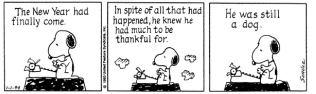
Read Text III and answer the question that follow it
Text III
From: https://peanuts.fandom.com/wiki/January_1994_comic_strips
The verb tense in the first panel is the:
Ano: 2023
Banca:
FGV
Órgão:
Prefeitura de São José dos Campos - SP
Prova:
FGV - 2023 - Prefeitura de São José dos Campos - SP - Professor II - Inglês |
Q2344894
Inglês
Texto associado

Read Text II and answer the question that follow it
Text II
The classes of the words “gift” and “give” are the same as in:
Ano: 2023
Banca:
FGV
Órgão:
Prefeitura de São José dos Campos - SP
Prova:
FGV - 2023 - Prefeitura de São José dos Campos - SP - Professor II - Inglês |
Q2344893
Inglês
Texto associado
Read Text II and answer the question that follow it
Text II
The verb used in the post is in the:
Ano: 2023
Banca:
FGV
Órgão:
Prefeitura de São José dos Campos - SP
Prova:
FGV - 2023 - Prefeitura de São José dos Campos - SP - Professor II - Inglês |
Q2344887
Inglês
Texto associado
Read Text I and answer the question that follow it:
Text I
Multimodality in the English language classroom:
A systematic review of literature
Literacy in the 21st century is now no longer regarded simply
as the ability to use a language competently in a mono-cultural
setting. Literacy today involves students knowing how to navigate
across an increasingly complex communication landscape and to
negotiate a range of contexts and patterns of intercultural
meanings as well as the prevalence of multimodal texts.
Contemporary communication environment is characterised
by multimodal meaning-making, that is the “multiplicities of media
and modes”, as well as “increasing local diversity and global
connectedness” (New London Group, 1996, p. 62) which
necessitates a shift in the pedagogical approaches that are
adopted by teachers. This is especially so in the digital age where
a sole focus on language in literacy is no longer sufficient for the
new workplace given that a revised sense of ‘competence’ is
required. The recognition of social diversity also demands
pedagogical approaches that engage with the transcultural and
multicultural classroom. Issues of the day such as fake news and
social justice concerns also need to be addressed in the literacy
classroom.
Multimodality focuses on understanding how semiotic
resources (visual, gestural, spatial, linguistic, and others) work and
are organised. Multimodality in education adopts an expanded
view of literacy to include the range of multimodal communicative
practices which young people are involved in today's digital age.
Multimodal pedagogies refer to the ways in which the teacher can
design learning experiences using a range of multimodal
resources. It involves teachers making design choices in the ways
in which the curriculum content is expressed, arranged, and sequenced multimodally. Multimodal pedagogies also involve
designing opportunities for students to explore and perform ideas
and identities using a range of meaning-making resources. The
teaching and learning activities often involve drawing from the
students’ funds of knowledge and their lifeworld. With multimodal
pedagogies, teachers orchestrate the learning process by weaving
together a series of knowledge representations into a cohesive
tapestry and in so doing make apt selection of meaning-making
resources to design the students’ learning experience.
Adapted from https://www.sciencedirect.com/science
/article/abs/pii/S0898589822000365
The modal verb in “The teacher can design learning experiences”
(3rd paragraph) indicates:
Ano: 2023
Banca:
OBJETIVA
Órgão:
Prefeitura de Capela de Santana - RS
Prova:
OBJETIVA - 2023 - Prefeitura de Capela de Santana - RS - Professo - Séries Finais - Inglês |
Q2343036
Inglês
Check the item that displays the CORRECT simple past
form for one of the verbs below:
Ano: 2023
Banca:
OBJETIVA
Órgão:
Prefeitura de Capela de Santana - RS
Prova:
OBJETIVA - 2023 - Prefeitura de Capela de Santana - RS - Professo - Séries Finais - Inglês |
Q2343027
Inglês
O simple past é a forma básica do passado (pretérito) no
inglês. O simple past é usado principalmente para:

 Conheça nossos planos