Questões de Concurso
Sobre substantivos e compostos | nouns and compounds em inglês
Foram encontradas 456 questões


Research-Article
How to be a successful app developer: lessons from the simulation of an app ecosystem
Soo Ling Lim, Peter J. Bentley
Abstract
App developers are constantly competing against each other to win more downloads for their apps. With hundreds of thousands of apps in these online stores, what strategy should a developer use to be successful? Should they innovate, make many similar apps, optimize their own apps or just copy the apps of others? Looking more deeply, how does a complex app ecosystem perform when developers choose to use different strategies? This paper investigates these questions using AppEco, the first Artificial Life model of mobile application ecosystems. In AppEco, developer agents build and upload apps to the app store; user agents browse the store and download the apps. A distinguishing feature of AppEco is the explicit modelling of apps as artefacts. In this work we use AppEco to simulate Apple's iOS app ecosystem and investigate common developer strategies, evaluating them in terms of downloads received, app diversity, and adoption rate.
https://dl.acm.org/doi/10.1145/2384697.2384698
The same word can also be used as a noun in sentence:
Assinale a alternativa que preenche corretamente as lacunas:
I. She has ______ friends in her new school.
II. He has _____ books on his shelf.
III. We need to buy _____ milk for the recipe.
IV. There are _____ clouds in the sky today.
( ) Compound words usually consist of two words.
( ) Compound words are ALWAYS written separately.
( ) Compound words may be written separately, with a hyphen (-).
( ) The stress in a compound noun is always on the second word of the noun.
Assinale a alternativa que apresente a sequência correta:
Read Text II and answer question
University Degree Sill Best Way into Good Job
How do you get a good job? It might literally be a milliondollar question. And researchers from Georgetown University in the US have an answer: the best way is still to get a college education, even if you're a little late. That's their simple answer – one they came up with after looking at US government data for more than 8,000 Americans who were born in the early 1980s. They found that getting a bachelor's degree by the age of 26 gave people a 56% chance of getting a good job by the age of 30. For their study, the researchers defined a "good job" as one paying at least $ 38,000 for workers under the age of 45.
According to The Wall Street Journal, the research didn't focus on people who went straight to college after finishing high school because they already have a high chance of getting a good job. Instead, it looked at different pathways that people who didn't go straight to college after high school could take to increase their chances of getting a good job. For example, even just beginning a bachelor's degree by age 22 increased the likelihood of getting a good job by 16 percentage points, according to the report. But despite this evidence, according to a separate Wall Street Journal survey, more than half of people don't feel that doing a four-year degree is worth the cost, because students may finish without specific job skills and with a large amount of debt.
According to US News, in the academic year that ended in the summer of 2023, the average cost of going to an American university for a year started at about $ 10,000 for a public university, and went as high as almost $ 40,000 for a private school. And Zach Mabel, one of the authors of the Georgetown report, admits that although a university education is likely to be beneficial, for financial reasons "the risk of pursuing higher education is higher than it's ever been."
Source: https://engoo.com.br/app/daily-news/article/study-university-degree-stillbest-way-into-good-job/crbIxBR3Ee6ComdOtgdXYw
Read Text I and answer question

"The author's creativity and passion shine through in every chapter, making the story both engaging and thought-provoking."
POLITICAL POLLS
Despite their popularity, political polls, often seen on TV during elections, sometimes give _______1 results, and some Americans question their _______ 2 .
_______ 3 both 2016 and 2020, most national polls overestimated support for Democrats. Polls aim to show what people think at a certain time but can be tricky to predict future outcomes accurately.
Mallory Newall explains that reliable polls focus on understanding public opinions rather than just predicting election winners. She warns _______4 reading too much into small differences in polls, especially far _______5 election day. Red flags for bad polls include _______6 the right people and not being clear about how the data was collected.
Polling methods _______ 7 since 2016, with more surveys done on line. Online surveys may influence results; however, concerns remain about reaching everyone, especially in rural areas without good internet. Although _______8 challenges, polls remain important _______9 public opinion.
Source:
https://www.newsinlevels.com/products/political-polls-level-3/
Text I
The BNCC and Twenty-First Century Skills
The most ambitious feature of the BNCC, which only appeared in the document’s third version, was to establish ten core competencies that all students should develop throughout basic education, starting in early childhood. These competencies include lifelong learning, critical thinking, aesthetic sensibilities, communication skills, digital literacy, entrepreneurship, self-care, empathy, citizenship and ethics. The core competencies broaden the goals of basic education well-beyond academic skills to twenty-first century skills widely regarded as essential to preparing the next generations for the challenges of the 4th industrial revolution.
As ambitious as it was, the BNCC was criticized for the lack of explicit links between the ten core competencies and the subject specific competencies and skills, leaving cities and states with the responsibility of making these links themselves. In addition to this, the core competencies are not generally integrated into teacher training programs and are often de-prioritized for the more basic literacy and numeracy needs. In this context, the Ministry of Education and its partners in the third sector have developed orientations, produced videos and online courses aimed at filling this gap, and helped cities and states integrate the ten core competencies in their curricula.
[…]
Ensuring all Brazilian students master the ten core competencies laid out by the BNCC by the end of high school is a long-term, extremely ambitious goal. Before we can set a timeframe for when we will be able to achieve this feat, we need to know where we stand. Due to the core competencies’ complexity, each involves several skills, attitudes and sometimes values, it is unclear whether we will be capable of measuring all ten of them and by when. Until then we are in the company of the OECD, which is already tackling this challenge and will likely pave the way for Brazil in this respect
Note: BNCC: Base Nacional Comum Curricular;
OECD: The Organization for Economic Cooperation and Development.
Adapted from https://link.springer.com/chapter/10.1007/978-3-030-41882-3_2
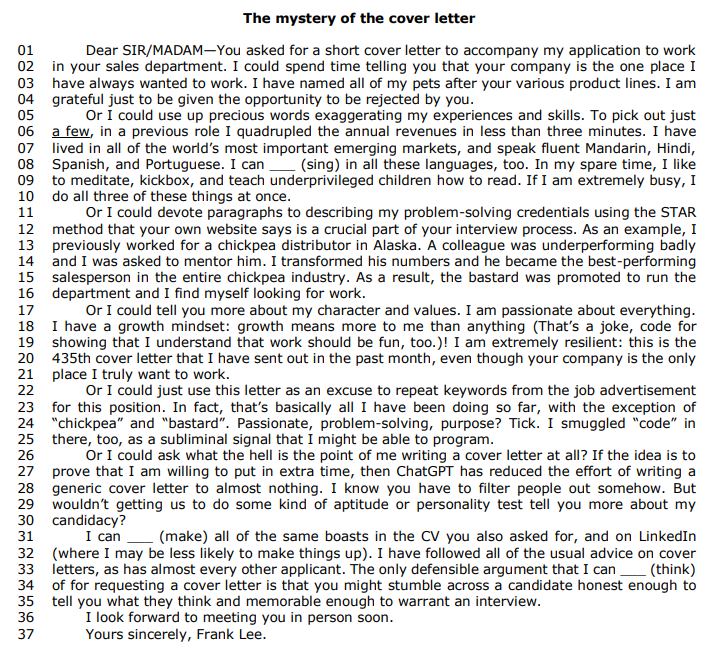
(Available at: https://www.economist.com/business/2024/09/05/the-mystery-of-the-cover-letter – text specially adapted for this test).
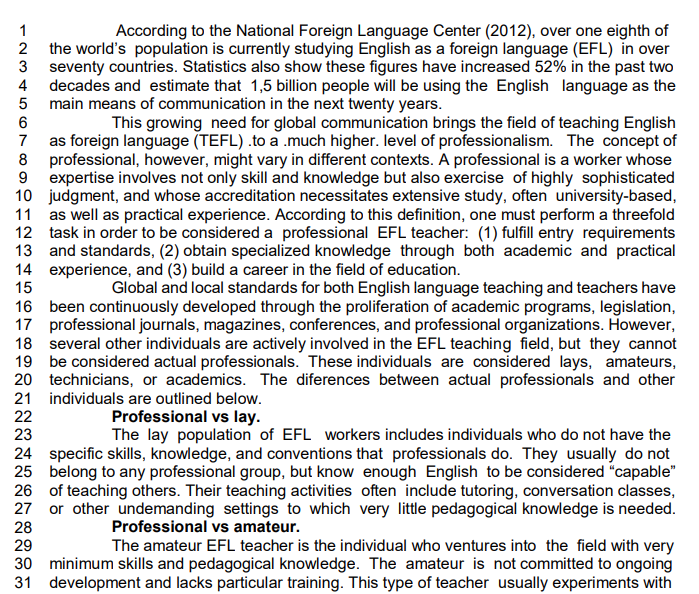
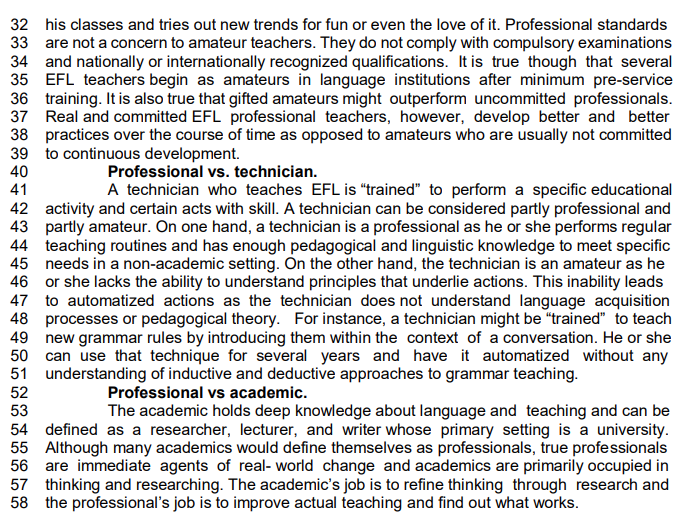
“The professional of Teaching English as a Foreign Language”
Author: Anderson Francisco Guimarães Maia
Determiners are words that modify nouns but cannot be used alone.
Judge the next item, about the semantics and morphosyntax of the English language.
The sentence "The committee is deciding on the new
policies" demonstrates a case of collective noun agreement, where "committee" is treated as singular
despite referring to a group
1. The phrasal verb took place (1st paragraph) means happened, occurred.
2. The underlined words in th first paragraph mainly, completely, and occasionally are examples of adverbs of manner.
3. In the 3rd paragraph, the pronoun They (in bold), refers to the rings.
4. Women (1st paragraph) is the plural form of woman.
Choose the alternative which contains the correct sentences.
Read the excerpts from Text I and analyze the assertions.
A. “… that the third quarter of 2021…”
B. “…it doesn't work as well as it should...”
C. “Clocking out at 5 p.m. on the dot…”
D. “… evoking images of a slacker…”
I. Used as a discourse marker, “should” is also an auxiliary modal verb that refers to a past situation in sentence B.
II. In sentence A, “third” is a cardinal number.
III. “Slacker” is a countable noun in sentence D.
IV. “On the dot”, in sentence C, means “exactly at the stated or expected time”.
The CORRECT assertion(s) is(are):
I. Her aunt will be vacating next week.
II. That toy on the shelf is mine.
III. Did you do it yourself?
IV. She is the girl I was talking to you about.
V. I am going home today evening.
VI. All my friends are coming home for my birthday party.
In the order they were respectively underlined and written in bold letters, the pronouns written in the sentences above have specific functions, check the answer whose pronouns types are correspondent to the ones read above.
( ) Similar kinds of analyses can diagnose two other forms of complexity. (Times, Sunday Times, 2009). ( ) The sanctuary needed more humdrum fowl, more farmyard ducks and geese. (Ballard, J. G. Rushing to Paradise, 2002). ( ) The animals closely resemble wolfes, howl, and are more likely to be aggressive. (Times, Sunday Times, 2012). ( ) The iris of their eyes have an unusual lacy appearance. (Wills, C. The Runaway Brain: the Evolution of Human Uniqueness, 1993). ( ) Your older brother has been thrown in jail for his political beliefs. (Times, Sunday Times, 2007).
Assinale a alternativa que apresenta a sequência CORRETA.
Having analysed the words in the group, and taking into account words’ formation processes, there is correct data applicable to all of the group components in:
endanger- kilometre-outnumber-telescope-polyglot-misunderstood-prewar-
maltreat-photosynthesis-archbishop-deforestation-enable-rewind-absent

 Conheça nossos planos