Questões de Concurso Sobre substantivos e compostos | nouns and compounds em inglês

Foram encontradas 447 questões

Q2248474 Inglês

What life in medieval Europe was really like


      A time of innovation, philosophy, and legendary works of art: the realities of the medieval period (500 to 1500 C.E.) in Europe may surprise you. Many know the years before the Renaissance and _________________ that followed as Europe’s “Dark Ages,” a time of backward, slovenly, and brutal people who were technologically primitive and hopelessly superstitious.

     Sure, it would take until the 19th century for the germ theory of disease to overtake the concept of humors and “miasmas” that could damage human health. But the ___________ image of medieval people as slovenly, unwashed, and lacking hygiene is false. In fact, both indoor and outdoor bathing were beloved in Europe. People not only made and used soap at home, but they frequented bathhouses—some public, some private, some merely fronts for brothels.

      A myth persists that during the Middle Ages, the unenlightened believed Earth was flat and worried that ships might even fall off the planet’s edge. That’s patently false: People knew the planet was a sphere as far back as ancient Greece (12th to 9th centuries B.C.), and had relatively complex astronomical and planetary ______________ by the time Christopher Columbus made his voyage to the Americas in 1492.

      The so-called “Dark Ages” is a myth historians have spent years trying to disprove. The myth seems to stem from some authors’ use of “dark” to refer to everything from a 14th-century poet’s complaints about the quality of local literature to a 17th-century historian’s failed attempt to find historical sources from centuries earlier.


(Fonte: National Geographic — adaptado.)
Considering the different uses for -ing forms, number the 2nd column according to the 1st column, then check the item that presents the CORRECT sequence:
(1) Noun. (2) Present participle. (3) Adjective.
(_) Playing piano is a great pleasure.
(_) That man is drinking.
(_) No parking.
( ) The rising prices are scary.

Alternativas
Q2238992 Inglês
Text 2A7

         Artificial intelligence (AI) is arguably the most rapidly advancing technology humans have ever developed. A year ago, you wouldn’t often hear AI come up in a regular conversation, but today it seems there’s constant talk about how generative AI tools like ChatGPT and DALL-E will affect the future of work, the spread of information, and more. A major question that has thus far been almost entirely unexamined is how this AI-dominated future will affect people’s minds.
           
           There’s been some research into how using AI in their jobs will affect people mentally, but there isn’t yet an understanding of how simply living amongst so much AI-generated content and systems will affect people’s sense of the world. How is AI going to change individuals and society in the not-too-distant future?

            AI will obviously make it easier to produce disinformation. That will affect people’s sense of trust as they’re scrolling on social media. AI can also allow someone to imitate your loved ones, which further erodes people’s general ability to trust what was once unquestionable.

Internet: <wired.com> (adapted). 
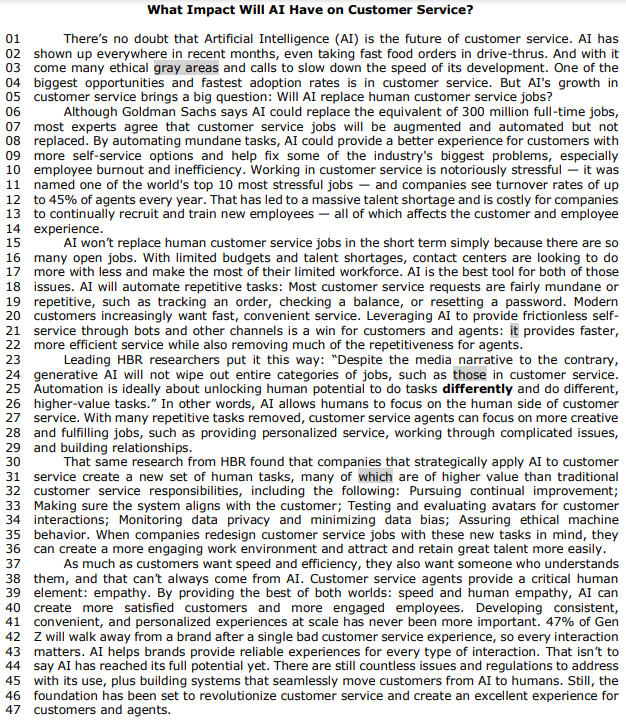
In the context of the first sentence of the second paragraph of text 2A7, the word “understanding” is grammatically classified as 
Alternativas
Q2231441 Inglês
(§1º)Budelli Island is part of the La Maddalena Archipelago and is home to Spiaggia Rosa - a stretch of pink sand that's been protected by the Italian government since 1992.

(§2º)The pink shade is caused by the crushed shells of a micro-organism mixing with the sand when it dies. But when the beach started to lose its rose-tinted hue because of over-tourism, visitors were banned in a bit to protect the pink sand.

(§3º)The colour has since returned but a new wave of unauthorised daytrippers are threatening the pink shores. While it is strictly forbidden to step foot on the beach, holidaymakers are able to admire the pink sand from the safety of a boat. But according to one expert, some holidaymakers are flouting the ban.

(§4º)In an article in the Times, Fabrizio Fonnesu, director of the Maddalena archipelago national park said: "The beach is again in danger as people arrive by boat, clamber up the beach, then post photos, which allow us to fine them up to 500 euros (£430)."

(§5º)Tourists who've attempted to take Sardinia's pink sand away as a souvenir can up fined up to 3,500 euros (£3,007). And according to the Guardian, a couple were fined 1,000 euros (£860) in 2001 after they were caught filling a plastic bottle with sand.

(§6º)Brits who want to visit the island will need to book themself onto a private boat tour or a ferry service to glimpse this secluded spot from afar. Other beaches on the island have also brought in measures to minimise the impact of tourists. Only 1,600 people can visit Cala Sisine while Santa Maria Navarrese only permits 1,300 euros.

(§7º)Fewer still are able to visit Cala Mariolu, with only 550 people allowed in per day and each having to pay a 1 euro fee. Elsewhere, Pelosa Beach has banned towels and asked visitors to instead bring mats which gather less sand. Anyone visiting will have to pay 3.50 euros.

(§8º)Meanwhile, tourists wanting to visit the beaches of Cala Coticcio and Cala Brigantina in the archipelago of La Maddalena will have to pay 3 euros per person for access each day after new rules were brought in. The archipelago itself is a national park and only accessible with a guide, which will cost 25 euros for five hours.

(§9º)And anyone caught visiting the archipelago without a guide could face prosecution. Just 60 people will be permitted on each beach per day, as the local authorities look at ways to protect the sites from the impact of tourism.

(§10º)Slots must be booked in advance by contacting a local guide but it is hoped that an app will be launched soon. Here are several other pink beaches holidaymakers can visit across Europe - and one's in the UK. And a beach in the Canary Islands even has sand that looks like popcorn, due to the shape of the coral.

itssfnneed
w.thesun.co.uk/travel/22667535/pink-beach-italy-bundelli-tourists-fined/
Identify the grammatical class of the word "unauthorised" (§3º) in the text: 
Alternativas
Q2215007 Inglês
          As new technologies take on increasingly humanlike qualities, there’s been a push to make them genderless. Apple’s Siri digital assistant unveiled a gender-neutral option last year, and when asked about their gender identities, the AI chatbots ChatGPT and Google Bard each reply, “I do not have a gender.”
     There have been concerns over gendering technology, since doing so reinforces societal stereotypes. That happens because the stereotypes commonly associated with men, such as competitiveness and dominance, are more valued than those associated with women. That is likely true, says Ashley Martin, a professor at Stanford University. “People are stereotyping their gendered objects in very traditional ways,” she says.
          Removing gender from the picture altogether seems like a simple way to fix this. Yet, as Martin has found in her latest research, conducted with Malia Mason, of Columbia Universty, gender is one of the fundamental ways people form connections with objects, particularly those designed to evoke human characteristics.
          Throughout the experiments, Martin and Mason found that gender increased users’ feelings of attachment to devices such as digital voice assistants –– and their interest in purchasing them. For example, participants said they would be less likely to buy a genderless voice assistant than versions with male or female voices.

Hope Reese. Is That Self-Driving Car a Boy or a Girl? In: Insights by Stanford Business. Internet:<http://www.gsb.stanford.edu/>  (adapted)

Judge the following item, related to the vocabulary and to the grammar in the precedent text.


The word “Removing” in the beginning of the third paragraph, is an example of how a verb can be turned into a noun in English.


Alternativas
Q2210436 Inglês

Stop Wasting Time: A 15-minute Planning Session That Will Save You Hours


(Available at: https://www.classycareergirl.com/5-simple-time-management-tips-for-a-great-week/– textespecially adapted for this test).
Each one of the nouns below follow a different spelling rule when in its plural form:
1. car > cars 2. witch > witches 3. city > cities
Which combination of words below follow the same rules, in the same order? 
Alternativas
Q2209848 Inglês


Try these expert tips for a safer solo trip


(Available at: https://news.airbnb.com/try-these-expert-tips-for-a-safer-solo-trip/ – text especially adapted for this text).

Analyze the following sentences below about the bold word “much” (l. 16):
I. It expresses a small amount. II. Its use is correct because it precedes an uncountable noun. III. It would be grammatically correct to replace the word by “many”.
Which ones are correct?
Alternativas
Q2208076 Inglês
Which noun does not have the correct definition? Choose the INCORRECT answer.
Alternativas
Q2204964 Inglês
Text I

What is English as a Lingua Franca?

      ‘English’, as a language, has for some time been seen as a global phenomenon and, therefore, as no longer defined by fixed territorial, cultural and social functions. At the same time, people using English around the world have been shaping it and adapting it to their contexts of use and have made it relevant to their socio-cultural settings. English as a Lingua Franca, or ELF for short, is a field of research interest that was born out of this tension between the global and the local, and it originally began as a ramification of the World Englishes framework in order to address the international, or, rather, transnational perspective on English in the world. The field of ELF very quickly took on a nature of its own in its attempt to address the communication, attitudes, ideologies in transnational contexts, which go beyond the national categorisations of World Englishes (such as descriptions of Nigerian English, Malaysian English and other national varieties). ELF research, therefore, has built on World Englishes research by focusing on the diversity of English, albeit from more transnational, intercultural and multilingual perspectives.
      ELF is an intercultural medium of communication used among people from different socio-cultural and linguistic backgrounds, and usually among people from different first languages. Although it is possible that many people who use ELF have learnt it formally as a foreign language, at school or in an educational institution, the emphasis is on using rather than on learning. And this is a fundamental difference between ELF and English as a Foreign Language, or EFL, whereby people learn English to assimilate to or emulate native speakers. In ELF, instead, speakers are considered language users in their own right, and not failed native speakers or deficient learners of English. Some examples of typical ELF contexts may include communication among a group of neuroscientists, from, say, Belgium, Brazil and Russia, at an international conference on neuroscience, discussing their work in English, or an international call concerning a business project between Chinese and German business experts, or a group of migrants from Syria, Ethiopia and Iraq discussing their migration documents and requirements in English. The use of English will of course depend on the linguistic profile of the participants in these contexts, and they may have another common language at their disposal (other than English), but today ELF is the most common medium of intercultural communication, especially in transnational contexts.
        So, research in ELF pertains to roughly the same area of research as English as a contact language and English sociolinguistics. However, the initial impetus to conducting research in ELF originated from a pedagogical rationale – it seemed irrelevant and unrealistic to expect learners of English around the world to conform to native norms, British or American, or even to new English national varieties, which would be only suitable to certain socio-cultural and geographical locations. So, people from Brazil, France, Russia, Mozambique, or others around the world, would not need to acquire the norms originated and relevant to British or American English speakers, but could orientate themselves towards more appropriate and relevant ways of using English, or ELF. Researchers called for “closing a conceptual gap” between descriptions of native English varieties and new empirical and analytical approaches to English in the world. With the compilation of a number of corpora, ELF empirical research started to explore how English is developing, emerging and changing in its international uses around the world. Since the empirical corpus work started, research has expanded beyond the pedagogical aim, to include explorations of communication in different domains of expertise (professional, academic, etc.) and in relation to other concepts and research, such as culture, ideology and identity.

Adapted from https://www.gold.ac.uk/glits-e/ back-issues/english-as-a-lingua-franca/

The underlined word in “Since the empirical corpus work started” (3rd paragraph) is a
Alternativas
Q2204596 Inglês

O texto seguinte servirá de base para responder a questão.


(1º§) Arthritis and osteoporosis are long-term conditions that affect your bones. Arthritis causes swelling and inflammation. Osteoporosis develops as a result of decreased bone mass and density, and can lead to fractures.

(2º§) Jane Atkinson looks at ways to keep your bones and joints healthy. Regular, low-impact exercise can help in the battle against joint pain. Nuffield Health has launched a free joint pain programme to help sufferers lead a more independent life - and you don't even need to be a paying member of the gym to join up. As well as exercises, it offers lifestyle tips and uses relaxation techniques to try to help with pain so those affected can sleep.

(3º§) The programme, which lasts six months, has proven results. Of those who completed it, 69 per cent say they have improvements in mobility, pain, general fitness levels and overall quality of life. Among participants who were in such pain they couldn't work, 30 per cent were able to return after week 12. Working out what supplements you need and how much you need is not always easy.

(4º§) Osteo Complete is a bone health complex that includes calcium, vitamin D3, zinc, boron and copper. These elements work together to help maintain your musculoskeletal system, which supports the body and its movements. Vitamin D3 is crucial for the absorption of calcium. The minerals magnesium and zinc contribute to normal protein synthesis, while copper helps maintain connective tissues.

(5º§) These very tasty vanilla-flavoured tablets are a good alternative for people who do not like swallowing pills as you can chew them. 240 chewable tablets, £18.95, healthspan.co.uk.

(6º§) The world has gone mad for collagen. There are different types, but for bone health the best is Type I. It provides structure to your skin, bones, tendons and ligaments. The change is not instant. Take it regularly and it could take a year to achieve the full results, but if you are persistent it does work. I like Correxiko Marine Collagen Type I. It comes from the skin of deep-sea fish, caught off the coast of Canada.

(7º§) It is an unflavoured powder that you bung in water or a coffee. Lisa Snowdon says her menopausal and age-related aches and pains have gone since she started using it. £39.95 for a 42-day supply, correxiko.com.


(adapted) https://www.thesun.co.uk/health/22499522/we-test-p ills-collagen-products-keep-bones-healthy/ (adapted) ts-keeeppboneeshealthy/ k/health/22499522/we-test-pills-collagen-products-keep-bones-healthy/
In the sentence "Of those who completed it, 69 percent say they have improvements [...]" (3º§), the parts of speech are as follows, EXCEPT:
Alternativas
Q2201497 Inglês

Text 2 – Computers

(Text adapted from History of Computing. Retrieved from

https://www.cs.utexas.edu/~mitra/csFall2006/cs 303/lectures/history.html)


When you hear the term computers, it’s difficult to imagine different devices from a laptop or a small desktop. Believe it or not, they weren’t always like they are today. They used to be very large and heavy, sometimes as big as an entire room. Some technology professors historically define computers, as “a device that can help with computations”. The word computation involves counting, calculating, adding, subtracting, etc. The modern definition of a computer is a little wider, because in our day and age, computers store, compile, analyze and compute an enormous amount of information. Ancient computers were very interesting. Actually, the first computer may have been located in Great Britain, at Stonehenge. It is a man-made circle of large stones. Citizens used it to measure the weather and forecast the change of seasons. Some specialists say that another ancient computer is the abacus. It was used by the early Romans, Greeks, and Egyptians to count and calculate. Even though they are no longer in use, certainly, these early devices are fascinating. Computers are embedded in our history and some people say that we are completely dependent of them. No matter the complexity of the task, easy or difficult, some people can’t do anything without them. Do you contest or share this opinion? 

The formation-ing in "Computing involves counting a lot of data" is correct. Check the alternative that explains the -ing formation of 'counting'. 
Alternativas
Q2201489 Inglês
A compound word is made of “two or more words linked together to produce a word with a new meaning” as stated in Cambridge Dictionary. Now tick the alternative that is an example of a compounded word. 
Alternativas
Q2201487 Inglês
Text 1- English as a global language
(Adapted from Teaching English Today: context
and objectives, Holden & Nobre, 2018, p.03)

All languages reflect the culture of the countries and regions where they have developed and are used. However, some languages are also used as a means of communication between a wide range of non-native speakers and contexts. In this way, the communication develops new priorities to reflect those contexts.
Today, English is probably the prime example of a global language. It is used to communicate in areas such as the workplace, science and technology, the arts and in the world of business. This is why so many parents are keen of their children to start learning it at an ever-earlier age. Students, too, realize that English in more than just a school subject: it is important for their own future success. This realization can be used to your advantage as a teacher:

Your students should be aware that English is widely used among non-native speakers in a variety of contexts in their own environments. It is no longer just linked with going to the US or Britain.
They are more likely to be motivated if they feel they are being given appropriate materials and practice for their own needs, which is easier to do nowadays, since English is present almost everywhere.
In fact, you are part of this world where English is used, however imperfectly, in real life, as well as being part of that other, classroom world. This gives your role even more importance.

The intercultural context

There are, then, clear practical and economic reasons why it is important for as many of your students as possible to feel positive about learning English, and ultimately, to feel confident about using it. However, there is also an equally important reason, which applies to all languages: their social function.
Learning and using another language can put people into contact, directly or indirectly, with others from different societies and cultures. It exposes them to different ways of thinking, different ways of communicating, different values. This, in turn, encourages them to think about their own culture, values and way of life. They realize there is not just one way of doing something, but many different ones.
In other words, as well as equipping learners with practical skills, learning a foreign language extends their horizons, which is one of the important aims of education in most countries.

In reading process, the strategy of finding the ‘headword(s)’ (noun in Morphology; and core argument in Syntax - as subject or object main word), and the ‘modifier(s)’ (words that modify the headword) is (are) important because it (they) can define the pluralization or not of a verb, and they can also provide the complement of a verb. The combination of H (headword) and M (modifier) is called nominal group.

From the underlined fragments, analyze the headword of each nominal group and mark the correct alternative. “the communication /develops /new priorities /to reflect /those contexts”. 

Alternativas
Q2184947 Inglês
Read the text fragment: “He has an interesting and unusual job”. About the -ing suffix forms, it is correct what is stated in:
I. Adjective, as in “His wife is a charming person!”. II. Noun, as in “The building is near the old market”. III. Verb, as in “Paul is developing a new product”.
Alternativas
Q2184946 Inglês
It is known that in the Morphological area, the final morpheme 's' can represent the plural of nouns (-es1), the verb in Simple Present Tense in the 3rd person singular (-es2) and the idea of possession in the genitive case (-es3). Analyze the verbs taken from the text and mark the alternative in which the -es2 sound is made in /s/.
Alternativas
Q2180616 Inglês

Mark the alternative that presents the plural of the nouns below:

wolf – person – potato - brother

Alternativas
Q2169470 Inglês
Read the excerpt of the chapter “Decolonization” from the book Post-Colonial Studies: The Key Concepts below to answer QUESTION.

“Decolonization is the process of revealing and dismantling colonialist power in all its forms. This includes dismantling the hidden aspects of those institutional and cultural forces that had maintained the colonialist power and that remain even after political independence is achieved. Initially, in many places in the colonized world, the process of resistance was conducted in terms or institutions appropriated from the colonizing culture itself. This was only to be expected, since early nationalists had been educated to perceive themselves as potential heirs to European political systems and models of culture. This occurred not only in settler colonies where the white colonial élite was a direct product of the system, but even in colonies of occupation. Macaulay’s infamous 1835 Minute on Indian Education had proposed the deliberate creation in India of just such a class of ‘brown white men’, educated to value European culture above their own. This is the locus classicus of this hegemonic process of control, but there are numerous other examples in the practices of other colonies. […]
As well as direct and indirect economic control, the continuing influence of Eurocentric cultural models privileged the imported over the indigenous: colonial languages over local languages; writing over orality and linguistic culture over inscriptive cultures of other kinds (dance, graphic arts, which had often been designated ‘folk culture’). Against all these occlusions and overwritings of pre-colonial cultural practices, a number of programmes of decolonization have been attempted. Notable among these have been those that seek to revive and revalue local languages. The pressure of the global economy means that élite communication is dominated by the use of the ex-colonial languages, notably the new ‘world language’ of English, whose power derives from its historical use across the largest of the modern empires and from its use by the United States.” (ASHCROFT, et al., 2007, p. 56-57)
A. Look at the following groups of countable and uncountable nouns:
I – nationalist, example, world, empire, program. II – process, culture, power, product, information. III – decolonization, information, power, education, advice. IV – institution, decolonization, advice, system, model.
B. Considering the classification between countable and uncountable nouns, in which groups do all the words share the same type of nouns? 
Alternativas
Q2166446 Inglês
Decide whether the bold nouns in the sentences below are COUNTABLE (C) or UNCOUNTABLE (U).
( ) That building is a piece of art! It’s made mainly of glass. ( ) Can you please hand me those clothes? ( ) I have so much work to do today, I’m already tired. ( ) Have you noticed how many new butters are available at the store? ( ) You know I love coffee!
The correct order of filling the parentheses, from top to bottom, is: 
Alternativas
Q2163865 Inglês

Julgue o item subsequente. 

The plural form of “That kid is a good student” is “Those kids are goods students”. 
Alternativas
Q2163852 Inglês

Julgue o item subsequente. 

The plural form of “mouse” is “mice”. 
Alternativas
Q2163840 Inglês

Julgue o item subsequente. 

The word “information” is an uncountable noun. 
Alternativas
Respostas
201: B
202: C
203: A
204: C
205: D
206: A
207: B
208: B
209: E
210: E
211: B
212: E
213: A
214: A
215: B
216: A
217: E
218: E
219: C
220: C