🎯 Saiba o que estudar

Avançado com Treinador a partir de R$ 0,76/dia

Questões de Concurso Sobre sinônimos | synonyms em inglês

Foram encontradas 1.586 questões

Q2494169 Inglês
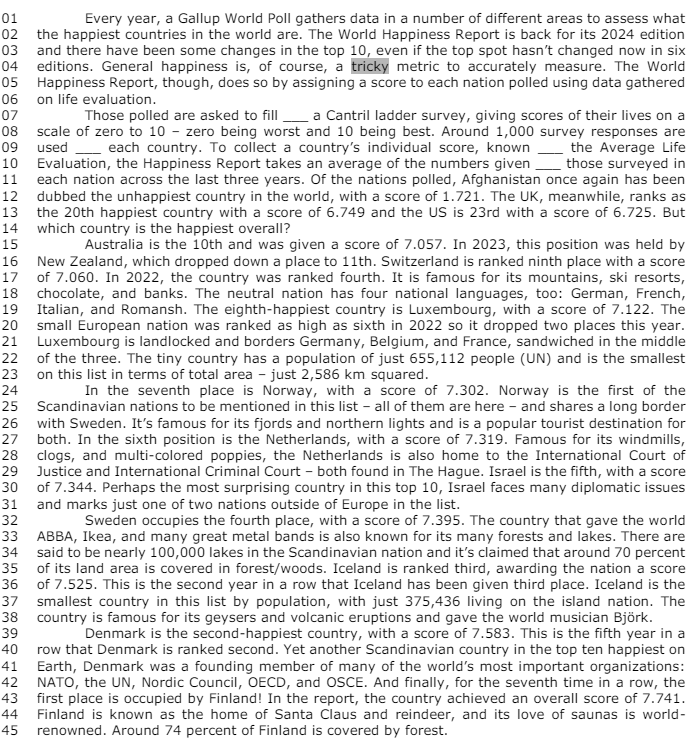
The top 10 happiest countries in the world 2024

By toby Saunders


*poll: the results of a set of questions people are asked to discover what they think about a subject. (dictionary.cambridge.org, 04/04/24)

(Available at: https://www.sciencefocus.com/science/the-top-10-happiest-countries-in-the-world – text specially adapted for this test).
In the context presented in the article, the Imagem associada para resolução da questão word “tricky” in line 4 means:
Alternativas
Q2486260 Inglês
TEXTO ASSOCIADO


Bob Dylan and the “Hot Hand”


For decades, there’s been a running academic debate about the question of “the hot hand”— the notion, in basketball, say, that a player has a statistically better chance of scoring from downtown if he’s been shooting that night with unusual accuracy. Put it this way: Stephen Curry, the point guard genius for the Golden State Warriors, who normally hits forty-four per cent of his threes, will raise his odds to fifty per cent or better if he’s already on a tear. He’s got a “hot hand.” If you watch enough N.B.A. ball, it appears to happen all the time. But does it? Thirty years ago, Thomas Gilovich, Amos Tversky, and Robert Vallone seemed to squelch the hot-hand theory with a stats-laden paper in the journal Cognitive Psychology, but, just last year, along came Joshua Miller and Adam Sanjurjo, marshalling no less evidence, to insist that an “atypical clustering of successes” in three-point shooting was not a “wide spread cognitive illusion” at all, but rather that it “occurs regularly.”

Steph Curry fans, who have been loyal witnesses to his improbable streaks from beyond the arc, surely agree with Professors Miller and Sanjurjo. But let’s assume that the debate, in basketball or at the blackjack table, remains open. What’s clear is that when it comes to the life of the imagination, the hot hand is a matter of historical fact. Novelists, composers, painters, and poets are apt to experience stretches of intense creativity that might derive from any number of factors — surrounding historical events, artistic rivalries, or, most mysteriously, inspiration — but the streak is undeniably there.

For Dylan, the greatest and most abundant songwriter who has ever lived, the most intense period of wild inspiration and creativity ran from the beginning of 1965 to the summer of 1966.

Before that fifteen-month period, Bob Dylan, who was twenty-three, had already transformed folk music, building on Woody Guthrie and Hank Williams. Now he was scribbling lyrics on pads and envelopes all night and listening to the Stones and the Beatles and feverishly reading the Surrealists and the Beats. In short order, he recorded the music for “Bringing It All Back Home” (the crossover to rock that ranges from “Mr. Tambourine Man” to “Subterranean Homesick Blues”); “Highway 61 Revisited” (the best rock album ever made; again, send your rebuttal to ); and “Blonde on Blonde” (a double album recorded in New York and Nashville that includes “Visions of Johanna” and “Just Like a Woman”).


Full text available on https://www.newyorker. com/culture/cultural-comment/bob-dylanand-the-hot-hand
[Questão inédita] In the sentence “Steph Curry fans, who have been loyal witnesses to his improbable streaks from beyond the arc”, the word witnesses can be replaced, with no change in meaning, by
Alternativas
Q2486259 Inglês
TEXTO ASSOCIADO


Bob Dylan and the “Hot Hand”


For decades, there’s been a running academic debate about the question of “the hot hand”— the notion, in basketball, say, that a player has a statistically better chance of scoring from downtown if he’s been shooting that night with unusual accuracy. Put it this way: Stephen Curry, the point guard genius for the Golden State Warriors, who normally hits forty-four per cent of his threes, will raise his odds to fifty per cent or better if he’s already on a tear. He’s got a “hot hand.” If you watch enough N.B.A. ball, it appears to happen all the time. But does it? Thirty years ago, Thomas Gilovich, Amos Tversky, and Robert Vallone seemed to squelch the hot-hand theory with a stats-laden paper in the journal Cognitive Psychology, but, just last year, along came Joshua Miller and Adam Sanjurjo, marshalling no less evidence, to insist that an “atypical clustering of successes” in three-point shooting was not a “wide spread cognitive illusion” at all, but rather that it “occurs regularly.”

Steph Curry fans, who have been loyal witnesses to his improbable streaks from beyond the arc, surely agree with Professors Miller and Sanjurjo. But let’s assume that the debate, in basketball or at the blackjack table, remains open. What’s clear is that when it comes to the life of the imagination, the hot hand is a matter of historical fact. Novelists, composers, painters, and poets are apt to experience stretches of intense creativity that might derive from any number of factors — surrounding historical events, artistic rivalries, or, most mysteriously, inspiration — but the streak is undeniably there.

For Dylan, the greatest and most abundant songwriter who has ever lived, the most intense period of wild inspiration and creativity ran from the beginning of 1965 to the summer of 1966.

Before that fifteen-month period, Bob Dylan, who was twenty-three, had already transformed folk music, building on Woody Guthrie and Hank Williams. Now he was scribbling lyrics on pads and envelopes all night and listening to the Stones and the Beatles and feverishly reading the Surrealists and the Beats. In short order, he recorded the music for “Bringing It All Back Home” (the crossover to rock that ranges from “Mr. Tambourine Man” to “Subterranean Homesick Blues”); “Highway 61 Revisited” (the best rock album ever made; again, send your rebuttal to ); and “Blonde on Blonde” (a double album recorded in New York and Nashville that includes “Visions of Johanna” and “Just Like a Woman”).


Full text available on https://www.newyorker. com/culture/cultural-comment/bob-dylanand-the-hot-hand
[Questão inédita] In the fragment in the fourth paragraph of the text, “Bu let’s assume that the debate, in basketball or at the blackjack table, remains open”, the word in bold refers to
Alternativas
Q2486258 Inglês
TEXTO ASSOCIADO


Bob Dylan and the “Hot Hand”


For decades, there’s been a running academic debate about the question of “the hot hand”— the notion, in basketball, say, that a player has a statistically better chance of scoring from downtown if he’s been shooting that night with unusual accuracy. Put it this way: Stephen Curry, the point guard genius for the Golden State Warriors, who normally hits forty-four per cent of his threes, will raise his odds to fifty per cent or better if he’s already on a tear. He’s got a “hot hand.” If you watch enough N.B.A. ball, it appears to happen all the time. But does it? Thirty years ago, Thomas Gilovich, Amos Tversky, and Robert Vallone seemed to squelch the hot-hand theory with a stats-laden paper in the journal Cognitive Psychology, but, just last year, along came Joshua Miller and Adam Sanjurjo, marshalling no less evidence, to insist that an “atypical clustering of successes” in three-point shooting was not a “wide spread cognitive illusion” at all, but rather that it “occurs regularly.”

Steph Curry fans, who have been loyal witnesses to his improbable streaks from beyond the arc, surely agree with Professors Miller and Sanjurjo. But let’s assume that the debate, in basketball or at the blackjack table, remains open. What’s clear is that when it comes to the life of the imagination, the hot hand is a matter of historical fact. Novelists, composers, painters, and poets are apt to experience stretches of intense creativity that might derive from any number of factors — surrounding historical events, artistic rivalries, or, most mysteriously, inspiration — but the streak is undeniably there.

For Dylan, the greatest and most abundant songwriter who has ever lived, the most intense period of wild inspiration and creativity ran from the beginning of 1965 to the summer of 1966.

Before that fifteen-month period, Bob Dylan, who was twenty-three, had already transformed folk music, building on Woody Guthrie and Hank Williams. Now he was scribbling lyrics on pads and envelopes all night and listening to the Stones and the Beatles and feverishly reading the Surrealists and the Beats. In short order, he recorded the music for “Bringing It All Back Home” (the crossover to rock that ranges from “Mr. Tambourine Man” to “Subterranean Homesick Blues”); “Highway 61 Revisited” (the best rock album ever made; again, send your rebuttal to ); and “Blonde on Blonde” (a double album recorded in New York and Nashville that includes “Visions of Johanna” and “Just Like a Woman”).


Full text available on https://www.newyorker. com/culture/cultural-comment/bob-dylanand-the-hot-hand
[Questão inédita] In the section “Now he was scribbling lyrics on pads and envelopes all night and listening to the Stones and the Beatles and feverishly reading the Surrealists and the Beats”, the expression scribbling lyrics is synonymous with
Alternativas
Q2486257 Inglês
TEXTO ASSOCIADO


Bob Dylan and the “Hot Hand”


For decades, there’s been a running academic debate about the question of “the hot hand”— the notion, in basketball, say, that a player has a statistically better chance of scoring from downtown if he’s been shooting that night with unusual accuracy. Put it this way: Stephen Curry, the point guard genius for the Golden State Warriors, who normally hits forty-four per cent of his threes, will raise his odds to fifty per cent or better if he’s already on a tear. He’s got a “hot hand.” If you watch enough N.B.A. ball, it appears to happen all the time. But does it? Thirty years ago, Thomas Gilovich, Amos Tversky, and Robert Vallone seemed to squelch the hot-hand theory with a stats-laden paper in the journal Cognitive Psychology, but, just last year, along came Joshua Miller and Adam Sanjurjo, marshalling no less evidence, to insist that an “atypical clustering of successes” in three-point shooting was not a “wide spread cognitive illusion” at all, but rather that it “occurs regularly.”

Steph Curry fans, who have been loyal witnesses to his improbable streaks from beyond the arc, surely agree with Professors Miller and Sanjurjo. But let’s assume that the debate, in basketball or at the blackjack table, remains open. What’s clear is that when it comes to the life of the imagination, the hot hand is a matter of historical fact. Novelists, composers, painters, and poets are apt to experience stretches of intense creativity that might derive from any number of factors — surrounding historical events, artistic rivalries, or, most mysteriously, inspiration — but the streak is undeniably there.

For Dylan, the greatest and most abundant songwriter who has ever lived, the most intense period of wild inspiration and creativity ran from the beginning of 1965 to the summer of 1966.

Before that fifteen-month period, Bob Dylan, who was twenty-three, had already transformed folk music, building on Woody Guthrie and Hank Williams. Now he was scribbling lyrics on pads and envelopes all night and listening to the Stones and the Beatles and feverishly reading the Surrealists and the Beats. In short order, he recorded the music for “Bringing It All Back Home” (the crossover to rock that ranges from “Mr. Tambourine Man” to “Subterranean Homesick Blues”); “Highway 61 Revisited” (the best rock album ever made; again, send your rebuttal to ); and “Blonde on Blonde” (a double album recorded in New York and Nashville that includes “Visions of Johanna” and “Just Like a Woman”).


Full text available on https://www.newyorker. com/culture/cultural-comment/bob-dylanand-the-hot-hand
[Questão inédita] Read the following excerpt of the text: “For Dylan, the greatest and most abundant song writer who has ever lived, the most intense period of wild inspiration and creativity ran from the beginning of 1965 to the summer of 1966”.

The word in bold is associated with the idea of:
Alternativas
Q2482230 Inglês

Julgue o item subsequente.


If subject of a sentence is a collective noun, the verb can either agree with the singular noun as a single unit or with the plural sense of the collective noun, depending on the context and intended meaning.
Alternativas
Q2465904 Inglês

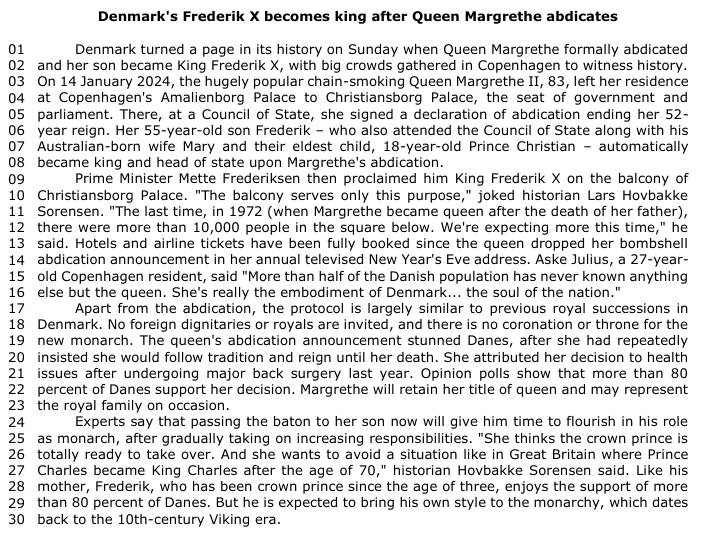
(Available in: https://www.france24.com/en/europe/20240114-denmark-s-frederik-x-to-become-king-afterqueen-margrethe-s-abdication – text especially adapted for this test).

Analyze the following statements about the excerpt “Margrethe will retain her title of queen and may represent the royal family on occasion” (l. 22-23):

I. The word “may” suggests a possibility.
II. In a negative structure, “may not represent” and “cannot represent” have the same meaning.
III. “Will retain” is an example of the Simple Future Verb Tense.

Which statements are correct?
Alternativas
Q2459383 Inglês

Read text II and answer the four questions that follow it:


Text II


                                                                  Adapted from: https://br.pinterest.com/pin/428897564482393461/

To be “at odds with ‘the majority’ position” means to

Alternativas
Q2459382 Inglês

Read text II and answer the four questions that follow it:


Text II


                                                                  Adapted from: https://br.pinterest.com/pin/428897564482393461/

If a person has an “open-minded attitude”, this person can be said to be

Alternativas
Q2459375 Inglês

Read Text I and answer the fourteen questions that follow it


 Text I The “literacy turn” in education: reexamining 

what it means to be literate


In response to the phenomena of mass migration and the emergence of digital communications media that defined the last decade of the 20th century, the New London Group (NLG) called for a broader view of literacy and literacy teaching in its 1996 manifesto, A Pedagogy of Multiliteracies: Designing Social Futures. The group argued that literacy pedagogy in education must (1) reflect the increasing cultural and linguistic diversity of the contemporary globalized world, and (2) account for the new kinds of texts and textual engagement that have emerged in the wake of new information and multimedia technologies. In order to better capture the plurality of discourses, languages, and media, they proposed the term ‘multiliteracies’.

Within the NLG’s pedagogy of multiliteracies, language and other modes of communication are viewed as dynamic resources for meaning making that undergo constant changes in the dynamics of language use as learners attempt to achieve their own purposes. Within this broader view of literacy and literacy teaching, learners are no longer “users as decoders of language” but rather “designers of meaning.” Meaning is not viewed as something that resides in texts; rather, deriving meaning is considered an active and dynamic process in which learners combine and creatively apply both linguistic and other semiotic resources (e.g., visual, gesture, sound, etc.) with an awareness of “the sets of conventions connected with semiotic activity [...] in a given social space” (NLG, 1996, p. 74).

Grounded within the view that learning develops in social, cultural, and material contexts as a result of collaborative interactions, NLG argued that instantiating literacy-based teaching in classrooms calls on the complex integration and interaction of four pedagogical components that are neither hierarchical nor linear and can at times overlap: situated practice, overt instruction, critical framing, and transformed practice. […]

Although the NLG’s pedagogy of multiliteracies was conceived as a “statement of general principle” (1996, p. 89) for schools, the group’s call for educators to recognize the diversity and social situatedness of literacy has had a lasting impact on foreign language (FL) teaching and learning. The reception of the group’s work along with that of other scholars from critical pedagogy appeared at a time when the field was becoming less solidly anchored in theories of L2 acquisition and more interested in the social practice of FL education itself. In the section that follows, we describe the current state of FL literacy studies as it has developed in recent years, before finally turning to some very recent emerging trends that we are likely to see develop going forward.

(Adapted from: https://www.colorado.edu/center/altec/sites/default/files/ attachedfiles/moving_toward_multiliteracies_in_foreign_language_teaching.pdf)

In “can at times overlap” (3rd paragraph), “at times” may be replaced without significant change in meaning by
Alternativas
Q2459373 Inglês

Read Text I and answer the fourteen questions that follow it


 Text I The “literacy turn” in education: reexamining 

what it means to be literate


In response to the phenomena of mass migration and the emergence of digital communications media that defined the last decade of the 20th century, the New London Group (NLG) called for a broader view of literacy and literacy teaching in its 1996 manifesto, A Pedagogy of Multiliteracies: Designing Social Futures. The group argued that literacy pedagogy in education must (1) reflect the increasing cultural and linguistic diversity of the contemporary globalized world, and (2) account for the new kinds of texts and textual engagement that have emerged in the wake of new information and multimedia technologies. In order to better capture the plurality of discourses, languages, and media, they proposed the term ‘multiliteracies’.

Within the NLG’s pedagogy of multiliteracies, language and other modes of communication are viewed as dynamic resources for meaning making that undergo constant changes in the dynamics of language use as learners attempt to achieve their own purposes. Within this broader view of literacy and literacy teaching, learners are no longer “users as decoders of language” but rather “designers of meaning.” Meaning is not viewed as something that resides in texts; rather, deriving meaning is considered an active and dynamic process in which learners combine and creatively apply both linguistic and other semiotic resources (e.g., visual, gesture, sound, etc.) with an awareness of “the sets of conventions connected with semiotic activity [...] in a given social space” (NLG, 1996, p. 74).

Grounded within the view that learning develops in social, cultural, and material contexts as a result of collaborative interactions, NLG argued that instantiating literacy-based teaching in classrooms calls on the complex integration and interaction of four pedagogical components that are neither hierarchical nor linear and can at times overlap: situated practice, overt instruction, critical framing, and transformed practice. […]

Although the NLG’s pedagogy of multiliteracies was conceived as a “statement of general principle” (1996, p. 89) for schools, the group’s call for educators to recognize the diversity and social situatedness of literacy has had a lasting impact on foreign language (FL) teaching and learning. The reception of the group’s work along with that of other scholars from critical pedagogy appeared at a time when the field was becoming less solidly anchored in theories of L2 acquisition and more interested in the social practice of FL education itself. In the section that follows, we describe the current state of FL literacy studies as it has developed in recent years, before finally turning to some very recent emerging trends that we are likely to see develop going forward.

(Adapted from: https://www.colorado.edu/center/altec/sites/default/files/ attachedfiles/moving_toward_multiliteracies_in_foreign_language_teaching.pdf)

The expression “in the wake of” in “in the wake of new information” (1st paragraph) can be replaced without change of meaning by
Alternativas
Q2453840 Inglês
Predicting the unpredictable


Some years ago, a devastating earthquake struck the Italian town of L’Aquila. More than 300 people lost their lives, over 1,500 people were injured, and many buildings were destroyed. Two years later, seven earthquake experts were involved in a court case: Did they adequately warn the public after the initial tremors began? At the heart of the debate is whether they could have predicted a disaster like this.


Although a lot of scientists are working to improve our ability to predict natural disasters, so far no one has come up with a reliable method to forecast earthquakes or volcanic eruptions, days or weeks beforehand. Most of the research focuses on the areas most likely to experience seismic activity – but even our knowledge about where these areas are, is very limited. One reason for this is that human beings have only been around for a very small part of the Earth’s history. In geological terms, we all arrived on the scene very recently. Records from the past 2,000 years are incomplete, and the biggest earthquakes nearly always happen in areas where there have been no earthquakes in recorded history.


So, is there any hope for improving our ability to predict disasters? A solution may come from an unexpected source. Four years ago, a team of US physicists at Rutgers University in New Jersey were studying why pharmaceutical powders stick together. They observed that the powder stuck together when placed in a spinning cylinder, but then developed cracks and collapsed. Just before the cracks developed, an electric signal, like a small bolt of lightning, was created. The scientists repeated the experiment with a wide range of different materials, and they got similar results every time.


This phenomenon might also exist in nature. Some scientists believe that rocks may become electrically charged under unusual pressure, such as before an earthquake. This electric charge then causes changes in the surrounding air or water, which animals may be able to sense before humans do. For example, while biologists were studying a colony of frogs in a pond near L’Aquila, they noticed that nearly all the animals left the water days before the earthquake. A similar thing happened in China, when snakes were hibernating for the winter in caves, but escaped just before a large earthquake. The same kind of electric charge, like the small bolt of lightning felt in the experiment at Rutgers, may have been responsible.


At the moment, there is no reliable way ............ using such findings to predict earthquakes, and further studies may be necessary to give us a better understanding of the interactions involved, but one day, the technology may be used ............ predict future catastrophes. For example, two science institutions in Russia and Britain are already developing a new micro-satellite, which could detect these electric signals and help rescue people ................ natural disasters in time. Scientists are planning to launch the first of these satellites ............... space. Will these satellites be the solution? Only time will tell. For the time being, the best defense is to be prepared.
Mark the alternative which contains the correct meaning of the underlined words from the text.
Alternativas
Q2443648 Inglês

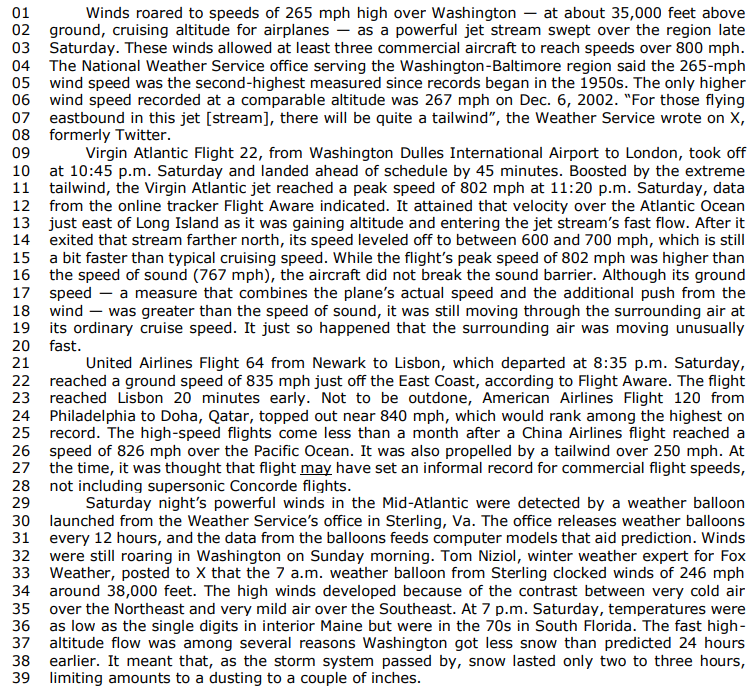
Planes top 800 mph as near-record winds sweep high over Mid-Atlantic


(Available at: www.washingtonpost.com/weather/2024/02/18/record-jet-stream-winds-dc-flights/ – text specially adapted for this test)
In which of the following excerpts from the text the structure in bold means “the same”? 
Alternativas
Q2439428 Inglês
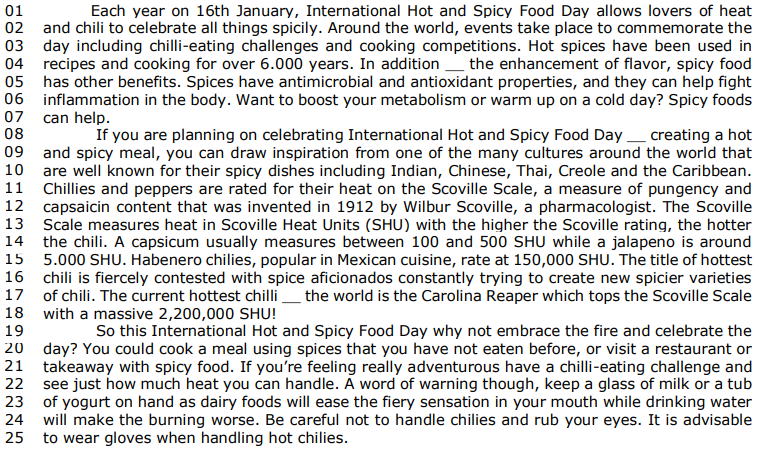
Fire up your taste buds … it’s International Hot and Spicy Food Day!


036.png (759×450)


(Available at: www.hillstreetgrocer.com – text especially adapted for this test).
Mark the best option below to replace "advisable" (l. 24) with no significant changes in meaning. 
Alternativas
Q2415253 Inglês
        Back in October 2011, Stanford professors launched three free online courses, open to the public. One by one, these courses went massive, with enrollments topping 100.000 students each. Soon the media was calling these courses MOOCs, short for massive open online courses.
         Since then, more than 1.200 universities around the world have launched free online courses. In addition to the larger global MOOC platforms, many national governments around the world have launched their own country-specific MOOC platforms, including India, Italy, Israel, Mexico and Thailand.
            After a decade of popularization, in 2021, over 220 million students had signed up for at least one course on one of these platforms, and 40 million did so in 2021 alone. MOOCs and MOOC platforms are still growing, even after the crazy “Year of the MOOC” prompted by the pandemic and travel restrictions.
            At Class Central, we try to catalog as many MOOCs as possible, and our listing currently includes more than 150.000 of them, from MOOC platforms and other online learning platforms. But due to limited resources, we cannot index every single one. If you’re looking for MOOCs from around the world, this list is our best attempt to catalog all different MOOC platforms that are out there.

Internet:<https://classcentral.coom>  (adapted)

Keeping in mind the ideas expressed above and the linguistic aspects of the text, judge the following item. 


The phrase “short for massive open online courses” (in the last sentence of the first paragraph) can be correctly replaced with which stands for massive open online courses.
Alternativas
Q2392599 Inglês
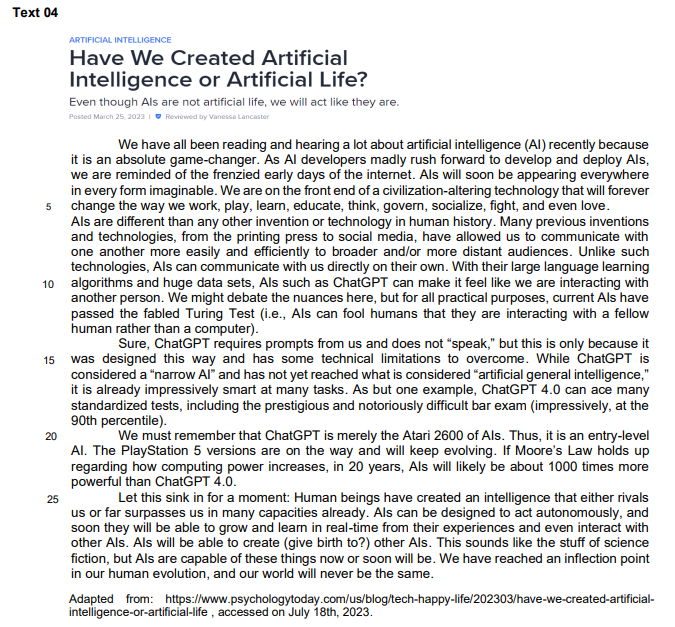
In “Unlike such technologies, AIs can communicate with us directly on their own. With their large language learning algorithms and huge data sets, AIs such as ChatGPT can make it feel like we are interacting with another person.”, “unlike” could be properly replaced by: 
Alternativas
Q2392595 Inglês

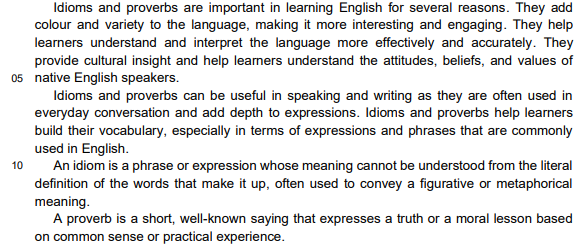
Text 03 – Idioms and proverbs 


Adapted from https://thefluentlife.com/content/difference-between-idioms-proverbs-meaning-examples/ , accessed on July 18th.

In “They help learners understand and interpret the language more effectively and accurately.”, we can replace accurately for:
Alternativas
Q2392591 Inglês
Text 02 - (Types of social practices) Linguistics


The language spoken is one of the characteristics that most differentiate us from other animals on the planet. According to the experts, its appearance was one of the main causes of our development as a species; This is because the use of the language caused our brain to increase in capacity.


Therefore, linguistic social practices are a fundamental part of each culture. They include elements such as the language spoken, expressions and phrases made, or the importance given to certain words.


[...]


Social practices of language


Within all types of social practices that exist some of the most influencing a given society are those that have to do with their linguistic expression.


Due to the way in which language modifies the brain and the individual experience of people, the social practices of language take on great importance when it comes to understanding the customs and ways of seeing the world proper to a given society.


Even several studies have shown that bilingual people change their personality depending on the language they are speaking. So, what are the social practices of language?


These are ways of interacting that include both spoken and written language, in addition to all those activities that surround the communication process through it. Depending on the context in which we find ourselves and what we want to transmit, these practices will be different.


Also adapted from: https://www.lifepersona.com/social-practices-types-and-practices-of-language, accessed on July 17th, 2023. 
In “Within all types of social practices that exist some of the most influencing a given society are those that have to do with their linguistic expression.”, the word “a” refers to: 
Alternativas
Q2384530 Inglês

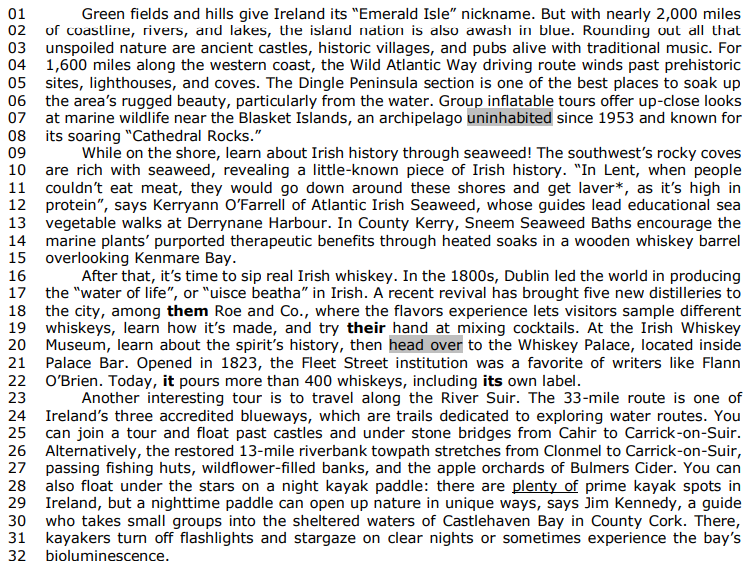
Things to do in Ireland


*laver: a type of seaweed / seaweed: alga marinha


(Available at: www.nationalgeographic.com/travel/article/10-best-things-to-do-ireland – text specially adapted for this test).

The underlined expression “plenty of” (l. 28) could be replaced, with no significant changes in meaning, by:
Alternativas
Q2383642 Inglês

Text 18A3-I 


    The roar of a waterfall suggests the power of water. Rampaging floodwaters can uproot strong trees and twist railroad tracks. When the power of water is harnessed, however, it can do useful work for humans. 


    Since ancient times, people have put the energy in the flow of water to work. They first made water work for them with the waterwheel, a wheel with paddles around its rim. Flowing water rotated the waterwheel, which in turn ran machinery that was linked to it. Today, new kinds of waterwheels — turbines — spin generators that produce electricity. Electricity from water-turned generators is known as hydroelectricity. 


    By building a dam across a river, the natural upstream water level is elevated and a difference in head is created that can be used to drive turbines and generate electricity. A large upstream reservoir may balance seasonal water flow; rain or melted snow can be stored in the reservoir during the wet season to provide electricity during dry seasons. 


    Waterpower is distributed unevenly among the continents and nations of the world. Europe and North America have developed much of their waterpower. Asia, South America, and Africa have abundant waterpower potential, but while countries such as China and Brazil have become leading hydroelectric producers, much of the waterpower resource on those continents remains undeveloped. 


Elizabeth Lachner. Hydroelectricity. Rosen Publishing Group, 2018 (adapted). 

Maintaining the original meaning of text 18A3-I, the fragment “Today, new kinds of waterwheels — turbines — spin generators that produce electricity” (fourth sentence of the second paragraph) could be correctly replaced with 
Alternativas
Respostas
341: B
342: B
343: D
344: C
345: A
346: C
347: E
348: E
349: A
350: D
351: C
352: E
353: E
354: D
355: C
356: C
357: B
358: C
359: E
360: D