Questões de Concurso
Sobre sinônimos | synonyms em inglês
Foram encontradas 1.586 questões


Read the following text to answer the question.
By Leo Selivan
In this article, informed by the Lexical Approach, I reflect on grammar instruction in the classroom […]. I consider the problems with ‘traditional’ grammar teaching before arguing that what we actually need is more grammar input as well as showing how lexis can provide necessary ‘crutches’ for the learner.
Lexis = vocabulary + grammar
The shift in ELT from grammar to lexis mirrors a similar change in the attitude of linguists. In the past linguists were preoccupied with the grammar of language; however the advances in corpus linguistics have pushed lexis to the forefront. The term ‘lexis’, which was traditionally used by linguists, is a common word these days and frequently used even in textbooks.
Why use a technical term borrowed from the realm of linguistics instead of the word ‘vocabulary’? Quite simply because vocabulary is typically seen as individual words (often presented in lists) whereas lexis is a somewhat wider concept and consists of collocations, chunks and formulaic expressions. It also includes certain patterns that were traditionally associated with the grammar of a language, e.g. If I were you…, I haven’t seen you for ages etc.
Recognising certain grammar structures as lexical
items means that they can be introduced much earlier,
without structural analysis or elaboration. Indeed, since the
concept of notions and functions made its way into language
teaching, particularly as Communicative Language Teaching
(CLT) gained prominence, some structures associated with
grammar started to be taught lexically (or functionally). I’d like
to is not taught as ‹the conditional› but as a chunk expressing
desire. Similarly many other ‹traditional› grammar items can
be introduced lexically relatively early on.
Less grammar or more grammar?
You are, no doubt, all familiar with students who on one hand seem to know the ‘rules’ of grammar but still fail to produce grammatically correct sentences when speaking or, on the other, sound unnatural and foreign-like even when their sentences are grammatically correct. Michael Lewis, who might be considered the founder of the Lexical Approach, once claimed that there was no direct relationship between the knowledge of grammar and speaking. In contrast, the knowledge of formulaic language has been shown by research to have a significant bearing on the natural language production.
Furthermore, certain grammar rules are practically impossible to learn. Dave Willis cites the grammar of orientation (which includes the notoriously difficult present perfect and the uses of certain modal verbs) as particularly resistant to teaching. The only way to grasp their meaning is through continuous exposure and use.
Finally, even the most authoritative English grammars never claim to provide a comprehensive description of all the grammar, hence the word ‘introduction’ often used in their titles (for instance, Huddleston & Pullum’s A Student’s Introduction to English Grammar or Halliday’s An Introduction to Functional Grammar).
If grammarians do not even attempt to address all areas of grammar, how can we, practitioners, cover all the aspects of grammar in our teaching, especially if all we seem to focus on is a limited selection of discrete items, comprised mostly of tenses and a handful of modal verbs? It would seem that we need to expose our students to a lot of naturally occurring language and frequently draw their attention to various grammar points as they arise.
For example, while teaching the expression fall asleep / be asleep you can ask your students:
• Don’t make any noise – she’s fallen asleep.
• Don’t make any noise – she’s asleep.
What does’s stand for in each of these cases (is or has)?
One of the fathers of the Communicative Language Teaching Henry Widdowson advocated using lexical items as a starting point and then ‘showing how they need to be grammatically modified to be communicatively effective’ (1990:95). For example, when exploring a text with your students, you may come across a sentence like this:
• They’ve been married for seven years.
You can ask your students: When did they get married? How should you change the sentence if the couple you are talking about is no longer married?
The above demonstrates how the teacher should be constantly on the ball and take every opportunity to draw students’ attention to grammar. Such short but frequent ‘grammar spots’ will help to slowly raise students’ awareness and build their understanding of the English grammar system.
[…]
Conclusion
So is there room for grammar instruction in the classroom? Certainly yes. But the grammar practice should always start with the exploitation of lexical items. Exposing students to a lot of natural and contextualised examples will offer a lexical way into the grammar of the language.
To sum up, grammar should play some role in language teaching but should not occupy a big part of class time. Instead grammar should be delivered in small but frequent portions. Students should be encouraged to collect a lot of examples of a particular structure before being invited to analyse it. Hence, analysis should be preceded by synthesis.
Lastly, language practitioners should bear in mind that grammar acquisition is an incremental process which requires frequent focus and refocus on the items already studied.
Available at: https://www.teachingenglish.org.uk/professionaldevelopment/teachers/knowing-subject/articles/grammar-vs-lexisor-grammar-through. Accessed on: April 29, 2024.
Empowering language learning through assessment
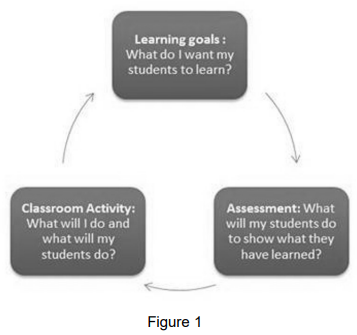
Assessment of, as, and for learning
Empowering language learning through assessment
Assessment of, as, and for learning
The word reliability is closest in meaning to
The item preserving the same message/idea as the one emphasized in the text below is:
Rahul: Hi, Raj. You 've participated the drawing competition.
Raj: Sure, you know drawing is my bailiwick.
Rahul: What is the topic you chose?
Raj: “Environmental Issues”
Rahul: How many days did it take you to complete it?
Raj: It took me 2.
Rahul: Have the results already? To whom did the prize go?
Raj: A dude in Texas, at least my personal experience has grown...
(Available in: https://brainly.in/question/6727599.)
Read Text | and answer questions 05 to 13.
Netflix is trying to prove to the world that it's all grown up
Netflix is trying to persuade Wall Street that it is now all grown up. After squeezing out millions of additional subscribers via its password sharing crackdown and through the introduction of cheaper advertiser-supported plans, the streamer knows that its growth spurts are coming to an end — and now it wants investors to stop obsessing over those pesky membership numbers and instead focus on other metrics.
"In our early days, when we had little revenue or profit, membership growth was a strong indicator of our future potential. But now we're generating very substantial profit and free cash flow. We are also developing new revenue streams like advertising and our extra member feature, so memberships are just one component of our growth", Netflix told shareholders as it reported quarterly earnings.
To that end, Netflix said that it will no longer report quarterly subscriber numbers, starting in 2025. Alas, the metric that Wall Street has forever judged Netflix on — the metric that prompted legacy media companies to burn endless piles of cash in their bids to compete with the streamer — will be retired. The decision to shut off transparency on the metric represents a significant turning point in the streaming revolution. For years, Netflix has prided itself on being extraordinarily transparent. Now it is aiming to hold its cards closer to its chest. And given that streaming giant is the trendsetter in the space, one could expect that other media companies will be inspired by the company's move and also opt to cease reporting such data.
To be fair, what Netflix is saying isn't necessarily off base either. As the company shifts its business model away from subscriptions and toward advertising and other revenue streams, it makes sense to consider how much time users are spending on the service. The more content a user consumes on Netflix, the more likely they are to continue paying for the service, and the more money Netflix then makes from that single subscriber. "We're focused on revenue and operating margin as our primary financial metrics — and engagement (i.e. time spent) as our best proxy for customer satisfaction,” Netflix underscored in its letter to shareholders.
Regardless, less transparency in an already opaque industry is not ideal. The walled garden of streaming already lacks the same detailed viewership data that Nielsen collects on linear television broadcasters. Now, visibility into the streaming world will get even dimmer.
The announcement from Netflix managed to overshadow its otherwise stellar quarter. The company handily beat expectations and added a staggering 9.3 million subscribers, meaning it now boasts nearly 270 million in total. Netflix also beat analyst expectations on both earnings and revenue. However, it wasn't all good news. Netflix forecasted its subscriber growth to be lower in quarter two, chalking it up to “typical seasonality.” That led the stock to slide nearly 5% in after-hours trading.
Whether "typical seasonality” is solely to blame, or whether the streamer is simply starting to hit a ceiling, is hard to tell. Perhaps it is a mix of both. Whatever the cause, the stock sliding on the less-than-ideal outlook is a prime example of why Netflix wants Wall Street to stop focusing on its subscriber numbers. And, in one year's time, investors won't have a choice.
Adapted from: https://edition.cnn.com/2024/04/19/media/netflix-subscription-numbers/index.html
In "(..) what Netflix is saying isn't necessarily off base either”, "off base” can be replaced, without changing its meaning in the context of the text, by:
Answer question according to TEXT 3 below.
TEXT 3

Available at: https://larrycuban.wordpress.com/2019/11/25/evenmore-cartoons-on-technology/. Access on: Apr. 9th, 2024.
Check the comic to answer question.

Fonte: https://media.baamboozle.com/uploads/images/76546/1598950862_26075
Text 2
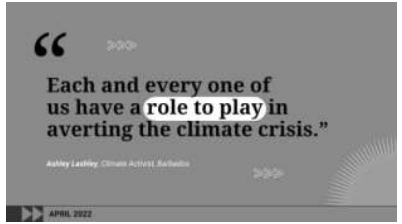
Available
in:<https://www.un.org/en/climatechange/voices-of-change-ashley-lashley>
Text 1
Romanticism
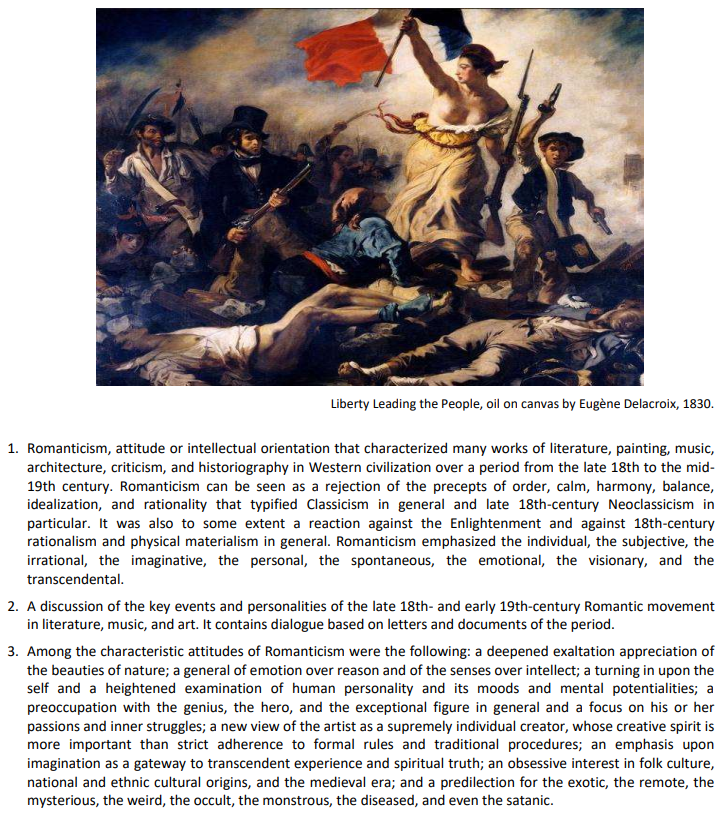
BRITANNICA, The Editors of Encyclopaedia. “Romanticism”. Encyclopedia Britannica, 26 Dec. 2023,
https://www.britannica.com/art/Romanticism. Accessed 1 February 2024
Poor Things – Emma Stone transfixes in Lanthimos’s thrilling carnival of oddness
(Available at: www.theguardian.com/film/2024/jan/14/poor-things-review-yorgos-lanthimos-emma-stonefrankenstein – text specially adapted for this test).
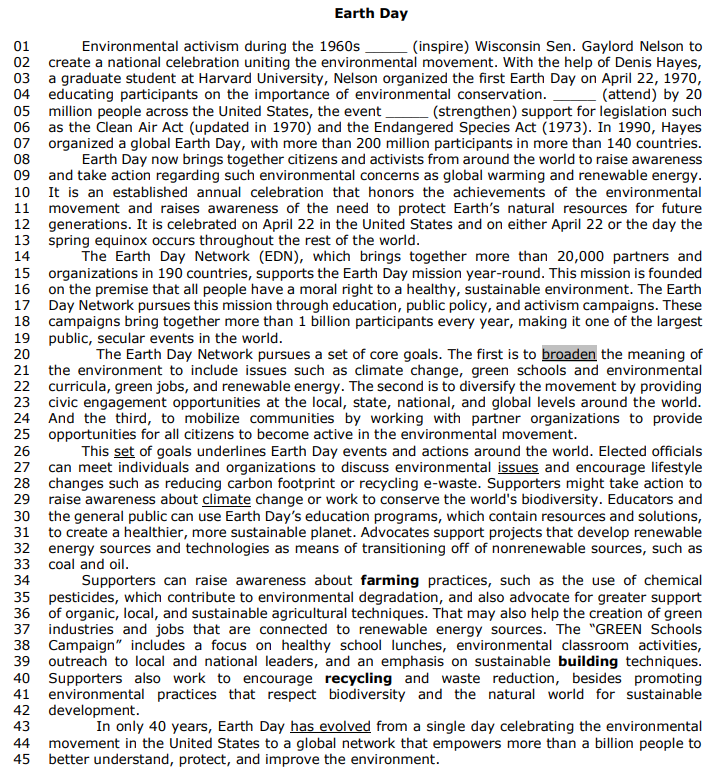
(Available at: education.nationalgeographic.org/resource/earth-day/– text specially adapted for this test).
Read Text I to answer the question.
TEXT I
“One very active research tradition in the field of second language acquisition (SLA) attempts to establish causal relationships between environmental factors and learning. These include the type and quantity of input, instruction and feedback, and the interactional context of learning (Larsen-Freeman and Long 1991). A second very influential line of research and theory in SLA that came to fruition during the 1980s investigates the possible role of universal grammar (UG) in SLA (Eubank 1991b, White 1989). In the Chomskyan tradition, UG refers not to properties of language as the external object of learning but to innate properties of mind that direct the course of primary language acquisition. One question asked within this tradition has been whether or not second language this tradition learners still “have access” to UG, but it is assumed that UG principles are not accessible to learner awareness for any kind of conscious analysis of input. It is possible that SLA is the result of UG (a deep internal factor) acting upon input (an external factor), as proposed by White (1989), but what seems to be left out of such an account is the role of the learner's conscious mental processes.” […]
Available at: https://www.cambridge.org/core/journals/annual-review-of-applied-linguistics/ (adapted)
Read Text I to answer the question.
TEXT I
“One very active research tradition in the field of second language acquisition (SLA) attempts to establish causal relationships between environmental factors and learning. These include the type and quantity of input, instruction and feedback, and the interactional context of learning (Larsen-Freeman and Long 1991). A second very influential line of research and theory in SLA that came to fruition during the 1980s investigates the possible role of universal grammar (UG) in SLA (Eubank 1991b, White 1989). In the Chomskyan tradition, UG refers not to properties of language as the external object of learning but to innate properties of mind that direct the course of primary language acquisition. One question asked within this tradition has been whether or not second language this tradition learners still “have access” to UG, but it is assumed that UG principles are not accessible to learner awareness for any kind of conscious analysis of input. It is possible that SLA is the result of UG (a deep internal factor) acting upon input (an external factor), as proposed by White (1989), but what seems to be left out of such an account is the role of the learner's conscious mental processes.” […]
Available at: https://www.cambridge.org/core/journals/annual-review-of-applied-linguistics/ (adapted)
Text 1
Youth and Adult Literacy in Brazil:
learning from practice
The Concept of functional ILLITERACY
[…] A person is considered functionally literate ..................... he or she is capable ................. using reading and writing skills ........................ meet the demands of his or her social context, using them to continue learning and developing over their lifetimes. With the expansion of the access to schooling beyond literacy, the focus was shifted to the quality of the educational process offered to all. The issue here is not simply whether people know how to read or write, but what they are capable of doing with those skills. This means that, besides the issue of illiteracy, a social problem that still persists in Brazil, there is also the issue of functional illiteracy; in other words, the inability to effectively use reading and writing skills in the various areas of social life after a certain number of years of schooling. According to census criteria, individuals with less than 4 years of schooling are considered functionally illiterate. […]
Source: https://unesdoc.unesco.org
Study these sentences below and decide if they are true ( T ) or false ( F ), according to structure and use of grammar and lexical aspects of language use.
( ) The words in bold, them and their in text 1, are respectively an object pronoun and a possessive adjective.
( ) In the sentence: The issue here is not simply whether people know how to read or write… the underlined word whether can be replaced by if without changing its meaning.
( ) The noun criteria in: According to census criteria, individuals with less than 4 years of schooling are considered functionally illiterate; is the singular form of criterium.
( ) In the following sentence from text 1: … the inability to effectively use reading and writing skills in the various areas of social life after a certain number of years of schooling; the underlined words reading, writing and schooling are examples of present participle.
Choose the alternative which presents the correct sequence, from top to bottom.

 Conheça nossos planos