Questões de Concurso
Sobre sinônimos | synonyms em inglês
Foram encontradas 1.586 questões


Read Text II and answer question
University Degree Sill Best Way into Good Job
How do you get a good job? It might literally be a milliondollar question. And researchers from Georgetown University in the US have an answer: the best way is still to get a college education, even if you're a little late. That's their simple answer – one they came up with after looking at US government data for more than 8,000 Americans who were born in the early 1980s. They found that getting a bachelor's degree by the age of 26 gave people a 56% chance of getting a good job by the age of 30. For their study, the researchers defined a "good job" as one paying at least $ 38,000 for workers under the age of 45.
According to The Wall Street Journal, the research didn't focus on people who went straight to college after finishing high school because they already have a high chance of getting a good job. Instead, it looked at different pathways that people who didn't go straight to college after high school could take to increase their chances of getting a good job. For example, even just beginning a bachelor's degree by age 22 increased the likelihood of getting a good job by 16 percentage points, according to the report. But despite this evidence, according to a separate Wall Street Journal survey, more than half of people don't feel that doing a four-year degree is worth the cost, because students may finish without specific job skills and with a large amount of debt.
According to US News, in the academic year that ended in the summer of 2023, the average cost of going to an American university for a year started at about $ 10,000 for a public university, and went as high as almost $ 40,000 for a private school. And Zach Mabel, one of the authors of the Georgetown report, admits that although a university education is likely to be beneficial, for financial reasons "the risk of pursuing higher education is higher than it's ever been."
Source: https://engoo.com.br/app/daily-news/article/study-university-degree-stillbest-way-into-good-job/crbIxBR3Ee6ComdOtgdXYw
Atenção! Leia o texto a seguir para responder à questão.
The research paper published in ‘Humanities & Social Sciences Communications’ — an open-access journal, distributed by Springer Nature — examines the impact of AI on “loss in decisionmaking and privacy concerns among university students in Pakistan and China”.
The rise of AI has also exposed students and teachers to a number of challenges, particularly data hacking and systemic and racial biases. “Many people are now concerned with the ethical attributes of AI systems and believe that the security issue must be considered in AI system development,” the researchers claimed. In order to mitigate safety concerns, the paper said there was a need to “continuously re-evaluate and re-design” security practices. However, academia is poorly equipped to deal this issue due to a shortage of funding and technical staff. “No one can run from the threat of AI concerning cybersecurity, it behaves like a double-edged sword.”
As per the research, AI has the potential to revolutionise the education sector but with certain drawbacks. In order to effectively harness this technology, the paper called for steps to ensure AI does not cause at least “severe ethical concerns”, and technology backed by secure algorithms to ensure data security and minimisation of AI’s bias. It also recommended measures to curtail overreliance on AI to address “laziness” and cognitive deficiency.
ABBAS, Zaki. AI making students lazy, impairing cognition: study. Disponível em: https://www.dawn.com/news/1759121/ai-making-students-lazy-impairingcognition-study. Acesso em: 12 jul. 2024. Adaptado.
O texto seguinte servirá de base para responder à questão.
Why is it called the Avenue of Volcanoes?
The "Avenue of Volcanoes" is a term used to describe a geographical feature in South America, specifically in Ecuador. This name is due to a long stretch of the Andes Mountain range in Ecuador, where several volcanoes are located near each other, creating a breathtaking natural spectacle you should visit. The Avenue of the Volcanoes is a geological wonder and significant. It is part of Ecuador's natural beauty and biodiversity. It attracts tourists and mountaineers from all over the world who come to explore the volcanoes, their surrounding landscapes, and the rich ecosystems that thrive in this region.
Predominant Volcanoes
The "Avenue of the Volcanoes" in Ecuador is characterized by numerous volcanoes, some very prominent and easily visible from the road. Discover some of the predominant volcanoes that Ecuador has for you.
Cayambe
Volcan Cayambe is a stratovolcano that is part of the Andes Mountain range. It is situated in the province of Pichincha, in the north-central region of Ecuador. The volcano is famous for its unique double summit, with the main panel located at 5,790 meters above sea level and the secondary summit just slightly lower. The volcanic cone of Cayambe is composed of alternating layers of lava, ash, and volcanic materials. Its last eruption resulted in a lava flow and ash that covered the surrounding area.
Antisana
Volcan Antisana sits at an impressive 18,891 feet above sea level. Located in the Andes mountains, it is surrounded by stunning wilderness and unique ecosystems for a breathtaking view. From the highest points, it is possible to catch glimpses of the surrounding glaciers, lava landscapes, and stunning birds and animals that call this area their home.
Los Illinizas
Los Ilinizas is a composite volcano comprised of layers of lava, ash, and debris built up over time. The mountain is part of the Andes Mountain range and is located between the provinces of Cotopaxi and Pichincha. The volcano's height is roughly 17,267 ft (5,260 m). The Illinizas are two volcanoes located in the Andes region of Ecuador; the two central volcanoes in this area are Illiniza Norte (also known as Illiniza Falsa) and Illiniza Sur (Illiniza Verdadero).
Cotopaxi
Cotopaxi is one of Ecuador's best-known and most prominent volcanoes and is part of the "Avenue of the Volcanoes," a chain of volcanoes in the Andean region of the country. It has an altitude of approximately 5,897 meters above sea level. Its summit is covered with snow and ice for much of the year. Cotopaxi has significant cultural and mythological importance for the indigenous peoples of the Andean region of Ecuador. In Andean cosmology, the Cotopaxi volcano is associated with divinities and legends.
Quilotoa
The Volcan Quilotoa is undoubtedly one of the most spectacular destinations for tourists from all around the world. Quilotoa is a caldera that sits at an altitude of 3,914 meters above sea level, and visitors can find a small, emerald-green lake inside the crater, surrounded by the most stunning scenery you can imagine. However, its caldera and the lagoon are evidence of its volcanic past and past activities.
Tungurahua
The Tungurahua volcano in the Cordillera Central of the Ecuadorian Andes is notable for its imposing altitude of approximately 5,023 meters above sea level. The Tungurahua volcano has been significant in local mythology and culture. Its name translates as "Throat of Fire" in the Quechua language, and nearby communities have developed a cultural and spiritual connection with the volcano over the years.
Chimborazo
Chimborazo is the highest mountain in Ecuador and one of the highest volcanoes in the world, with an altitude of approximately 6,310 meters above sea level. Its summit is covered with snow and ice all year round, making it a popular destination for mountaineers and climbers.
Altar
El Altar is a volcanic complex composed of several peaks and craters, which gives it an impressive and unique appearance. Some of the most prominent peaks include El Obispo, El Fraile, El Monja, La Virgen, and others. The volcanic complex resembles a considerable fortress or altar, hence its name.
Sangay
It is in the Andes region, specifically in the province of Morona Santiago, in the south-central part of the country. Sangay is approximately 5,230 meters above sea level and is one of the most active volcanoes in Ecuador and the world. It has had frequent eruptions throughout history, with almost constant eruptive activity during the 20th and early 21st century.
https://www.casagangotena.com/blog/activities/avenue-of-the-volcanoe s-in-Ecuador/
O texto seguinte servirá de base para responder a questão.
HVAC Contractors Need to Adapt to Repair Market
Repair or replace is a question homeowners often need to answer, and it greatly impacts an HVAC contractor's business. During COVID, the residential HVAC industry saw a replacement market boom. But in 2023 and now the beginning of 2024, there has been a shift to a repair market that HVAC contractors need to be aware of as they run their businesses.
According to numbers from the Air-Conditioning, Heating and Refrigeration Institute (AHRI), shipments of unitary air conditioners and heat pumps were down 16.7% in 2023, compared to 2022. Gas furnaces were down 23%.
"The replacement market is performing worse when you strip out new construction," said industry leader Matt Michel. "Housing starts were down around 5%, according to the St. Louis Federal Reserve, so the replacement market for unitary air conditioners and heat pumps was down in the low 20s."
Distributors are seeing similar numbers, according to the Heating, Air-conditioning, & Refrigeration Distributors International (HARDI).
"We definitely are seeing a shift here. And that shift has actually been visible for some time," said Tim Fisher, HARDI director of market intelligence.
HARDI receives data from FieldEdge on the invoice and quote trends exhibited by their users. Invoices reflect work that has been completed, whereas quotes reflect potential future work and are most often provided for new system installations. HARDI has found that, over time, the ratio of new invoices to new quotes is a useful indicator of whether a market is trending more toward repair than replace and vice versa.
The numbers show the annual growth rate bottomed out in the spring of 2022 but remained negative through most of the year, indicating that replacement trends were broadly higher in 2022 than in 2021. That figure increased through 2023, peaking in May but generally remaining positive for most of the year. While the three-month growth rate has slowed in recent months — an encouraging sign — they don't expect much of a negative drift in 2024, meaning that repair versus replace trends will broadly remain similar to where they were in 2023.
So why is this change happening? It can't be attributed to any single factor but rather a combination of items. Certainly, higher costs of both HVAC systems and housing in general play a role.
"Adapting to the economy is something contractors need to do. We can't just assume people are going to reach into their pocket and replace," said ACCA CEO Bart James. "Contractors need to help customers get through the current need. People are slowing down on their spending. People are worried about what is coming and how they are preparing for it. Wages and other things are not keeping up with how fast prices are going up."
James said reading the numbers shows there is a shift in the home improvement market.
"Just look at the Walmart and Home Depot quarterly projections. Walmart did well with more visits but had smaller purchases, while Home Depot did not hit their numbers. That tells you that people are handling investments into housing differently. That will catch up with HVAC, too. "Contractors need to prepare by making investments in their team to meet the needs of the customer. And that need is not always a replacement option but also can be a repair option," James continued.
The sluggish home resale market is another reason for the shift towards a repair market. "Home improvement spending, in aggregate, tends to follow existing home sales totals nationally," Fisher said. "People invest more in their homes prior to selling to boost its value, and new homeowners spend more in their first year of moving than homeowners who stay put. This has major implications for HVAC replacement demand, which, historically, peaks when existing home sales are at their highest and falls off when existing home sales decline.
"Both the 3-month and 12-month growth rates bottomed out earlier in 2023, and while still negative, have slowed significantly," he continued. "We believe that home sale totals are at or nearing their trough, and over the duration of 2024 should steadily improve and finish at or ahead of 2023 totals."
The final reason is the cyclical nature of HVAC. It reflects the shipment cliff from 15 years ago, when the industry contracted 40% after peak shipments in 2005. Contractors cannot replace what was never installed.
How do HVAC contractors deal with this shift? Michel believes they should embrace the repair market.
"The money is better in replacements," he said. "It always has been and always will be. However, margins are better in service. For the next couple of years, anyway, contractors should focus on building up their service business and making money on it."
Since service involves more labor, and labor carries more overhead than equipment and material, keeping a close watch on overhead expenses is a must.
"Contractors need to build the service base, watch your marketing expenses drop, and down the road, the replacement margins and close rates to a satisfied service base will rise," Michel said. "Once we get past the shipment cliff, the replacement market will begin a decade-long run with every year being better than the year before it. We know this because it's what happened in the past, and when it comes to replacements, the past truly is a prologue."
Contractors in most parts of the country are already feeling the pinch of a slower market, and their experiences in 2024 are unlikely to be much different from their experiences in 2023 though rebounds from the milder temperatures we saw during peak months last year would go a long way in improving demand in 2024.
HARDI advises contractors should consider the following six tactics in '24:
- •Offer financing options: Any homeowner considering a new system is likely going to feel some sticker shock if it's been a few years since they
- last bought a system. Financing a new system helps to alleviate that shock, making the big sticker prices much more palatable monthly payments.
- •Protect margins: Work to ensure that your pricing for jobs is consistent with market trends, and attempt to pass through as much of the higher system costs as possible. Likewise, now is a critical time to manage operating expenses closely. Together, good cost management and smart pricing can help protect business margins in 2024.
- •Educate homeowners: Many homeowners may not fully understand the long-term benefits of replacing their HVAC system versus frequent repairs. Offer educational materials, such as blog posts, videos, or pamphlets, explaining the advantages of a new system
- in terms of energy efficiency, lower maintenance costs, and improved IAQ. Also, be sure to make clear to your customers which incentives they may qualify for through IRA or other state-level rebate/incentive programs.
- •Focus on value proposition: Emphasize the value proposition of a new HVAC system, highlighting its reliability, longevity, and performance. Help homeowners understand that investing in a replacement now can save them money and hassle in the long run.
- •Offer maintenance packages: Create maintenance packages that bundle regular servicing with discounts on repairs or replacements. This can encourage homeowners to invest in preventive maintenance and build a long-term relationship with your company.
- •Diversify services: Explore diversifying your services beyond just HVAC installations and repairs. For example, you could offer IAQ assessments, smart thermostat installations, or energy audits to provide additional value to homeowners and generate new revenue streams.
https://www.achrnews.com/articles/154324-hvac-contractors-need-to-ad apt-to-repair-market
Consider the sentence below:
"The sluggish home resale market is another reason for the shift towards a repair market."
What is the best synonym for the word "sluggish" in the context of the passage?
McDonald’s and Wendy’s investors group demands fixes to franchisee child labor issues

Available at: https://www.msnbc.com/the-reidout/reidout-blog/ mcdonalds-wendys-investors-child-labor-rcna151722. Retrieved on: May 14, 2024. Adapted.
After carrying out text reading, it is possible to infer the featured words highlight.
The announcement of pandemic-related lockdown measures in March 2020 in the UK led to a wide-ranging series of measures in education as a whole to deal with the sudden changes in the learning environment. These included top-down policy directives and centralised toolkits, but arguably in language education the most effective responses were often bottom-up community initiatives. Language education was well placed to deal with some of the challenges in responding to the rapid move to online teaching through historical work in areas such as computer-assisted language learning (CALL) (Levy) dating back to the 1960s and more recent variants such as mobile-assisted language learning (MALL). There has been undeniably community-driven work in the school sector in particular in recent years, with the use of the #MFLTwitterati hashtag in part driving debate around the use of technology in language education on Twitter long before COVID-19 struck, and the TiLT (Technology in Language Teaching) webinar series, which began soon afterwards in March 2020. During the COVID-19 crisis, in a drive to support language teachers in moving to online teaching, experts at the Open University developed a free toolkit that could be downloaded, used, adapted and modified by ML practitioners which indeed made a difference. Social media was often a useful platform to provide help with teaching online (Rosell-Aguilar). Other examples include interdisciplinary discussions, such as the AMLUK Symposium on Modern Languages, Area Studies and Linguistics in 2021, which provided examples of the relationship and possible interdisciplinary links between research and pedagogy in Modern Languages, Area Studies and Linguistics. This symposium assuredly opened up constructive discussions about which teaching methodologies and strategies could support the internationalisation and decolonisation of our discipline.
(Reflections on Post-Pandemic Pedagogical Trends in Language Education. In: Dec, 2023.)
Based on the text CB1A2-II, judge the following item.
The adjective “makeshift”, in the last sentence of the text, is
a synonym for obsolete.
Choose the option that would correctly replace the highlighted word:
“He shouted from the other side of the lake.”
I. “Never mind I’ll find someone like you.” - said Adele.
II. “Would you mind putting your seat upright?” - said the flight attendant.
III. “Mind your own business!” - said Kathleen.
IV. “You also need to bear in mind that not every student here can fully understand it.” - said the teacher.
V. “I don’t mind telling people my age.” - said Mrs. Howard.
Leia a tirinha a seguir e responda a questão.
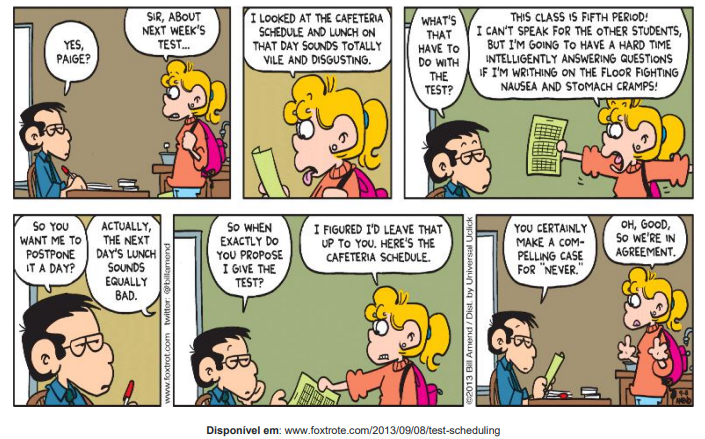
Leia a tirinha a seguir e responda a questão.

 Conheça nossos planos