Questões de Concurso Sobre inglês
Foram encontradas 25.994 questões


Para responder à questão, leia o texto abaixo.
How Will You Get from How Things Are to How Things "Should" Be?
A lot of people get fixated on things that they think "should" happen, but fail to address substantial obstacles in the way. I may even agree with them about what I think "should" happen. But that doesn't mean that it's going to happen. If you're thinking that there is also a danger in being overly cautious or waiting to work out the perfect plan, you're right. That can become a form of procrastination. Acting on an imperfect plan is usually better than waiting until you've worked out every last detail. But at least have some kind of plan that doesn't require a miracle to happen.
The plan that works will also probably not be the plan you started with. You will have to update the plan as you proceed and the situation evolves.
A good model for this process is John Boyd's OODA decision making loop. OODA stands for Observe, Orient, Decide, Act. Actions produce responses that provide new information. New information requires reorientation and new decisions will have to be made that lead to new actions, and the loop repeats.
No big changes happened because a bunch of people sat around complaining about how things "should be."
That's like saying "l should be a millionaire." You could be, but you're going to need some kind of plan to get there that realistically acknowledges the obstacles in your way.
Many of the problems we face today took years to create.
We have inherited a big mess. A lot of things happened that "should not" have happened. Mistakes were made.
But that's life. It's going to throw all kinds of things at you that are sub-optimal. Things you didn't "deserve" or ask for. Cleaning up messes you didn't create is as normal as dealing with bad weather.
Some messes only require a dustpan.
But if you want to clean up a really big mess, you're going to need a plan.
Fonte: https://mrjackdonovan.substack.com/p/the-flow-chart
Para responder à questão, leia o texto abaixo.
How Will You Get from How Things Are to How Things "Should" Be?
A lot of people get fixated on things that they think "should" happen, but fail to address substantial obstacles in the way. I may even agree with them about what I think "should" happen. But that doesn't mean that it's going to happen. If you're thinking that there is also a danger in being overly cautious or waiting to work out the perfect plan, you're right. That can become a form of procrastination. Acting on an imperfect plan is usually better than waiting until you've worked out every last detail. But at least have some kind of plan that doesn't require a miracle to happen.
The plan that works will also probably not be the plan you started with. You will have to update the plan as you proceed and the situation evolves.
A good model for this process is John Boyd's OODA decision making loop. OODA stands for Observe, Orient, Decide, Act. Actions produce responses that provide new information. New information requires reorientation and new decisions will have to be made that lead to new actions, and the loop repeats.
No big changes happened because a bunch of people sat around complaining about how things "should be."
That's like saying "l should be a millionaire." You could be, but you're going to need some kind of plan to get there that realistically acknowledges the obstacles in your way.
Many of the problems we face today took years to create.
We have inherited a big mess. A lot of things happened that "should not" have happened. Mistakes were made.
But that's life. It's going to throw all kinds of things at you that are sub-optimal. Things you didn't "deserve" or ask for. Cleaning up messes you didn't create is as normal as dealing with bad weather.
Some messes only require a dustpan.
But if you want to clean up a really big mess, you're going to need a plan.
Fonte: https://mrjackdonovan.substack.com/p/the-flow-chart
Para responder à questão, leia o texto abaixo.
How Will You Get from How Things Are to How Things "Should" Be?
A lot of people get fixated on things that they think "should" happen, but fail to address substantial obstacles in the way. I may even agree with them about what I think "should" happen. But that doesn't mean that it's going to happen. If you're thinking that there is also a danger in being overly cautious or waiting to work out the perfect plan, you're right. That can become a form of procrastination. Acting on an imperfect plan is usually better than waiting until you've worked out every last detail. But at least have some kind of plan that doesn't require a miracle to happen.
The plan that works will also probably not be the plan you started with. You will have to update the plan as you proceed and the situation evolves.
A good model for this process is John Boyd's OODA decision making loop. OODA stands for Observe, Orient, Decide, Act. Actions produce responses that provide new information. New information requires reorientation and new decisions will have to be made that lead to new actions, and the loop repeats.
No big changes happened because a bunch of people sat around complaining about how things "should be."
That's like saying "l should be a millionaire." You could be, but you're going to need some kind of plan to get there that realistically acknowledges the obstacles in your way.
Many of the problems we face today took years to create.
We have inherited a big mess. A lot of things happened that "should not" have happened. Mistakes were made.
But that's life. It's going to throw all kinds of things at you that are sub-optimal. Things you didn't "deserve" or ask for. Cleaning up messes you didn't create is as normal as dealing with bad weather.
Some messes only require a dustpan.
But if you want to clean up a really big mess, you're going to need a plan.
Fonte: https://mrjackdonovan.substack.com/p/the-flow-chart
Analyze the sentence below
Once an action ________, it _________feedback that ________ the next deciston.
Regarding this, select the sequence that CORRECTLY fills the blanks in this OODA loop description.
Para responder à questão, leia o texto abaixo.
How Will You Get from How Things Are to How Things "Should" Be?
A lot of people get fixated on things that they think "should" happen, but fail to address substantial obstacles in the way. I may even agree with them about what I think "should" happen. But that doesn't mean that it's going to happen. If you're thinking that there is also a danger in being overly cautious or waiting to work out the perfect plan, you're right. That can become a form of procrastination. Acting on an imperfect plan is usually better than waiting until you've worked out every last detail. But at least have some kind of plan that doesn't require a miracle to happen.
The plan that works will also probably not be the plan you started with. You will have to update the plan as you proceed and the situation evolves.
A good model for this process is John Boyd's OODA decision making loop. OODA stands for Observe, Orient, Decide, Act. Actions produce responses that provide new information. New information requires reorientation and new decisions will have to be made that lead to new actions, and the loop repeats.
No big changes happened because a bunch of people sat around complaining about how things "should be."
That's like saying "l should be a millionaire." You could be, but you're going to need some kind of plan to get there that realistically acknowledges the obstacles in your way.
Many of the problems we face today took years to create.
We have inherited a big mess. A lot of things happened that "should not" have happened. Mistakes were made.
But that's life. It's going to throw all kinds of things at you that are sub-optimal. Things you didn't "deserve" or ask for. Cleaning up messes you didn't create is as normal as dealing with bad weather.
Some messes only require a dustpan.
But if you want to clean up a really big mess, you're going to need a plan.
Fonte: https://mrjackdonovan.substack.com/p/the-flow-chart
Analyze the sentence below:
If you _______ to become a millionaire, you _________ to develop a plan that accounts for realíty, rather than just comp/aining.
Choose the alternative that CORRECTLY completes the logic of the millionaire analogy.
Para responder à questão, leia o texto abaixo.
How Will You Get from How Things Are to How Things "Should" Be?
A lot of people get fixated on things that they think "should" happen, but fail to address substantial obstacles in the way. I may even agree with them about what I think "should" happen. But that doesn't mean that it's going to happen. If you're thinking that there is also a danger in being overly cautious or waiting to work out the perfect plan, you're right. That can become a form of procrastination. Acting on an imperfect plan is usually better than waiting until you've worked out every last detail. But at least have some kind of plan that doesn't require a miracle to happen.
The plan that works will also probably not be the plan you started with. You will have to update the plan as you proceed and the situation evolves.
A good model for this process is John Boyd's OODA decision making loop. OODA stands for Observe, Orient, Decide, Act. Actions produce responses that provide new information. New information requires reorientation and new decisions will have to be made that lead to new actions, and the loop repeats.
No big changes happened because a bunch of people sat around complaining about how things "should be."
That's like saying "l should be a millionaire." You could be, but you're going to need some kind of plan to get there that realistically acknowledges the obstacles in your way.
Many of the problems we face today took years to create.
We have inherited a big mess. A lot of things happened that "should not" have happened. Mistakes were made.
But that's life. It's going to throw all kinds of things at you that are sub-optimal. Things you didn't "deserve" or ask for. Cleaning up messes you didn't create is as normal as dealing with bad weather.
Some messes only require a dustpan.
But if you want to clean up a really big mess, you're going to need a plan.
Fonte: https://mrjackdonovan.substack.com/p/the-flow-chart
Reconstruct the following segments into a logically and grammatically sound sentence that aligns with the author's argument:
a / realistic / you / if / want,/ success / need / plan / that / acknowledges / obstacles
Regarding this, mark the alternative that presents the CORRECT sentence structure.
Para responder à questão, leia o texto abaixo.
How Will You Get from How Things Are to How Things "Should" Be?
A lot of people get fixated on things that they think "should" happen, but fail to address substantial obstacles in the way. I may even agree with them about what I think "should" happen. But that doesn't mean that it's going to happen. If you're thinking that there is also a danger in being overly cautious or waiting to work out the perfect plan, you're right. That can become a form of procrastination. Acting on an imperfect plan is usually better than waiting until you've worked out every last detail. But at least have some kind of plan that doesn't require a miracle to happen.
The plan that works will also probably not be the plan you started with. You will have to update the plan as you proceed and the situation evolves.
A good model for this process is John Boyd's OODA decision making loop. OODA stands for Observe, Orient, Decide, Act. Actions produce responses that provide new information. New information requires reorientation and new decisions will have to be made that lead to new actions, and the loop repeats.
No big changes happened because a bunch of people sat around complaining about how things "should be."
That's like saying "l should be a millionaire." You could be, but you're going to need some kind of plan to get there that realistically acknowledges the obstacles in your way.
Many of the problems we face today took years to create.
We have inherited a big mess. A lot of things happened that "should not" have happened. Mistakes were made.
But that's life. It's going to throw all kinds of things at you that are sub-optimal. Things you didn't "deserve" or ask for. Cleaning up messes you didn't create is as normal as dealing with bad weather.
Some messes only require a dustpan.
But if you want to clean up a really big mess, you're going to need a plan.
Fonte: https://mrjackdonovan.substack.com/p/the-flow-chart
Based on a rigorous critical appraisal of the text's argumentative framework and logical progression, analyze the assertions below:
I. The OODA decision-making loop functions as a permanent, static mechanism where a single isolated action definitively concludes the operational cycle.
II. The author draws a direct analogy to assert that clearing away messes for which one bears no direct responsibility is a routine, inescapable reality of existence.
III. The author warns that prioritizing extreme caution while waiting to craft a flawless blueprint can deteriorate into counterproductive procrastination.
Which of the following statements islare CORRECT?
Para responder à questão, leia o texto abaixo.
How Will You Get from How Things Are to How Things "Should" Be?
A lot of people get fixated on things that they think "should" happen, but fail to address substantial obstacles in the way. I may even agree with them about what I think "should" happen. But that doesn't mean that it's going to happen. If you're thinking that there is also a danger in being overly cautious or waiting to work out the perfect plan, you're right. That can become a form of procrastination. Acting on an imperfect plan is usually better than waiting until you've worked out every last detail. But at least have some kind of plan that doesn't require a miracle to happen.
The plan that works will also probably not be the plan you started with. You will have to update the plan as you proceed and the situation evolves.
A good model for this process is John Boyd's OODA decision making loop. OODA stands for Observe, Orient, Decide, Act. Actions produce responses that provide new information. New information requires reorientation and new decisions will have to be made that lead to new actions, and the loop repeats.
No big changes happened because a bunch of people sat around complaining about how things "should be."
That's like saying "l should be a millionaire." You could be, but you're going to need some kind of plan to get there that realistically acknowledges the obstacles in your way.
Many of the problems we face today took years to create.
We have inherited a big mess. A lot of things happened that "should not" have happened. Mistakes were made.
But that's life. It's going to throw all kinds of things at you that are sub-optimal. Things you didn't "deserve" or ask for. Cleaning up messes you didn't create is as normal as dealing with bad weather.
Some messes only require a dustpan.
But if you want to clean up a really big mess, you're going to need a plan.
Fonte: https://mrjackdonovan.substack.com/p/the-flow-chart
Which feature most clearly makes the activity consistent with a communicative approach rather than merely a technology-based lesson?
Consider the following actions:
I.Students read a short text under a reasonable time constraint to identify its overall purpose.
II.Students infer selected unfamiliar words from contextual and morphological clues.
III.Students reread the text to increase automaticity and process larger meaningful units rather than isolated words.
IV.Students translate every unfamiliar lexical item before attempting to identify the main idea.
Which combination is pedagogically consistent with developing reading fluency and comprehension?
"Although the proposal initially drew criticism from several teachers, the revised version eventually gained broad support. What had seemed an unnecessary complication came to be regarded as a useful safeguard against inconsistent assessment practices."
Based on the text, the expression "came to be regarded as" indicates that:
Arrange the stages below in a coherent instructional sequence:
I.Students produce a short spoken response in pairs, using information from the video to defend a position.
II.Students watch once to identify the general topic and communicative purpose.
III.Students use the title and an image from the video to predict possible content.
IV.Students watch again to identify specific evidence and compare it with their initial predictions.
The correct sequence is:
Which characteristic clearly distinguishes the activity as a task rather than a contextualized grammar exercise?
(__)The BNCC approaches English as a lingua franca, recognizing its use among speakers with diverse linguistic and cultural repertoires.
(__)Interculturality is relevant to English teaching because language learning also involves contact with different ways of interpreting and participating in the world.
(__)The curricular perspective privileges approximation to a single native-speaker model as the main criterion for legitimate language use.
(__)Issues such as intelligibility, negotiation of meaning, and plurality of English uses are compatible with the BNCC perspective.
The correct sequence, from top to bottom, is:
I.Had the students received clearer instructions, they might have completed the task differently.
II.Only after the second reading did the students notice the contradiction.
III.Neither the teacher nor the students was prepared to change their interpretation.
Which statements about their grammatical structure are correct?
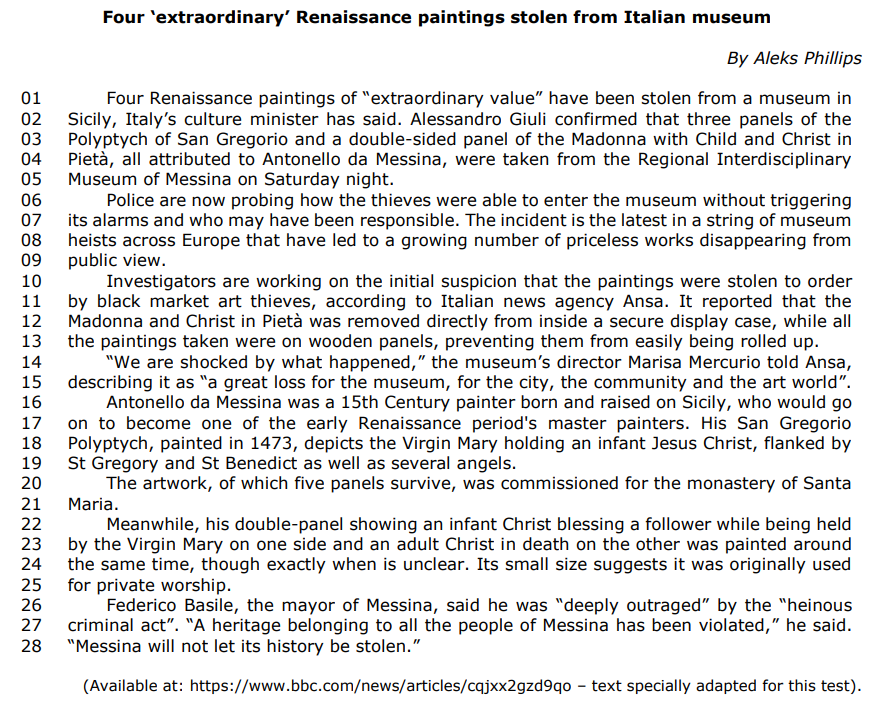
I. In “a museum in Sicily” (l. 01-02), the indefinite article “a” introduces a singular countable noun that has not been previously identified.
II. In “the Regional Interdisciplinary Museum of Messina” (l. 04-05), the definite article “the” refers to a specific institution.
III. In “the paintings taken” (l. 13), the definite article “the” is used because the paintings had already been mentioned in the text.
Which ones are correct?

 Conheça nossos planos