Questões de Concurso Sobre inglês
Foram encontradas 25.999 questões


Choose the correct word formed from the base word “happy” to complete the sentence:
“Despite the bad weather, she remained ______ and cheerful throughout the trip.
Consider the English word record:
ˈrecord (noun)
reˈcord (verb)
The difference in stress placement shows the relationship between lexical stress and grammatical category. Based on this, choose the correct option:
Read the excerpts below, each from a different text genre:
(A) News article:
“Government officials announced new measures to reduce energy consumption across the country.”
(B) Advertisement:
“Looking for the perfect gift? Try our new fragrance and feel the difference!”
(C) Academic abstract:
“This study investigates the impact of digital tools on students” vocabulary acquisition.”
Considering the linguistic aspects and communicative purposes typical of these genres, choose the correct statement:
MEGALE, A. O que é uma perspectiva decolonial de ensino em/de inglês?. ENTREVISTA. 25 de agosto de 2020. Disponível em: https://www. santillana.com.br/conteudos/o-que-e-uma-perspectiva-decolonial-de-ensino-em-de-ingles. Acesso em: 22 abr. 2025.
Judge the items as (T) TRUE or (F) FALSE about Decolonialism in English Language Teaching.
( ) It is not uncommon to come across questions about whether your English is British or American, whether you have ever lived in the United States, or which English rock band you prefer. According to Pardo (2019), these questions reveal issues of submission and subordination and demonstrate how much the issue of coloniality is still present in English language teaching today.
( ) It is emphasized that a model of native speaker to be imitated, usually the American or British, is still very present in language teaching and in teaching materials that do not "consider the diversity and multiplicity of epistemologies, cultures and English-speaking people around the world" (Pardo, 2019, p. 212).
( ) The United States and England are positioned as "'owners of knowledge´ and language, reiterating their epistemic privilege and the maintenance of the logic of coloniality". Therefore, it is necessary to break with the imposed logic that only hegemonic countries represent cultures and models of English speakers.
( ) Part of this process of decoloniality in English language teaching is related to the view that the role of the teacher is not the mere technical and utilitarian work of teaching English, but rather providing students with a linguistic education that is based on the concept that teaching a language is a political task that should aim to develop critical thinking and that, to this end, it must be committed to work that values difference, be it linguistic, political, social, ethnic or gender, as a pedagogical input and as a mark of our humanity.
( ) "When we realize that English is used as a language of interaction in more than 70 countries (Eberhard; Gary; Charles, 2020 apud Megale, 2020, p.3), the opportunity opens up for the histories and cultures of nonhegemonic countries to enter the school community".
Choose the CORRECT sequence.
RODINADZE, S., & ZARBAZOIA, K. The Advantages of Information Technology in Teaching English Language. Frontiers of Language and Teaching. Vol. 3, 2012, pages 271-275.
Choose the alternative that brings WRONG information about Information Technology in the classroom.
NASCIMENTO, W. C.; OLIVEIRA-MELO, F. G. English language and active learning: challenges, experiences, and perspectives from teachers. Research, Society and Development, v. 11, n. 6, 2022. Disponível em: https://rsdjournal.org/index.php/rsd/article/view/29345. Acesso em: 10 nov. 2024.
Choose the INCORRECT item about flipped classroom.
BRASIL. Ministério da Educação: Secretaria de Educação Básica. Base Curricular Nacional Comum: Educação é a base. Ensino Médio. A área de Linguagens e suas Tecnologias, 2021.
Choose the INCORRECT alternative regarding English language teaching, according to the BNCC.
Mato Grosso. Secretaria de Estado de Educação. Orientações Curriculares: Área de Linguagens: Educação Básica. Cuiabá: Gráfica Print, 2012
From those considerations, it is CORRECT to say that:
"Activity B
A teacher brings an advertisement about Mother's Day, taken from a magazine. She asks students to read it and answer questions such as:
- Do the mothers represented in the advertisement resemble those you know? Why not?
- Which mothers are not represented in the advertisement?
- Which children will give presents to their mothers?
- How do the children get money to buy presents for their mothers?
- Who creates/produces these advertisements?
- Why do the people who produce the advertisements spend time and effort to ensure that the reader knows which product is available on the market?"
BRASIL. Ministério da Educação: Secretaria de Educação Básica. Orientações Curriculares para o Ensino Médio: Linguagens, códigos e suas tecnologias. Brasília, 2006, p.116.
Concerning Critical Literacy studies, choose the CORRECT alternative:
BRASIL. Ministério da Educação: Secretaria de Educação Básica. Orientações Curriculares para o Ensino Médio: Linguagens, códigos e suas tecnologias. Brasília, 2006, p.87.
Choose the item(s) that point(s) those new aims.
I. To revisit the reflection on the educational role of foreign language teaching in High School and emphasize its importance.
II. To reaffirm the relevance of the notion of citizenship and discuss the practice of this concept in foreign language teaching.
III. To discuss the problem of exclusion in education in the face of "globalizing" values and the feeling of inclusion often associated with knowledge of foreign languages.
IV. To introduce theories on language (literacies, multiliteracies, multimodality, hypertext).
V. To provide suggestions for the practice of foreign language teaching through new technologies.
Choose the CORRECT alternative.
BRASIL. Ministério da Educação: Secretaria de Educação Básica. Parâmetros Curriculares Nacionais (Ensino Médio). Parte II - Linguagens, Códigos e suas Tecnologias. 2000.
Choose the INCORRECT sentence about the discussion presented in PCNs (2000) about foreign language teaching.
SIYASWATI. Multiliteracies Approach in English Language Teaching Paradigm in 21st Century. Advances in Social Science, Education and Humanities Research. Volume 434. Pages 90 - 96. Disponível em: https://www.atlantis-press.com/proceedings/iconelt-19/125939251. Acesso em: 03 mai. 2025.
After reading Siyaswati´s definition of multiliteracies, judge the items as (T) TRUE or (F) FALSE about the role of multiliteracies in English Language Teaching (ELT).
( ) The multiliteracies pedagogy in ELT is inclusive, as it makes provision for learners with different learning styles and abilities as well as learners who struggle with conventional literacy skills.
( ) ELT pedagogy based on multiliteracies moves English language learning beyond just the acquisition of language skills, and supports the development of critical literacy.
( ) Multiliteracies try to integrate technologies (e.g., new literacies; digital m edia) in the classroom and are characterized by four pedagogical practices (situated practice, overt instruction, critical framing, and transformed practice), and cultural and social practices.
( ) ELT pedagogy based on multiliteracies considers language is still taught as a set of productive (speaking and writing) and receptive (listening and reading) skills.
Choose the CORRECT sequence.
SPRATT, M.; PULVERNESS A.; WILLIAMS, M. The TKT – Teaching Knowledge Test Course. Cambridge University Press: Cambridge, 2005.
Based on the concept of grammar, choose the INCORRECT sentence.
Oxford. L.Language Learning Strategies in a Nutshell: Update and ESL Suggestions.In: RICHARDS, J. C. & RENANDYA. W.A. Methodology in Language Teaching: an Anthology of Current Practice. Cambridge: Cambridge University Press 2002. Chapter 11 - pages 121 -132.
Identify the learning strategies as exposed by Oxford (2002) by matching each definition to the CORRECT category.
1. Cognitive
2. Metacognitive
3. Affective
4. Social
( ) This strategy deals with the planning, monitoring, and evaluation of language learning activities. For example, students may develop a plan for monitoring their progress by constantly comparing their current level of proficiency with the course goals outlined in the curriculum.
( ) This strategy involves the identification, retention, and retrieval of language elements. For example, students may use memory-enhancing strategies (e.g., the keyword method) to help them remember new words.
( ) This strategy refers to actions learners take to interact with users of the language. For example, students may deliberately seek out opportunities to use the target language with native speakers of the language.
( ) This strategy serves to regulate emotions, attitudes, and motivation. For example, students may read linguistically simplified books to develop a positive attitude toward reading materials.
Choose the CORRECT sequence.
FARRELL, T. S. C. Lesson Planning In: RICHARDS, J. C. & RENANDYA. W.A. Methodology in Language Teaching: an Anthology of Current Practice. Cambridge: Cambridge University Press 2002. Chapter 3 - pages 30-39.
After reading about the importance of lesson planning, match the CORRECT information to the number in the following Lesson Plan.
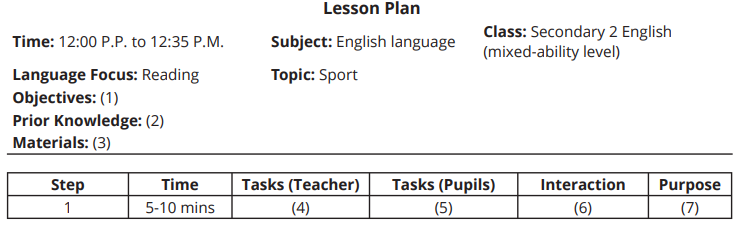
( ) 1. Reading materials - article from a book on sports 2. Television 3. Whiteboard
( ) To teach the students how to skim for main idea of the passage - identify key words.
( ) Students have learned how to locate information by reading and finding the main sentence of each paragraph.
( )

( )

( ) Arouse interest. Activate schema for sport
( )

Choose the CORRECT sequence.
PIAZZA, Paulo Thiago. The historical development of english as a foreign language teaching in brazilian schools: methods and legal documents. Revista Contribuciones a Las Ciencias Sociales, São José dos Pinhais, v.17, n.6, p. 01-23, 2024. Disponível em: https://ojs.revistacontribuciones.com/ojs/index.php/clcs. Acesso em: 10 mai. 2025.
Judge the items as ( T ) TRUE or ( F ) FALSE according to the Communicative Approach.
( ) Instead of organizing the syllabus based on grammar topics (simple past, simple present, if clauses, etc.), the organization is focused on developing students´ communicative competence.
( ) Classes based on Communicative Language Teaching (CLT) tend to be more teacher-centered, with a greater emphasis on teacher-student interactions and situations where the language must be used by students for communicative purposes.
( ) Errors are viewed as part of development, and most of the time are not corrected immediately. ( ) The role of the teacher in CLT is to promote situations where students need to communicate in their mother tongue.
( ) Students must be exposed to authentic materials, that is, language as it is actually used in daily routines in the real world.
Choose the CORRECT sequence.
PIAZZA, Paulo Thiago. The historical development of english as a foreign language teaching in brazilian schools: methods and legal documents. Revista Contribuciones a Las Ciencias Sociales, São José dos Pinhais, v.17, n.6, p. 01-23, 2024. Disponível em: https://ojs.revistacontribuciones.com/ojs/index.php/clcs. Acesso em: 10 mai. 2025.
According to Larsen-Freeman and Anderson (2011, p.38 apud PIAZZA, 2024, p. 5), in a class based on the GrammarTranslation method, the "fundamental purpose of learning a language is to be able to read literature written in the target language".
Choose the item that IS NOT applied to the Grammar-Translation method.

Read the comic strip and choose the option that correctly explains the meaning of the expression “gravy boat” as used in the dialogue.

 Conheça nossos planos