Questões de Concurso
Sobre interpretação de texto | reading comprehension em inglês
Foram encontradas 12.687 questões


Ano: 2025
Banca:
FAU
Órgão:
Prefeitura de Pinhalão - PR
Prova:
FAU - 2025 - Prefeitura de Pinhalão - PR - Professor de Inglês |
Q3492017
Inglês
Texto associado
O texto I refere-se à questão.
TEXT I – The Role of Motivation in Learning English as a Second Language
Learning English as a second language can be a long and challenging process. Students
often face difficulties such as unfamiliar grammar rules, pronunciation differences, and vocabulary
gaps. However, one factor that significantly affects success in learning is motivation. Motivated
students tend to participate more actively in class, complete assignments, and practice the
language outside the classroom.
There are two main types of motivation: intrinsic and extrinsic. Intrinsic motivation comes
from the student’s internal desire to learn, such as personal interest in English culture or the joy of
learning new languages. On the other hand, extrinsic motivation is related to external rewards, like
passing an exam, getting a job promotion, or meeting school requirements. Both types of
motivation play an important role in language learning.
Teachers can use different strategies to increase student motivation. One effective method
is to create engaging and meaningful activities. For example, using real-life situations like roleplays, interviews, or debates can make students feel that what they are learning is useful and
relevant. Also, providing positive feedback and celebrating small achievements helps build student
confidence and encourages continuous effort.
Another essential factor is setting realistic goals. When students see progress over time,
such as learning a certain number of new words per week or being able to hold a short
conversation, they feel more motivated to continue. Clear and achievable targets make the
learning process less overwhelming and more enjoyable.
Finally, it is important for teachers to understand the individual needs and interests of their
students. Adapting lessons to include topics that students enjoy, such as music, movies, or travel,
can make classes more dynamic and inspiring. Motivation is not something fixed; it can grow with
the right teaching approach and a supportive classroom environment.
What is one example of intrinsic motivation for learning English, according to the text?
Ano: 2025
Banca:
EDUCA
Órgão:
Prefeitura de São João do Rio do Peixe - PB
Prova:
EDUCA - 2025 - Prefeitura de São João do Rio do Peixe - PB - Professor de Educação Básica II - Língua Inglesa |
Q3482503
Inglês
Texto associado
TEXT 2
GRAMMAR
Most English language teachers are probably comfortable
using the word ‘grammar’. There is an established
grammatical tradition within ELT, and terms such as
‘tense’, ‘conditional form’, or ‘defining relative clause’ are
likely to be familiar even to relatively inexperienced
teachers. Grammar is often thought of as something
reliable and predictable, but although the term is a
keyword in the ELT profession, it is somewhat under-examined. A look at the word’s history reveals a perhaps
surprising amount of variation and inconsistency.
The word ‘grammar’ comes originally from Ancient Greek
grammatike (‘pertaining to letters/written language’).
Grammar was one of the ‘liberal arts’ taught in Ancient
Greece, and in Rome from around the fifth century BC,
although at this time it was a wider area of study than
today, including textual and aesthetic criticism and literary
history. Its study continued in Europe in medieval times
and beyond, with grammar being taught at schools
alongside logic and rhetoric in what was known as the
‘trivium’.
The tradition of studying the grammar of English in British
schools did not emerge until the 16th century (Howatt with
Widdowson 2004: 77) — until then, studying grammar at
school meant studying Latin or Ancient Greek, not
vernacular languages. Indeed, the first grammar of
English, Bullokar’s Pamphlet for Grammar (1586), is said
to have been written to demonstrate that the English
language was in fact rule-based and could be analysed in
the same way as Latin (Linn 2006: 74).
Grammar has lost its status as a distinct subject in the
school curriculum but the word has continued (since 1530
according to the Oxford English Dictionary) to be used as
a countable noun meaning ‘a book describing the grammar
of a language’.
Content extracted and adapted from:
https://academic.oup.com/eltj/articleabstract/74/2/198/5805512?redirectedFrom=fulltext
According to Text 2, what does the Oxford English
Dictionary say about the term "grammar”?
Ano: 2025
Banca:
EDUCA
Órgão:
Prefeitura de São João do Rio do Peixe - PB
Prova:
EDUCA - 2025 - Prefeitura de São João do Rio do Peixe - PB - Professor de Educação Básica II - Língua Inglesa |
Q3482502
Inglês
Texto associado
TEXT 2
GRAMMAR
Most English language teachers are probably comfortable
using the word ‘grammar’. There is an established
grammatical tradition within ELT, and terms such as
‘tense’, ‘conditional form’, or ‘defining relative clause’ are
likely to be familiar even to relatively inexperienced
teachers. Grammar is often thought of as something
reliable and predictable, but although the term is a
keyword in the ELT profession, it is somewhat under-examined. A look at the word’s history reveals a perhaps
surprising amount of variation and inconsistency.
The word ‘grammar’ comes originally from Ancient Greek
grammatike (‘pertaining to letters/written language’).
Grammar was one of the ‘liberal arts’ taught in Ancient
Greece, and in Rome from around the fifth century BC,
although at this time it was a wider area of study than
today, including textual and aesthetic criticism and literary
history. Its study continued in Europe in medieval times
and beyond, with grammar being taught at schools
alongside logic and rhetoric in what was known as the
‘trivium’.
The tradition of studying the grammar of English in British
schools did not emerge until the 16th century (Howatt with
Widdowson 2004: 77) — until then, studying grammar at
school meant studying Latin or Ancient Greek, not
vernacular languages. Indeed, the first grammar of
English, Bullokar’s Pamphlet for Grammar (1586), is said
to have been written to demonstrate that the English
language was in fact rule-based and could be analysed in
the same way as Latin (Linn 2006: 74).
Grammar has lost its status as a distinct subject in the
school curriculum but the word has continued (since 1530
according to the Oxford English Dictionary) to be used as
a countable noun meaning ‘a book describing the grammar
of a language’.
Content extracted and adapted from:
https://academic.oup.com/eltj/articleabstract/74/2/198/5805512?redirectedFrom=fulltext
According to Text 2, what was the first grammar book
of the English language?
Ano: 2025
Banca:
EDUCA
Órgão:
Prefeitura de São João do Rio do Peixe - PB
Prova:
EDUCA - 2025 - Prefeitura de São João do Rio do Peixe - PB - Professor de Educação Básica II - Língua Inglesa |
Q3482501
Inglês
Texto associado
TEXT 2
GRAMMAR
Most English language teachers are probably comfortable
using the word ‘grammar’. There is an established
grammatical tradition within ELT, and terms such as
‘tense’, ‘conditional form’, or ‘defining relative clause’ are
likely to be familiar even to relatively inexperienced
teachers. Grammar is often thought of as something
reliable and predictable, but although the term is a
keyword in the ELT profession, it is somewhat under-examined. A look at the word’s history reveals a perhaps
surprising amount of variation and inconsistency.
The word ‘grammar’ comes originally from Ancient Greek
grammatike (‘pertaining to letters/written language’).
Grammar was one of the ‘liberal arts’ taught in Ancient
Greece, and in Rome from around the fifth century BC,
although at this time it was a wider area of study than
today, including textual and aesthetic criticism and literary
history. Its study continued in Europe in medieval times
and beyond, with grammar being taught at schools
alongside logic and rhetoric in what was known as the
‘trivium’.
The tradition of studying the grammar of English in British
schools did not emerge until the 16th century (Howatt with
Widdowson 2004: 77) — until then, studying grammar at
school meant studying Latin or Ancient Greek, not
vernacular languages. Indeed, the first grammar of
English, Bullokar’s Pamphlet for Grammar (1586), is said
to have been written to demonstrate that the English
language was in fact rule-based and could be analysed in
the same way as Latin (Linn 2006: 74).
Grammar has lost its status as a distinct subject in the
school curriculum but the word has continued (since 1530
according to the Oxford English Dictionary) to be used as
a countable noun meaning ‘a book describing the grammar
of a language’.
Content extracted and adapted from:
https://academic.oup.com/eltj/articleabstract/74/2/198/5805512?redirectedFrom=fulltext
What does Text 2 suggest about the status of grammar
in today’s school curriculum?
Ano: 2025
Banca:
EDUCA
Órgão:
Prefeitura de São João do Rio do Peixe - PB
Prova:
EDUCA - 2025 - Prefeitura de São João do Rio do Peixe - PB - Professor de Educação Básica II - Língua Inglesa |
Q3482498
Inglês
Texto associado
TEXT 1
NATIVE-SPEAKERISM
Framing the Issue
Native-speakerism is an ideology that upholdsthe idea that
so-called “native speakers” are the best models and
teachers of English because they represent a “Western
culture” from which spring the ideals both of English and
of the methodology for teaching it (Holliday, 2005, p. 6).
As an ideology, it is a system of ideas that represents a
distorted worldview that supports a particular vested
interest. The vested interest in the case of nativespeakerism is the promotion by the ELT industry of the
so-called “native speaker” brand. The realization that this
is an ideologically constructed brand derives from
Phillipson’s (1992) linguistic imperialism thesis that the
concept of the “native speaker” as a superior model and
teacher was explicitly constructed by American and British aid agencies in the 1960s to support their agenda of
spreading English as a global product.
Further indication that the “native speaker” brand is an
ideological construction is that the native-non-native
speaker distinction is not self-evident on technical
linguistic or even nationality grounds. It is instead a
professionally popularized distinction that has been falsely
associated with cultural orientation (Kubota & Lin, 2006).
Teachers who are labeled “native speakers” have been
falsely idealized as organized and autonomous in fitting
with the common yet mistaken description of so-called
“individualist cultures” of the West; while teachers who
are labeled “non-native speakers” are demonized as
deficient in these attributes in fitting with the common yet
mistaken description of so-called “collectivist cultures” of
the non-West (Holliday, 2005, p. 19, citing Kubota,
Kumaravadivelu, Nayar, and Pennycook). The collectivist
stereotype is itself considered to be a Western construction
of non-Western cultural deficiency. An example of this is
a British teacher’s reference to a superior “native speaker”
“birthright” at the same time as criticizing, albeit without
foundation, not only the linguistic and pedagogic
performance, but also the cultural background and
proficiency of his “non-native speaker” colleagues
(Holliday & Aboshiha, 2009, p. 667).
The Othering of teachers who are labeled “non-native
speakers” therefore results in a cultural disbelief—not
believing in their ability to teach English within a Western,
and indeed superficially constructed “learning group
ideal” that is characterized by “active” oral expression,
initiation, self-direction, and students working in groups
and pairs (Holliday, 2005, p. 44). The association of the
“non-native speaker” label with deficiency is also deeply
rooted within a wider and equally mistaken Western
perception that people from non-Western cultural
backgrounds are unable to be critical and self-determined.
Excerpt extracted and adapted from:
https://adrianholliday.com/wp-content/uploads/2017/02/nativespeakerism-proofs.pdf
Based on Text 1, which institutions contributed to the
creation of the native-speaker model, according to
Phillipson?
Ano: 2025
Banca:
EDUCA
Órgão:
Prefeitura de São João do Rio do Peixe - PB
Prova:
EDUCA - 2025 - Prefeitura de São João do Rio do Peixe - PB - Professor de Educação Básica II - Língua Inglesa |
Q3482497
Inglês
Texto associado
TEXT 1
NATIVE-SPEAKERISM
Framing the Issue
Native-speakerism is an ideology that upholdsthe idea that
so-called “native speakers” are the best models and
teachers of English because they represent a “Western
culture” from which spring the ideals both of English and
of the methodology for teaching it (Holliday, 2005, p. 6).
As an ideology, it is a system of ideas that represents a
distorted worldview that supports a particular vested
interest. The vested interest in the case of nativespeakerism is the promotion by the ELT industry of the
so-called “native speaker” brand. The realization that this
is an ideologically constructed brand derives from
Phillipson’s (1992) linguistic imperialism thesis that the
concept of the “native speaker” as a superior model and
teacher was explicitly constructed by American and British aid agencies in the 1960s to support their agenda of
spreading English as a global product.
Further indication that the “native speaker” brand is an
ideological construction is that the native-non-native
speaker distinction is not self-evident on technical
linguistic or even nationality grounds. It is instead a
professionally popularized distinction that has been falsely
associated with cultural orientation (Kubota & Lin, 2006).
Teachers who are labeled “native speakers” have been
falsely idealized as organized and autonomous in fitting
with the common yet mistaken description of so-called
“individualist cultures” of the West; while teachers who
are labeled “non-native speakers” are demonized as
deficient in these attributes in fitting with the common yet
mistaken description of so-called “collectivist cultures” of
the non-West (Holliday, 2005, p. 19, citing Kubota,
Kumaravadivelu, Nayar, and Pennycook). The collectivist
stereotype is itself considered to be a Western construction
of non-Western cultural deficiency. An example of this is
a British teacher’s reference to a superior “native speaker”
“birthright” at the same time as criticizing, albeit without
foundation, not only the linguistic and pedagogic
performance, but also the cultural background and
proficiency of his “non-native speaker” colleagues
(Holliday & Aboshiha, 2009, p. 667).
The Othering of teachers who are labeled “non-native
speakers” therefore results in a cultural disbelief—not
believing in their ability to teach English within a Western,
and indeed superficially constructed “learning group
ideal” that is characterized by “active” oral expression,
initiation, self-direction, and students working in groups
and pairs (Holliday, 2005, p. 44). The association of the
“non-native speaker” label with deficiency is also deeply
rooted within a wider and equally mistaken Western
perception that people from non-Western cultural
backgrounds are unable to be critical and self-determined.
Excerpt extracted and adapted from:
https://adrianholliday.com/wp-content/uploads/2017/02/nativespeakerism-proofs.pdf
According to text 1, what is native-speakerism mainly
based on?
Ano: 2025
Banca:
EDUCA
Órgão:
Prefeitura de São João do Rio do Peixe - PB
Prova:
EDUCA - 2025 - Prefeitura de São João do Rio do Peixe - PB - Professor de Educação Básica II - Língua Inglesa |
Q3482496
Inglês
Texto associado
TEXT 1
NATIVE-SPEAKERISM
Framing the Issue
Native-speakerism is an ideology that upholdsthe idea that
so-called “native speakers” are the best models and
teachers of English because they represent a “Western
culture” from which spring the ideals both of English and
of the methodology for teaching it (Holliday, 2005, p. 6).
As an ideology, it is a system of ideas that represents a
distorted worldview that supports a particular vested
interest. The vested interest in the case of nativespeakerism is the promotion by the ELT industry of the
so-called “native speaker” brand. The realization that this
is an ideologically constructed brand derives from
Phillipson’s (1992) linguistic imperialism thesis that the
concept of the “native speaker” as a superior model and
teacher was explicitly constructed by American and British aid agencies in the 1960s to support their agenda of
spreading English as a global product.
Further indication that the “native speaker” brand is an
ideological construction is that the native-non-native
speaker distinction is not self-evident on technical
linguistic or even nationality grounds. It is instead a
professionally popularized distinction that has been falsely
associated with cultural orientation (Kubota & Lin, 2006).
Teachers who are labeled “native speakers” have been
falsely idealized as organized and autonomous in fitting
with the common yet mistaken description of so-called
“individualist cultures” of the West; while teachers who
are labeled “non-native speakers” are demonized as
deficient in these attributes in fitting with the common yet
mistaken description of so-called “collectivist cultures” of
the non-West (Holliday, 2005, p. 19, citing Kubota,
Kumaravadivelu, Nayar, and Pennycook). The collectivist
stereotype is itself considered to be a Western construction
of non-Western cultural deficiency. An example of this is
a British teacher’s reference to a superior “native speaker”
“birthright” at the same time as criticizing, albeit without
foundation, not only the linguistic and pedagogic
performance, but also the cultural background and
proficiency of his “non-native speaker” colleagues
(Holliday & Aboshiha, 2009, p. 667).
The Othering of teachers who are labeled “non-native
speakers” therefore results in a cultural disbelief—not
believing in their ability to teach English within a Western,
and indeed superficially constructed “learning group
ideal” that is characterized by “active” oral expression,
initiation, self-direction, and students working in groups
and pairs (Holliday, 2005, p. 44). The association of the
“non-native speaker” label with deficiency is also deeply
rooted within a wider and equally mistaken Western
perception that people from non-Western cultural
backgrounds are unable to be critical and self-determined.
Excerpt extracted and adapted from:
https://adrianholliday.com/wp-content/uploads/2017/02/nativespeakerism-proofs.pdf
According to Text 1, choose the alternative that
CORRECTLY summarizes its general idea:
Ano: 2025
Banca:
VUNESP
Órgão:
Prefeitura de Itatiba - SP
Prova:
VUNESP - 2025 - Prefeitura de Itatiba - SP - Professor de Ensino Básico II - Inglês (Substituto) |
Q3464014
Inglês
Texto associado
Leia o texto para responder à questão.
In the literature on language learning, one particular
process has commonly been singled out for explication:
transfer. The term describes the carryover of previous
performance or knowledge to subsequent learning. Positive
transfer occurs when the prior knowledge benefits the learning
task; negative transfer, or interference, occurs when previous
performance disrupts the performance of a second task.
It has been common in second language teaching to
stress the role of interference. This is of course not surprising,
as native language interference is surely the most immediately
noticeable source of error among second language learners.
The saliency of interference is strong. For example, a French
native speaker might say in English, “I am in New York since
January,” a perfectly logical transfer of the French sentence
“Je suis a New York depuis Janvier.” Because of the negative
transfer of the French verb form to English, the French system
has, in this case, interfered with the person’s production of a
correct English form.
It is exceedingly important to remember, however, that
the native language of a second language learner is often
positively transferred, in which case the learner benefits
from the facilitating effects of the first language. In the above
sentence, for example, the correct one-to-one word order
correspondence, the personal pronoun, and the preposition
have been positively transferred from French to English. We
often mistakenly overlook the facilitating effects of the native
language in our appetite for analyzing errors in the second
language and for overstressing the interfering effects of the
first language.
(Douglas Brown. Principles of language learning and teaching, 2000.
Adaptado)
Vistas em seu conjunto, as duas frases do segundo
parágrafo “This is of course not surprising, as native
language interference is surely the most immediately
noticeable source of error among second language
learners. The saliency of interference is strong.”
exemplificam
Ano: 2025
Banca:
VUNESP
Órgão:
Prefeitura de Itatiba - SP
Prova:
VUNESP - 2025 - Prefeitura de Itatiba - SP - Professor de Ensino Básico II - Inglês (Substituto) |
Q3464011
Inglês
Texto associado
Leia o texto para responder à questão.
In the literature on language learning, one particular
process has commonly been singled out for explication:
transfer. The term describes the carryover of previous
performance or knowledge to subsequent learning. Positive
transfer occurs when the prior knowledge benefits the learning
task; negative transfer, or interference, occurs when previous
performance disrupts the performance of a second task.
It has been common in second language teaching to
stress the role of interference. This is of course not surprising,
as native language interference is surely the most immediately
noticeable source of error among second language learners.
The saliency of interference is strong. For example, a French
native speaker might say in English, “I am in New York since
January,” a perfectly logical transfer of the French sentence
“Je suis a New York depuis Janvier.” Because of the negative
transfer of the French verb form to English, the French system
has, in this case, interfered with the person’s production of a
correct English form.
It is exceedingly important to remember, however, that
the native language of a second language learner is often
positively transferred, in which case the learner benefits
from the facilitating effects of the first language. In the above
sentence, for example, the correct one-to-one word order
correspondence, the personal pronoun, and the preposition
have been positively transferred from French to English. We
often mistakenly overlook the facilitating effects of the native
language in our appetite for analyzing errors in the second
language and for overstressing the interfering effects of the
first language.
(Douglas Brown. Principles of language learning and teaching, 2000.
Adaptado)
Elementary English teachers in Brazil who adequately
understand the author’s claim in the text will
Ano: 2025
Banca:
VUNESP
Órgão:
Prefeitura de Itatiba - SP
Prova:
VUNESP - 2025 - Prefeitura de Itatiba - SP - Professor de Ensino Básico II - Inglês (Substituto) |
Q3464008
Inglês
Texto associado
Leia o texto a seguir para responder à questão.
Speakers of different languages have different sounds.
Thus, as there is no equivalent in English for the ‘click’ in
the South African language Xhosa, English speakers find it
difficult to produce. British speakers mangle French vowels
because they are not the same as the English ones. Japanese
speakers, on the other hand, do not have different phonemes
for /l/ and /r/ and so have difficulty differentiating between
them.
Whereas in some languages there seems to be a close
relationship between sounds and spelling, in English this is
often not the case. The sound /ʌ/, for example, can be realized
in a number of different spellings (e.g. won, young, funny,
flood). The letters ou, on the other hand, can be pronounced
in a number of different ways (e.g. enough, through, though,
and even journey). A lot depends on the sounds that come
before or after them, but the fact remains that we spell some
sounds in a variety of different ways, and we have a variety of
different sounds for the same spelling.
(Jeremy Harmer. The practice of English language teaching, 2007)
In the fragment at the end of the text “and we have a
variety of different sounds for the same spelling”, the
bolded word refers to
Ano: 2025
Banca:
VUNESP
Órgão:
Prefeitura de Itatiba - SP
Prova:
VUNESP - 2025 - Prefeitura de Itatiba - SP - Professor de Ensino Básico II - Inglês (Substituto) |
Q3464006
Inglês
Texto associado
Leia o texto a seguir para responder à questão.
Speakers of different languages have different sounds.
Thus, as there is no equivalent in English for the ‘click’ in
the South African language Xhosa, English speakers find it
difficult to produce. British speakers mangle French vowels
because they are not the same as the English ones. Japanese
speakers, on the other hand, do not have different phonemes
for /l/ and /r/ and so have difficulty differentiating between
them.
Whereas in some languages there seems to be a close
relationship between sounds and spelling, in English this is
often not the case. The sound /ʌ/, for example, can be realized
in a number of different spellings (e.g. won, young, funny,
flood). The letters ou, on the other hand, can be pronounced
in a number of different ways (e.g. enough, through, though,
and even journey). A lot depends on the sounds that come
before or after them, but the fact remains that we spell some
sounds in a variety of different ways, and we have a variety of
different sounds for the same spelling.
(Jeremy Harmer. The practice of English language teaching, 2007)
Os exemplos no primeiro parágrafo visam a
Ano: 2025
Banca:
VUNESP
Órgão:
Prefeitura de Itatiba - SP
Prova:
VUNESP - 2025 - Prefeitura de Itatiba - SP - Professor de Ensino Básico II - Inglês (Substituto) |
Q3464005
Inglês
Read the cartoon.

(https://larrycuban.wordpress.com)
The cartoon may be used in an English class for teenage learners in Brazil to discuss the
(https://larrycuban.wordpress.com)
The cartoon may be used in an English class for teenage learners in Brazil to discuss the
Ano: 2025
Banca:
VUNESP
Órgão:
Prefeitura de Itatiba - SP
Prova:
VUNESP - 2025 - Prefeitura de Itatiba - SP - Professor de Ensino Básico II - Inglês (Substituto) |
Q3464004
Inglês
Texto associado

Leia a entrevista a seguir para responder à questão.
Can childhood survive the smartphone?
Below is an excerpt from a conversation between the
reporter Katty Kay and Jonathan Haidt who, with his book The
Anxious Generation, sparked a global reckoning about mobile
phone usage among children when it came out last year.
Katty Kay: It’s been a year since your book came out
and caused a huge conversation. I wanted to start by getting
a kind of report card of where we are on the various aspects
of what you put forward: phones in school, age gating, social
media, getting kids to have more free playtime. Who’s doing
well and who isn’t in America on all of those issues?
Jonathan Haidt: I knew that the book was going to be
popular. What I wasn’t prepared for is that this issue would
spread like wildfire around the world, not just in the US.
Because around the world, family life has turned into a fight
over screen time. Everyone hates it. Everyone sees it.
Where it took off most quickly was phone-free schools,
because that is something that is more easily done. It’s so
hard to teach to a classroom when half of them are watching
short videos and playing video games. So, the teachers have
hated the phones from the beginning but they were afraid,
especially in America – maybe it’s the same in other countries
– but in America, there are a lot of parents who want to be able
to communicate all the time with their child, and they think they
have a right to check in on their child. And, ‘What if something
goes wrong? I need to be there.’ So, the overparenting — ...
KK: That’s a paradox, then, because you’ve got the
parents who are super worried about the phones; they see
what phones are doing to their kids. But they also don’t want
their kids to relinquish their phones when they go into school.
JH: Hey, look, people are complicated! They contain
multitudes. And I shouldn’t say that everyone saw the problem,
because there were a lot of parents who saw the phone as a
lifeline. They see the world as very threatening and dangerous.
But we have to focus on what it will take to allow kids to have
healthy brain development through puberty. We’ve got to give
kids a lot less screen time. A lot less fragmenting time. No
TikTok. No short videos. Let’s give them a lot more experience
interacting with people.
(Katty Kay. www.bbc.com, 10.04.2025. Adaptado)
Read the graph.
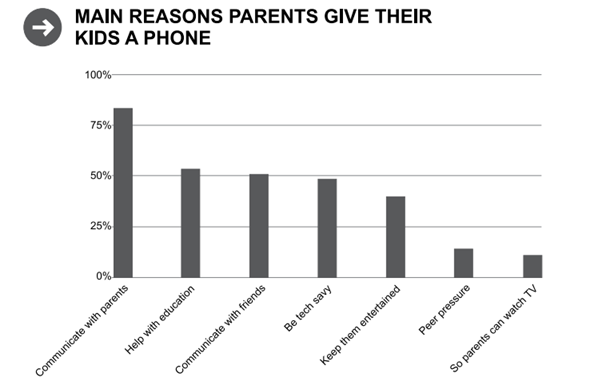
(https://www.sellcell.com)
The content of the text “Can childhood survive the smartphone?” is confirmed in the following finding in the survey on reasons why kids get a phone:
(https://www.sellcell.com)
The content of the text “Can childhood survive the smartphone?” is confirmed in the following finding in the survey on reasons why kids get a phone:
Ano: 2025
Banca:
VUNESP
Órgão:
Prefeitura de Itatiba - SP
Prova:
VUNESP - 2025 - Prefeitura de Itatiba - SP - Professor de Ensino Básico II - Inglês (Substituto) |
Q3464003
Inglês
Texto associado
Leia a entrevista a seguir para responder à questão.
Can childhood survive the smartphone?
Below is an excerpt from a conversation between the
reporter Katty Kay and Jonathan Haidt who, with his book The
Anxious Generation, sparked a global reckoning about mobile
phone usage among children when it came out last year.
Katty Kay: It’s been a year since your book came out
and caused a huge conversation. I wanted to start by getting
a kind of report card of where we are on the various aspects
of what you put forward: phones in school, age gating, social
media, getting kids to have more free playtime. Who’s doing
well and who isn’t in America on all of those issues?
Jonathan Haidt: I knew that the book was going to be
popular. What I wasn’t prepared for is that this issue would
spread like wildfire around the world, not just in the US.
Because around the world, family life has turned into a fight
over screen time. Everyone hates it. Everyone sees it.
Where it took off most quickly was phone-free schools,
because that is something that is more easily done. It’s so
hard to teach to a classroom when half of them are watching
short videos and playing video games. So, the teachers have
hated the phones from the beginning but they were afraid,
especially in America – maybe it’s the same in other countries
– but in America, there are a lot of parents who want to be able
to communicate all the time with their child, and they think they
have a right to check in on their child. And, ‘What if something
goes wrong? I need to be there.’ So, the overparenting — ...
KK: That’s a paradox, then, because you’ve got the
parents who are super worried about the phones; they see
what phones are doing to their kids. But they also don’t want
their kids to relinquish their phones when they go into school.
JH: Hey, look, people are complicated! They contain
multitudes. And I shouldn’t say that everyone saw the problem,
because there were a lot of parents who saw the phone as a
lifeline. They see the world as very threatening and dangerous.
But we have to focus on what it will take to allow kids to have
healthy brain development through puberty. We’ve got to give
kids a lot less screen time. A lot less fragmenting time. No
TikTok. No short videos. Let’s give them a lot more experience
interacting with people.
(Katty Kay. www.bbc.com, 10.04.2025. Adaptado)
Pela relevância do tema abordado, determinado professor decide usar a entrevista, ou trechos dela, em uma
aula de Língua Inglesa para alunos mais avançados.
Ciente da importância de se considerar o contexto de
produção para a compreensão mais plena de um texto,
em sua aula o professor decide
Ano: 2025
Banca:
VUNESP
Órgão:
Prefeitura de Itatiba - SP
Prova:
VUNESP - 2025 - Prefeitura de Itatiba - SP - Professor de Ensino Básico II - Inglês (Substituto) |
Q3464002
Inglês
Texto associado
Leia a entrevista a seguir para responder à questão.
Can childhood survive the smartphone?
Below is an excerpt from a conversation between the
reporter Katty Kay and Jonathan Haidt who, with his book The
Anxious Generation, sparked a global reckoning about mobile
phone usage among children when it came out last year.
Katty Kay: It’s been a year since your book came out
and caused a huge conversation. I wanted to start by getting
a kind of report card of where we are on the various aspects
of what you put forward: phones in school, age gating, social
media, getting kids to have more free playtime. Who’s doing
well and who isn’t in America on all of those issues?
Jonathan Haidt: I knew that the book was going to be
popular. What I wasn’t prepared for is that this issue would
spread like wildfire around the world, not just in the US.
Because around the world, family life has turned into a fight
over screen time. Everyone hates it. Everyone sees it.
Where it took off most quickly was phone-free schools,
because that is something that is more easily done. It’s so
hard to teach to a classroom when half of them are watching
short videos and playing video games. So, the teachers have
hated the phones from the beginning but they were afraid,
especially in America – maybe it’s the same in other countries
– but in America, there are a lot of parents who want to be able
to communicate all the time with their child, and they think they
have a right to check in on their child. And, ‘What if something
goes wrong? I need to be there.’ So, the overparenting — ...
KK: That’s a paradox, then, because you’ve got the
parents who are super worried about the phones; they see
what phones are doing to their kids. But they also don’t want
their kids to relinquish their phones when they go into school.
JH: Hey, look, people are complicated! They contain
multitudes. And I shouldn’t say that everyone saw the problem,
because there were a lot of parents who saw the phone as a
lifeline. They see the world as very threatening and dangerous.
But we have to focus on what it will take to allow kids to have
healthy brain development through puberty. We’ve got to give
kids a lot less screen time. A lot less fragmenting time. No
TikTok. No short videos. Let’s give them a lot more experience
interacting with people.
(Katty Kay. www.bbc.com, 10.04.2025. Adaptado)
Suppose this text is read by teachers taking an in-service
training course in teaching English as a Foreign Language.
One of the course’s objectives is to develop the teachers’
awareness about the importance of critical reading and
interculturality. To help achieve these purposes, the
following activity is proposed:
Ano: 2025
Banca:
VUNESP
Órgão:
Prefeitura de Itatiba - SP
Prova:
VUNESP - 2025 - Prefeitura de Itatiba - SP - Professor de Ensino Básico II - Inglês (Substituto) |
Q3464001
Inglês
Texto associado
Leia a entrevista a seguir para responder à questão.
Can childhood survive the smartphone?
Below is an excerpt from a conversation between the
reporter Katty Kay and Jonathan Haidt who, with his book The
Anxious Generation, sparked a global reckoning about mobile
phone usage among children when it came out last year.
Katty Kay: It’s been a year since your book came out
and caused a huge conversation. I wanted to start by getting
a kind of report card of where we are on the various aspects
of what you put forward: phones in school, age gating, social
media, getting kids to have more free playtime. Who’s doing
well and who isn’t in America on all of those issues?
Jonathan Haidt: I knew that the book was going to be
popular. What I wasn’t prepared for is that this issue would
spread like wildfire around the world, not just in the US.
Because around the world, family life has turned into a fight
over screen time. Everyone hates it. Everyone sees it.
Where it took off most quickly was phone-free schools,
because that is something that is more easily done. It’s so
hard to teach to a classroom when half of them are watching
short videos and playing video games. So, the teachers have
hated the phones from the beginning but they were afraid,
especially in America – maybe it’s the same in other countries
– but in America, there are a lot of parents who want to be able
to communicate all the time with their child, and they think they
have a right to check in on their child. And, ‘What if something
goes wrong? I need to be there.’ So, the overparenting — ...
KK: That’s a paradox, then, because you’ve got the
parents who are super worried about the phones; they see
what phones are doing to their kids. But they also don’t want
their kids to relinquish their phones when they go into school.
JH: Hey, look, people are complicated! They contain
multitudes. And I shouldn’t say that everyone saw the problem,
because there were a lot of parents who saw the phone as a
lifeline. They see the world as very threatening and dangerous.
But we have to focus on what it will take to allow kids to have
healthy brain development through puberty. We’ve got to give
kids a lot less screen time. A lot less fragmenting time. No
TikTok. No short videos. Let’s give them a lot more experience
interacting with people.
(Katty Kay. www.bbc.com, 10.04.2025. Adaptado)
In case you did not yet know the meaning of the word
“relinquish” before reading this text, and used contextual
clues to arrive at its meaning, you employed the
compensatory reading strategy known as
Ano: 2025
Banca:
VUNESP
Órgão:
Prefeitura de Itatiba - SP
Prova:
VUNESP - 2025 - Prefeitura de Itatiba - SP - Professor de Ensino Básico II - Inglês (Substituto) |
Q3463998
Inglês
Texto associado
Leia a entrevista a seguir para responder à questão.
Can childhood survive the smartphone?
Below is an excerpt from a conversation between the
reporter Katty Kay and Jonathan Haidt who, with his book The
Anxious Generation, sparked a global reckoning about mobile
phone usage among children when it came out last year.
Katty Kay: It’s been a year since your book came out
and caused a huge conversation. I wanted to start by getting
a kind of report card of where we are on the various aspects
of what you put forward: phones in school, age gating, social
media, getting kids to have more free playtime. Who’s doing
well and who isn’t in America on all of those issues?
Jonathan Haidt: I knew that the book was going to be
popular. What I wasn’t prepared for is that this issue would
spread like wildfire around the world, not just in the US.
Because around the world, family life has turned into a fight
over screen time. Everyone hates it. Everyone sees it.
Where it took off most quickly was phone-free schools,
because that is something that is more easily done. It’s so
hard to teach to a classroom when half of them are watching
short videos and playing video games. So, the teachers have
hated the phones from the beginning but they were afraid,
especially in America – maybe it’s the same in other countries
– but in America, there are a lot of parents who want to be able
to communicate all the time with their child, and they think they
have a right to check in on their child. And, ‘What if something
goes wrong? I need to be there.’ So, the overparenting — ...
KK: That’s a paradox, then, because you’ve got the
parents who are super worried about the phones; they see
what phones are doing to their kids. But they also don’t want
their kids to relinquish their phones when they go into school.
JH: Hey, look, people are complicated! They contain
multitudes. And I shouldn’t say that everyone saw the problem,
because there were a lot of parents who saw the phone as a
lifeline. They see the world as very threatening and dangerous.
But we have to focus on what it will take to allow kids to have
healthy brain development through puberty. We’ve got to give
kids a lot less screen time. A lot less fragmenting time. No
TikTok. No short videos. Let’s give them a lot more experience
interacting with people.
(Katty Kay. www.bbc.com, 10.04.2025. Adaptado)
In the context of the fourth paragraph, the fragment “–
maybe it’s the same in other countries –” functions as
Ano: 2025
Banca:
VUNESP
Órgão:
Prefeitura de Itatiba - SP
Prova:
VUNESP - 2025 - Prefeitura de Itatiba - SP - Professor de Ensino Básico II - Inglês (Substituto) |
Q3463996
Inglês
Texto associado
Leia a entrevista a seguir para responder à questão.
Can childhood survive the smartphone?
Below is an excerpt from a conversation between the
reporter Katty Kay and Jonathan Haidt who, with his book The
Anxious Generation, sparked a global reckoning about mobile
phone usage among children when it came out last year.
Katty Kay: It’s been a year since your book came out
and caused a huge conversation. I wanted to start by getting
a kind of report card of where we are on the various aspects
of what you put forward: phones in school, age gating, social
media, getting kids to have more free playtime. Who’s doing
well and who isn’t in America on all of those issues?
Jonathan Haidt: I knew that the book was going to be
popular. What I wasn’t prepared for is that this issue would
spread like wildfire around the world, not just in the US.
Because around the world, family life has turned into a fight
over screen time. Everyone hates it. Everyone sees it.
Where it took off most quickly was phone-free schools,
because that is something that is more easily done. It’s so
hard to teach to a classroom when half of them are watching
short videos and playing video games. So, the teachers have
hated the phones from the beginning but they were afraid,
especially in America – maybe it’s the same in other countries
– but in America, there are a lot of parents who want to be able
to communicate all the time with their child, and they think they
have a right to check in on their child. And, ‘What if something
goes wrong? I need to be there.’ So, the overparenting — ...
KK: That’s a paradox, then, because you’ve got the
parents who are super worried about the phones; they see
what phones are doing to their kids. But they also don’t want
their kids to relinquish their phones when they go into school.
JH: Hey, look, people are complicated! They contain
multitudes. And I shouldn’t say that everyone saw the problem,
because there were a lot of parents who saw the phone as a
lifeline. They see the world as very threatening and dangerous.
But we have to focus on what it will take to allow kids to have
healthy brain development through puberty. We’ve got to give
kids a lot less screen time. A lot less fragmenting time. No
TikTok. No short videos. Let’s give them a lot more experience
interacting with people.
(Katty Kay. www.bbc.com, 10.04.2025. Adaptado)
According to the author of The Anxious Generation, one
main difficulty in banning child smartphone use from
American schools is
Ano: 2025
Banca:
VUNESP
Órgão:
Prefeitura de Itatiba - SP
Prova:
VUNESP - 2025 - Prefeitura de Itatiba - SP - Professor de Ensino Básico II - Inglês (Titular) |
Q3456350
Inglês
Texto associado
Leia o texto para responder à questão.
Consider these anecdotes:
1. An ESL teacher instructs a group of 7 children every day
for 45 minutes. They sing “I’m a Little Teapot” over and over
again. Standing, they make gestures to show the tea pouring
out. “I’m a little teapot, short and stout, here is my handle,
here is my spout. When I get it all steamed up, hear me shout,
just tip me over and pour me out”. And then the group starts
again…
2. In visiting a class of a successful ESL teacher, you are
struck that each activity lasts no more than ten minutes, that
children are usually in movement - making something, holding
something, moving their hands and walking somewhere.
There are few major contrasts that we can make between
child and adult ESL learners. Children are more likely to play
with language than adults are. In general, children are more
holistic learners who need to use language for authentic
communication in ESL classes.
In a children’s class, activities need to be child centered
and communication should be authentic. Several themes
repeatedly come up:
• Focus on meaning, not correctness.
• Focus on the value of the activity, not the value of language.
• Focus on collaboration and social development.
• Provide a rich context, including movement, the senses,
objects and pictures, and a variety of activities.
• Teach ESL holistically, integrating the four skills.
• Treat learners appropriately in the light of their age and
interests.
• Treat language as a tool for children to use for their own
social and academic ends.
(S. Peck. Developing Children´s Listening and Speaking. IN: Marianne
Cerce-Murcia(ed). Teaching English as a second or foreign language.
Boston, Massachusstes: Heinle&Heinle. 2nd edition. 2001. Adaptado)
Items 1 and 2 in the excerpt represent
Ano: 2025
Banca:
VUNESP
Órgão:
Prefeitura de Itatiba - SP
Prova:
VUNESP - 2025 - Prefeitura de Itatiba - SP - Professor de Ensino Básico II - Inglês (Titular) |
Q3456347
Inglês
Texto associado
Leia o texto para responder à questão.
One of the major foci of applied linguistics scholarship
has been the foreign or second language classroom. A glance
through the past century or so of language teaching gives us
an interesting picture of varied interpretations of the best way
to teach a foreign language. As schools of thought have come
and gone, so have language teaching trends waxed and
waned in popularity.
Albert Marckwardt (1972) saw these “changing winds and
shifting sands” as a cyclical pattern where a new paradigm
of teaching methodology emerged about every quarter of a
century, with each new method breaking from the old but at
the same time taking with it some of the positive aspects of the
previous paradigm. One of the best examples of the cyclical
nature of methods is seen in the revolutionary Audiolingual
Method (ALM) of the late 1940s and 1950s. The ALM borrowed
principles and beliefs from its predecessor by almost half
a century, the Direct Method, while breaking away entirely
from the Grammar-Translation paradigm. Within a short time,
however, ALM critics were advocating more attention to rules
of language which, to some, smacked a return to Grammar
Translation.
(BROWN, H.Douglas. Principles of language learning and teaching.
5th ed. Longman, 2000. Adaptado)
É proposta de sala de aula condizente com o ensino
comunicativo de línguas:

 Conheça nossos planos