Questões de Concurso
Sobre interpretação de texto | reading comprehension em inglês
Foram encontradas 12.539 questões


Ano: 2023
Banca:
VUNESP
Órgão:
Prefeitura de Peruíbe - SP
Prova:
VUNESP - 2023 - Prefeitura de Peruíbe - SP - Professor de Educação Básica II (Língua Estrangeira Moderna - Inglês) |
Q4227846
Inglês
Texto associado
Leia o texto para responder à questão.
Through practice and experience in an increasingly
wide range of communicative contexts and events, learners
gradually expand their communicative competence, consisting
of grammatical competence, discourse competence,
sociocultural competence and strategic competence. All these
components are interrelated. An increase in one component
interacts with other components to produce a corresponding
increase in overall communicative competence.
Grammatical competence refers to sentence-level
grammatical form, the ability to recognize the lexical,
morphological, syntactic and phonological feature of a
language and to make use of these features to interpret
and form words and whole sentences. One demonstrates
grammatical competence not by stating a rule but by using a
rule in the interpretation, expression or negotiation of meaning.
Discourse competence is concerned not with isolated
words or phrases but with the interconnectedness of a series
of utterances, written words and/or phrases to build a text,
a meaningful whole. Two familiar concepts to talk about
discourse competence are text coherence and cohesion. Text
coherence is the relation of all sentences or utterances in a text
to a single global proposition. Local connections or structural
links between individual sentences provide cohesion.
Sociocultural competence extends well beyond linguistic
forms and is an interdisciplinary field of inquiry having to do with
the social rules of language use.
Sociocultural competence
requires an understanding of the social context where
language is used: the roles of the participants, the information
they share, and the function of the interation. And although we
are far from an adequate description of sociocultural rules of
appropriateness, we use them to communicate successfully in
many different contexts of situation. Sociocultural competence
also includes a willingness to suspend judgement and take
into consideration the possibility of cultural differences in
convention and use. Thus the importance of the term cultural
flexibility or cultural awareness.
The ‘’ideal native speaker,’’ someone who knows a
language perfectly and uses it appropriately in all social
interactions, exists in theory only. None of us knows all there is
to know of English in its many manifestations, both around the
world and in our own backyards. Communicative competence
is always relative. The coping strategies we use in unfamiliar
contexts, with constraints due to imperfect knowledge of
rules or limiting factors in their application such as fatigue or
distraction, are represented as strategic competence. With
practice and experience, we gain in grammatical, discourse,
and socio-cultural competence. The relative importance of
strategic competence thus decreases. However, the effective
use of coping strategies is important for communicative
competence in all contexts and distinguishes highly competent
communicators from those who are less so.
(Sandra J. Savignon. Communicative language teaching for the
twenty-first century. IN: Marianne Celce-Murcia. Teaching English as a
second or foreign language. Boston, Massachusstes: Heinle&Heinle.
3rd edition. 2002. Adaptado)
In the sentence from the last paragraph, “None of us knows
all there is to know of English in its many manifestations,
both around the world and in our own backyards.”, the
underlined cohesive device refers to
Ano: 2023
Banca:
VUNESP
Órgão:
Prefeitura de Peruíbe - SP
Prova:
VUNESP - 2023 - Prefeitura de Peruíbe - SP - Professor de Educação Básica II (Língua Estrangeira Moderna - Inglês) |
Q4227845
Inglês
Texto associado
Leia o texto para responder à questão.
Through practice and experience in an increasingly
wide range of communicative contexts and events, learners
gradually expand their communicative competence, consisting
of grammatical competence, discourse competence,
sociocultural competence and strategic competence. All these
components are interrelated. An increase in one component
interacts with other components to produce a corresponding
increase in overall communicative competence.
Grammatical competence refers to sentence-level
grammatical form, the ability to recognize the lexical,
morphological, syntactic and phonological feature of a
language and to make use of these features to interpret
and form words and whole sentences. One demonstrates
grammatical competence not by stating a rule but by using a
rule in the interpretation, expression or negotiation of meaning.
Discourse competence is concerned not with isolated
words or phrases but with the interconnectedness of a series
of utterances, written words and/or phrases to build a text,
a meaningful whole. Two familiar concepts to talk about
discourse competence are text coherence and cohesion. Text
coherence is the relation of all sentences or utterances in a text
to a single global proposition. Local connections or structural
links between individual sentences provide cohesion.
Sociocultural competence extends well beyond linguistic
forms and is an interdisciplinary field of inquiry having to do with
the social rules of language use.
Sociocultural competence
requires an understanding of the social context where
language is used: the roles of the participants, the information
they share, and the function of the interation. And although we
are far from an adequate description of sociocultural rules of
appropriateness, we use them to communicate successfully in
many different contexts of situation. Sociocultural competence
also includes a willingness to suspend judgement and take
into consideration the possibility of cultural differences in
convention and use. Thus the importance of the term cultural
flexibility or cultural awareness.
The ‘’ideal native speaker,’’ someone who knows a
language perfectly and uses it appropriately in all social
interactions, exists in theory only. None of us knows all there is
to know of English in its many manifestations, both around the
world and in our own backyards. Communicative competence
is always relative. The coping strategies we use in unfamiliar
contexts, with constraints due to imperfect knowledge of
rules or limiting factors in their application such as fatigue or
distraction, are represented as strategic competence. With
practice and experience, we gain in grammatical, discourse,
and socio-cultural competence. The relative importance of
strategic competence thus decreases. However, the effective
use of coping strategies is important for communicative
competence in all contexts and distinguishes highly competent
communicators from those who are less so.
(Sandra J. Savignon. Communicative language teaching for the
twenty-first century. IN: Marianne Celce-Murcia. Teaching English as a
second or foreign language. Boston, Massachusstes: Heinle&Heinle.
3rd edition. 2002. Adaptado)
In the first sentence in the last paragraph “The ‘’ideal native
speaker”, someone who knows a language perfectly and
uses it appropriately in all social interaction, exists in theory
only.”, the underlined fragment plays the role of
Ano: 2023
Banca:
VUNESP
Órgão:
Prefeitura de Peruíbe - SP
Prova:
VUNESP - 2023 - Prefeitura de Peruíbe - SP - Professor de Educação Básica II (Língua Estrangeira Moderna - Inglês) |
Q4227844
Inglês
Texto associado
Leia o texto para responder à questão.
Through practice and experience in an increasingly
wide range of communicative contexts and events, learners
gradually expand their communicative competence, consisting
of grammatical competence, discourse competence,
sociocultural competence and strategic competence. All these
components are interrelated. An increase in one component
interacts with other components to produce a corresponding
increase in overall communicative competence.
Grammatical competence refers to sentence-level
grammatical form, the ability to recognize the lexical,
morphological, syntactic and phonological feature of a
language and to make use of these features to interpret
and form words and whole sentences. One demonstrates
grammatical competence not by stating a rule but by using a
rule in the interpretation, expression or negotiation of meaning.
Discourse competence is concerned not with isolated
words or phrases but with the interconnectedness of a series
of utterances, written words and/or phrases to build a text,
a meaningful whole. Two familiar concepts to talk about
discourse competence are text coherence and cohesion. Text
coherence is the relation of all sentences or utterances in a text
to a single global proposition. Local connections or structural
links between individual sentences provide cohesion.
Sociocultural competence extends well beyond linguistic
forms and is an interdisciplinary field of inquiry having to do with
the social rules of language use.
Sociocultural competence
requires an understanding of the social context where
language is used: the roles of the participants, the information
they share, and the function of the interation. And although we
are far from an adequate description of sociocultural rules of
appropriateness, we use them to communicate successfully in
many different contexts of situation. Sociocultural competence
also includes a willingness to suspend judgement and take
into consideration the possibility of cultural differences in
convention and use. Thus the importance of the term cultural
flexibility or cultural awareness.
The ‘’ideal native speaker,’’ someone who knows a
language perfectly and uses it appropriately in all social
interactions, exists in theory only. None of us knows all there is
to know of English in its many manifestations, both around the
world and in our own backyards. Communicative competence
is always relative. The coping strategies we use in unfamiliar
contexts, with constraints due to imperfect knowledge of
rules or limiting factors in their application such as fatigue or
distraction, are represented as strategic competence. With
practice and experience, we gain in grammatical, discourse,
and socio-cultural competence. The relative importance of
strategic competence thus decreases. However, the effective
use of coping strategies is important for communicative
competence in all contexts and distinguishes highly competent
communicators from those who are less so.
(Sandra J. Savignon. Communicative language teaching for the
twenty-first century. IN: Marianne Celce-Murcia. Teaching English as a
second or foreign language. Boston, Massachusstes: Heinle&Heinle.
3rd edition. 2002. Adaptado)
In the fourth paragraph, the discourse markers “although”
and “thus” indicate, respectively,
Ano: 2023
Banca:
VUNESP
Órgão:
Prefeitura de Peruíbe - SP
Prova:
VUNESP - 2023 - Prefeitura de Peruíbe - SP - Professor de Educação Básica II (Língua Estrangeira Moderna - Inglês) |
Q4227843
Inglês
Texto associado
Leia o texto para responder à questão.
Through practice and experience in an increasingly
wide range of communicative contexts and events, learners
gradually expand their communicative competence, consisting
of grammatical competence, discourse competence,
sociocultural competence and strategic competence. All these
components are interrelated. An increase in one component
interacts with other components to produce a corresponding
increase in overall communicative competence.
Grammatical competence refers to sentence-level
grammatical form, the ability to recognize the lexical,
morphological, syntactic and phonological feature of a
language and to make use of these features to interpret
and form words and whole sentences. One demonstrates
grammatical competence not by stating a rule but by using a
rule in the interpretation, expression or negotiation of meaning.
Discourse competence is concerned not with isolated
words or phrases but with the interconnectedness of a series
of utterances, written words and/or phrases to build a text,
a meaningful whole. Two familiar concepts to talk about
discourse competence are text coherence and cohesion. Text
coherence is the relation of all sentences or utterances in a text
to a single global proposition. Local connections or structural
links between individual sentences provide cohesion.
Sociocultural competence extends well beyond linguistic
forms and is an interdisciplinary field of inquiry having to do with
the social rules of language use.
Sociocultural competence
requires an understanding of the social context where
language is used: the roles of the participants, the information
they share, and the function of the interation. And although we
are far from an adequate description of sociocultural rules of
appropriateness, we use them to communicate successfully in
many different contexts of situation. Sociocultural competence
also includes a willingness to suspend judgement and take
into consideration the possibility of cultural differences in
convention and use. Thus the importance of the term cultural
flexibility or cultural awareness.
The ‘’ideal native speaker,’’ someone who knows a
language perfectly and uses it appropriately in all social
interactions, exists in theory only. None of us knows all there is
to know of English in its many manifestations, both around the
world and in our own backyards. Communicative competence
is always relative. The coping strategies we use in unfamiliar
contexts, with constraints due to imperfect knowledge of
rules or limiting factors in their application such as fatigue or
distraction, are represented as strategic competence. With
practice and experience, we gain in grammatical, discourse,
and socio-cultural competence. The relative importance of
strategic competence thus decreases. However, the effective
use of coping strategies is important for communicative
competence in all contexts and distinguishes highly competent
communicators from those who are less so.
(Sandra J. Savignon. Communicative language teaching for the
twenty-first century. IN: Marianne Celce-Murcia. Teaching English as a
second or foreign language. Boston, Massachusstes: Heinle&Heinle.
3rd edition. 2002. Adaptado)
In the first sentence from the third paragraph “Discourse
competence is concerned not with isolated words or
phrases but with the interconnectedness of a series of
utterances, written words and/or phrases to build a text,
a meaningful whole.”, the underlined word functions as
a cohesive device, and the expression “to build” can be
replaced, with no change in meaning, by
Ano: 2023
Banca:
VUNESP
Órgão:
Prefeitura de Peruíbe - SP
Prova:
VUNESP - 2023 - Prefeitura de Peruíbe - SP - Professor de Educação Básica II (Língua Estrangeira Moderna - Inglês) |
Q4227839
Inglês
Texto associado
Leia o texto para responder à questão.
Through practice and experience in an increasingly
wide range of communicative contexts and events, learners
gradually expand their communicative competence, consisting
of grammatical competence, discourse competence,
sociocultural competence and strategic competence. All these
components are interrelated. An increase in one component
interacts with other components to produce a corresponding
increase in overall communicative competence.
Grammatical competence refers to sentence-level
grammatical form, the ability to recognize the lexical,
morphological, syntactic and phonological feature of a
language and to make use of these features to interpret
and form words and whole sentences. One demonstrates
grammatical competence not by stating a rule but by using a
rule in the interpretation, expression or negotiation of meaning.
Discourse competence is concerned not with isolated
words or phrases but with the interconnectedness of a series
of utterances, written words and/or phrases to build a text,
a meaningful whole. Two familiar concepts to talk about
discourse competence are text coherence and cohesion. Text
coherence is the relation of all sentences or utterances in a text
to a single global proposition. Local connections or structural
links between individual sentences provide cohesion.
Sociocultural competence extends well beyond linguistic
forms and is an interdisciplinary field of inquiry having to do with
the social rules of language use.
Sociocultural competence
requires an understanding of the social context where
language is used: the roles of the participants, the information
they share, and the function of the interation. And although we
are far from an adequate description of sociocultural rules of
appropriateness, we use them to communicate successfully in
many different contexts of situation. Sociocultural competence
also includes a willingness to suspend judgement and take
into consideration the possibility of cultural differences in
convention and use. Thus the importance of the term cultural
flexibility or cultural awareness.
The ‘’ideal native speaker,’’ someone who knows a
language perfectly and uses it appropriately in all social
interactions, exists in theory only. None of us knows all there is
to know of English in its many manifestations, both around the
world and in our own backyards. Communicative competence
is always relative. The coping strategies we use in unfamiliar
contexts, with constraints due to imperfect knowledge of
rules or limiting factors in their application such as fatigue or
distraction, are represented as strategic competence. With
practice and experience, we gain in grammatical, discourse,
and socio-cultural competence. The relative importance of
strategic competence thus decreases. However, the effective
use of coping strategies is important for communicative
competence in all contexts and distinguishes highly competent
communicators from those who are less so.
(Sandra J. Savignon. Communicative language teaching for the
twenty-first century. IN: Marianne Celce-Murcia. Teaching English as a
second or foreign language. Boston, Massachusstes: Heinle&Heinle.
3rd edition. 2002. Adaptado)
According to the second paragraph, grammatical
competence helps interpretation of words. Thus in the
phrase “whole sentences” (paragraph 2), grammatical
structure helps identify the underlined word as an
adjective; in “a meaningful whole” (paragraph 3), the
underlined word is a noun. Sentence structure allows the
identification of the word “quiet” as a noun in alternative:
Ano: 2026
Banca:
FUNDATEC
Órgão:
Prefeitura de Água Doce - SC
Prova:
FUNDATEC - 2026 - Prefeitura de Água Doce - SC - Professor de Português / Inglês |
Q4226412
Inglês
Texto associado
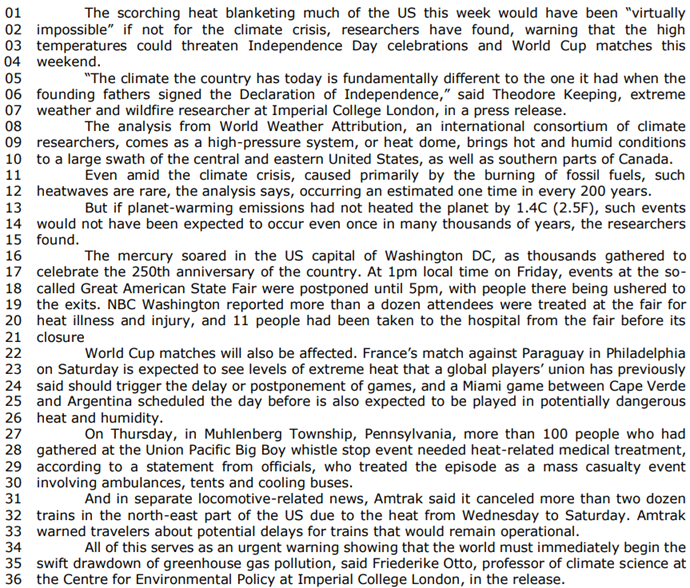

US heatwave threatens 250th anniversary events and World Cup
By Dharna Noor
(Available at: https://www.theguardian.com/us-news/2026/jul/03/heatwave-world-cup-250th-anniversary –
text specially adapted for this test).
In the excerpt “But if planet-warming emissions had not heated the planet by 1.4 °C
(2.5 °F), such events would not have been expected to occur [...]” (l. 13–14), the conditional sentence
indicates that the researchers suggest that
Ano: 2026
Banca:
FUNDATEC
Órgão:
Prefeitura de Água Doce - SC
Prova:
FUNDATEC - 2026 - Prefeitura de Água Doce - SC - Professor de Português / Inglês |
Q4226411
Inglês
Texto associado
US heatwave threatens 250th anniversary events and World Cup
By Dharna Noor
(Available at: https://www.theguardian.com/us-news/2026/jul/03/heatwave-world-cup-250th-anniversary –
text specially adapted for this test).
In the sentence "[...] it will continue to get worse the longer we drag out the
inevitable transition to net zero emissions." (l. 41–42), the expression in bold means:
Ano: 2026
Banca:
FUNDATEC
Órgão:
Prefeitura de Água Doce - SC
Prova:
FUNDATEC - 2026 - Prefeitura de Água Doce - SC - Professor de Português / Inglês |
Q4226410
Inglês
Texto associado
US heatwave threatens 250th anniversary events and World Cup
By Dharna Noor
(Available at: https://www.theguardian.com/us-news/2026/jul/03/heatwave-world-cup-250th-anniversary –
text specially adapted for this test).
What is the main purpose of the text?
Ano: 2022
Banca:
EPL Concursos
Órgão:
Prefeitura de Curitibanos - SC
Prova:
EPL Concursos - 2022 - Prefeitura de Curitibanos - SC - Professor de Língua Inglesa |
Q4225406
Inglês
According to the article, in the 1950s children …
Ano: 2022
Banca:
EPL Concursos
Órgão:
Prefeitura de Curitibanos - SC
Prova:
EPL Concursos - 2022 - Prefeitura de Curitibanos - SC - Professor de Língua Inglesa |
Q4225405
Inglês
The writer quotes a grandmother who …
Ano: 2022
Banca:
EPL Concursos
Órgão:
Prefeitura de Curitibanos - SC
Prova:
EPL Concursos - 2022 - Prefeitura de Curitibanos - SC - Professor de Língua Inglesa |
Q4225404
Inglês
The article describes families in ….
Ano: 2026
Banca:
Ápice Consultoria
Órgão:
Prefeitura de Sobrado - PB
Prova:
Ápice Consultoria - 2026 - Prefeitura de Sobrado - PB - Professor B - Inglês |
Q4221000
Inglês
Observe o período abaixo:
“The diagnostic software flagged a critical anomaly in the server architecture. Engineers immediately initiated a rollback sequence, fearing that the glitch could compromise core database integrity. This proactive measure, however, caused a localized outage.”
Analisando os mecanismos de coesão lexical e anafórica empregados, os termos em negrito operam, respectivamente, como:
“The diagnostic software flagged a critical anomaly in the server architecture. Engineers immediately initiated a rollback sequence, fearing that the glitch could compromise core database integrity. This proactive measure, however, caused a localized outage.”
Analisando os mecanismos de coesão lexical e anafórica empregados, os termos em negrito operam, respectivamente, como:
Ano: 2026
Banca:
Ápice Consultoria
Órgão:
Prefeitura de Sobrado - PB
Prova:
Ápice Consultoria - 2026 - Prefeitura de Sobrado - PB - Professor B - Inglês |
Q4220999
Inglês
Considere o seguinte enunciado extraído de
um editorial econômico:
"The administration’s robust job growth metrics look spectacular on paper, provided one ignores the systemic transition towards precarious, low-wage gig employment."
A intenção comunicativa predominante do autor ao estruturar o período dessa forma é:
"The administration’s robust job growth metrics look spectacular on paper, provided one ignores the systemic transition towards precarious, low-wage gig employment."
A intenção comunicativa predominante do autor ao estruturar o período dessa forma é:
Ano: 2026
Banca:
INSTITUTO AOCP
Órgão:
Prefeitura de Vitória da Conquista - BA
Prova:
INSTITUTO AOCP - 2026 - Prefeitura de Vitória da Conquista - BA - Professor Fundamental II - Nível II - Inglês |
Q4219697
Inglês
Texto associado
Underground library in Warsaw metro invites
commuters to trade scrolling for stories
In Warsaw’s Targówek district, a metro ride has
become more than a daily routine. Now it offers a
chance to escape into a story. Thanks to Metroteka, a
newly opened subterranean library inside the
Kondratowicza M2 metro station, commuters can now
trade mindless scrolling for meaningful reading.
The 150-square-meter space is stocked with more than
16,000 books, all available through a fast self-checkout
system. Visitors can also borrow laptops, sip
complimentary coffee, and unwind in a cozy communal
area, all while waiting for their train.
“Our dream is for Metroteka to become an educational
and cultural center, and not just a place where you can
borrow your books from,” says Grażyna StrzelczakBatkowska, deputy director of the Targówek library.
A modern space that breathes life into books
Metroteka’s design is as inviting as its mission. A lush
hydroponic garden wall filled with herbs and flowers
gives the underground space a breath of fresh air,
literally. Basil, oregano, and other plants grow without
soil or sunlight, infusing the library with an unexpected
sense of vitality. The bookshelves, shaped like soft,
undulating waves, add to the organic feel.
“I always joke that books are not made of glass,”
Strzelczak-Batkowska says. “You can just pop in, grab
a few, throw them on a self-checkout machine, and
that’s it—you’re out on a new adventure.”
Aiming to reverse a national trend
Poland’s reading habits have been in steady decline for
years. A 2024 survey by the National Library of Poland
found that only 41 percent of respondents had read at
least one book in the past year. According to Tomasz
Makowski, director of the National Library, the legacy
of war has shaped these numbers. During World War
II, Poland lost 70 percent of its libraries.
“We had several generations that did not see their
parents or grandparents in front of a wall of books,”
Makowski says. “Reading is [also] not something
associated with adulthood, but with schools, teachers,
librarians, and usually mothers reading to children.”
By placing literature in the path of everyday
commuters, Metroteka hopes to shift that cultural
perception.
An open invitation to all
For Makowski, the location is just as important as the
books. “Opening a library in a metro station is like a
dream for us,” he says. “Libraries should be beautiful
and open; inviting, not intimidating. It’s not a shrine, but
a place where you can spend time freely, take part in
discussions, public consultations, or meet people.”
In the coming months, Metroteka plans to host author
readings, workshops, and classes to further engage the
community. Books can be returned either directly to the
library or via parcel lockers outside the station,
available around the clock.
As commuters pass through Kondratowicza station
with coffee in hand and a novel tucked under one arm,
Metroteka quietly transforms daily routines into cultural
moments. By meeting people where they are, literally
underground, the library isn’t just promoting reading.
It’s redefining what public space can offer.
Source: https://www.optimistdaily.com/2025/09/underground-libraryin-warsaw-metro-invites-commuters-to-trade-scrolling-for-stories/.
Access on May 4th 2026.
Analyze the sentences below:
- […] a place where you can spend time freely […]
- Books can be returned either directly to the library […]
- Metroteka quietly transforms daily routines into cultural moments.
- By meeting people where they are, literally underground […]
The underlined words are all
- […] a place where you can spend time freely […]
- Books can be returned either directly to the library […]
- Metroteka quietly transforms daily routines into cultural moments.
- By meeting people where they are, literally underground […]
The underlined words are all
Ano: 2026
Banca:
INSTITUTO AOCP
Órgão:
Prefeitura de Vitória da Conquista - BA
Prova:
INSTITUTO AOCP - 2026 - Prefeitura de Vitória da Conquista - BA - Professor Fundamental II - Nível II - Inglês |
Q4219696
Inglês
Texto associado
Underground library in Warsaw metro invites
commuters to trade scrolling for stories
In Warsaw’s Targówek district, a metro ride has
become more than a daily routine. Now it offers a
chance to escape into a story. Thanks to Metroteka, a
newly opened subterranean library inside the
Kondratowicza M2 metro station, commuters can now
trade mindless scrolling for meaningful reading.
The 150-square-meter space is stocked with more than
16,000 books, all available through a fast self-checkout
system. Visitors can also borrow laptops, sip
complimentary coffee, and unwind in a cozy communal
area, all while waiting for their train.
“Our dream is for Metroteka to become an educational
and cultural center, and not just a place where you can
borrow your books from,” says Grażyna StrzelczakBatkowska, deputy director of the Targówek library.
A modern space that breathes life into books
Metroteka’s design is as inviting as its mission. A lush
hydroponic garden wall filled with herbs and flowers
gives the underground space a breath of fresh air,
literally. Basil, oregano, and other plants grow without
soil or sunlight, infusing the library with an unexpected
sense of vitality. The bookshelves, shaped like soft,
undulating waves, add to the organic feel.
“I always joke that books are not made of glass,”
Strzelczak-Batkowska says. “You can just pop in, grab
a few, throw them on a self-checkout machine, and
that’s it—you’re out on a new adventure.”
Aiming to reverse a national trend
Poland’s reading habits have been in steady decline for
years. A 2024 survey by the National Library of Poland
found that only 41 percent of respondents had read at
least one book in the past year. According to Tomasz
Makowski, director of the National Library, the legacy
of war has shaped these numbers. During World War
II, Poland lost 70 percent of its libraries.
“We had several generations that did not see their
parents or grandparents in front of a wall of books,”
Makowski says. “Reading is [also] not something
associated with adulthood, but with schools, teachers,
librarians, and usually mothers reading to children.”
By placing literature in the path of everyday
commuters, Metroteka hopes to shift that cultural
perception.
An open invitation to all
For Makowski, the location is just as important as the
books. “Opening a library in a metro station is like a
dream for us,” he says. “Libraries should be beautiful
and open; inviting, not intimidating. It’s not a shrine, but
a place where you can spend time freely, take part in
discussions, public consultations, or meet people.”
In the coming months, Metroteka plans to host author
readings, workshops, and classes to further engage the
community. Books can be returned either directly to the
library or via parcel lockers outside the station,
available around the clock.
As commuters pass through Kondratowicza station
with coffee in hand and a novel tucked under one arm,
Metroteka quietly transforms daily routines into cultural
moments. By meeting people where they are, literally
underground, the library isn’t just promoting reading.
It’s redefining what public space can offer.
Source: https://www.optimistdaily.com/2025/09/underground-libraryin-warsaw-metro-invites-commuters-to-trade-scrolling-for-stories/.
Access on May 4th 2026.
Consider the last part of the article to answer
question.
An open invitation to all
For Makowski, the location is just as important as the books. “Opening a library in a metro station is like a dream for us,” he says. “Libraries should be beautiful and open; inviting, not intimidating. It’s not a shrine, but a place where you can spend time freely, take part in discussions, public consultations, or meet people.”
In the coming months, Metroteka plans to host author readings, workshops, and classes to further engage the community. Books can be returned either directly to the library or via parcel lockers outside the station, available around the clock.
As commuters pass through Kondratowicza station with coffee in hand and a novel tucked under one arm, Metroteka quietly transforms daily routines into cultural moments. By meeting people where they are, literally underground, the library isn’t just promoting reading. It’s redefining what public space can offer.
You, an English teacher, decided to use the last part of the article to teach fixed phrases, idiomatic expressions and phrasal verbs to your students. After reading the article, you found three good examples to use during your class. Before explaining, you ask your students to guess their meanings. All your students’ guesses can be considered correct in the context of the article, EXCEPT
An open invitation to all
For Makowski, the location is just as important as the books. “Opening a library in a metro station is like a dream for us,” he says. “Libraries should be beautiful and open; inviting, not intimidating. It’s not a shrine, but a place where you can spend time freely, take part in discussions, public consultations, or meet people.”
In the coming months, Metroteka plans to host author readings, workshops, and classes to further engage the community. Books can be returned either directly to the library or via parcel lockers outside the station, available around the clock.
As commuters pass through Kondratowicza station with coffee in hand and a novel tucked under one arm, Metroteka quietly transforms daily routines into cultural moments. By meeting people where they are, literally underground, the library isn’t just promoting reading. It’s redefining what public space can offer.
You, an English teacher, decided to use the last part of the article to teach fixed phrases, idiomatic expressions and phrasal verbs to your students. After reading the article, you found three good examples to use during your class. Before explaining, you ask your students to guess their meanings. All your students’ guesses can be considered correct in the context of the article, EXCEPT
Ano: 2026
Banca:
INSTITUTO AOCP
Órgão:
Prefeitura de Vitória da Conquista - BA
Prova:
INSTITUTO AOCP - 2026 - Prefeitura de Vitória da Conquista - BA - Professor Fundamental II - Nível II - Inglês |
Q4219692
Inglês
Texto associado
Underground library in Warsaw metro invites
commuters to trade scrolling for stories
In Warsaw’s Targówek district, a metro ride has
become more than a daily routine. Now it offers a
chance to escape into a story. Thanks to Metroteka, a
newly opened subterranean library inside the
Kondratowicza M2 metro station, commuters can now
trade mindless scrolling for meaningful reading.
The 150-square-meter space is stocked with more than
16,000 books, all available through a fast self-checkout
system. Visitors can also borrow laptops, sip
complimentary coffee, and unwind in a cozy communal
area, all while waiting for their train.
“Our dream is for Metroteka to become an educational
and cultural center, and not just a place where you can
borrow your books from,” says Grażyna StrzelczakBatkowska, deputy director of the Targówek library.
A modern space that breathes life into books
Metroteka’s design is as inviting as its mission. A lush
hydroponic garden wall filled with herbs and flowers
gives the underground space a breath of fresh air,
literally. Basil, oregano, and other plants grow without
soil or sunlight, infusing the library with an unexpected
sense of vitality. The bookshelves, shaped like soft,
undulating waves, add to the organic feel.
“I always joke that books are not made of glass,”
Strzelczak-Batkowska says. “You can just pop in, grab
a few, throw them on a self-checkout machine, and
that’s it—you’re out on a new adventure.”
Aiming to reverse a national trend
Poland’s reading habits have been in steady decline for
years. A 2024 survey by the National Library of Poland
found that only 41 percent of respondents had read at
least one book in the past year. According to Tomasz
Makowski, director of the National Library, the legacy
of war has shaped these numbers. During World War
II, Poland lost 70 percent of its libraries.
“We had several generations that did not see their
parents or grandparents in front of a wall of books,”
Makowski says. “Reading is [also] not something
associated with adulthood, but with schools, teachers,
librarians, and usually mothers reading to children.”
By placing literature in the path of everyday
commuters, Metroteka hopes to shift that cultural
perception.
An open invitation to all
For Makowski, the location is just as important as the
books. “Opening a library in a metro station is like a
dream for us,” he says. “Libraries should be beautiful
and open; inviting, not intimidating. It’s not a shrine, but
a place where you can spend time freely, take part in
discussions, public consultations, or meet people.”
In the coming months, Metroteka plans to host author
readings, workshops, and classes to further engage the
community. Books can be returned either directly to the
library or via parcel lockers outside the station,
available around the clock.
As commuters pass through Kondratowicza station
with coffee in hand and a novel tucked under one arm,
Metroteka quietly transforms daily routines into cultural
moments. By meeting people where they are, literally
underground, the library isn’t just promoting reading.
It’s redefining what public space can offer.
Source: https://www.optimistdaily.com/2025/09/underground-libraryin-warsaw-metro-invites-commuters-to-trade-scrolling-for-stories/.
Access on May 4th 2026.
Considering paragraph 04 of the article, it is correct
to say about Metroteka’s design that
Ano: 2026
Banca:
INSTITUTO AOCP
Órgão:
Prefeitura de Vitória da Conquista - BA
Prova:
INSTITUTO AOCP - 2026 - Prefeitura de Vitória da Conquista - BA - Professor Fundamental II - Nível II - Inglês |
Q4219690
Inglês
Texto associado
Underground library in Warsaw metro invites
commuters to trade scrolling for stories
In Warsaw’s Targówek district, a metro ride has
become more than a daily routine. Now it offers a
chance to escape into a story. Thanks to Metroteka, a
newly opened subterranean library inside the
Kondratowicza M2 metro station, commuters can now
trade mindless scrolling for meaningful reading.
The 150-square-meter space is stocked with more than
16,000 books, all available through a fast self-checkout
system. Visitors can also borrow laptops, sip
complimentary coffee, and unwind in a cozy communal
area, all while waiting for their train.
“Our dream is for Metroteka to become an educational
and cultural center, and not just a place where you can
borrow your books from,” says Grażyna StrzelczakBatkowska, deputy director of the Targówek library.
A modern space that breathes life into books
Metroteka’s design is as inviting as its mission. A lush
hydroponic garden wall filled with herbs and flowers
gives the underground space a breath of fresh air,
literally. Basil, oregano, and other plants grow without
soil or sunlight, infusing the library with an unexpected
sense of vitality. The bookshelves, shaped like soft,
undulating waves, add to the organic feel.
“I always joke that books are not made of glass,”
Strzelczak-Batkowska says. “You can just pop in, grab
a few, throw them on a self-checkout machine, and
that’s it—you’re out on a new adventure.”
Aiming to reverse a national trend
Poland’s reading habits have been in steady decline for
years. A 2024 survey by the National Library of Poland
found that only 41 percent of respondents had read at
least one book in the past year. According to Tomasz
Makowski, director of the National Library, the legacy
of war has shaped these numbers. During World War
II, Poland lost 70 percent of its libraries.
“We had several generations that did not see their
parents or grandparents in front of a wall of books,”
Makowski says. “Reading is [also] not something
associated with adulthood, but with schools, teachers,
librarians, and usually mothers reading to children.”
By placing literature in the path of everyday
commuters, Metroteka hopes to shift that cultural
perception.
An open invitation to all
For Makowski, the location is just as important as the
books. “Opening a library in a metro station is like a
dream for us,” he says. “Libraries should be beautiful
and open; inviting, not intimidating. It’s not a shrine, but
a place where you can spend time freely, take part in
discussions, public consultations, or meet people.”
In the coming months, Metroteka plans to host author
readings, workshops, and classes to further engage the
community. Books can be returned either directly to the
library or via parcel lockers outside the station,
available around the clock.
As commuters pass through Kondratowicza station
with coffee in hand and a novel tucked under one arm,
Metroteka quietly transforms daily routines into cultural
moments. By meeting people where they are, literally
underground, the library isn’t just promoting reading.
It’s redefining what public space can offer.
Source: https://www.optimistdaily.com/2025/09/underground-libraryin-warsaw-metro-invites-commuters-to-trade-scrolling-for-stories/.
Access on May 4th 2026.
Consider the first part of the article to answer
question.
In Warsaw’s Targówek district, a metro ride has become more than a daily routine. Now it offers a chance to escape into a story. Thanks to Metroteka, a newly opened subterranean library inside the Kondratowicza M2 metro station, commuters can now trade mindless scrolling for meaningful reading.
The 150-square-meter space is stocked with more than 16,000 books, all available through a fast self-checkout system. Visitors can also borrow laptops, sip complimentary coffee, and unwind in a cozy communal area, all while waiting for their train.
“Our dream is for Metroteka to become an educational and cultural center, and not just a place where you can borrow your books from,” says Grażyna Strzelczak-Batkowska, deputy director of the Targówek library.
Choose the alternative that best describes Metroteka.
Considering paragraphs 01, 02 and 03 of the article, choose the alternative that best describes Metroteka.
In Warsaw’s Targówek district, a metro ride has become more than a daily routine. Now it offers a chance to escape into a story. Thanks to Metroteka, a newly opened subterranean library inside the Kondratowicza M2 metro station, commuters can now trade mindless scrolling for meaningful reading.
The 150-square-meter space is stocked with more than 16,000 books, all available through a fast self-checkout system. Visitors can also borrow laptops, sip complimentary coffee, and unwind in a cozy communal area, all while waiting for their train.
“Our dream is for Metroteka to become an educational and cultural center, and not just a place where you can borrow your books from,” says Grażyna Strzelczak-Batkowska, deputy director of the Targówek library.
Choose the alternative that best describes Metroteka.
Considering paragraphs 01, 02 and 03 of the article, choose the alternative that best describes Metroteka.
Ano: 2026
Banca:
INSTITUTO AOCP
Órgão:
Prefeitura de Vitória da Conquista - BA
Prova:
INSTITUTO AOCP - 2026 - Prefeitura de Vitória da Conquista - BA - Professor Fundamental II - Nível II - Inglês |
Q4219684
Inglês
Texto associado
Why art gallery visits may be one of the healthiest
habits you can build
This year’s top Health stories celebrate the kind of
progress that hits close to home: advances that help
us live longer, feel better, and take care of one
another. From mental health wins to medical
innovations, these 2025 highlights are all about
healing, hope, and human potential.
Most of us know the feeling of standing in front of a
painting that makes us pause. Maybe it’s a burst of
color that lifts our mood or a quiet scene that steadies
the mind. Either way, a new study from King’s College
London suggests that these moments are doing far
more than sparking emotion. Researchers have found
measurable evidence that viewing original art can
support both mental health and long-term physical wellbeing.
Their findings point to something powerful: spending
even a short amount of time with original artworks may
reduce stress, improve emotional balance, and
potentially contribute to a longer, healthier life. And the
best part is that you do not need to be an art expert to
benefit.
What the study actually measured
To explore the connection between art and health,
researchers invited fifty healthy adults between the
ages of eighteen and forty to take part in an experiment.
One group visited The Courtauld Gallery in London,
where they viewed original masterpieces by artists
including Vincent van Gogh and Édouard Manet. A
second group viewed high-quality reproductions in a
non-gallery setting.
Participants wore sensors that tracked heart rate, skin
temperature, and other subtle responses. They also
provided saliva samples before and after the
experience so researchers could measure changes in
stress and inflammation.
The results were striking:
Cortisol, better known as the body’s primary stress
hormone, fell by 22 percent among gallery visitors.
Those who saw reproductions saw only an eight
percent drop.
Pro-inflammatory cytokines decreased by 30 percent
in the gallery group and 28 percent in the reproduction
group.
Gallery visitors also showed signs of emotional
engagement, including small drops in skin temperature
and variation in heart-rate patterns.
These shifts matter because high cortisol and
inflammation are linked to chronic conditions such as
anxiety, heart disease, and diabetes. In other words,
your quiet moment with an original painting could be
supporting your long-term health in ways you cannot
feel immediately.
Why original art matters even more
Although both groups experienced some positive
changes, the impact was stronger for those who viewed
original artworks. Researchers believe that the
immersive environment of a gallery adds layers of
sensory experience with elements that highlight space,
scale, texture, and atmosphere. These aspects work
together to deepen the body’s response.
Importantly, the researchers emphasized that the
benefits appeared regardless of art knowledge or
emotional intelligence. You do not need to understand
an artist’s entire catalog or even consider yourself an
“art person” to gain something meaningful.
A simple, accessible step toward wellbeing
The implications of this study reach beyond museum
walls. These findings help pave the way for broader
integration of art and wellbeing, offering a low-cost and
accessible option for reducing loneliness, easing
depression, and improving life satisfaction.
And while art may not replace clinical care, it can be a
gentle, joyful tool to add to your wellness routine. The
next time you find yourself lingering in front of a
painting, know that your body is responding in ways
that support you; calming, stimulating, and restoring at
the same time.
Source: https://www.optimistdaily.com/2026/01/why-art-galleryvisits-may-be-one-of-the-healthiest-habits-you-can-build-2/. Access
on May 4th 2026.
Read the fifth and sixth paragraphs of the text and
analyze the statements below.
I. In ‘Those who saw reproductions saw only an eight percent drop’, ‘who’ is a relative pronoun.
II. In ‘your quiet moment with an original painting could be supporting your long-term health in ways you cannot feel immediately’, there are two examples of modal verbs.
III. In ‘Those who saw reproductions saw only an eight percent drop’, ‘an’ is an example of preposition.
IV. In ‘The results were striking’, ‘the’ is an example of indefinite article.
Which statements are completely accurate?
I. In ‘Those who saw reproductions saw only an eight percent drop’, ‘who’ is a relative pronoun.
II. In ‘your quiet moment with an original painting could be supporting your long-term health in ways you cannot feel immediately’, there are two examples of modal verbs.
III. In ‘Those who saw reproductions saw only an eight percent drop’, ‘an’ is an example of preposition.
IV. In ‘The results were striking’, ‘the’ is an example of indefinite article.
Which statements are completely accurate?
Ano: 2026
Banca:
INSTITUTO AOCP
Órgão:
Prefeitura de Vitória da Conquista - BA
Prova:
INSTITUTO AOCP - 2026 - Prefeitura de Vitória da Conquista - BA - Professor Fundamental II - Nível II - Inglês |
Q4219682
Inglês
Texto associado
Why art gallery visits may be one of the healthiest
habits you can build
This year’s top Health stories celebrate the kind of
progress that hits close to home: advances that help
us live longer, feel better, and take care of one
another. From mental health wins to medical
innovations, these 2025 highlights are all about
healing, hope, and human potential.
Most of us know the feeling of standing in front of a
painting that makes us pause. Maybe it’s a burst of
color that lifts our mood or a quiet scene that steadies
the mind. Either way, a new study from King’s College
London suggests that these moments are doing far
more than sparking emotion. Researchers have found
measurable evidence that viewing original art can
support both mental health and long-term physical wellbeing.
Their findings point to something powerful: spending
even a short amount of time with original artworks may
reduce stress, improve emotional balance, and
potentially contribute to a longer, healthier life. And the
best part is that you do not need to be an art expert to
benefit.
What the study actually measured
To explore the connection between art and health,
researchers invited fifty healthy adults between the
ages of eighteen and forty to take part in an experiment.
One group visited The Courtauld Gallery in London,
where they viewed original masterpieces by artists
including Vincent van Gogh and Édouard Manet. A
second group viewed high-quality reproductions in a
non-gallery setting.
Participants wore sensors that tracked heart rate, skin
temperature, and other subtle responses. They also
provided saliva samples before and after the
experience so researchers could measure changes in
stress and inflammation.
The results were striking:
Cortisol, better known as the body’s primary stress
hormone, fell by 22 percent among gallery visitors.
Those who saw reproductions saw only an eight
percent drop.
Pro-inflammatory cytokines decreased by 30 percent
in the gallery group and 28 percent in the reproduction
group.
Gallery visitors also showed signs of emotional
engagement, including small drops in skin temperature
and variation in heart-rate patterns.
These shifts matter because high cortisol and
inflammation are linked to chronic conditions such as
anxiety, heart disease, and diabetes. In other words,
your quiet moment with an original painting could be
supporting your long-term health in ways you cannot
feel immediately.
Why original art matters even more
Although both groups experienced some positive
changes, the impact was stronger for those who viewed
original artworks. Researchers believe that the
immersive environment of a gallery adds layers of
sensory experience with elements that highlight space,
scale, texture, and atmosphere. These aspects work
together to deepen the body’s response.
Importantly, the researchers emphasized that the
benefits appeared regardless of art knowledge or
emotional intelligence. You do not need to understand
an artist’s entire catalog or even consider yourself an
“art person” to gain something meaningful.
A simple, accessible step toward wellbeing
The implications of this study reach beyond museum
walls. These findings help pave the way for broader
integration of art and wellbeing, offering a low-cost and
accessible option for reducing loneliness, easing
depression, and improving life satisfaction.
And while art may not replace clinical care, it can be a
gentle, joyful tool to add to your wellness routine. The
next time you find yourself lingering in front of a
painting, know that your body is responding in ways
that support you; calming, stimulating, and restoring at
the same time.
Source: https://www.optimistdaily.com/2026/01/why-art-galleryvisits-may-be-one-of-the-healthiest-habits-you-can-build-2/. Access
on May 4th 2026.
Consider the third and fourth paragraphs of the
article to answer question.
Choose the correct alternative about the way the study was conducted.
Choose the correct alternative about the way the study was conducted.
Ano: 2026
Banca:
INSTITUTO AOCP
Órgão:
Prefeitura de Vitória da Conquista - BA
Prova:
INSTITUTO AOCP - 2026 - Prefeitura de Vitória da Conquista - BA - Professor Fundamental II - Nível II - Inglês |
Q4219680
Inglês
Texto associado
Why art gallery visits may be one of the healthiest
habits you can build
This year’s top Health stories celebrate the kind of
progress that hits close to home: advances that help
us live longer, feel better, and take care of one
another. From mental health wins to medical
innovations, these 2025 highlights are all about
healing, hope, and human potential.
Most of us know the feeling of standing in front of a
painting that makes us pause. Maybe it’s a burst of
color that lifts our mood or a quiet scene that steadies
the mind. Either way, a new study from King’s College
London suggests that these moments are doing far
more than sparking emotion. Researchers have found
measurable evidence that viewing original art can
support both mental health and long-term physical wellbeing.
Their findings point to something powerful: spending
even a short amount of time with original artworks may
reduce stress, improve emotional balance, and
potentially contribute to a longer, healthier life. And the
best part is that you do not need to be an art expert to
benefit.
What the study actually measured
To explore the connection between art and health,
researchers invited fifty healthy adults between the
ages of eighteen and forty to take part in an experiment.
One group visited The Courtauld Gallery in London,
where they viewed original masterpieces by artists
including Vincent van Gogh and Édouard Manet. A
second group viewed high-quality reproductions in a
non-gallery setting.
Participants wore sensors that tracked heart rate, skin
temperature, and other subtle responses. They also
provided saliva samples before and after the
experience so researchers could measure changes in
stress and inflammation.
The results were striking:
Cortisol, better known as the body’s primary stress
hormone, fell by 22 percent among gallery visitors.
Those who saw reproductions saw only an eight
percent drop.
Pro-inflammatory cytokines decreased by 30 percent
in the gallery group and 28 percent in the reproduction
group.
Gallery visitors also showed signs of emotional
engagement, including small drops in skin temperature
and variation in heart-rate patterns.
These shifts matter because high cortisol and
inflammation are linked to chronic conditions such as
anxiety, heart disease, and diabetes. In other words,
your quiet moment with an original painting could be
supporting your long-term health in ways you cannot
feel immediately.
Why original art matters even more
Although both groups experienced some positive
changes, the impact was stronger for those who viewed
original artworks. Researchers believe that the
immersive environment of a gallery adds layers of
sensory experience with elements that highlight space,
scale, texture, and atmosphere. These aspects work
together to deepen the body’s response.
Importantly, the researchers emphasized that the
benefits appeared regardless of art knowledge or
emotional intelligence. You do not need to understand
an artist’s entire catalog or even consider yourself an
“art person” to gain something meaningful.
A simple, accessible step toward wellbeing
The implications of this study reach beyond museum
walls. These findings help pave the way for broader
integration of art and wellbeing, offering a low-cost and
accessible option for reducing loneliness, easing
depression, and improving life satisfaction.
And while art may not replace clinical care, it can be a
gentle, joyful tool to add to your wellness routine. The
next time you find yourself lingering in front of a
painting, know that your body is responding in ways
that support you; calming, stimulating, and restoring at
the same time.
Source: https://www.optimistdaily.com/2026/01/why-art-galleryvisits-may-be-one-of-the-healthiest-habits-you-can-build-2/. Access
on May 4th 2026.
Read the first paragraph of the article and choose
the option that best summarizes the King’s College
London’s new study’s results.

 Conheça nossos planos