Questões de Concurso
Sobre interpretação de texto | reading comprehension em inglês
Foram encontradas 12.689 questões


Text 1
A Message Across Screens
Every morning, Emma checked her phone before getting out of bed. Messages, videos, and stories filled her screen, connecting her to people from different parts of the world. One day, she came across a short digital story shared by a student from another country. It talked about learning English through music, social media, and online friendships.
Curious, Emma replied to the post. Soon, they started exchanging messages and videos, sharing their daily routines, cultures, and challenges. Through these digital interactions, Emma realized that storytelling was no longer limited to books. It now lived on screens, combining images, sounds, and words to create meaning.
Over time, their stories helped them understand each other better. Digital storytelling became a bridge between cultures, showing that language learning is also about empathy, communication, and connection.
Read the following text about Reading Comprehension.
Cohesion and coherence play a crucial role in reading comprehension because they help readers understand how ideas are connected and how meaning is constructed throughout a text.
..............................., on the other hand, relates to the logical organization of ideas and the overall sense that the text makes as a whole.
............................... refers to the linguistic elements that link sentences and paragraphs, such as conjunctions, pronouns, repetition, and ............................. ties, guiding the reader through the text smoothly. When a text is cohesive and coherent, readers can follow the flow of information more easily, make inferences, and grasp both explicit and implicit meanings, which significantly ..................... comprehension.
Choose the alternative that contains the correct words to complete it.
Text 1
A Message Across Screens
Every morning, Emma checked her phone before getting out of bed. Messages, videos, and stories filled her screen, connecting her to people from different parts of the world. One day, she came across a short digital story shared by a student from another country. It talked about learning English through music, social media, and online friendships.
Curious, Emma replied to the post. Soon, they started exchanging messages and videos, sharing their daily routines, cultures, and challenges. Through these digital interactions, Emma realized that storytelling was no longer limited to books. It now lived on screens, combining images, sounds, and words to create meaning.
Over time, their stories helped them understand each other better. Digital storytelling became a bridge between cultures, showing that language learning is also about empathy, communication, and connection.
Read text 1 carefully. Study the sentences below and decide if they are true ( T ) or false ( F ).
( ) Emma shared the digital story she found with a student from another country.
( ) Storytelling has changed because now it combines images, sounds, and words on digital platforms.
( ) The main idea of the text is ‘social media replaces education’.
( ) Emma and her students communicate through messages and books.
( ) Every morning Emma writes stories.
Choose the alternative which presents the correct sequence, from top to bottom.
Atenção: Considere o texto abaixo para responder à questão.
Artificial Intelligence in Accounting and Auditing
Federica De Santis
27 October 2024
The labor-intensive and repetitive nature of auditing tasks, combined with strict compliance requirements, make auditing an ideal area for the integration of digital technologies like artificial intelligence (Al). Al offers significant potential for auditors, enabling them to accelerate auditing tasks, minimize human errors and bias, overcome sampling limitations, examine entire transaction populations, and lower audit costs. Nonetheless. similar to any innovation in professional practices, the adoption of Al in auditing poses unique challenges for both professionals and policymakers. These challenges mainly pertain to auditors' readiness for technological advancements, their willingness to adapt their approach to audit tasks, and the ethical considerations of utilizing Al in their work.
(Adapted from https://link.springer.com/chapter/10.1007/978-3-031-71371-2_9)
[...] Foreign language learners may encounter various communication problems when their interlanguage is limited. In order to convey their messages and remain in a conversation until their communication goal is achieved, [...] learners need to employ communication strategies, which have been defined generally as device used by second language learners to overcome perceived barriers to achieving specific communication goals [...]. Language learning cannot be separated from its culture. Language is a clear manifestation of culture. A word can have both cognitive meaning and cultural meaning. Cultural meaning refers to words and expressions which represent cultural perception, values and behavior. At discourse level, the link between language, communication and culture is virtually inseparable.
Miscommunication occurs when one interprets communicative rules of one culture in terms of the rules of another culture. In the process of learning a second language, learners make some errors due to first language interference. By knowing strategies to avoid misinterpretation between different backgrounds of speakers, the problems mentioned before shall be avoided easily. Language teaching at school has traditionally been aimed at developing linguistic competence. Teachers tend to teach grammar and linguistic features without letting their learners practice and improve their communication in English. Probably this is one reason that cause some learners are good in English but they cannot use English orally. This problem may be solved by introducing communication strategies to learners in order to avoid communication problems and equip them with strategies to overcome the problems of speaking that they are dealing with [...].
Communication strategies are usually associated with spoken language and research has shown that students tend to use various communication strategies when they are unable to express what they want to say because of their lack of resources in their second language (L2) [...]. When learners experience that fluency in their first language (hereafter L1) does not follow the same pattern as their L2, a gap is created in the knowledge of their L2. These gaps can take many forms: a word, a phrase, a structure, a tense marker or an idiom [...]. In order to overcome that gap, learners have two options: they can either leave the original communicative goal or they can try to reach alternative plans and use other linguistic means that they have at their disposal [...]. It is also important to know that culture and language cannot be separated. Therefore, in the context of language teaching, the knowledge of language and its culture need to be taught as well. The role of teachers in introducing communication strategies to students could determine learners’ successfulness in facing problems of communication [...].
Despite the fact that many [...] researchers lend support to communication strategies training, some opposition to it has been expressed. Bialystok (1990) and Kellerman (1991) argue that one should teach the language itself rather than the strategies. Schmidt (1983) believes that L2 learners develop their strategic competence at the expense of their linguistic competence. According to Skehan (1998), using communication strategies by skilled learners may hinder the development of their interlanguage knowledge resources [...].
Available in: https://files.eric.ed.gov/fulltext/EJ1129727.pdf. Acess on: Jan. 30, 2026.
According to the text,
Central to multiliteracies is the concept of Design. The New London Group indicates the numerous ways by which signification occurs. More recently, as Kalantzis and Cope (2005) describe it, “there is a nice ambiguity in the word ‘design’. Design can denote morphology or the sense of invisible inner structures or inherent relationships of cause and effect” (p. 41). Kalantzis and Cope (2005) use Design in a comprehensive manner to denote “agency” as the “stuff of the characteristically self-conscious pedagogical moves, teaching frameworks and organisational forms of education as we currently understand it” (p. 41). In brief, as Falk (2001) observes, for the New London Group, Design expresses “the active role of the literacy learner in constructing new meaning from existing resources” (p. 314). Because Design rejects isolated, abstract and decentralised learning, it demands “production of the new rather than replication of the old” (Kress, 2000, p. 141). In Design, the learner is actively creating and re-creating while having choices in learning that did not exist in traditional print-based models of literacy.
The modes or Design concepts are: linguistic, visual, audio, spatial and gestural; however, the New London Group do not perceive each of these literacies as singular and isolated from other literacies. For students who engage with the four knowledge processes there is deep understanding and proactive learning:
• Experiencing: through the known and the new, where the evidence data from the prior knowledge and life experience of the learner is combined with immersion in new knowledge and new experience in meaningful settings.
• Conceptualising: abstract concepts and theoretical synthesis by the process of naming and theorising. This enables the learner to define, apply concepts and comprehend the abstract generalised meanings in concepts and visual representations.
• Analysing: analysing, interpreting functions capably, through the comprehension of the role of knowledge and critically by analysing purpose and intentions.
• Applying: knowledge appropriately and creatively by understanding suitable situations to apply knowledge and extending it to create new knowledges.
IYER, Radha; LUKE, Carmen. Multimodal, Multiliteracies: Texts and Literacies for the 21st century. In: PULLEN, Darren L.; COLE, David R. Multiliteracies and Technology Enhanced Education. Social Practice and the Global Classroom. Hershey and New York: ICI Global, 2010, p. 22. (Adapted).
After reading this passage on multiliteracies and design, choose the alternative that best conceptualizes those two words.
Abstract
Social media permeates the daily lives of millennials, as they use it constantly for a variety of reasons. A significant contributing factor is the availability of social media through smartphones and mobile apps. This kind of immersive and complex media environment calls for a literacy pedagogy that prepares students to understand, engage with, and adapt to social media that are inevitably going to remain a part of their lives. Research into digital literacy/literacies has sought to address the development of tools and methods to aid college students in becoming more situated and adept digital citizens. This article extends the conceptualization and application of digital media literacy through the inclusion of a critical, multimodal, and interdisciplinary pedagogical approach. The paper illustrates that critical digital literacy drawing upon multimodal and interdisciplinary analysis is imperative in preparing students to manage the predominance of social media in their lives.
TALIB, Saman. Social media pedagogy: Applying an interdisciplinary approach to teach multimodal critical digital literacy. In E-Learning and Digital Media. Sage, 2018. Available at: journals.sagepub.com/home/ldm. Access on: Feb 12, 2026. DOI: 10.1177/2042753018756904.
This objective of the article as stated in the abstract is to
The standard-language ideology has been under attack for some time. Two discourses were active in the 1960s in opposition to it. One was centred around the Idea that what would later be called outer-circle varieties should be treated as valid and encouraged to be endonormative. Through the work of Kachru and Smith in the 1980s, this developed into the World Englishes position, arguing for teaching varieties independent of inner-circle culture and appropriate to the needs of local users. World Englishes focuses on and celebrates the differences between and individuality of varieties, as used on their home ground within a community of speakers. The other development of the 1960s was what came to be called ‘Real English’, which focuses on the actual spoken usage of inner-circle native speakers of all varieties and is critical of the status that is granted the minority of standard-language users and written grammar. A critique of these positions argues that, in fact, in any country, the standard language and the prestige accent are associated with power, and worldwide it is Standard English with an American or RP accent that is ‘powerful’ in this way. To fail to teach these is to deprive learners of the power that might accrue to them from having the standard. Such an argument serves to maintain established power relations, although this does not mean that it outlines a bad strategy for an individual.
MELCHERS, Gunnel; SHAW, Philip; SUNDKVIST, Peter. World Englishes. London and New York: Routledge. Taylor & Francis Group, 2019, p. 205. (Adapted).
On reading the excerpt, we can infer that, according to the text, that
[...] Considering the importance of having critical reading skills for English as a Foreign Language (EFL) students, the topic of developing of the students’ critical reading always has a prominent place among the researchers and educators. Numerous studies have been conducted to investigate the students’ critical reading ability in English language teaching (ELT) [...]. All of the studies reveal significant roles of critical reading ability on students’ success in academic study and its powerful effect on students’ critical thinking. More specifically, a study by Sultan et al. (2017) reveals that critical literacy approach had a significant effect on the pre-service language teachers’ critical reading skills, which include interpretation, analysis, making an inference, evaluation, explanation, and self-regulation [...]. Moreover, a study conducted by Karabay (2015) finds that, when reading texts, critical readers are always analytical; especially when they take critical notes and underline important information in the texts. Similarly, Kobayashi (2007), far before the study conducted by Karabay (2015), also indicate that critical readers substantially produce critical notes while reading expository texts, comparing to the less-critical readers who relied much on making a summary of the texts. Critical reading is a skeptical, careful, active, reflective, and analytical activity to judge the value of the text [...]. It is true that when reading texts, critical readers do not only grasp what is explicitly stated in the text but also go far beyond it using their high order thinking skills (HOTs) to tackle and evaluate the content of reading texts. These skeptical and analytical skills are required because of the emergence of the internet and other media [...]. This suggests that critical reading should become a part of foreign language teaching and learning. The English teachers or instructors should design appropriate teaching activities which encourage the students to develop their critical skills in reading [...]. The critical reading skills are important for the students because it affects their critical thinking abilities which are required nowadays, and in turn, helping them to be critical citizens and critical readers. A study by Zin & Eng (2014) indicates that critical reading ability can foster the students’ critical thinking habits. This is because reading is thinking and one cannot read without thinking [...]. Nevertheless, it is still difficult for the students to acquire the critical reading ability and big efforts and time are necessary to train the students to be critical. It is because the freshmen are sometimes not ready for the college academic tasks which require their critical thinking. Research carried out by Lisa (2008) confirms that many of the freshmen at the university level are not prepared for the demands of college reading, however, their critical reading skills are developed throughout the semester [...]
Available in: https://jurnalfaktarbiyah.iainkediri.ac.id/index.php/jeels/article/view/72. Acess on: Jan. 30, 2026.
According to the article,
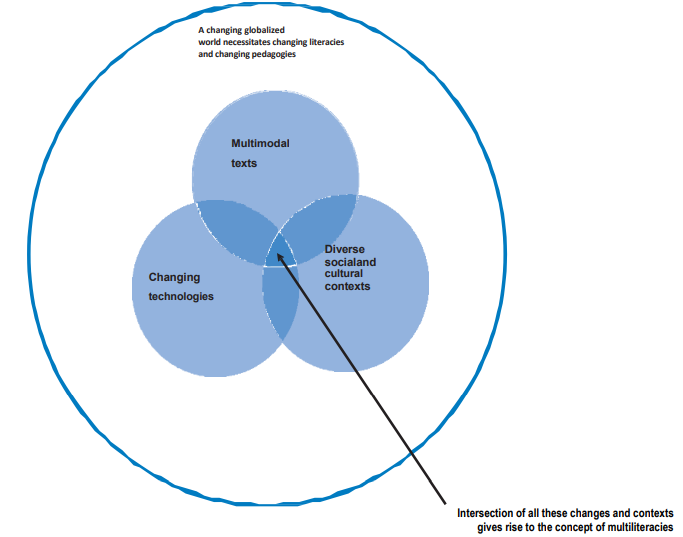
The chart taken from the chapter “The rise of multiliteracies” from a book titled Foundations of Multiliteracies visually conceptualizes multiliteracies. Observe the chart and them choose the definition that best completes the sentence: Multiliteracies is
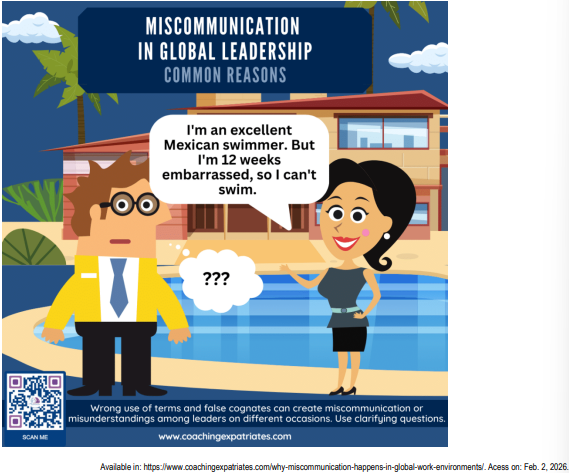
According to the text, there is misunderstanding because
Theoretical Foundation of Critical Literacies and Global and Multicultural Education
In this chapter, I invite the reader to a more in-depth discussion on critical literacies from global and multicultural perspectives by presenting important theoretical constructs of each field. I first provide a historical and theoretical review of global and multicultural education, followed by the literature review of critical literacies, including relevant definitions. Overall, this chapter serves as the literature review of the three areas. Through this review, I attempt to answer the question on why global and multicultural perspectives matter in the field of critical literacies.
Global Education
The notions of “global” and “multicultural” are different in their theoretical orientation. The former was developed in response to international issues, while the latter was developed in response to national minority struggles in the U.S. This difference of visions and orientations is important as it highlights the difference in scope: global education traditionally is concerned with educational dilemmas that are relevant across nations and continents. It, therefore, covers a broader spectrum of issues such as intercultural relations. Rapid globalization driven by the Internet and human migration highlighted the need for global education and propelled scholarly attention to such matters. Philosophically speaking, global education is based on recognizing core human rights and it pertains to the notion of moral universalism. Namely, it is based on the view that human beings are created equal.
Multicultural Education
Research on multicultural education has flourished around the globe. In particular, in the U.S. historical context, it emerged with the American Civil Rights Movement. Unlike global education, multicultural education focuses more on national issues, specifically learning about cultures within the state. With its original purpose from the early 1960s and 1970s to address racism in schools and societies, early discussions on race and ethnicity focused on African Americans and were spearheaded by African American scholars. This type of ethnic studies has been the first phase in the development of multicultural education as a field. Since then, more multicultural theorists began to analyze the power issues underlying race and inequality, as well as other topics such as social class gaps and economic discrimination.
YOON, Bogum. Critical Literacies. Global and Multicultural Perspectives. New York: Springer, 2016, pp. 26-29. (Adapted).
We could define the idea of global and multicultural literacies respectively as
We are interested in communication between native and non-native speakers for one very important reason: this is the kind of communication for which all teachers are essentially preparing students. Regardless of the level of our students, whether they are beginners or already near-native speakers, if they want to use their second language, they need to enter this type of communication. We need to help them to participate in this communication with dignity and power, and to close the gap between their language skill and those of the native speakers. In order for us to prepare our students in this way, we must be knowledgeable about the specific nuances of verbal communication between native and non-native speakers.
The most obvious distinction between the language performance of native and non-native speakers is the dramatic difference in levels of language accuracy and fluency. While native speakers usually talk effortlessly, naturally and correctly; non-native speakers consistently experience difficulties in expressing their thoughts, struggle for the right words, and typically lack confidence in their communication. When trying to speak a foreign language, non-native speakers think extensively in their own native language and, worse, they often translate directly from their native language into the foreign language. This frequently leads them to create utterances that do not make sense to native speakers, further diminishing their confidence in their speaking ability and often causing them to dread native speakers’ questions that they are then likely to answer very abruptly and awkwardly.
SHEKHTMAN, Boris; KUPCHANKA, Dina. Teaching Foreign Language on the Basis of the Native Speaker’s Communicative Focus. California: MSI Press, 2007. (Adapted).
Excerpt 2
From a sociocultural perspective, language phenomena reflect contextual needs, which, together with learner needs, have implications for language teaching. These phenomena pertain to both language use and language learning; the former is a function of an interaction of attitude, function, context, and competence; the latter has to do with language educational systems, institutional practices, and learner beliefs and attitudes. Understanding these components that inform language use and learning is a prerequisite to any pedagogical innovation. To understand English language use and learning within the context of Taiwan, a study delineated a sociolinguistic profile of English use and learning within a four-dimensional framework: attitude, function, pedagogy, and learner beliefs. Data were both quantitative and qualitative and included teacher, learner, and parent questionnaire responses and interview accounts.
This chapter presents only a small part of the study concerning teacher educators’ perceptions of English language teaching and learning in Taiwan. The interview accounts contribute to a fuller understanding of present day English teaching and learning in Taiwan, where curricular innovation has been both encouraged and challenged. Another reason for presenting this qualitative part of the much larger study is that it provides rich information necessary for in-depth analysis and addresses research questions for which quantitative methods alone are insufficient.
SAVIGNON, Sandra (Ed.). Interpreting Communicative Language Teaching. Contexts and Concerns in Teacher Education. New Haven and London: Yale University Press, 2002. (Adapted).
In these two excerpts of texts, there is a discussing teaching non-native speakers to communicate. According to their reading, choose the alternative that best presents the views carried out by the texts.
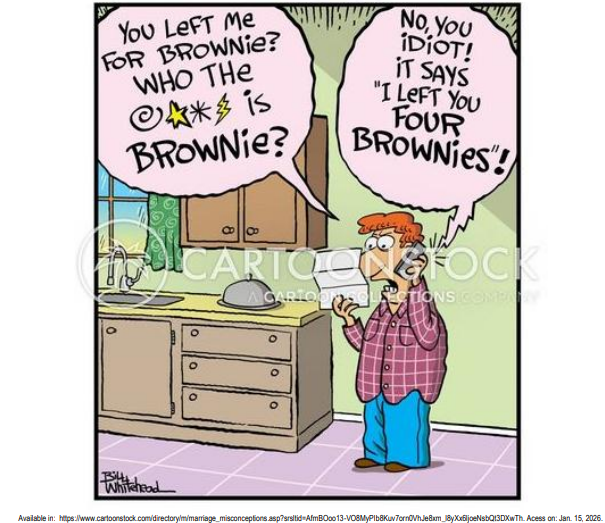
According to the cartoon,
THORNBURY, Scott. How to Teach Speaking. Cambridge: Longman, 2005, pp. 110-1. (Adapted).
In this excerpt, the author states that “By extension, it has been argued that conversation in English as second or foreign language is not the result of language learning, but it is the site where learning occurs”.
After reading the passage as a whole, choose the best alternative that explains how to cope with this matter.
[...] Recent studies in corpus linguistics have examined specific aspects of spoken grammar particularly in unplanned speech. According to McCarthy and Carter (2001), spoken grammars have uniquely special qualities that distinguish them from written ones [...]. In spoken discourse, according to Fung and Carter (2007), the amount and frequency of DM use is significant in comparison to the use of other forms because they serve important interpersonal functions.
Therefore, DMs act as influential interactional features rather than having a purely grammatical function. One of the most important features of DMs is to constitute and organize talk [...]. There is acknowledgement that DMs have a pragmatic meaning in discourse and consequently play a significant role in speakers’ pragmatic competence because they contribute to the pragmatic meaning of utterances. Thus, there is the view that DMs contribute to the interpretation of an utterance rather than to its propositional content [...]. There are a limited number of studies conducted on the instruction of DMs in EFL contexts. All studies revealed similar findings, namely explicit instruction has a positive impact on learners’ production. The main difference being that each study focused on a different genre: writing skills, oral production and listening comprehension, respectively. In all these studies the addition of a post-test would have been beneficial to measure the long-lasting effects of teaching DMs on learners’ acquisition. Rahimi and Riasati (2012) stated that using DMs will help learners to perform better in spoken skills. In English as a Second Language context (ESL) Jones (2009) carried out a small-scale study with two groups, both of which were given the same DMs using two different teaching approaches: illustration, interaction and induction (III) and presentation, practice and production (PPP). The results demonstrated that PPP had a considerable effect on learners’ use of the taught DMs [...].
Available in: https://files.eric.ed.gov/fulltext/EJ1101735.pdf. Acess on: Feb. 2, 2026.
According to the text’s perspective,

 Conheça nossos planos