Questões de Concurso
Sobre interpretação de texto | reading comprehension em inglês
Foram encontradas 12.687 questões


Adding ethics to public finance
Evolutionary moral psychologists point the way to garnering broader support for fiscal policies
Policy decisions on taxation and public expenditures intrinsically reflect moral choices. How much of your hard-earned money is it fair for the state to collect through taxes? Should the rich pay more? Should the state provide basic public services such as education and health care for free to all citizens? And so on.
Economists and public finance practitioners have traditionally focused on economic efficiency. When considering distributional issues, they have generally steered clear of moral considerations, perhaps fearing these could be seen as subjective. However, recent work by evolutionary moral psychologists suggests that policies can be better designed and muster broader support if policymakers consider the full range of moral perspectives on public finance. A few pioneering empirical applications of this approach in the field of economics have shown promise.
For the most part, economists have customarily analyzed redistribution in a way that requires users to provide their own preferences with regard to inequality: Tell economists how much you care about inequality, and they can tell you how much redistribution is appropriate through the tax and benefit system. People (or families or households) have usually been considered as individuals, and the only relevant characteristics for these exercises have been their incomes, wealth, or spending potential.
There are two — understandable but not fully satisfactory — reasons for this approach. First, economists often wish to be viewed as objective social scientists. Second, most public finance scholars have been educated in a tradition steeped in values of societies that are WEIRD (Western, Educated, Industrialized, Rich, and Democratic). In this context, individuals are at the center of the analysis, and morality is fundamentally about the golden rule — treat other people the way that you would want them to treat you, regardless of who those people are. These are crucial but ultimately insufficient perspectives on how humans make moral choices.
Evolutionary moral psychologists during the past couple of decades have shown that, faced with a moral dilemma, humans decide quickly what seems right or wrong based on instinct and later justify their decision through more deliberate reasoning. Based on evidence presented by these researchers, our instincts in the moral domain evolved as a way of fostering cooperation within a group, to help ensure survival. This modern perspective harks back to two moral philosophers of the Scottish Enlightenment — David Hume and Adam Smith — who noted that sentiments are integral to people’s views on right and wrong. But most later philosophers in the Western tradition sought to base morality on reason alone.
Moral psychologists have recently shown that many people draw on moral perspectives that go well beyond the golden rule. Community, authority, divinity, purity, loyalty, and sanctity are important considerations not only in many non-Western countries, but also among politically influential segments of the population in advanced economies, as emphasized by proponents of moral foundations theory.
Regardless of whether one agrees with those broader moral perspectives, familiarity with them makes it easier to understand the underlying motivations for various groups’ positions in debates on public policies. Such understanding may help in the design of policies that can muster support from a wide range of groups with differing moral values.
Adapted from: https://www.imf.org/en/Publications/fandd/issues/2022/03/Addingethics-to-public-finance-Mauro
Based on the text, mark the statements below as TRUE (T) or FALSE (F).
I. The planning of fiscal strategies is impervious to moral considerations.
II. Traditional public finance education based on the golden rule is wanting as regards moral choices.
III. Since the 18th century, philosophers have been on the same page as regards moral dilemmas.
The statements are, respectively,

( ) The text is an advertisement for people to apply for this job position.
( ) The text is a description of what this kind of professional is expected to do at work.
( ) A QA can be promoted to a management position.
( ) To be a QA, you need an Information Technology degree.
The correct order of filling the parentheses, from top to bottom, is:

(Available: https://www.dreamstime.com.)
As we embrace more and more new technology, troublesome new trends – such as cyberbullying – have emerged that may have more widespread effects than traditional bullying alone. Choose the item which describes one sort of cyberbullying correctly.

(Maya Angelou.) I’ve got the children to tend The clothes to mend The floor to mop The food to shop Then the chicken to fry The baby to dry I got company to feed The garden to weed I've got shirts to press The tots to dress The cane to be cut I gotta clean up this hut Then see about the sick And the cotton to pick. Shine on me, sunshine Rain on me, rain Fall softly, dewdrops And cool my brow again. Storm, blow me from here with your fiercest wind Let me float across the sky ‘til I can rest again, fall gently, snowflakes, Cover me with white cold icy kisses and let me rest tonight. Sun, rain, curving sky, mountain, oceans, leaf and stone You're all that I can call my own. (Available: http://www.aquaculturewithoutfrontiers.org.)
In “Fall softly, dewdrops” and “Let me float across the sky ‘til I can rest again, fall gently, snowflakes” the words GENTLY and SOFTLY convey the concept of:
The Story Behind TIME’s ‘Resilience of Ukraine’ Cover

(Artwork by JR; Photograph by Artem Iurchenko. A drone was used to capture the cover image on March 14 in Lviv.)
Since Russia’s invasion began, dozens of Ukraine’s 7.5 million children have been killed and thousands of others have fled in search of safety. Among those thousands is 5-year-old Valeriia from Kryvyi Rih, President Volodymyr Zelensky’s hometown in central Ukraine. Her image – a smiling child – appears on one of this issue’s covers.
If you met Valeriia, you might think she’s shy, her mother Taisiia told TIME, but don’t be fooled; at home, she commands attention. She loves the same things as many little girls – her stuffed bunny; her Elsa doll fromCold Heart(which English speakers know as Frozen); and her pink backpack, which she had to leave behind as she ran off her country. Valeriia also has big dreams: in particular, starting her first year of school on Sept. 1. Now, it’s hard to say when and where Valeriia will be able to do so. On March 9, mother and daughter fled to Poland; for safety, they asked that TIME use only their first names. In an interview, Taisiia explained her decision to leave home to keep her child safe. “She is my sunshine, my joy.”
According to Taisiia they woke up early in the morning of Feb. 24 to learn the occupying army had started bombing military bases. “I thought about my daughter, Valeriia; for her safety, I knew we had to go. We left Ukraine before we were bombarded, so we had a chance.” Even though Valeriia is with her now, husband and son stayed in Ukraine and therefore, it was very hard to leave. The day they left, the lines for buses and trainsstretched 3 km, mostly women and children, she says, “We were packed together and had to stand for 18 hours on the train to Lviv”.
The Russians still haven’t come to their city. The people from Kryvyi Rih have fought them off. But they are closer and closer, and you can see them approaching. In the media, Russia says they aren’t at war in Ukraine. But the war is real. People are dying for real. “And here I am, with my sister, my nephew, and my mother in Poland, in a hotel near Warsaw. They take care of us and even in this difficult situation, it was a warm reception. I cannot find the words to express how grateful I am to everyone who has helped”, ends up a crying Taisiia.
(Available: https://time.com/magazine/europe. Adapted.)
Ten critical actions needed to address four major cybersecurity challenges:
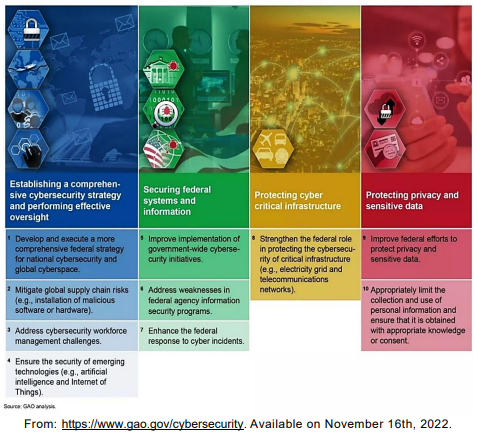
The use of the preposition for in “1. Develop and execute a more comprehensive
federal strategy for national cybersecurity…” indicates
Cybersecurity: An overview of cyber challenges facing the nation, and actions needed
Federal agencies and the nation’s critical infrastructure — such as energy, transportation systems, communications, and financial services — depend on Information Technology (IT) systems to carry out operations and process essential data. However, the risks to these IT systems are increasing—including insider threats from witting or unwitting employees, escalating and emerging threats from around the globe, and the emergence of new and more destructive attacks. Rapid developments in new technologies, such as artificial intelligence, the Internet of Things, and ubiquitous Internet and cellular connectivity, can also introduce security issues. Over 28,000 security incidents were reported by federal civilian agencies to the Department of Homeland Security in FY 2019.
Additionally, since many government IT systems contain vast amounts of personally identifiable information (PII), federal agencies must protect the confidentiality, integrity, and availability of this information—and effectively respond to data breaches and security incidents. Likewise, the trend in the private sector of collecting extensive and detailed information about individuals needs appropriate limits.
To highlight the importance of these issues, Government Accountability Office (GAO) has designated information security as a government-wide high-risk area since 1997. This high-risk area was expanded in 2003 to include the protection of critical cyber infrastructure and, in 2015, to include protecting the privacy of PII.
GAO has made about 3,300 recommendations to federal agencies to address cybersecurity shortcomings—and we reported that more than 750 of these had not been fully implemented as of December 2020. We designated 67 as priority, meaning that we believe they warrant priority attention from heads of key departments and agencies.
Adapted from: https://www.gao.gov/cybersecurity. Available on November 16th, 2022
Cybersecurity: An overview of cyber challenges facing the nation, and actions needed
Federal agencies and the nation’s critical infrastructure — such as energy, transportation systems, communications, and financial services — depend on Information Technology (IT) systems to carry out operations and process essential data. However, the risks to these IT systems are increasing—including insider threats from witting or unwitting employees, escalating and emerging threats from around the globe, and the emergence of new and more destructive attacks. Rapid developments in new technologies, such as artificial intelligence, the Internet of Things, and ubiquitous Internet and cellular connectivity, can also introduce security issues. Over 28,000 security incidents were reported by federal civilian agencies to the Department of Homeland Security in FY 2019.
Additionally, since many government IT systems contain vast amounts of personally identifiable information (PII), federal agencies must protect the confidentiality, integrity, and availability of this information—and effectively respond to data breaches and security incidents. Likewise, the trend in the private sector of collecting extensive and detailed information about individuals needs appropriate limits.
To highlight the importance of these issues, Government Accountability Office (GAO) has designated information security as a government-wide high-risk area since 1997. This high-risk area was expanded in 2003 to include the protection of critical cyber infrastructure and, in 2015, to include protecting the privacy of PII.
GAO has made about 3,300 recommendations to federal agencies to address cybersecurity shortcomings—and we reported that more than 750 of these had not been fully implemented as of December 2020. We designated 67 as priority, meaning that we believe they warrant priority attention from heads of key departments and agencies.
Adapted from: https://www.gao.gov/cybersecurity. Available on November 16th, 2022
Cybersecurity: An overview of cyber challenges facing the nation, and actions needed
Federal agencies and the nation’s critical infrastructure — such as energy, transportation systems, communications, and financial services — depend on Information Technology (IT) systems to carry out operations and process essential data. However, the risks to these IT systems are increasing—including insider threats from witting or unwitting employees, escalating and emerging threats from around the globe, and the emergence of new and more destructive attacks. Rapid developments in new technologies, such as artificial intelligence, the Internet of Things, and ubiquitous Internet and cellular connectivity, can also introduce security issues. Over 28,000 security incidents were reported by federal civilian agencies to the Department of Homeland Security in FY 2019.
Additionally, since many government IT systems contain vast amounts of personally identifiable information (PII), federal agencies must protect the confidentiality, integrity, and availability of this information—and effectively respond to data breaches and security incidents. Likewise, the trend in the private sector of collecting extensive and detailed information about individuals needs appropriate limits.
To highlight the importance of these issues, Government Accountability Office (GAO) has designated information security as a government-wide high-risk area since 1997. This high-risk area was expanded in 2003 to include the protection of critical cyber infrastructure and, in 2015, to include protecting the privacy of PII.
GAO has made about 3,300 recommendations to federal agencies to address cybersecurity shortcomings—and we reported that more than 750 of these had not been fully implemented as of December 2020. We designated 67 as priority, meaning that we believe they warrant priority attention from heads of key departments and agencies.
Adapted from: https://www.gao.gov/cybersecurity. Available on November 16th, 2022
According to the text, the escalating threats to IT systems
Social media influencers
It is estimated that about 40 per cent of the world’s population use social media, and many of these billions of social media users look up to influencers to help them decide what to buy and what trends to follow.
So what is an influencer and how do we become one?
An influencer is a person who can influence the decisions of their followers because of their relationship with their audience and their knowledge and expertise in a particular area, e.g. fashion, travel or technology.
Influencers often have a large following of people who pay close attention to their views. They have the power to persuade people to buy things, and influencers are now seen by many companies as a direct way to customers’ hearts. Brands are now asking powerful influencers to market their products. With some influencers charging up to $25,000 for one social media post, it is no surprise that more and more people are keen to become influencers too. If you are one of them, then here are five tips on how to do it.
1. Choose your niche
What is the area that you know most about? What do you feel most excited talking about? Find the specific area that you’re most interested in and develop it.
2. Choose your medium and write an interesting bio
Most influencers these days are bloggers and micro-bloggers. Decide which medium – such as your own online blog, Instagram or Snapchat – is the best way to connect with your followers and chat about your niche area. When you have done that, write an attention-grabbing bio that describes you and your speciality area in an interesting and unique way. Make sure that people who read your bio will want to follow you.
3. Post regularly and consistently
Many influencers post daily on their social media accounts. The more you post, the more likely people will follow you. Also, ensure that your posts are consistent and possibly follow a theme.
4. Tell an interesting story
Whether it is a photo or a comment that you are posting, use it to tell a story that will catch the attention of your followers and help them connect with you.
5. Make sure people can easily find your content
Publicise your posts on a variety of social media, use hashtags and catchy titles and make sure that they can be easily found. There is no point writing the most exciting blogposts or posting the most attractive photographs if no one is going to see them.
Most importantly, if you want to become a social media influencer, you need to have patience. Keep posting and your following will gradually increase. Good luck!
Fonte: https://learnenglish.britishcouncil.org/skills/reading/b1-reading/social-media-influencers (Acesso em 17/10/2022
às 13h20)
Social media influencers
It is estimated that about 40 per cent of the world’s population use social media, and many of these billions of social media users look up to influencers to help them decide what to buy and what trends to follow.
So what is an influencer and how do we become one?
An influencer is a person who can influence the decisions of their followers because of their relationship with their audience and their knowledge and expertise in a particular area, e.g. fashion, travel or technology.
Influencers often have a large following of people who pay close attention to their views. They have the power to persuade people to buy things, and influencers are now seen by many companies as a direct way to customers’ hearts. Brands are now asking powerful influencers to market their products. With some influencers charging up to $25,000 for one social media post, it is no surprise that more and more people are keen to become influencers too. If you are one of them, then here are five tips on how to do it.
1. Choose your niche
What is the area that you know most about? What do you feel most excited talking about? Find the specific area that you’re most interested in and develop it.
2. Choose your medium and write an interesting bio
Most influencers these days are bloggers and micro-bloggers. Decide which medium – such as your own online blog, Instagram or Snapchat – is the best way to connect with your followers and chat about your niche area. When you have done that, write an attention-grabbing bio that describes you and your speciality area in an interesting and unique way. Make sure that people who read your bio will want to follow you.
3. Post regularly and consistently
Many influencers post daily on their social media accounts. The more you post, the more likely people will follow you. Also, ensure that your posts are consistent and possibly follow a theme.
4. Tell an interesting story
Whether it is a photo or a comment that you are posting, use it to tell a story that will catch the attention of your followers and help them connect with you.
5. Make sure people can easily find your content
Publicise your posts on a variety of social media, use hashtags and catchy titles and make sure that they can be easily found. There is no point writing the most exciting blogposts or posting the most attractive photographs if no one is going to see them.
Most importantly, if you want to become a social media influencer, you need to have patience. Keep posting and your following will gradually increase. Good luck!
Fonte: https://learnenglish.britishcouncil.org/skills/reading/b1-reading/social-media-influencers (Acesso em 17/10/2022
às 13h20)
1. An influencer has to know about a specific topic. 2. Influencers pay up to $25.000,00 to post about a company’s product. 3. An influencer should have a random bio.
Social media influencers
It is estimated that about 40 per cent of the world’s population use social media, and many of these billions of social media users look up to influencers to help them decide what to buy and what trends to follow.
So what is an influencer and how do we become one?
An influencer is a person who can influence the decisions of their followers because of their relationship with their audience and their knowledge and expertise in a particular area, e.g. fashion, travel or technology.
Influencers often have a large following of people who pay close attention to their views. They have the power to persuade people to buy things, and influencers are now seen by many companies as a direct way to customers’ hearts. Brands are now asking powerful influencers to market their products. With some influencers charging up to $25,000 for one social media post, it is no surprise that more and more people are keen to become influencers too. If you are one of them, then here are five tips on how to do it.
1. Choose your niche
What is the area that you know most about? What do you feel most excited talking about? Find the specific area that you’re most interested in and develop it.
2. Choose your medium and write an interesting bio
Most influencers these days are bloggers and micro-bloggers. Decide which medium – such as your own online blog, Instagram or Snapchat – is the best way to connect with your followers and chat about your niche area. When you have done that, write an attention-grabbing bio that describes you and your speciality area in an interesting and unique way. Make sure that people who read your bio will want to follow you.
3. Post regularly and consistently
Many influencers post daily on their social media accounts. The more you post, the more likely people will follow you. Also, ensure that your posts are consistent and possibly follow a theme.
4. Tell an interesting story
Whether it is a photo or a comment that you are posting, use it to tell a story that will catch the attention of your followers and help them connect with you.
5. Make sure people can easily find your content
Publicise your posts on a variety of social media, use hashtags and catchy titles and make sure that they can be easily found. There is no point writing the most exciting blogposts or posting the most attractive photographs if no one is going to see them.
Most importantly, if you want to become a social media influencer, you need to have patience. Keep posting and your following will gradually increase. Good luck!
Fonte: https://learnenglish.britishcouncil.org/skills/reading/b1-reading/social-media-influencers (Acesso em 17/10/2022
às 13h20)
Social media influencers
It is estimated that about 40 per cent of the world’s population use social media, and many of these billions of social media users look up to influencers to help them decide what to buy and what trends to follow.
So what is an influencer and how do we become one?
An influencer is a person who can influence the decisions of their followers because of their relationship with their audience and their knowledge and expertise in a particular area, e.g. fashion, travel or technology.
Influencers often have a large following of people who pay close attention to their views. They have the power to persuade people to buy things, and influencers are now seen by many companies as a direct way to customers’ hearts. Brands are now asking powerful influencers to market their products. With some influencers charging up to $25,000 for one social media post, it is no surprise that more and more people are keen to become influencers too. If you are one of them, then here are five tips on how to do it.
1. Choose your niche
What is the area that you know most about? What do you feel most excited talking about? Find the specific area that you’re most interested in and develop it.
2. Choose your medium and write an interesting bio
Most influencers these days are bloggers and micro-bloggers. Decide which medium – such as your own online blog, Instagram or Snapchat – is the best way to connect with your followers and chat about your niche area. When you have done that, write an attention-grabbing bio that describes you and your speciality area in an interesting and unique way. Make sure that people who read your bio will want to follow you.
3. Post regularly and consistently
Many influencers post daily on their social media accounts. The more you post, the more likely people will follow you. Also, ensure that your posts are consistent and possibly follow a theme.
4. Tell an interesting story
Whether it is a photo or a comment that you are posting, use it to tell a story that will catch the attention of your followers and help them connect with you.
5. Make sure people can easily find your content
Publicise your posts on a variety of social media, use hashtags and catchy titles and make sure that they can be easily found. There is no point writing the most exciting blogposts or posting the most attractive photographs if no one is going to see them.
Most importantly, if you want to become a social media influencer, you need to have patience. Keep posting and your following will gradually increase. Good luck!
Fonte: https://learnenglish.britishcouncil.org/skills/reading/b1-reading/social-media-influencers (Acesso em 17/10/2022
às 13h20)
Social media influencers
It is estimated that about 40 per cent of the world’s population use social media, and many of these billions of social media users look up to influencers to help them decide what to buy and what trends to follow.
So what is an influencer and how do we become one?
An influencer is a person who can influence the decisions of their followers because of their relationship with their audience and their knowledge and expertise in a particular area, e.g. fashion, travel or technology.
Influencers often have a large following of people who pay close attention to their views. They have the power to persuade people to buy things, and influencers are now seen by many companies as a direct way to customers’ hearts. Brands are now asking powerful influencers to market their products. With some influencers charging up to $25,000 for one social media post, it is no surprise that more and more people are keen to become influencers too. If you are one of them, then here are five tips on how to do it.
1. Choose your niche
What is the area that you know most about? What do you feel most excited talking about? Find the specific area that you’re most interested in and develop it.
2. Choose your medium and write an interesting bio
Most influencers these days are bloggers and micro-bloggers. Decide which medium – such as your own online blog, Instagram or Snapchat – is the best way to connect with your followers and chat about your niche area. When you have done that, write an attention-grabbing bio that describes you and your speciality area in an interesting and unique way. Make sure that people who read your bio will want to follow you.
3. Post regularly and consistently
Many influencers post daily on their social media accounts. The more you post, the more likely people will follow you. Also, ensure that your posts are consistent and possibly follow a theme.
4. Tell an interesting story
Whether it is a photo or a comment that you are posting, use it to tell a story that will catch the attention of your followers and help them connect with you.
5. Make sure people can easily find your content
Publicise your posts on a variety of social media, use hashtags and catchy titles and make sure that they can be easily found. There is no point writing the most exciting blogposts or posting the most attractive photographs if no one is going to see them.
Most importantly, if you want to become a social media influencer, you need to have patience. Keep posting and your following will gradually increase. Good luck!
Fonte: https://learnenglish.britishcouncil.org/skills/reading/b1-reading/social-media-influencers (Acesso em 17/10/2022
às 13h20)
Social media influencers
It is estimated that about 40 per cent of the world’s population use social media, and many of these billions of social media users look up to influencers to help them decide what to buy and what trends to follow.
So what is an influencer and how do we become one?
An influencer is a person who can influence the decisions of their followers because of their relationship with their audience and their knowledge and expertise in a particular area, e.g. fashion, travel or technology.
Influencers often have a large following of people who pay close attention to their views. They have the power to persuade people to buy things, and influencers are now seen by many companies as a direct way to customers’ hearts. Brands are now asking powerful influencers to market their products. With some influencers charging up to $25,000 for one social media post, it is no surprise that more and more people are keen to become influencers too. If you are one of them, then here are five tips on how to do it.
1. Choose your niche
What is the area that you know most about? What do you feel most excited talking about? Find the specific area that you’re most interested in and develop it.
2. Choose your medium and write an interesting bio
Most influencers these days are bloggers and micro-bloggers. Decide which medium – such as your own online blog, Instagram or Snapchat – is the best way to connect with your followers and chat about your niche area. When you have done that, write an attention-grabbing bio that describes you and your speciality area in an interesting and unique way. Make sure that people who read your bio will want to follow you.
3. Post regularly and consistently
Many influencers post daily on their social media accounts. The more you post, the more likely people will follow you. Also, ensure that your posts are consistent and possibly follow a theme.
4. Tell an interesting story
Whether it is a photo or a comment that you are posting, use it to tell a story that will catch the attention of your followers and help them connect with you.
5. Make sure people can easily find your content
Publicise your posts on a variety of social media, use hashtags and catchy titles and make sure that they can be easily found. There is no point writing the most exciting blogposts or posting the most attractive photographs if no one is going to see them.
Most importantly, if you want to become a social media influencer, you need to have patience. Keep posting and your following will gradually increase. Good luck!
Fonte: https://learnenglish.britishcouncil.org/skills/reading/b1-reading/social-media-influencers (Acesso em 17/10/2022
às 13h20)
Leia o texto 1 para responder a questão que se segue.


 Conheça nossos planos