Questões de Concurso
Sobre interpretação de texto | reading comprehension em inglês
Foram encontradas 12.687 questões



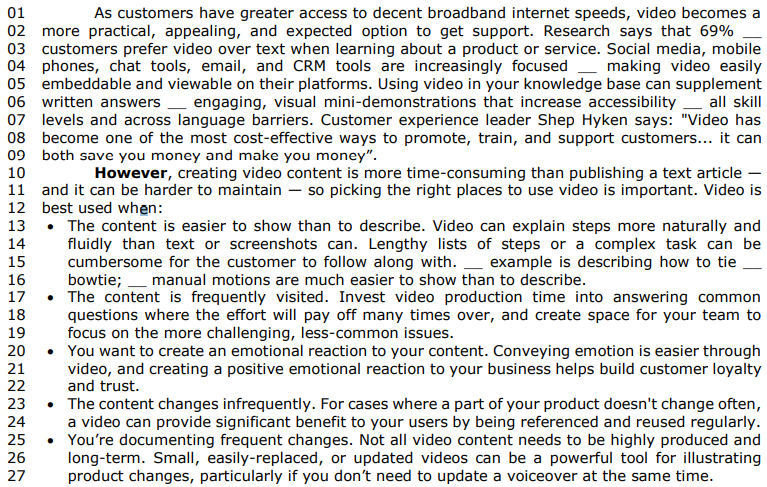
I. Its past form is “could”. II. It could be replaced by “must” with no significative changes in meaning. III. It expresses permission.
Which statements are correct?

( ) The same oil has been used to anoint kings and queens for the past 100 years. ( ) The coronation oil that will be used on The King has the same formula as the one used on Queen Elizabeth II. ( ) The Archbishop of Canterbury thinks that having the oil prepared in Jerusalem is a symbol of The King’s family being considered Holy by its people.
The correct order of filling the parentheses, from top to bottom, is:
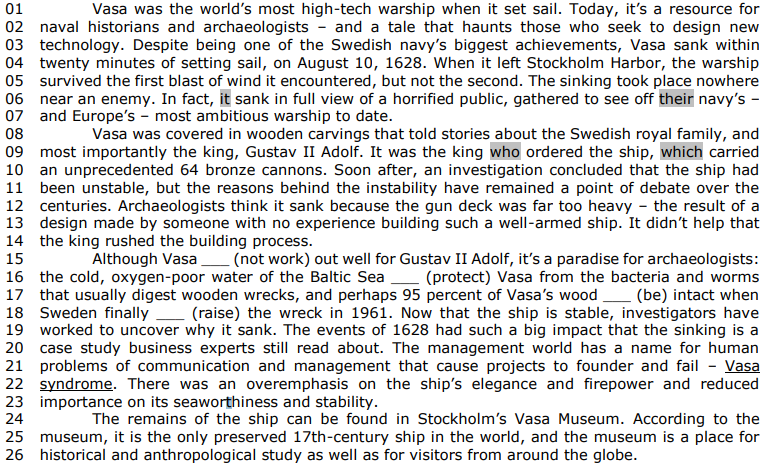
I. It is a condition that makes it difficult for people to communicate well, what can cause trouble when business people need to explain their projects. II. It is a reference to the warship Vasa, making it an example of a situation in which miscommunication can cause the failure of a project. III. It is based on the idea that the people involved in designing and building the ship failed to balance their goals, creating a beautiful ship that could not serve its main purpose: sail.
Which statements are correct?
I. The soil on which the port is being built was once parched. II. The industry is quite diffident about the success of the investment. III. From an international viewpoint the project described will have sweeping implications.
Choose the correct answer:
Text I
Trust and audit
Trust is what auditors sell. They review the accuracy, adequacy or propriety of other people’s work. Financial statement audits are prepared for the owners of a company and presented publically to provide assurance to the market and the wider public. Public service audits are presented to governing bodies and, in some cases, directly to parliament.
It is the independent scepticism of the auditor that allows shareholders and the public to be confident that they are being given a true and fair account of the organisation in question. The auditor’s signature pledges his or her reputational capital so that the audited body’s public statements can be trusted. […]
Given the fundamental importance of trust, should auditors not then feel immensely valuable in the context of declining trust? Not so. Among our interviewees, a consensus emerged that the audit profession is under-producing trust at a critical time. One aspect of the problem is the quietness of audit: it is a profession that literally goes about its work behind the scenes. The face and processes of the auditor are rarely seen in the organisations they scrutinise, and relatively rarely in the outside world. Yet, if we listen to the mounting evidence of the importance of social capital, we know that frequent and reliable contacts between groups are important to strengthening and expanding trust.
So what can be done? Our research suggests that more frequent dialogue with audit committees and a more ambitious outward facing role for the sector’s leadership would be welcome. But we think more is needed. Audit for the 21st century should be understood and designed as primarily a confidence building process within the audited organisation and across its stakeholders. If the audit is a way of ensuring the client’s accountability, much more needs to be done to make the audit itself exemplary in its openness and inclusiveness.
Instead of an audit report being a trust-producing product, the audit process could become a trust-producing practice in which the auditor uses his or her position as a trusted intermediary to broker rigorous learning across all dimensions of the organisation and its stakeholders. The views of investors, staff, suppliers and customers could routinely be considered, as could questions from the general public; online technologies offer numerous opportunities to inform, involve and invite.
From being a service that consists almost exclusively of external investigation by a warranted professional, auditing needs to become more co-productive, with the auditor’s role expanding to include that of an expert convenor who is willing to share the tools of enquiry. Audit could move from ‘black box’ to ‘glass box’.
But the profession will still struggle to secure trust unless it can stake a stronger claim to supporting improvement. Does it increase the economic, social or environmental value of the organisations it reviews? It is one thing to believe in the accuracy of a financial statement audit, but it is another thing to believe in its utility.
Adapted from: https://auditfutures.net/pdf/AuditFutures-RSA-EnlighteningProfessions.pdf
Text I
Trust and audit
Trust is what auditors sell. They review the accuracy, adequacy or propriety of other people’s work. Financial statement audits are prepared for the owners of a company and presented publically to provide assurance to the market and the wider public. Public service audits are presented to governing bodies and, in some cases, directly to parliament.
It is the independent scepticism of the auditor that allows shareholders and the public to be confident that they are being given a true and fair account of the organisation in question. The auditor’s signature pledges his or her reputational capital so that the audited body’s public statements can be trusted. […]
Given the fundamental importance of trust, should auditors not then feel immensely valuable in the context of declining trust? Not so. Among our interviewees, a consensus emerged that the audit profession is under-producing trust at a critical time. One aspect of the problem is the quietness of audit: it is a profession that literally goes about its work behind the scenes. The face and processes of the auditor are rarely seen in the organisations they scrutinise, and relatively rarely in the outside world. Yet, if we listen to the mounting evidence of the importance of social capital, we know that frequent and reliable contacts between groups are important to strengthening and expanding trust.
So what can be done? Our research suggests that more frequent dialogue with audit committees and a more ambitious outward facing role for the sector’s leadership would be welcome. But we think more is needed. Audit for the 21st century should be understood and designed as primarily a confidence building process within the audited organisation and across its stakeholders. If the audit is a way of ensuring the client’s accountability, much more needs to be done to make the audit itself exemplary in its openness and inclusiveness.
Instead of an audit report being a trust-producing product, the audit process could become a trust-producing practice in which the auditor uses his or her position as a trusted intermediary to broker rigorous learning across all dimensions of the organisation and its stakeholders. The views of investors, staff, suppliers and customers could routinely be considered, as could questions from the general public; online technologies offer numerous opportunities to inform, involve and invite.
From being a service that consists almost exclusively of external investigation by a warranted professional, auditing needs to become more co-productive, with the auditor’s role expanding to include that of an expert convenor who is willing to share the tools of enquiry. Audit could move from ‘black box’ to ‘glass box’.
But the profession will still struggle to secure trust unless it can stake a stronger claim to supporting improvement. Does it increase the economic, social or environmental value of the organisations it reviews? It is one thing to believe in the accuracy of a financial statement audit, but it is another thing to believe in its utility.
Adapted from: https://auditfutures.net/pdf/AuditFutures-RSA-EnlighteningProfessions.pdf
Text I
Trust and audit
Trust is what auditors sell. They review the accuracy, adequacy or propriety of other people’s work. Financial statement audits are prepared for the owners of a company and presented publically to provide assurance to the market and the wider public. Public service audits are presented to governing bodies and, in some cases, directly to parliament.
It is the independent scepticism of the auditor that allows shareholders and the public to be confident that they are being given a true and fair account of the organisation in question. The auditor’s signature pledges his or her reputational capital so that the audited body’s public statements can be trusted. […]
Given the fundamental importance of trust, should auditors not then feel immensely valuable in the context of declining trust? Not so. Among our interviewees, a consensus emerged that the audit profession is under-producing trust at a critical time. One aspect of the problem is the quietness of audit: it is a profession that literally goes about its work behind the scenes. The face and processes of the auditor are rarely seen in the organisations they scrutinise, and relatively rarely in the outside world. Yet, if we listen to the mounting evidence of the importance of social capital, we know that frequent and reliable contacts between groups are important to strengthening and expanding trust.
So what can be done? Our research suggests that more frequent dialogue with audit committees and a more ambitious outward facing role for the sector’s leadership would be welcome. But we think more is needed. Audit for the 21st century should be understood and designed as primarily a confidence building process within the audited organisation and across its stakeholders. If the audit is a way of ensuring the client’s accountability, much more needs to be done to make the audit itself exemplary in its openness and inclusiveness.
Instead of an audit report being a trust-producing product, the audit process could become a trust-producing practice in which the auditor uses his or her position as a trusted intermediary to broker rigorous learning across all dimensions of the organisation and its stakeholders. The views of investors, staff, suppliers and customers could routinely be considered, as could questions from the general public; online technologies offer numerous opportunities to inform, involve and invite.
From being a service that consists almost exclusively of external investigation by a warranted professional, auditing needs to become more co-productive, with the auditor’s role expanding to include that of an expert convenor who is willing to share the tools of enquiry. Audit could move from ‘black box’ to ‘glass box’.
But the profession will still struggle to secure trust unless it can stake a stronger claim to supporting improvement. Does it increase the economic, social or environmental value of the organisations it reviews? It is one thing to believe in the accuracy of a financial statement audit, but it is another thing to believe in its utility.
Adapted from: https://auditfutures.net/pdf/AuditFutures-RSA-EnlighteningProfessions.pdf
I. In auditing, taking heed of what other parties have to say needs to be downplayed. II. Auditors are generally unobtrusive when carrying out their jobs. III. Trust is obtained when auditors eschew straightforward statements.
The statements are, respectively,
How trade can become a gateway to climate resilience
Most people don't think about climate change when they lift a café latte to their lips or nibble on a square of chocolate — but this could soon change.
Based on current trajectories, around a quarter of Brazil’s coffee farms and 37% of Indonesia’s are likely to be lost to climate change. Swathes of Ghana and Côte d’Ivoire — where most of the world’s chocolate is sourced — will become too hot to grow cocoa by 2050.
Climate-related droughts and deadly heatwaves across the world have coincided with severe storms, cyclones, hurricanes, and, of course, a pandemic. As a consequence of these shocks, millions of people have been left without homes, and a growing number of people now face starvation and a total collapse of livelihoods as growing and exporting staple crops becomes untenable.
We must immediately rethink the shape of our economies, agricultural systems and consumption patterns. Our priority is to manufacture climate resilience in global economies and societies — and we must do it quickly.
Trade can kickstart the emergence of climate-resilient economies, especially in the poorest countries. Trade has a multiplier effect on economies by driving production growth and fostering the expansion of export industries. By shifting focus to production and exports that increase climate resilience, there is potential to exponentially increase the land surface and trade processes prepared to withstand the climate crisis.
Adapted from: https://www.weforum.org/agenda/2022/07/trade-can-be-agateway-to-climate-resilience
How trade can become a gateway to climate resilience
Most people don't think about climate change when they lift a café latte to their lips or nibble on a square of chocolate — but this could soon change.
Based on current trajectories, around a quarter of Brazil’s coffee farms and 37% of Indonesia’s are likely to be lost to climate change. Swathes of Ghana and Côte d’Ivoire — where most of the world’s chocolate is sourced — will become too hot to grow cocoa by 2050.
Climate-related droughts and deadly heatwaves across the world have coincided with severe storms, cyclones, hurricanes, and, of course, a pandemic. As a consequence of these shocks, millions of people have been left without homes, and a growing number of people now face starvation and a total collapse of livelihoods as growing and exporting staple crops becomes untenable.
We must immediately rethink the shape of our economies, agricultural systems and consumption patterns. Our priority is to manufacture climate resilience in global economies and societies — and we must do it quickly.
Trade can kickstart the emergence of climate-resilient economies, especially in the poorest countries. Trade has a multiplier effect on economies by driving production growth and fostering the expansion of export industries. By shifting focus to production and exports that increase climate resilience, there is potential to exponentially increase the land surface and trade processes prepared to withstand the climate crisis.
Adapted from: https://www.weforum.org/agenda/2022/07/trade-can-be-agateway-to-climate-resilience
How trade can become a gateway to climate resilience
Most people don't think about climate change when they lift a café latte to their lips or nibble on a square of chocolate — but this could soon change.
Based on current trajectories, around a quarter of Brazil’s coffee farms and 37% of Indonesia’s are likely to be lost to climate change. Swathes of Ghana and Côte d’Ivoire — where most of the world’s chocolate is sourced — will become too hot to grow cocoa by 2050.
Climate-related droughts and deadly heatwaves across the world have coincided with severe storms, cyclones, hurricanes, and, of course, a pandemic. As a consequence of these shocks, millions of people have been left without homes, and a growing number of people now face starvation and a total collapse of livelihoods as growing and exporting staple crops becomes untenable.
We must immediately rethink the shape of our economies, agricultural systems and consumption patterns. Our priority is to manufacture climate resilience in global economies and societies — and we must do it quickly.
Trade can kickstart the emergence of climate-resilient economies, especially in the poorest countries. Trade has a multiplier effect on economies by driving production growth and fostering the expansion of export industries. By shifting focus to production and exports that increase climate resilience, there is potential to exponentially increase the land surface and trade processes prepared to withstand the climate crisis.
Adapted from: https://www.weforum.org/agenda/2022/07/trade-can-be-agateway-to-climate-resilience
Adding ethics to public finance
Evolutionary moral psychologists point the way to garnering broader support for fiscal policies
Policy decisions on taxation and public expenditures intrinsically reflect moral choices. How much of your hard-earned money is it fair for the state to collect through taxes? Should the rich pay more? Should the state provide basic public services such as education and health care for free to all citizens? And so on.
Economists and public finance practitioners have traditionally focused on economic efficiency. When considering distributional issues, they have generally steered clear of moral considerations, perhaps fearing these could be seen as subjective. However, recent work by evolutionary moral psychologists suggests that policies can be better designed and muster broader support if policymakers consider the full range of moral perspectives on public finance. A few pioneering empirical applications of this approach in the field of economics have shown promise.
For the most part, economists have customarily analyzed redistribution in a way that requires users to provide their own preferences with regard to inequality: Tell economists how much you care about inequality, and they can tell you how much redistribution is appropriate through the tax and benefit system. People (or families or households) have usually been considered as individuals, and the only relevant characteristics for these exercises have been their incomes, wealth, or spending potential.
There are two — understandable but not fully satisfactory — reasons for this approach. First, economists often wish to be viewed as objective social scientists. Second, most public finance scholars have been educated in a tradition steeped in values of societies that are WEIRD (Western, Educated, Industrialized, Rich, and Democratic). In this context, individuals are at the center of the analysis, and morality is fundamentally about the golden rule — treat other people the way that you would want them to treat you, regardless of who those people are. These are crucial but ultimately insufficient perspectives on how humans make moral choices.
Evolutionary moral psychologists during the past couple of decades have shown that, faced with a moral dilemma, humans decide quickly what seems right or wrong based on instinct and later justify their decision through more deliberate reasoning. Based on evidence presented by these researchers, our instincts in the moral domain evolved as a way of fostering cooperation within a group, to help ensure survival. This modern perspective harks back to two moral philosophers of the Scottish Enlightenment — David Hume and Adam Smith — who noted that sentiments are integral to people’s views on right and wrong. But most later philosophers in the Western tradition sought to base morality on reason alone.
Moral psychologists have recently shown that many people draw on moral perspectives that go well beyond the golden rule. Community, authority, divinity, purity, loyalty, and sanctity are important considerations not only in many non-Western countries, but also among politically influential segments of the population in advanced economies, as emphasized by proponents of moral foundations theory.
Regardless of whether one agrees with those broader moral perspectives, familiarity with them makes it easier to understand the underlying motivations for various groups’ positions in debates on public policies. Such understanding may help in the design of policies that can muster support from a wide range of groups with differing moral values.
Adapted from: https://www.imf.org/en/Publications/fandd/issues/2022/03/Addingethics-to-public-finance-Mauro
Adding ethics to public finance
Evolutionary moral psychologists point the way to garnering broader support for fiscal policies
Policy decisions on taxation and public expenditures intrinsically reflect moral choices. How much of your hard-earned money is it fair for the state to collect through taxes? Should the rich pay more? Should the state provide basic public services such as education and health care for free to all citizens? And so on.
Economists and public finance practitioners have traditionally focused on economic efficiency. When considering distributional issues, they have generally steered clear of moral considerations, perhaps fearing these could be seen as subjective. However, recent work by evolutionary moral psychologists suggests that policies can be better designed and muster broader support if policymakers consider the full range of moral perspectives on public finance. A few pioneering empirical applications of this approach in the field of economics have shown promise.
For the most part, economists have customarily analyzed redistribution in a way that requires users to provide their own preferences with regard to inequality: Tell economists how much you care about inequality, and they can tell you how much redistribution is appropriate through the tax and benefit system. People (or families or households) have usually been considered as individuals, and the only relevant characteristics for these exercises have been their incomes, wealth, or spending potential.
There are two — understandable but not fully satisfactory — reasons for this approach. First, economists often wish to be viewed as objective social scientists. Second, most public finance scholars have been educated in a tradition steeped in values of societies that are WEIRD (Western, Educated, Industrialized, Rich, and Democratic). In this context, individuals are at the center of the analysis, and morality is fundamentally about the golden rule — treat other people the way that you would want them to treat you, regardless of who those people are. These are crucial but ultimately insufficient perspectives on how humans make moral choices.
Evolutionary moral psychologists during the past couple of decades have shown that, faced with a moral dilemma, humans decide quickly what seems right or wrong based on instinct and later justify their decision through more deliberate reasoning. Based on evidence presented by these researchers, our instincts in the moral domain evolved as a way of fostering cooperation within a group, to help ensure survival. This modern perspective harks back to two moral philosophers of the Scottish Enlightenment — David Hume and Adam Smith — who noted that sentiments are integral to people’s views on right and wrong. But most later philosophers in the Western tradition sought to base morality on reason alone.
Moral psychologists have recently shown that many people draw on moral perspectives that go well beyond the golden rule. Community, authority, divinity, purity, loyalty, and sanctity are important considerations not only in many non-Western countries, but also among politically influential segments of the population in advanced economies, as emphasized by proponents of moral foundations theory.
Regardless of whether one agrees with those broader moral perspectives, familiarity with them makes it easier to understand the underlying motivations for various groups’ positions in debates on public policies. Such understanding may help in the design of policies that can muster support from a wide range of groups with differing moral values.
Adapted from: https://www.imf.org/en/Publications/fandd/issues/2022/03/Addingethics-to-public-finance-Mauro

 Conheça nossos planos