Questões de Concurso
Sobre interpretação de texto | reading comprehension em inglês
Foram encontradas 12.687 questões


TEXT 2
Best language learning apps in 2024, tested by our editors
By Wayne Rash, CNN Underscored
Updated 6:31 PM EST, Fri December 29, 2023

IStock
1. If you’re traveling soon to a place where you don’t know the language well (or at all), then you’ll want to download a language learning app to your smartphone before you embark on your journey. These apps can help you whether you’re on your latest family vacation, an unforgettable trip with friends or even a honeymoon.
2. “I always advise clients who book trips with us to use a language learning app if they don’t already know the language where they’re going. I’ve done it myself on my vacations,” says travel agent Liz Harnos, co-owner of Burr Travel, a Northport, New York-based travel agency. “These apps can help you learn enough that you’ll be able to order food, ask for directions and other basic things during your trip.”
3. Even if you have no travel plans in the near future and you just want to learn a new language for your own betterment, then using a language learning app on your smartphone or laptop can be the right choice for you. To find the best one, we tested five candidates over the course of five weeks. On our list were the premium (i.e., paid) versions of Babbel, Busuu Premium Plus, Memrise, Rosetta Stone and Super Duolingo. We tested each of them for easy of setup, design and features.
4. We learned two important things during testing: 1) some of the apps are easier to use than others, and 2) these apps can teach you the basics for up to 38 different languages, depending on the app. When all our testing was done, we found that Rosetta Stone emerged as the winner because of its easy-to-use design and the way it presented its lessons in the most logical manner.
RASH, W.; UNDERSCORED, C. N. N. Best language learning apps in 2023, tested by our editors. Disponível em:https://edition.cnn.com/cnn-underscored/reviews/best-language-learning-apps
TEXT 2
Best language learning apps in 2024, tested by our editors
By Wayne Rash, CNN Underscored
Updated 6:31 PM EST, Fri December 29, 2023
IStock
1. If you’re traveling soon to a place where you don’t know the language well (or at all), then you’ll want to download a language learning app to your smartphone before you embark on your journey. These apps can help you whether you’re on your latest family vacation, an unforgettable trip with friends or even a honeymoon.
2. “I always advise clients who book trips with us to use a language learning app if they don’t already know the language where they’re going. I’ve done it myself on my vacations,” says travel agent Liz Harnos, co-owner of Burr Travel, a Northport, New York-based travel agency. “These apps can help you learn enough that you’ll be able to order food, ask for directions and other basic things during your trip.”
3. Even if you have no travel plans in the near future and you just want to learn a new language for your own betterment, then using a language learning app on your smartphone or laptop can be the right choice for you. To find the best one, we tested five candidates over the course of five weeks. On our list were the premium (i.e., paid) versions of Babbel, Busuu Premium Plus, Memrise, Rosetta Stone and Super Duolingo. We tested each of them for easy of setup, design and features.
4. We learned two important things during testing: 1) some of the apps are easier to use than others, and 2) these apps can teach you the basics for up to 38 different languages, depending on the app. When all our testing was done, we found that Rosetta Stone emerged as the winner because of its easy-to-use design and the way it presented its lessons in the most logical manner.
RASH, W.; UNDERSCORED, C. N. N. Best language learning apps in 2023, tested by our editors. Disponível em:https://edition.cnn.com/cnn-underscored/reviews/best-language-learning-apps


Disponível em: https://www.gocomics.com/calvinandhobbes/20 19/11/02
In the comic strip, Calvin is upset because his teacher did not give him credit for his research on bats. What is the likely reason he is digging a hole?
And on his head he had a cap as broad as a buckler,
The brims were splayed out like the sails of a ship.
He wore a gray coat with pouches hanging down, Which were stuffed full of pardons from Rome. He had a pouch full of relics too,
Which he would show to people for a fee."
Chaucer, Geoffrey. The Canterbury Tales.. London: Penguin Classics, 1951.
In the passage from "The Canterbury Tales" by Geoffrey Chaucer, the speaker is describing the:
"The window panes were blurred, the trees were blurred; the leaves were blurred in the breeze. The breeze came in faint puffs, then died away. The sun became brighter, and now a single bird chirped, and another answered, and another, and others, and the first bird sang out loud and clear, and another answered, and another, and others, and the air was filled with chirping and with the humming of bees and the whirring of wings."
Which of the following statements best describes the use of imagery in these lines?
Woolf, Virginia. To the Lighthouse. New York: Harcourt, Brace & World, 1927.
In the passage from "To the Lighthouse" by Virginia Woolf, Lily Briscoe is describing the:
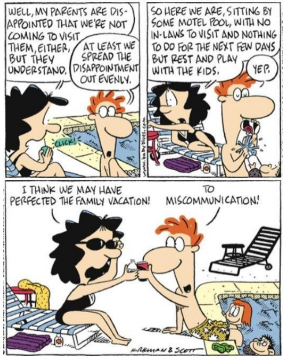
Available at: https://www.gocomics.com/babyblues/2003/08/ 16
The overall theme of the comic strip is:
Joyce, James. "The Dead." In Dubliners, pp. 153-174. Penguin Books, 2002.
The mood of the passage is best described as:
Santiago is an old Cuban fisherman who has gone eighty-four days without catching a fish. His young apprentice, Manolin, is forbidden by his parents to fish with him anymore because they believe that Santiago is bringing bad luck. One day, Santiago sets out alone in his skiff to fish off the coast of Cuba. He casts his line and waits patiently for a bite.
After two days, Santiago finally feels a fish on his line. He struggles to land the fish, which is much larger than he is. The fish pulls the skiff far out to sea, and Santiago is forced to fight for two days and nights to land it.
Finally, Santiago lands the fish, but it is so large that he cannot bring it into the skiff. The fish dies, and Santiago ties it to the side of the skiff. He is exhausted, but he is also proud of his accomplishment.
That night, a school of sharks attacks the fish. Santiago fights them off with a harpoon, but they eventually eat most of the fish. By the time Santiago reaches shore, he is left with only the skeleton of the fish.
Manolin is waiting for Santiago when he arrives. He helps Santiago carry the skeleton of the fish to his shack. Santiago is disappointed, but he is also grateful for the experience. He knows that he has faced his greatest challenge and has emerged victorious.
Hemingway, Ernest. The Old Man and the Sea. Charles Scribner's Sons, 1952.
The story's narrative is told from Santiago's perspective, allowing readers to experience his thoughts, feelings, and motivations. What effect does this narrative technique have on the story?
Historical figures:
1. Edith Cowan
2. Margaret Thatcher
3. Nelson Mandela
4. Barack Obama
5. Justin Trudeau
Countries of origin:
( ) United Kingdom
( ) United States
( ) Canada
( ) South Africa
( ) Australia
The correct sequence is, respectively:

 Conheça nossos planos