Questões de Concurso
Sobre interpretação de texto | reading comprehension em inglês
Foram encontradas 12.687 questões


Ethical codes evolve in response to changing conditions, values, and ideas. A professional code of ethics must, therefore, be periodically updated, and also rest upon widely shared values.
Although the operating environment of museums grows more complex each year, the root value for museums, the tie that connects all of us together despite our diversity, is the commitment to serving people, both present and future generations.
Historically, museums have owned and used natural objects, living and non-living, and all manner of human artifacts to advance knowledge and nourish the human spirit. Today, the range of their special interests reflects the scope of human vision. Their missions include collecting and preserving, as well as exhibiting and educating with materials not only owned but also borrowed and fabricated for these ends. Their numbers include both governmental and private museums.
The museum universe in the United States includes both collecting and noncollecting institutions. Although diverse in their missions, they have in common their nonprofit form of organization and a commitment of service to the public. Their collections and/or the objects they borrow or fabricate are the basis for research, exhibits, and programs that invite public participation.
Taken as a whole, museum collections and exhibition materials represent the world's natural and cultural common wealth. As stewards of that wealth, museums are compelled to advance an understanding of all natural forms and of the human experience. It is incumbent on museums to be resources for humankind and in all their activities to foster an informed appreciation of the rich and diverse world we have inherited. It is also incumbent upon them to preserve that inheritance for posterity.
www.aam-us.org/museumresources/ethics/coe.cfm. Acessado em 22/02/2024. Adaptado.
Ethical codes evolve in response to changing conditions, values, and ideas. A professional code of ethics must, therefore, be periodically updated, and also rest upon widely shared values.
Although the operating environment of museums grows more complex each year, the root value for museums, the tie that connects all of us together despite our diversity, is the commitment to serving people, both present and future generations.
Historically, museums have owned and used natural objects, living and non-living, and all manner of human artifacts to advance knowledge and nourish the human spirit. Today, the range of their special interests reflects the scope of human vision. Their missions include collecting and preserving, as well as exhibiting and educating with materials not only owned but also borrowed and fabricated for these ends. Their numbers include both governmental and private museums.
The museum universe in the United States includes both collecting and noncollecting institutions. Although diverse in their missions, they have in common their nonprofit form of organization and a commitment of service to the public. Their collections and/or the objects they borrow or fabricate are the basis for research, exhibits, and programs that invite public participation.
Taken as a whole, museum collections and exhibition materials represent the world's natural and cultural common wealth. As stewards of that wealth, museums are compelled to advance an understanding of all natural forms and of the human experience. It is incumbent on museums to be resources for humankind and in all their activities to foster an informed appreciation of the rich and diverse world we have inherited. It is also incumbent upon them to preserve that inheritance for posterity.
www.aam-us.org/museumresources/ethics/coe.cfm. Acessado em 22/02/2024. Adaptado.
Ethical codes evolve in response to changing conditions, values, and ideas. A professional code of ethics must, therefore, be periodically updated, and also rest upon widely shared values.
Although the operating environment of museums grows more complex each year, the root value for museums, the tie that connects all of us together despite our diversity, is the commitment to serving people, both present and future generations.
Historically, museums have owned and used natural objects, living and non-living, and all manner of human artifacts to advance knowledge and nourish the human spirit. Today, the range of their special interests reflects the scope of human vision. Their missions include collecting and preserving, as well as exhibiting and educating with materials not only owned but also borrowed and fabricated for these ends. Their numbers include both governmental and private museums.
The museum universe in the United States includes both collecting and noncollecting institutions. Although diverse in their missions, they have in common their nonprofit form of organization and a commitment of service to the public. Their collections and/or the objects they borrow or fabricate are the basis for research, exhibits, and programs that invite public participation.
Taken as a whole, museum collections and exhibition materials represent the world's natural and cultural common wealth. As stewards of that wealth, museums are compelled to advance an understanding of all natural forms and of the human experience. It is incumbent on museums to be resources for humankind and in all their activities to foster an informed appreciation of the rich and diverse world we have inherited. It is also incumbent upon them to preserve that inheritance for posterity.
www.aam-us.org/museumresources/ethics/coe.cfm. Acessado em 22/02/2024. Adaptado.
The terrible food in hospitals has long been one of the greatest contradictions in health care. Over the past few years, several doctors have spoken out about the lack of healthy food options and how frustrating it can be to tell their patients to make dietary changes, only to have that guidance undermined by the very hospital treating their patients.But now, some hospitals are taking note.
Across the country, medical centers are hiring executive chefs, working closely with nutritionists and dietitians, and striving to ensure that patients with a wide range of dietary needs and restrictions are getting not only the nourishment they need while in the hospital, but the information they need to keep from coming back.
Hospital malnutrition affects 30-50% of patients worldwide, according to a September 2019 study published in the Journal of Parenteral and Enteral Nutrition.
How to prioritize healthy food is a question that chef Christopher Dickens at Southeast Health in Alabama is also asking as the hospital and the food facilities go through a ground-up renovation that’s putting healthier options at the forefront.
“Our patients can’t choose where they are, how they feel. They just don’t have a lot of choice,” Dickens said. “If we don’t do everything in our power to make sure that’s a great experience, then shame on us.” He explained that the hospital is trying to move away from processed foods, refined sugars, and excess oil “so that we can produce a product that truly helps our patient, and our community and our staff, with overall health.” Dickens continued. “People have their preconceived notions of what hospital food is, and we want to break those. We know that food is medicine,” said Dickens, “and we need to be ahead of the curve.”
https://www.huffpost.com/entry/bad-hospital-foodhealthy_n_5e5d3de2c5b63aaf8f5b0390. Acesso em Mar 16, 2020. Adaptado.
A: Hello, what's up?
B: Hi, Mary. I’m fine and you?What are you up to?
A: I’m planning a party this weekend. Do you want to come?
B: I’d love to! Could you give me the address, please?
A: It is going to happen here, at my house!
B: Ok! I’ll be there! See ya.
Mark the alternative that refers to the subject of the text.
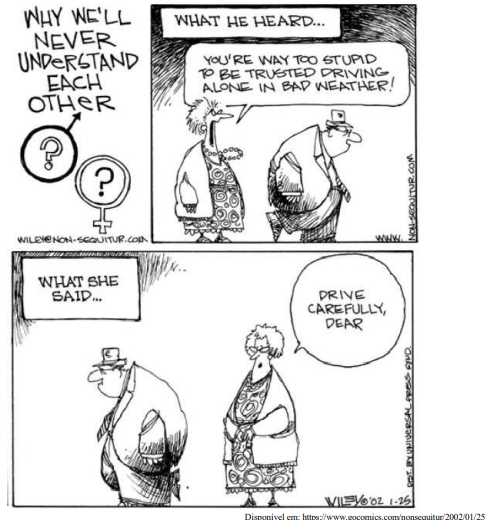
What is the actual message the woman intends to convey to the man about driving in bad weather?
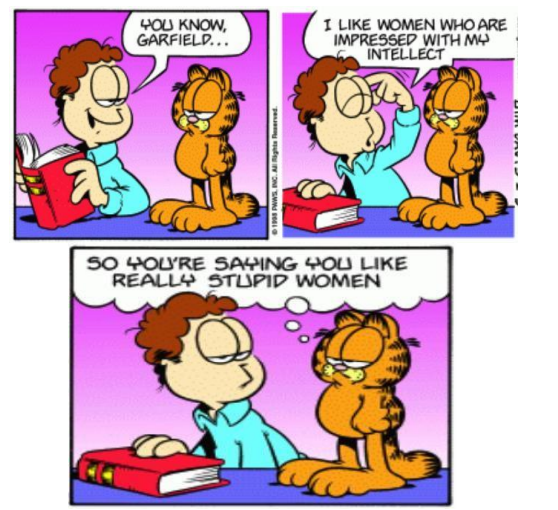
Disponível em: https://www.gocomics.com/garfield/1998/02/09
In the comic strip, Jon Arbuckle says that he likes women who are impressed with his intellect. Garfield's response indicates that he believes Jon is saying that he likes:
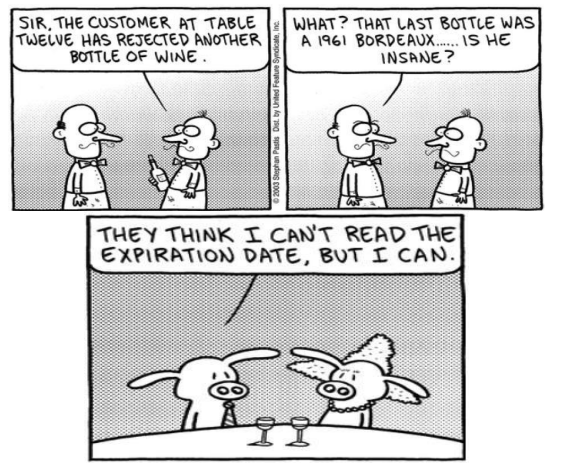
Disponível em: https://www.gocomics.com/pearlsbeforeswine/2003/07/01
What is the reason behind the customer's rejection of the wine in the comic strip?
Associate the reading strategies with their respective descriptions.
1 - Skimming;
2 - Scanning;
3 - Critical Reading;
4 - Predictive Reading:
( ) It is a thoughtful and analytical reading strategy. It goes beyond understanding the literal meaning of the text and involves evaluating the author's arguments, questioning assumptions, and considering alternative perspectives.
( ) It involves making educated guesses about the content of a text based on headings, subheadings, and other organizational cues. Readers use their prior knowledge and the structure of the material to anticipate what information might come next.
( ) It is a reading strategy that involves searching for specific information within a text. Instead of reading the entire passage, the reader focuses on keywords, phrases, or numbers to quickly locate the relevant details.
( ) It is a rapid reading technique used to get an overview of the text. Readers quickly glance through the material to identify the main ideas, important points, and the overall structure of the text without reading every word.
The correct association is, respectively:
poor and rich and white and black,
but they will never wake again.
And those dead folks would give anything at all
for just five minutes of this weather
or ten minutes of plowing.
So you watch yourself about complaining.
What you're supposed to do when you don't like a thing is change it.
If you can't change it, change the way you think about it.”
— Maya Angelou
The passage uses the phrase "those dead folks" to refer to:
"I'll not change my mind, Heathcliff," I said, "and I won't marry you. I'll never be yours, and you shall never be mine."
He looked incredibly shocked at this unexpected declaration, and drew his breath in and out in short, hurried gasps. His face grew red and white, and he stared at me wildly.
"Why not?" he demanded at last, in a voice that sounded almost strangled. "Why won't you marry me?"
"Because I don't love you," I said simply.
He stared at me for a moment, then burst out laughing. "You don't love me?" he repeated. "You don't love me? Then why did you come here?"
"I came here because I was afraid of you," I said. "I thought you would hurt me if I didn't." He laughed again, but this time it was a different kind of laugh. It was a bitter, mocking laugh. "You were right to be afraid of me," he said. "I would have hurt you. I would have killed you."
He reached out and grabbed my arm, his fingers digging into my flesh. "But now I'm going to let you go," he said. "I'm going to let you go, and you'll never see me again."
He released my arm and stepped back, his eyes blazing with anger. "Go," he said. "Go, and never come back."
Emily Brontë
What is the main conflict in this excerpt?
INSTRUCTION: Read the following text to answer question.
Communicative Language Teaching
By Judson Wright
Introduction
The teacher as model
In some approaches to teaching English, the teacher’s main role is to pass on knowledge to students through explanations. In Communicative Language Teaching, the role of the teacher is rather different, although providing clear explanations of language points is still an important part of it. First of all, the teacher acts as a model of good communication skills. This involves asking clear questions, providing clear answers, and giving clear instructions to students. The teacher also models active listening skills, which include making eye contact, listening carefully to what people are saying, checking that listeners understand what’s being said, and responding appropriately. It is the teacher who sets the expectation that these and other communication skills, such as taking turns appropriately in a conversation, are the classroom norm.
Classroom interaction
As in many other classrooms, some of the interaction in the CLT classroom consists of the teacher talking to the whole class while the students listen or respond to the teacher’s questions, particularly when the teacher is explaining a language point. However, CLT is based on the idea that in order to improve students’ communication skills, most of the interaction that teachers need to provide for their students should be classroom tasks that require and develop communication skills. In particular, CLT makes use of roleplays, pair work and group work tasks. These forms of interaction provide some important benefits.
One benefit is that students usually find these forms of interaction motivating and engaging. Pair and group work provide opportunities to focus more on fluency and on content than on accuracy, which often means that students are able to speak more freely than when they are asked to respond to direct questions from the teacher in front of the whole class. These interactions provide a safer space to practise communication skills. The teacher has an important part to play here, ensuring that students avoid focusing on form too much during tasks as well as bringing their students’ focus back onto the content of the interaction rather than correcting each other’s English while carrying out the task
Another benefit is a better use of time. When students are divided into pairs or groups and given a task that each pair or group carries out at the same time, it is a far more efficient and effective use of classroom time than other forms of classroom interaction. It means that all students can be engaged and active at the same time, rather than merely listening to other students respond to the teacher’s questions or prompts, which is a typical interaction in some classrooms. Through pair and group work, each individual student spends far more time using English and practising their communication skills.
Meaningful communication
In order for the interactions to be effective, we need to ensure that successfully completing a task depends on meaningful communication. In other words, each pair and group work task are designed so that there is a real purpose for the interaction, mirroring communicative interactions in the real world. This real purpose might involve a student communicating something about their own life which another student doesn’t know, such as information about their family, or their own opinions on a subject. It might also involve creating an information gap between the students which requires the use of different communication skills. Let’s consider a couple of examples at different levels of English ability that illustrate the idea of meaningful communication.
Imagine a teacher is working with students at an elementary level of English who are learning or practising the names of colours. The teacher produces sheets of paper with perhaps four or five coloured circles on them. Most sheets are different from each other, but each sheet has at least one other that matches it exactly. Each student receives a sheet and is asked not to let other people see their sheet. The task is for each student to find another student whose sheet exactly matches their own. Armed with a simple structure, such as Do you have a … circle?, students mingle around the classroom, asking and answering each other’s questions, until they have each found a matching partner. This type of task can be easily adapted to focus on shapes, body parts, and a range of other lexical sets. Contrast this with a situation where a teacher indicates different objects that the whole class can see and asks questions such as What colour is this? and expects students to respond with the correct colour. In that case, no meaningful communication takes place since all students already know the answer.
[…]
Assessment and correction
During the task, the students’ focus should be on achieving the communicative aim, whether that’s finding someone in the class with matching information, reconstructing a text, or successfully completing a roleplay. The teacher’s role is to employ ongoing informal assessment by monitoring the interactions and making sure that each pair and group stays on task and does not get distracted by trying to correct each other’s use of language. It’s worth making the importance of completing the task explicit at the start of any communicative task. As teachers monitor the students, they should make a note of any errors that they want to focus on after the activity. This is usually most effective when the teacher selects errors that more than one student makes since focusing on these is likely to be of use to more students. While the teacher may choose to ignore most other errors, it is sometimes worth using ‘hot correction’ with individual students. With hot correction, the teacher quickly makes a note of the correct form on a slip of paper and simply places it on the table in front of the student, without interrupting the interaction.
Conclusion
Communicative Language Teaching prepares students for communicative demands outside the classroom using techniques that develop communication skills. In its pure form, some teachers may feel that there is not enough focus on accuracy and language structure to meet their needs and the needs of their students. However, introducing elements of the approach into your classroom and reconsidering your role as a teacher and the types of tasks you ask your students to take part in will motivate and engage your students while developing their communication skills.
Available at: https://www.onestopenglish.com/methodology-theworld-of-elt/communicative-language-teaching/1000116.article. Accessed on: Jan 23rd, 2024.
Concerning assessment in the Communicative Approach, a teacher is encouraged
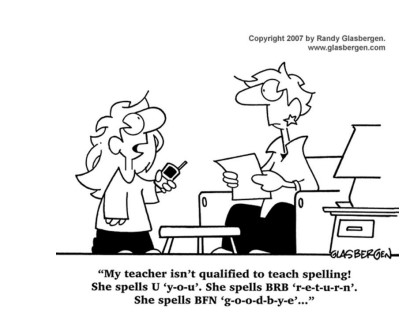
Available at: https://www.glasbergen.com/education-cartoons/language-grammar/. Accessed on: Jan 23rd, 2024.
An essential feature of cartoons is humor. The cartoonist is making fun of the fact that
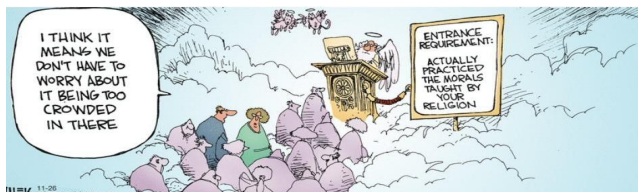 Available at: https://www.gocomics.com/nonsequitur
 In the given comic strip, the character expresses the belief that heaven won't be crowded. What is the reason behind the character's assumption? Choose the most appropriate explanation from the options below.
In the line "Wait without thought, for you are not ready for thought", how does it relate to the overall theme of the poem?
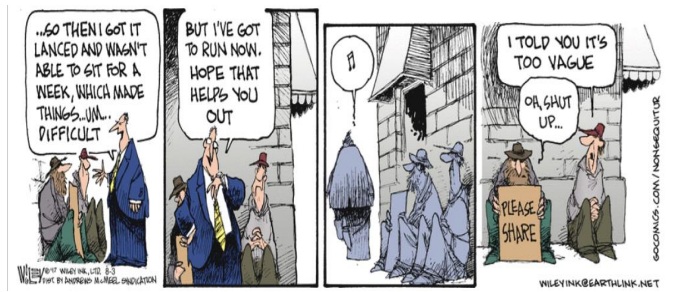
Available at: https://www.gocomics.com/nonsequitur/2021/08/03
The character's speech "I told you it's too vague" refers to:
“I know the night is not the same as the day: that all things are different, that the things of the night cannot be explained in the day, because they do not then exist, and the night can be a dreadful time for lonely people once their loneliness has started.”
Which of the following statements best captures the essence of the author's reflection on the contrast between night and day?

 Conheça nossos planos