Questões de Concurso
Sobre adjetivos | adjectives em inglês
Foram encontradas 776 questões


Everyone keeps data. Big organizations spend millions to look after their payroll, customer and transaction data. The penalties for getting it wrong are severe: businesses may collapse, shareholders and customers lose money, and for many organizations (airlines, health boards, energy companies), it is not exaggerating to say that even personal safety may be put at risk. And then there are the lawsuits. The problems in successfully designing, installing, and maintaining such large databases are the subject of numerous books on data management and software engineering. However, many small databases are used within large organizations and also for small businesses, clubs, and private concerns. When these go wrong, it doesn't make the front page of the papers; but the costs, often hidden, can be just as serious.
Where do we find these smaller electronic databases? Sports clubs will have membership information and match results; small businesses might maintain their own customer data. Within large organizations, there will also be a number of small projects to maintain data information that isn't easily or conveniently managed by the large system-wide databases. Researchers may keep their own experiment and survey results; groups will want to manage their own rosters or keep track of equipment; departments may keep their own detailed accounts and submit just a summary to the organization's financial software.
Most of these small databases are set up by end users. These are people whose main job is something other than that of a Computer professional. They will typically be scientists, administrators, technicians, accountants, or teachers, and many will have only modest skills when it comes to spreadsheet or database software.
The resulting databases often do not live up to expectations. Time and energy is expended to set up a few tables in a database product such as Microsoft Access, or in setting up a spreadsheet in a product such as Excel. Even more time is spent collecting and keying in data. But invariably (often within a short time frame) there is a problem producing what seems to be a quite simple report or query. Often this is because the way the tables have been set up makes the required result very awkward, if not impossible, to achieve.
A database that does not fulfill expectations becomes a
costly exercise in more ways than one. We clearly have the
cost of the time and effort expended on setting up an
unsatisfactory application. However, a much more serious
problem is the unability to make the best use of valuable
data. This is especially so for research data. Scientific and
social researchers may spend considerable money and many
years designing experiments, hiring assistants and collecting
and analyzing data, but often very little thought goes into
storing it in an appropriately designed database.
Unfortunately, some quite simple mistakes in design can mean that much of the potential information is lost. The
immediate objective may be satisfied, but unforeseen uses
of the data may be seriously compromised. Next year's grant
opportunities are lost.
Read text II and answer the question:
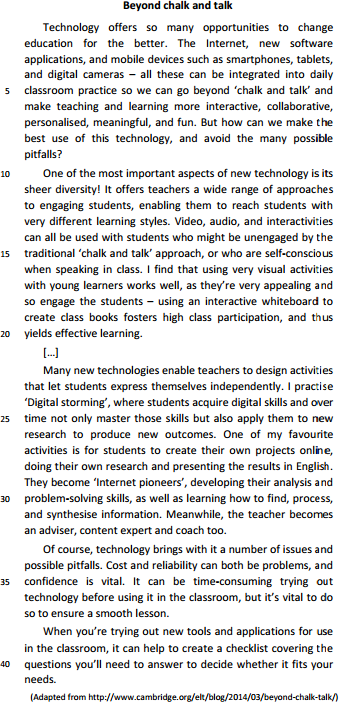
Read text II and answer the question:

( ) highest (line 2), most basic (line 3), best work (line 16) are in the superlative form.
( ) better grades (lines 11 and 12), higher wages (line 13), more extrinsically motivated (line 18) are in the comparative of inferiority form.
( ) us (line 3) and our (line 18) are possessive pronouns.
( ) motivated (line 11) and theoretical (line 2) are adjectives.
Mark the correct sequence.
Starring Sandra Bullock and George Clooney as astronauts adrift in
space, Alfonso Cuarón’s astonishing thriller is one of the films of
the year, says Robbie Collin
Watch an astronaut drifting through space for long enough and eventually you notice how much they look like a newborn baby. The oxygen helmet makes their head bigger, rounder and cuter; their hands grasp eagerly at whatever happens to be passing; their limbs are made fat and their movements simple by the spacesuit’s cuddly bulk. They tumble head-over-heels like tripping toddlers or simply bob there in amniotic suspension. Even the lifeline that keeps them tethered to their ship has a pulsing, umbilical aspect.
Gravity, the new Alfonso Cuarón picture, is a heart- achingly tender film about the miracle of motherhood, and the billion-to-one odds against any of us being here, astronauts or not. It’s also a totally absorbing, often overpowering spectacle - a $100 million 3D action movie in which Sandra Bullock and George Clooney play two Hollywood-handsome spacefarers, fighting for their lives 375 miles above the Earth’s crust.
A series of captions over the opening titles reminds us that this is a dead zone: no oxygen or air pressure, and nothing to carry sound. “Life in space is impossible,” the final message tells us, as the cinema shakes with Steven Price’s resonant score, and then suddenly falls quiet.
For Dr. Ryan Stone (Bullock), a mission specialist in orbit for the first time, the lack of noise is welcome. She’s a medical engineer called up by NASA to install new software on to the Hubble Telescope, but also a mother in mourning for her four- year-old daughter, whom she lost in a senseless accident, and the silence enfolds her like a comfort blanket.
Available in: http://www.telegraph.co.uk
“The oxygen helmet makes their1 head bigger2 , rounder and cuter; their hands3 grasp eagerly at whatever happens to be passing; their limbs are made fat and their movements simple by the spacesuit’s cuddly bulk.”
This is how stars die
5,000 light years away in Centaurus, a large constellation in the southern sky, is the Boomerang Nebula, a cloud of gas being expelled from a dying star.
This cloud is one of _________ (bizarre) 1 and ___________ (mysterious) 2 objects in the universe. Here, within the gas streaming outwards, astronomers have found that the temperature drops ___________ (low) 3 nearly absolute zero.
It is, ___________ (far) 4 anyone knows, the coldest place in the universe.
It may also prove to be quite important. Because this ____________ (frigid) 5 place, and objects like it, albeit a tad ___________ (warm) 6– may help astronomers unravel a host of cosmic conundrums, from the violent yet spectacular deaths of stars and the formation of galaxies to cosmic explosions and the origin of life itself.
Death of stars, birth of life
In many respects the Boomerang Nebula is unremarkable. All stars have to die some day. When ___________ (small) 7 stars end, those about eight times _____________ (massive) 8 our own sun, they produce a similar display of gas and dust.
display of gas and dust.
Text 2:
English for Adults & Seniors!
Learning a language isn’t only for the young! It’s for everyone and if you are an older learner,maybe 40+ to 70+ then joining an English Language Course in an environment with people in similar age groups is a greatway to do it.
When you join a course at one of the International Schools you will find that approximately more than 20% of our students are aged 30 to 44 and a further 32% are aged 45 to 75 - sometimes older. You aremore than likely to find yourself in a class with people of a similar age;
Some mature students choose Business English courses for their working needs but many more join standard General English courses or the Intensive English Mini-Group courses. Courses like these help you to combine your language course with a holiday and you can make your own afternoon programme or join social programmes which are designed to have a variety of different activities suitable for all the age groups at the school. The programme changes every week and you can see samples of all the different activities on the social programme pages or on Facebook pages.
Mature learners will feel safe joining one of the International Schools. You will find others of a similar age in your class at all times of year
The International School ( I S ) accommodation is also suitable for older clients - you can choose froma homestay with a private bathroom, an apartment, but most convenient of all is Club IS Hotel which is opposite the school. Club IS is for mature individuals who are studying at the school. Classes are always organised according to level and according to age groups.
(Adapted from: < http: www.tisenglish.co.uk /courses-for-adults- seniors>)


In the sentence “these findings suggest that Facebook may undermine it” (l.32 and 33), the verb “undermine” means the opposite of the verb to mine.

2. This view of bilingualism is remarkably different from the understanding of bilingualism through much of the 20th century. Researchers, educators and policy makers long considered a second language to be an interference, cognitively speaking, that hindered a child’s academic and intellectual development.
3. They were not wrong about the interference: there is ample evidence that in a bilingual’s brain both language systems are active even when he is using only one language, thus creating situations in which one system obstructs the other. But this interference, researchers are finding out, isn’t so much a handicap as a blessing in disguise. It forces the brain to resolve internal conflict, giving the mind a workout that strengthens its cognitive muscles. (…)
4. The collective evidence from a number of such studies suggests that the bilingual experience improves the brain’s so-called executive function — a command system that directs the attention processes that we use for planning, solving problems and performing various other mentally demanding tasks. These processes include ignoring distractions to stay focused, switching attention willfully from one thing to another and holding information in mind — like remembering a sequence of directions while driving. (…)
5. The key difference between bilinguals and monolinguals may be more basic: a heightened ability to monitor the environment. “Bilinguals have to switch languages quite often — you may talk to your father in one language and to your mother in another language,” says Albert Costa, a researcher at the University of Pompeu Fabra in Spain. “It requires keeping track of changes around you in the same way that we monitor our surroundings when driving.” In a study comparing German-Italian bilinguals with Italian monolinguals on monitoring tasks, Mr. Costa and his colleagues found that the bilingual subjects not only performed better, but they also did so with less activity in parts of the brain involved in monitoring, indicating that they were more efficient at it. (…)
6. Bilingualism’s effects also extend into the twilight years. In a recent study of 44 elderly Spanish-English bilinguals, scientists led by the neuropsychologist Tamar Gollan of the University of California, San Diego, found that individuals with a higher degree of bilingualism — measured through a comparative evaluation of proficiency in each language — were more resistant than others to the onset of dementia and other symptoms of Alzheimer’s disease: the higher the degree of bilingualism, the later the age of onset.
7. Nobody ever doubted the power of language. But who would have imagined that the words we hear and the sentences we speak might be leaving such a deep imprint?
(Source: http://www.nytimes.com/2012/03/18/opinion/sunday/thebenefits-of-bilingualism.html?_r=0. Acesso: 04/02/2013)
The words globalized (paragraph 01), considered (paragraph 02), blessing (paragraph 03), and like (paragraph 04), are respectively presented in text as:
TEXT 1



 Conheça nossos planos