Questões de Concurso
Sobre adjetivos | adjectives em inglês
Foram encontradas 776 questões


Read the following text and answer question.
How do people see disability today?
Some time ago, people’s idea of disability was very distressing, especially towards people with disability and their families. If a child was born with any kind of disability, they _____________ that to many strange taboos, spiritual and traditional beliefs.
Today, disability is seen very differently. Education, information, support services, policy and accessibility efforts by many modern societies have empowered people with disabilities, together with _____ families, to rise to their fullest potential. Children with disability are able to go to school and feel part of society. Many people with disability have grown to become great, successful people.
Ray Charles and Steve Wonder, both blind from childhood, are some of ____________ musicians in the world. Marlee Matlin, ______ lost her hearing from childhood, is a great Standup Comedian and Actress. Chris Burke, a favorite American TV character, and writer, is a person with Down Syndrome. Nick Vujicic is _______ Australian Christian Evangelist and Motivational Speaker. Born ______ 1982 with a rare disorder, characterized by no hands and legs, has lived to inspire millions and continue to empower people.
Disability is part of life. People with disability have potential too, just like people without a disability.
They have the same rights as everyone else and if people with disabilities, families, and society can
work together on policy, we can make society all-inclusive and every person will have a fair chance to
be the best they can be.
(Adapted from: https://goo.gl/fhJZCM. Access: 01/22/2018)

Read the following text and answer question.
How do people see disability today?
Some time ago, people’s idea of disability was very distressing, especially towards people with disability and their families. If a child was born with any kind of disability, they _____________ that to many strange taboos, spiritual and traditional beliefs.
Today, disability is seen very differently. Education, information, support services, policy and accessibility efforts by many modern societies have empowered people with disabilities, together with _____ families, to rise to their fullest potential. Children with disability are able to go to school and feel part of society. Many people with disability have grown to become great, successful people.
Ray Charles and Steve Wonder, both blind from childhood, are some of ____________ musicians in the world. Marlee Matlin, ______ lost her hearing from childhood, is a great Standup Comedian and Actress. Chris Burke, a favorite American TV character, and writer, is a person with Down Syndrome. Nick Vujicic is _______ Australian Christian Evangelist and Motivational Speaker. Born ______ 1982 with a rare disorder, characterized by no hands and legs, has lived to inspire millions and continue to empower people.
Disability is part of life. People with disability have potential too, just like people without a disability.
They have the same rights as everyone else and if people with disabilities, families, and society can
work together on policy, we can make society all-inclusive and every person will have a fair chance to
be the best they can be.
(Adapted from: https://goo.gl/fhJZCM. Access: 01/22/2018)
Read the following text and answer question.
Introduction to Climate change
Many people make Climate Change and Global Warming a scary and difficult thing to understand, _______ it’s not.
Scientists have warned that the world's climate has changed a lot, and has affected many living and non-living things. Many places _______ were warmer are now getting colder, and many colder regions are getting much colder or even warmer nown as Global Warming).
For example, _________ 1901 and 2012, it is believed that the earth's temperature has risen by 0.89 °C. Rainfall amounts have also risen in the mid-latitudes of the northern hemisphere since the beginning of the 20th Century. It is also believed that sea levels have risen up to about 19cm globally, with lots of glaciers melting in addition.
Some people do not believe that these are caused by human activities. They think it is all political actions and falsehood intended to cause panic among humans.
Well, whatever it is, we would like to know more, and take a few good points from this confusion, and
use them to make our world a better place to live.
(Adapted from: https://goo.gl/xQnjzZ. Access: 01/22/2018)

Read the following text and answer question.
Introduction to Climate change
Many people make Climate Change and Global Warming a scary and difficult thing to understand, _______ it’s not.
Scientists have warned that the world's climate has changed a lot, and has affected many living and non-living things. Many places _______ were warmer are now getting colder, and many colder regions are getting much colder or even warmer nown as Global Warming).
For example, _________ 1901 and 2012, it is believed that the earth's temperature has risen by 0.89 °C. Rainfall amounts have also risen in the mid-latitudes of the northern hemisphere since the beginning of the 20th Century. It is also believed that sea levels have risen up to about 19cm globally, with lots of glaciers melting in addition.
Some people do not believe that these are caused by human activities. They think it is all political actions and falsehood intended to cause panic among humans.
Well, whatever it is, we would like to know more, and take a few good points from this confusion, and
use them to make our world a better place to live.
(Adapted from: https://goo.gl/xQnjzZ. Access: 01/22/2018)
A Brief and Simplified Description of Papermaking
The paper we use today is created from individual wood fibers that are first suspended in water and then pressed and dried into sheets. The process of converting the wood to a suspension of wood fibers in water is known as pulp making, while the manufacture of the dried and pressed sheets of paper is formally termed papermaking. The process of making paper has undergone a steady evolution, and larger and more sophisticated equipment and better technology continue to improve it.
The Wood yard and Wood rooms
The process at Androscogging began with receiving wood in the form of chips or of logs 4 or 8 feet in length. From 6 AM to 10 PM a steady stream of trucks and railroad cars were weighted and unloaded. About 40 percent were suplied by independents who were paid by weight their logs. The mill also received wood chips from lumber mills in the area. The chips and logs were stored in mammoth piles with separate piles for wood of different species (such as pine, spruce, hemlock).
When needed, logs were floated in flumes......(1).....the wood yard.....(2).....one of the mill’s three wood rooms. There, bark was rubbed......(3)........in long, ribbed debarking drums by tumbling the logs against one another. The logs then fell into a chipper;......(4)......seconds a large log was reduced to a pile of chips approximately 1 inch by 1 inch by 1/4 inch.
The chips were stored in silos. There were separate silos for softwoods (spruce, fir, hemlock, and pine) and hardwoods (maple, oak, beech, and birch). This separate and temporary storage of chips permitted the controlled mixing of chips into the precise recipe for the grade of paper being produced.
The wood chips were then sorted through large, flat vibrating screens. Oversized chips were rechipped, and ones that were too small were collected for burning in the power house. (The mill provided approximately 20 percent of all its own steam and electricity needs from burning waste. An additional 50 percent of total electricity needs was produced by harnessing the river for hydroelectric power.)
Once drawn from the silo into the digesters, there was no stopping the flow of chips into paper.
Pulpmaking
The pulp made at Androscoggin was of two types: Kraft pulp (produced chemically) and ground wood pulp (produced mechanically). Kraft pulp was far more important to the high quality white papers produced at Androscoggin, accounting for 80 percent of all the pulp used. Kraft pulp makes strong paper. (Kraft is German for strength. A German invented the Kraft pulp process in 1884.) A paper’s strength generally comes from the overlap and binding of long fibers of softwood; only chemically was it initially possible to separate long wood fibers for suspension in water. Hardwood fibers are generally smaller and thinner and help smooth the paper and make it less porous.
The ground wood pulping process was simpler and less expensive than the Kraft process. It took high quality spruce and fir logs and pressed them continuously against a revolving stone that broke apart the wood’s fibers. The fibers, however, were smaller than those produced by the Kraft process and, although used to make newsprint, were useful at Androscoggin in providing “fill” for the coated publication gloss papers of machines 2 and 3, as will be described later.
(A)The chemical Kraft process worked by dissolving the lignin that bonds wood fibers together. (B) It did this in a tall pressure cooker, called a digester, by “cooking” the chips in a solution of caustic soda (NaOH) and sodium sulfide (Na2S), which was termed the “white liquor.” (C)The two digesters at Androscoggin were continuous digesters; chips and liquor went into the top, were cooked together as they slowly settled down to the bottom, and were drawn off the bottom after about three hours. (D) By this time, the white liquor had changed chemically to “black liquor’’; the digested chips were then separated from this black liquor. (E)
In what was known as the “cold blow” process, the hot, pressurized chips were gradually cooled and depressurized. A “cold liquor’’ (170°F) was introduced to the bottom of the digester and served both to cool and to transport the digested chips to a diffusion washer that washed and depressurized the chips. Because so much of the lignin bonding the fibers together had been removed, the wood fiber in the chips literally fell apart at this stage.
The black liquor from the digester entered a separate four-step recovery process. Over 95 percent of the black liquor could be reconstituted as white liquor, thereby saving on chemical costs and significantly lowering pollution. The four-step process involved (1) washing the black liquor from the cooked fiber to produce weak black liquor, (2) evaporating the weak black liquor to a thicker consistency, (3) combustion of this heavy black liquor with sodium sulfate (Na2SO4 ), and redissolving the smelt, yielding a “green liquor” (sodium carbonate + sodium sulfide), and (4) adding lime, which reacted with the green liquor to produce white liquor. The last step was known as causticization.
Meanwhile, the wood-fiber pulp was purged of impurities like bark and dirt by mechanical screening and by spinning the mixture in centrifugal cleaners. The pulp was then concentrated by removing water from it so that it could be stored and bleached more economically.
By this time, depending on the type of pulp being made, it had been between 3 1/2 and 5 hours since the chips had entered the pulp mill.
All the Kraft pulp was then bleached. Bleaching took between 5 and 6 hours. It consisted of a three-step process in which (1) a mix of chlorine (Cl2 ) and chlorine dioxide (CIO2 ) was introduced to the pulp and the pulp was washed; (2) a patented mix of sodium hydroxide (NaOH), liquid oxygen, and hydrogen peroxide (H2 O2 ) was then added to the pulp and the pulp was again washed; and (3) chlorine dioxide (ClO2 ) was introduced and the pulp washed a final time. The result was like fluffy cream of wheat. By this time the pulp was nearly ready to be made into paper.
From the bleachery, the stock of pulp was held for a short time in storage (a maximum of 16 hours) and then proceeded through a series of blending operations that permitted a string of additives (for example, filler clay, resins, brighteners, alum, dyes) to be mixed into the pulp according to the recipe for the paper grade being produced. Here, too, “broke” (paper wastes from the mill itself) was recycled into the pulp. The pulp was then once again cleaned and blended into an even consistency before moving to the papermaking machine itself.
It made a difference whether the broke was of coated
or uncoated paper, and whether it was white or colored. White, uncoated paper could be recycled immediately. Colored, uncoated paper had to be rebleached.
Coated papers, because of the clays in them, could not
be reclaimed.
“The ground wood pulping process was simpler and less expensive than the Kraft process. It took high quality spruce and fir logs and pressed them continuously against a revolving stone that broke apart the wood’s fibers.”
1. the word ‘simpler’ is an adjective in the superlative form. 2. the word ‘them’ is an object pronoun. 3. the tense used in ’took’, is simple past of a regular verb. 4. the word ‘that’ can be replaced by ‘which’ without changing its meaning.
Choose the alternative which presents the correct ones:
Adjectives are one of the four major word classes, along with nouns, verbs and adverbs. It is a word that describes a noun, giving extra information about it.
Just one alternative about adjective is not right. Mark it.
Analyze the sentences below.
I - I think he was more mad than brave;
II - Some residents were madder than a wet hen loathing the idea of the bylaw;
III - Is there anything more fun than a Trump rally?
Observing the underlined items, choose the correct option.
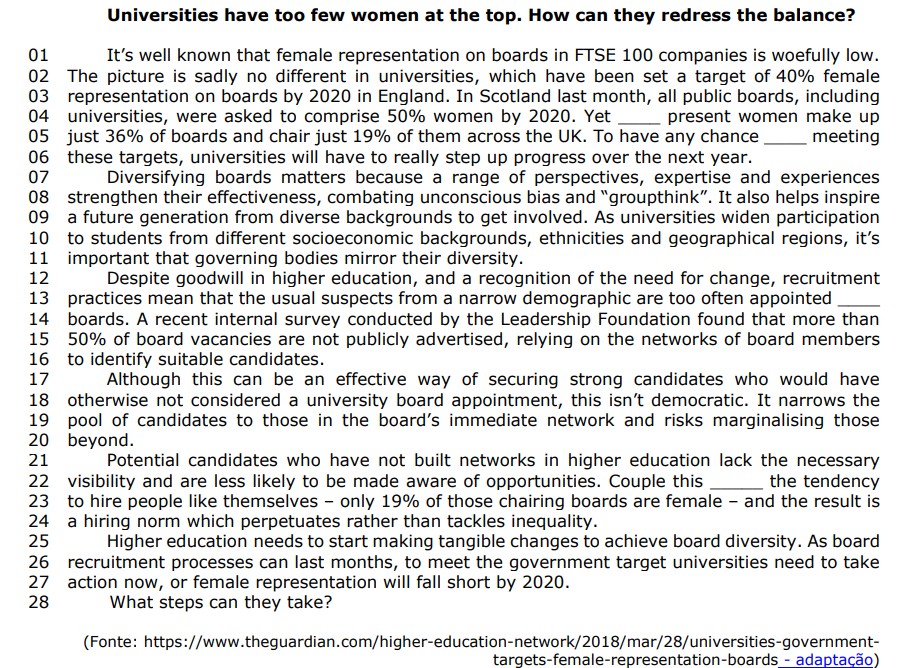
Column 1 1. Adverb. 2. Adjective. 3. Noun. 4. Verb.
Column 2 ( ) known (l.01). ( ) sadly (l.02). ( ) chair (l.05). ( ) unconscious (l.08). ( ) need (l.12). ( ) likely (l.22).
The correct order, top-down, is:

• It is an adverb. • It is followed by an adjective. • It is part of a to-infinitive verb. • It is the subject of the sentences.
 The fair trade movement, which aims
ensure that fair prices are paid to producers in
developing countries, is one of the true global success
stories recent decades. The International
Fairtrade Certification Mark, a guarantee that producers are getting a fair price, has become one of the
most recognizable logos the world, which
91 percent of customers associate positive
values. When the logo first appeared in the UK, the
country where the largest number of fair-trade products are sold, nobody expected that the number of
certified products would grow from only 3 to over
4,500 in just 18 years. In 2011, people around the
world spent more than 6.5 billion US dollars on fair-
-trade certified goods, signifying a 12 percent increase
in sales from the previous year. This was at a time
when most market segments in the developed world
were still shrinking or stagnating from the after effects
of the 2008 banking crisis. Over 1.2 million farmers
and workers living in 66 countries benefit from fair-
-trade certification by being able to sell their products
at competitive prices, to ensure sustainability.
The fair trade movement, which aims
ensure that fair prices are paid to producers in
developing countries, is one of the true global success
stories recent decades. The International
Fairtrade Certification Mark, a guarantee that producers are getting a fair price, has become one of the
most recognizable logos the world, which
91 percent of customers associate positive
values. When the logo first appeared in the UK, the
country where the largest number of fair-trade products are sold, nobody expected that the number of
certified products would grow from only 3 to over
4,500 in just 18 years. In 2011, people around the
world spent more than 6.5 billion US dollars on fair-
-trade certified goods, signifying a 12 percent increase
in sales from the previous year. This was at a time
when most market segments in the developed world
were still shrinking or stagnating from the after effects
of the 2008 banking crisis. Over 1.2 million farmers
and workers living in 66 countries benefit from fair-
-trade certification by being able to sell their products
at competitive prices, to ensure sustainability.
 Fair-trade initiatives have been growing steadily since the late 1960s, when the fair trade
movement started with only a handful of committed
individuals in the West who believed there was an
alternative to the exploitation of farmers and workers
in the developing world. Fair trade ensures fair prices
for suppliers, as well as payment of a premium that
can be reinvested in the local communities (for example, in schools or sanitation) or in improving productivity. In India, for instance, a group of rice farmers used
the premium to buy farm machinery, which meant a
30 percent improvement in production.
Fair-trade initiatives have been growing steadily since the late 1960s, when the fair trade
movement started with only a handful of committed
individuals in the West who believed there was an
alternative to the exploitation of farmers and workers
in the developing world. Fair trade ensures fair prices
for suppliers, as well as payment of a premium that
can be reinvested in the local communities (for example, in schools or sanitation) or in improving productivity. In India, for instance, a group of rice farmers used
the premium to buy farm machinery, which meant a
30 percent improvement in production.
 As consumers look for, and recognize, the logo
and purchase fair-trade products, they put
pressure on companies and governments to do more
for global welfare. They also put pressure on supermarkets to sell fair-trade goods at the same price as
conventional products, shifting the extra costs involved from consumers to the corporations that collect
the profits.
As consumers look for, and recognize, the logo
and purchase fair-trade products, they put
pressure on companies and governments to do more
for global welfare. They also put pressure on supermarkets to sell fair-trade goods at the same price as
conventional products, shifting the extra costs involved from consumers to the corporations that collect
the profits.
 Critics of the fair trade movement say it is still
not doing enough. They stress that the key to
long-term development is not in small local improvements, but in moving the developing world from
the production of raw materials into processing them,
which can bring in greater profit. There are already some signs of this happening. A group of tea growers
in Kenya recently set up a processing factory to deliver the final products directly to their customers in
the West. By switching from the export of raw tea to
boxed fair-trade products, they achieved 500 percent
higher profits.
Critics of the fair trade movement say it is still
not doing enough. They stress that the key to
long-term development is not in small local improvements, but in moving the developing world from
the production of raw materials into processing them,
which can bring in greater profit. There are already some signs of this happening. A group of tea growers
in Kenya recently set up a processing factory to deliver the final products directly to their customers in
the West. By switching from the export of raw tea to
boxed fair-trade products, they achieved 500 percent
higher profits.
 It is important to realize that, despite all of its
benefits, the fair trade movement has its limitations. Some of the poorest farmers can’t afford to pay
the certification fees required for each fair-trade initiative, while others work for big, multinational employers that are excluded from participating. Fair trade is
certainly a step in the right direction, but there is a lot
more we must continue to do in order to help people
in the world’s poorest regions.
It is important to realize that, despite all of its
benefits, the fair trade movement has its limitations. Some of the poorest farmers can’t afford to pay
the certification fees required for each fair-trade initiative, while others work for big, multinational employers that are excluded from participating. Fair trade is
certainly a step in the right direction, but there is a lot
more we must continue to do in order to help people
in the world’s poorest regions.“A group of tea growers in Kenya recently set up a processing factory to deliver the final products directly to their customers in the West. By switching from the export of raw tea to boxed fair-trade products, they achieved 500 percent higher profits.”
The underlined words are examples of:
Choose the best option to complete the following dialog:
A: My car is __________ yours. Even though, it is __________ comfortable.
B: I don’t; agree. Your car is __________ mine.
Watch out for your baby girl! She is playing with that _____________ of yours.
In the phrase “Only an old man, mittened and scarved”, the two words “mittened” and “scarved” are
In the sentence “The taxi, an old Rover smelling of old cigarette smoke, trundled along the empty, country road at an unhurried pace”, the words “empty” and “country” are used as
TEXTO I
English for Specific Purposes
English for specific purposes (ESP) refers to language research and instruction that focuses on the specific communicative needs and practices of particular social groups. Emerging out of Halliday, Macintosh, and Strevens’ (1964) groundbreaking work nearly 40 years ago, ESP started life as a branch of English language teaching, promising a stronger descriptive foundation for pedagogic materials. In the years since, ESP has consistently been at the cutting-edge of both theory development and innovative practice in applied linguistics, making a significant contribution to our understanding of the varied ways language is used in particular communities. Drawing on a range of interdisciplinary influences for its research methods, theory, and practices, ESP has consistently provided grounded insights into the structures and meanings of texts, the demands placed by academic or workplace contexts on communicative behaviors, and the pedagogic practices by which these behaviors can be developed.
HYLAND, K. “English for specific purposes: some influences and impacts”. In: Cummins, J. and Davison, C., (eds.) The International Handbook of English language education. Springer: Norwell, Mass, 2006.

Based on the text, judge the following item.
“bad” in “reception was sometimes bad” (line 9) is not
the contrary of better.

 Conheça nossos planos