Questões de Concurso
Sobre adjetivos | adjectives em inglês
Foram encontradas 776 questões


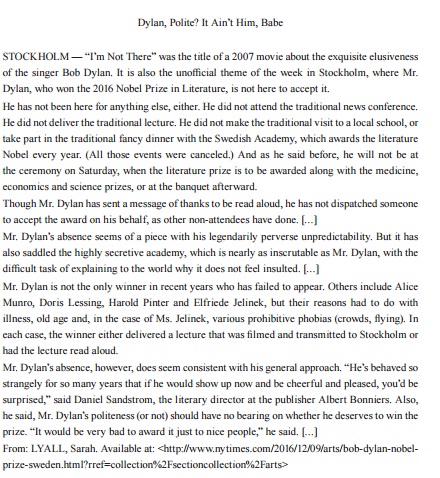
Read the text about Nobel Prize for the question.
As questões de números 56 a 60 verificam o domínio do conhecimento sistêmico da língua inglesa. Cada uma das questões apresenta uma frase com uma lacuna. Assinale a alternativa que contém a palavra ou expressão que completa a lacuna de maneira adequada quanto ao sentido e ao uso da norma-padrão da língua inglesa.
___________ time, I have dinner at seven.
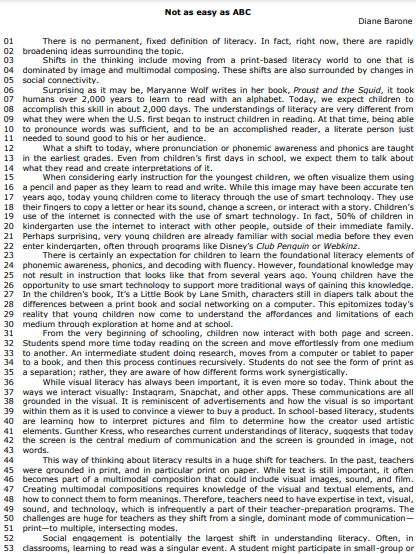
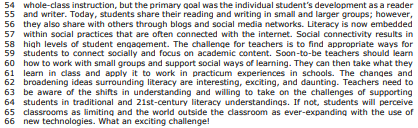
Instructions: Question are based on the following text.
Source: http://languagemagazine.com/?page_id=124967
Instructions: Question are based on the following text.
Source: http://languagemagazine.com/?page_id=124967
When I look at the photo circulating of a woman in Nice being surrounded by armed police officers as she is coerced into removing her clothing, because French officials deemed the burkini to be inappropriate beach attire, I see infringement on a woman’s right to choose what she puts on her body by a group of white males. I see the scapegoating, ostracization, and criminalization of Muslims in the aftermath of the Nice terror attacks. I am a woman who wears the hijab, and I see an affront to the rights and civil liberties of women like me.
Deputy Mayor of Nice, Christian Estrosi: You have stated that you support this ban on “inappropriate clothing” in the wake of the Nice terror attacks. Mayor Vivoni, you have described the burkini ban as a necessary measure to “protect the population.” Former French president Nicolas Sarkozy, you have labeled the burkini as a symbol of extremism.
Let me respond to all of you by saying this: any conflation of the burkini with terrorism is invalid, virulent, and discriminatory. Tell me, in what way does our way of dress pose a threat to France’s national security? In what way does the burkini propagate hateful, violent ideologies? How is it that our way of dress poses a national security threat, yet some wetsuits, which take on strikingly similar designs to the burkini, aren’t? While France’s highest administrative court has now overturned the ban, the damage has already been done — this attack on the Muslim way of dress only serves as fodder to the already existing rising anti-Muslim sentiment and stigmatization of Muslims in France. If this institutionalized Islamophobia and fearmongering is being perpetrated by French officials and authorities, I fear how the general public’s poor treatment of hijab-clad women may be exacerbated in the coming weeks. We’re all well aware that hate crimes and violence targeting Muslim women wearing the hijab is not a new phenomenon in France.
As one burkini-clad woman who was forced to leave the beach states, “Because people who have nothing to do with my religion have killed, I no longer have the right to go to the beach.” In the eyes of many authority figures, our religious identity in and of itself is incriminating. Our way of dress is incriminating. Our sheer existence is incriminating.
Many of you have called the hijab an emblem of oppression. In April, France’s Minister for Women’s Rights equated women who choose to wear the hijab with “Negroes who were in favor of slavery.” More recently, France’s prime minister stated that the burkini is a tool of “enslavement,” and former French President Sarkozy insinuated that hijabclad women are imprisoned.
I am genuinely tired of individuals like you imposing your brand of colonial feminism on us and telling us that we are oppressed, that we have been indoctrinated, that this was not our choice, and that we need to be unshackled. Instead of continuing to pursue these offensive and failing attempts at liberating us, I implore you to liberate yourselves from this white savior complex and recognize that we don’t need your saving. The hijab does not oppress me. For me, the hijab is a symbol of feminism and freedom of expression — so who are you to invalidate my experiences, to invalidate a fundamental, inextricable aspect of my identity, and to label me as enslaved, as imprisoned, as oppressed? By depriving us of our rights to dress the way we want, by making public spaces inaccessible to us, by publicly humiliating us and coercing us to remove some of our clothing while we are trying to enjoy a day at the beach — you are oppressing us.
My news feed has been saturated with people posting photos of a Muslim woman at a beach being forced to strip, captioned with outrage and vitriol towards this form of discrimination. While your support of our rights is appreciated, I ask that you refrain from doing a disservice to this individual by circulating this photo. It may not seem like you are violating a woman’s privacy and liberties by sharing a picture revealing her arms or shoulders, but it is incumbent upon us to understand that she did not freely choose to show those parts of her body in public. Even if the intent is to excoriate the burkini ban while circulating these photos, I implore you to not be complicit, whether directly or indirectly, in systems of oppression that are stripping women, literally, of their right to choose what they wear. Yours truly,
Amara Majeed – a muslin woman (Source: http://www.bustle.com/articles/180721-an-open-letter-tofrench-officials-who-support-the-burkini-ban-from-a-muslim-woman)
Observe the following excerpt: “In the eyes of many authority figures, our religious identity in and of itself is incriminating. Our way of dress is incriminating. Our sheer existence is incriminating”. Considering the sentences above, mark the alternative that best describes the usage of the word “sheer” in the context above.
With Brazil in Turmoil, Rio Counts Down to Olympics
By REBECCAR. RUIZAPRIL27, 2016
RIO DE JANEIRO- Brazil's president is facing impeachment. The country's economy is in sharp decline. Bodies of water that will be used for Olympic competitions are polluted, and global public health officials are trying to tamp down the Zika virus epidemic.
With less than 100 days before the Olympic Games come to South Amarica for the first time, Rio de Janeiro faces more than the usual challenges that bedevil host cities, like delayed stadium construction and transportation concerns. (Rio has those, too.) The mood here, however, is hardly one of panic. Officials in charge of executing the Summer Games say they feel insulated from Brazil's turmoil at this late stage. The Olympics, after all, tend to exist in their own bubble, elaborately coordinated to ensure that the multibillion-dollar operation goes off smoothly. "The machine is in place, and it's relatively stable," Ricardo Leyser, Brazil's sports minister, said in an interview this week. "My biggest concern isn't any individual issue. lt's the small demands that all come at once."
Local organizers are beginning to lay colorful comforters patterned with the silhouettes of cartoon cyclists, fencers and swimmers - on the twin beds in the athletes' village. They are monitoring the growth of 14-month-old grass that will be transplanted to Maracanã, the storied soccer stadium that will also be used for the opening and closing ceremonies. They are pulling trash from Guanabara Bay, where the Games' sailing events will be held; mopping up standing water to minimize mosquito breeding; and ramping up a round-the-clock security operation - all while publicly expressing little worry about the unrest encircling them.
On Wednesday, with the handoff of the Olympic flame in Greece and the start of a journey that in little more than a week will bring it to Brazil, the official countdown to the Aug. 5 opening ceremony began.
ln Rio, the race to be ready is intensifying, with construction workers here still laboring on mass transit projects that were key promises seven years ago in the city's bid to host the Games. Costing several billion dollars, those projects include a new subway line and express bus lanes that connect the Olympic Park in Barra da Tijuca to the rest of the city, which is expected to swell with more than half a million visitors.
As the value ofthe Brazilian real has drastically declined overthe last year, some have expressed doubt that the transit projects will materialize beyond the sleek, modernist weather shelters that have been built at various stations. At a news conference Wednesday, the city's secretary of transportation said the new routes would be ready i n ti me but did not specify when. To the vast majority of people watching the Games on television, however, such infrastructure may not matter.
The permanent venues for competitions here are mostly complete - all but those for tennis and track cycling - and athletes from around the world have competed in dozens of test events in Rio in recent months. "lt's about the filling of the cake," Mr. Leyser said. "lt's not about the stadiums; it's about the scoreboards."
As ofthe latest counts, 62 percent ofthe 5.7 million tickets on the market had been sold - roughly half of the total tickets for the Olympics - and 24 percent of tickets available for the Paralympics had been sold. But compareci with past Olympics, the buyers of those tickets may be disproportionately international, saidAndrew Parsons, the presidentofthe Brazilian Paralympic Committee.
For some Brazilians, the country's political and economic crises have cast a shadow on the celebration. President Dilma Rousseff's ouster looks increasingly likely amid a sweeping graft scandal, and those in line to succeed her have their own controversies hanging overthem.
Questions of corruption have extended to Olympics planning, particularly after a businessman who worked on many Olympic projects in Rio was convicted of corruption and money laundering related to separata contracts. Mr. Leyser said that the questions centered on irregularities at the Deodoro event site and that no publicofficial had been accused ofwrongdoing. "lt's more an administrativa issue than a corruption scheme," he said. "lt's basically a question ofthe numbers." Mr. Leyser called the devaluation of Brazil's currency an opportunity because it increases the buying power of foreign money coming into Brazil forthe Games.
But not everyone sees the event as a boon to the country. Shirlei Alves, who lives in the Santa Marta favela of Rio, criticized the government for spending on the Olympics in the face of Brazil's problems.
"The world is just getting worse here," Ms. Alves said, noting that she was without medication and electricity. "The government is making a mistake. l'd like if they'd take a better look at the poor people and not help people who are already rich." Eduardo Paes, the mayor of Rio, said Wednesday that the city had a "comfortable financial situation" and had spent on stadium construction 1 percent ofwhat it spent on health education. "I know people are skeptical," Mr. Paes said, citing the "huge deliverables" for the Olympics. "Of course the situation here has been difficult. But there is a commitment of the Brazilian state to deliverthe Olympics."
Perhaps the most vexing issue for local organizers-the one that may stir anxiety among athletes and spectators - is the mosquito-borne Zika virus, which has been linked to birth defects and temporary paralysis. Zika is of greater concern outside Rio, in the far north part of Brazil, but the World Health Organization has declared the virus a global public health emergency and has advised pregnant women notto travei anywhere in Brazil.
"The Olympics is a pretty effective way of taking whatever disease is local and making it global," said Ashish K. Jha, director ofthe Global Health lnstitute at Harvard.
Some scientists have suggested that by the time the Olympics start in August - wintertime in Brazil, when mosquitoes are less numerous - the virus might be more prevalent in the southern United States.
"Zika's been spreading effectively on its own, but there's very good reason to think the Olympics will accelerate the spread," Dr. Jhasaid.
But the virus poses a unique problem because it isso far beyond the contrai of local organizing officials, and so many questions about it remain unanswered. Few athletes have publicly expressed concern, but it is unclear how many might withdraw as the Games draw closer.
"At this point you just keep going," David Wallechinsky, an Olympics historian, said. "You have to continue as if everything's going to be fine. These are real concerns - Zika, the water quality. But even if Dilma is forced out of office, it's not going to stop the Olympics."
Com base na Leitura do texto "With Brazil in Turmoil, Rio Counts Down to Olympics", responda a questão:
With Brazil in Turmoil, Rio Counts Down to Olympics
By REBECCAR. RUIZAPRIL27, 2016
RIO DE JANEIRO- Brazil's president is facing impeachment. The country's economy is in sharp decline. Bodies of water that will be used for Olympic competitions are polluted, and global public health officials are trying to tamp down the Zika virus epidemic.
With less than 100 days before the Olympic Games come to South Amarica for the first time, Rio de Janeiro faces more than the usual challenges that bedevil host cities, like delayed stadium construction and transportation concerns. (Rio has those, too.) The mood here, however, is hardly one of panic. Officials in charge of executing the Summer Games say they feel insulated from Brazil's turmoil at this late stage. The Olympics, after all, tend to exist in their own bubble, elaborately coordinated to ensure that the multibillion-dollar operation goes off smoothly. "The machine is in place, and it's relatively stable," Ricardo Leyser, Brazil's sports minister, said in an interview this week. "My biggest concern isn't any individual issue. lt's the small demands that all come at once."
Local organizers are beginning to lay colorful comforters patterned with the silhouettes of cartoon cyclists, fencers and swimmers - on the twin beds in the athletes' village. They are monitoring the growth of 14-month-old grass that will be transplanted to Maracanã, the storied soccer stadium that will also be used for the opening and closing ceremonies. They are pulling trash from Guanabara Bay, where the Games' sailing events will be held; mopping up standing water to minimize mosquito breeding; and ramping up a round-the-clock security operation - all while publicly expressing little worry about the unrest encircling them.
On Wednesday, with the handoff of the Olympic flame in Greece and the start of a journey that in little more than a week will bring it to Brazil, the official countdown to the Aug. 5 opening ceremony began.
ln Rio, the race to be ready is intensifying, with construction workers here still laboring on mass transit projects that were key promises seven years ago in the city's bid to host the Games. Costing several billion dollars, those projects include a new subway line and express bus lanes that connect the Olympic Park in Barra da Tijuca to the rest of the city, which is expected to swell with more than half a million visitors.
As the value ofthe Brazilian real has drastically declined overthe last year, some have expressed doubt that the transit projects will materialize beyond the sleek, modernist weather shelters that have been built at various stations. At a news conference Wednesday, the city's secretary of transportation said the new routes would be ready i n ti me but did not specify when. To the vast majority of people watching the Games on television, however, such infrastructure may not matter.
The permanent venues for competitions here are mostly complete - all but those for tennis and track cycling - and athletes from around the world have competed in dozens of test events in Rio in recent months. "lt's about the filling of the cake," Mr. Leyser said. "lt's not about the stadiums; it's about the scoreboards."
As ofthe latest counts, 62 percent ofthe 5.7 million tickets on the market had been sold - roughly half of the total tickets for the Olympics - and 24 percent of tickets available for the Paralympics had been sold. But compareci with past Olympics, the buyers of those tickets may be disproportionately international, saidAndrew Parsons, the presidentofthe Brazilian Paralympic Committee.
For some Brazilians, the country's political and economic crises have cast a shadow on the celebration. President Dilma Rousseff's ouster looks increasingly likely amid a sweeping graft scandal, and those in line to succeed her have their own controversies hanging overthem.
Questions of corruption have extended to Olympics planning, particularly after a businessman who worked on many Olympic projects in Rio was convicted of corruption and money laundering related to separata contracts. Mr. Leyser said that the questions centered on irregularities at the Deodoro event site and that no publicofficial had been accused ofwrongdoing. "lt's more an administrativa issue than a corruption scheme," he said. "lt's basically a question ofthe numbers." Mr. Leyser called the devaluation of Brazil's currency an opportunity because it increases the buying power of foreign money coming into Brazil forthe Games.
But not everyone sees the event as a boon to the country. Shirlei Alves, who lives in the Santa Marta favela of Rio, criticized the government for spending on the Olympics in the face of Brazil's problems.
"The world is just getting worse here," Ms. Alves said, noting that she was without medication and electricity. "The government is making a mistake. l'd like if they'd take a better look at the poor people and not help people who are already rich." Eduardo Paes, the mayor of Rio, said Wednesday that the city had a "comfortable financial situation" and had spent on stadium construction 1 percent ofwhat it spent on health education. "I know people are skeptical," Mr. Paes said, citing the "huge deliverables" for the Olympics. "Of course the situation here has been difficult. But there is a commitment of the Brazilian state to deliverthe Olympics."
Perhaps the most vexing issue for local organizers-the one that may stir anxiety among athletes and spectators - is the mosquito-borne Zika virus, which has been linked to birth defects and temporary paralysis. Zika is of greater concern outside Rio, in the far north part of Brazil, but the World Health Organization has declared the virus a global public health emergency and has advised pregnant women notto travei anywhere in Brazil.
"The Olympics is a pretty effective way of taking whatever disease is local and making it global," said Ashish K. Jha, director ofthe Global Health lnstitute at Harvard.
Some scientists have suggested that by the time the Olympics start in August - wintertime in Brazil, when mosquitoes are less numerous - the virus might be more prevalent in the southern United States.
"Zika's been spreading effectively on its own, but there's very good reason to think the Olympics will accelerate the spread," Dr. Jhasaid.
But the virus poses a unique problem because it isso far beyond the contrai of local organizing officials, and so many questions about it remain unanswered. Few athletes have publicly expressed concern, but it is unclear how many might withdraw as the Games draw closer.
"At this point you just keep going," David Wallechinsky, an Olympics historian, said. "You have to continue as if everything's going to be fine. These are real concerns - Zika, the water quality. But even if Dilma is forced out of office, it's not going to stop the Olympics."
Com base na Leitura do texto "With Brazil in Turmoil, Rio Counts Down to Olympics", responda a questão:
João: I prefer the Harry Potter films. The books are boring, don’t you agree?
Joana: No, I think the films are ...... the books.
Executive Secretary
We are looking for a competent Executive Secretary to support high-ranking officials in our company. You will be the one to organize and maintain the executive’s schedule and assist them by performing a variety of administrative tasks.
Executive secretaries must be quick professionals with great time-management and multitasking abilities. It is with their diligence and competence in their work that executives can focus on their managerial responsibilities without worrying for other tasks.
The goal is to contribute to the efficiency of the overall business by ensuring all assigned administrative duties are carried on timely and efficiently.
Responsibilities
• Maintain executive’s agenda and assist in planning appointments, board meetings, conferences, etc;
• Attend meetings and keep minutes;
• Receive and screen phone calls and redirect them when appropriate;
• Handle and prioritize all outgoing or incoming correspondence (e-mail, letters, packages etc.);
• Make travel arrangements for executives;
• Handle confidential documents ensuring they remain secure;
• Prepare invoices or financial statements and provide assistance in bookkeeping;
• Monitor office supplies and negotiate terms with suppliers to ensure the most cost-effective orders;
• Maintain electronic and paper records ensuring information is organized and easily accessible;
• Conduct research and prepare presentations or reports as assigned.
Requirements
• Proven experience as executive secretary or similar administrative role; Proficient in MS Office and “back-office” software (e.g. ERP);
• In depth knowledge of office management as well as technical vocabulary of relevant industry;
• Familiarity with basic research methods and reporting techniques;
• Excellent organizational and time-management skills;
• Outstanding communication and negotiation abilities;
• Integrity and confidentiality;
• Degree in business administration or relative field.
(Adapted from: https://resources.workable.com/executive-secretary-job-description)
Consider the following words from the text:
DILIGENCE – CARRIED ON – OVERALL
We can state that possible opposites for them are:
Read TEXT 3 and answer question.
TEXT 3
THE PAPERLESS CLASSROOM IS COMING
Michael Scherer
Back-to-school night this year in Mr. G’s sixth-grade classroom felt a bit like an inquisition.
Teacher Matthew Gudenius, a boyish, 36-year-old computer whiz who runs his class like a preteen tech startup, had prepared 26 PowerPoint slides filled with facts and footnotes to deflect the concerns of parents. But time was short, the worries were many, and it didn’t take long for the venting to begin.
“I like a paper book. I don’t like an e-book,” one father told him, as about 30 adults squeezed into a room for 22 students. Another dad said he could no longer help his son with homework because all the assignments were online. “I’m now kind of taking out of the routine.”, he complained. Rushing to finish, Gudenius passed a slide about the debate over teaching cursive, mumbling, “We don’t care about handwriting.” In a flash a mother objected: “Yeah, we do.”
At issue was far more than penmanship. The future of K-12 education is arriving fast, and it looks a lot like Mr. G’s classroom in the northern foothills of California’s wine country. Last year, President Obama announced a federal effort to get a laptop, tablet or smartphone into the hands of every student in every school in the U.S. and to pipe in enough bandwidth to get all 49.8 million American kids online simultaneously by 2017. Bulky textbooks will be replaced by flat screens. Worksheets will be stored in the cloud, not clunky Trapper Keepers. The Dewey decimal system will give way to Google. “This one is a big, big deal,” says Secretary of Education Arne Duncan.
It’s a deal Gudenius has been working to realize for years. He doesn’t just teach a computer on every student’s desk; he also tries to do it without any paper at all, saving, by his own estimate, 46,800 sheets a year, or about four trees. The paperless learning environment, while not the goals of most fledgling programs, represents the ultimate result of technology transforming classroom.
Gudenius started teaching as a computer-lab instructor, seeing students for just a few hours each month. That much time is still the norm for most kids. American schools have about 3.6 students for every classroom computing device, according to Education Market Research, and only 1 in 5 school buildings has the wiring to get all students online at once. But Gudenius always saw computers as a tool, not a subject. “We don’t have a paper-and-pencil lab, he says. When you are learning to be a mechanic, you don’t go to a wrench lab.”
Ask his students if they prefer the digital to the tree-based technology and everyone will say yes. It is not unusual for kids to groan when the bell rings because they don’t want to leave their work, which is often done in ways that were impossible just a few years ago. Instead of telling his students to show their work when they do an algebra equation, Gudenius asks them to create and narrate a video about the process, which can then be shown in class. History lessons are enlivened by brief videos that run on individual tablets. And spelling, grammar and vocabulary exercises have the feel of a game, with each student working at his own speed, until Gudenius – who tracks the kids’ progress on a smartphone – gives commands like “Spin it” to let the kids know to flip the screens of their devices around so that he can see their work and begin the next lesson.
Source: TIME- How to Eat Now. Education: The Paperless Classroom is Coming, p. 36-37; October 20, 2014
Fill in the blanks with the most appropriate words:
She was the ____________ woman I ever met. Besides, she was ____________ intelligent and creative. Also, she received the ___________ recognition of her time for _________ the first pianist of her country to receive an international award.
LARGEST AIRCRAFT IN THE WORLD

We have lift-off. The world's largest aircraft has taken to the skies for the first time.The Airlander 10 spent nearly two hours in the air, having taken off from Cardington Airfield in Bedfordshire. During its flight, it reached 3,000 feet (914 meters) and performed a series of gentle turns all over a safe area.
The aircraft is massive – as long as a football pitch and as tall as six double decker buses and capable of flying for up to five days. It was first developed for the US government as a long-rangesurveillance aircraft but was scrapped following cutbacks.
Each one cost 25 million pounds and can carry heavier loads than jumbo jets while also producing less noise and emitting less pollution. The makers, Hybrid Air Vehicles, believe it‟s the future of aircraft, and that one day we'll be using them to get places.
But we're a while away yet. The Airlander
will need to clock up 200 hours‟ flying time before
beingdeemed airworthy by aviation bodies. If it passes though, we can hope we'll all get some
extra leg room.

Decide whether the statements below, concerning the ideas and the vocabulary of text II, are right (C) or wrong (E).
In the text, the adjective “totemic” (l.26) is the same as
emblematic.
Considering the ideas and the vocabulary of text II, decide whether the statements below are right (C) or wrong (E).
The adjective “coeval” (l.19) could be replaced by coetaneous
without changing the meaning of the sentence.

 Conheça nossos planos