Foram encontradas 865 questões
Resolva questões gratuitamente!
Junte-se a mais de 4 milhões de concurseiros!


( ) A analogia entre a guerra na Síria e o funcionamento de um colégio expõe o atual estado de conflito interno no país.
( ) Os riscos que os sírios enfrentam, sem condições de infraestrutura básica, sustenta o apelo à ajuda humanitária.
( ) A fragmentação das facções de resistência ao governo é apresentada como a causa da distribuição de privilégios pelo governo sírio entre seus aliados.
( ) Felipe Castanhari explicita seu posicionamento em relação à guerra na Síria com a frase “Véio, isso é um P. absurdo”.
Assinale a alternativa que apresenta a sequência correta, de cima para baixo.
Texto A:
A era dos memes na crise política atual
Seria cômico, se não fosse trágico, o estado de irreverência do brasileiro frente à crise em que o país encontra-se imerso. A nossa capacidade de fazer piada de nós mesmos e da acentuada crise político-econômica atual nos instiga a refletir se estamos “jogando a toalha” ou se este é apenas um “jeitinho brasileiro” de encarar a realidade. A criatividade de produzir piadas, memes e áudios engraçados expõe um certo tipo de estratégia do brasileiro para lidar com situações de conflito: “Tira a Dilma. Tira o Aécio. Tira o Cunha. Tira o Temer. Tira a calça jeans e bota um fio dental, morena você é tão sensual”. Eis uma das milhares de piadas que circulam nas redes sociais e que, de forma irreverente, estimulam o debate. Não há aquele que não se divirta com essa piada ou outra congênere; que não gargalhe diante dos diversos textos engraçados que circulam por meio de postagens ou mensagens de celular, independentemente do grau de escolaridade de quem compartilha. Seja por meio do deboche e do riso, é de “notório saber” que todas as classes estão conscientes da gravidade da situação e que, por conseguinte, concordam que medidas enérgicas precisam ser tomadas. A diferença está na forma ideologicamente defendida para a tomada de medidas.
A “memecrítica” é uma categoria de crítica social que tem causado desconforto nos políticos e membros dos poderes judiciário e executivo, estimulando, inclusive, tentativas frustradas de mapeamento e controle do uso da internet por parte dos internautas. [...]
Por outro lado, questionar as contradições presentes apenas por meio da piada, em certo aspecto politizada, não garante mudanças sociais de grande impacto.
Esses manifestos e/ou críticas de formas isoladas (ou uníssonas) podem, mesmo sem intenção, relegar os cidadãos brasileiros a um estado de inércia, a uma condição de estado permanente de sonolência eterna em “berço esplêndido”. Já os manifestos, protestos e/ou passeatas nas ruas e demais enfrentamentos em espaços de poder instituídos ainda são os mecanismos mais eloquentes e potenciais para contrapor discursos e práticas opressoras que contribuem para o caos social. É preciso o tête-à-tête, o diálogo crítico e reflexivo em casa, na comunidade e demais ambientes socioculturais. Entretanto, um diálogo respeitoso, cordial, que busca a alteridade. Que apresente discordâncias, entretanto respeite a opinião divergente, sem abrir mão da ética e do respeito aos direitos humanos.
(Luciano Freitas Filho – Carta Capital (adaptado), junho/2017. Disponível em: <http://justificando.cartacapital.com.br/2017/06/07/era-dos-memes-nacrise-politica-atual/>
O texto serve de referência para a questão.
Glória Pires incapaz de opinar no Oscar, Eduardo Jorge, Tapa na pantera, Luisa Marilac, Japonês da federal, John Travolta confuso, diferentona, cala a boca Galvão, Nissim Ourfali, Winona Ryder em choque, e tantos outros memes e virais – que costumam ser tratados como mera zoeira, simplesmente uma das mil manias derivadas da internet – passaram a ser tratados como peças de museu, literalmente. Criado como um projeto do curso de Estudos de Mídia na Universidade Federal Fluminense (UFF), o Museu dos Memes leva justamente a zoeira a sério. […]
Ainda que sejam tratados como besteira, para o criador e coordenador do museu, Viktor Chagas, os memes possuem, para além de sua função cômica, uma função social – basta olhar para as diversas hashtags de denúncia em causas como dentro do movimento negro e feminista para entender que tal lógica possui mais desdobramentos, possibilidades e sentidos do que imaginamos em seu aspecto mais pueril.
(Disponível em: <http://www.hypeness.com.br/2017/05/o-museu-de-memes-e-brasileiro-e-e-a-melhor-forma-de-eternizar-a-zueira-que-abunda-nainternet/>
( ) A função cômica, própria dos memes, é apresentada como atenuante da função social, que também é própria deles.
( ) O autor do texto antecipa-se a uma avaliação negativa acerca dos memes e apresenta contra-argumento em relação a ela.
( ) Os exemplos de memes como peças de museu, apresentados no início do texto, servem de sustentação à ideia de paradoxo entre zoeira e seriedade.
( ) O autor apresenta a denúncia em causas como a feminista e a do movimento negro para explicitar a lógica de funcionamento das hashtags.
Assinale a alternativa que apresenta a sequência correta, de cima para baixo.
1. Em “Tira a Dilma, Tira o Aécio, Tira o Cunha, Tira o Temer. Tira a calça jeans e bota o fio dental, morena você é tão sensual”, as aspas cumprem o papel de demarcar citação.
2. Em “jogando a toalha”, as aspas estão demarcando uma expressão idiomática.
3. Em “memecrítica”, as aspas estão demarcando um deslocamento do sentido usual da palavra.
4. Em “berço esplêndido” as aspas demarcam ironia pela via do recurso da intertextualidade.
Assinale a alternativa correta.
Six things I learned from riding in a Google self-driving car
1 - Human beings are terrible drivers.
We drink. We doze. We text. In the US, 30,000 people die from automobile accidents every year. Traffic crashes are the primary cause of death worldwide for people aged 15-24, and during a crash, 40% of drivers never even hit the brakes. We’re flawed organisms, barreling around at high speeds in vessels covered in glass, metal, distraction, and death. This is one of Google’s “moonshots” – to remove human error from a job which, for the past hundred years, has been entirely human.
2 - Google self-driving cars are timid.
The car we rode in did not strike me as dangerous. It drove slowly and deliberately, and I got the impression that it’s more likely to annoy other drivers than to harm them. In the early versions they tested on closed courses, the vehicles were programmed to be highly aggressive. Apparently during these tests, which involved obstacle courses full of traffic cones and inflatable crash-test objects, there were a lot of screeching brakes, roaring engines and terrified interns.
3 - They’re cute.
Google’s new fleet was intentionally designed to look adorable. Our brains are hardwired to treat inanimate (or animate) objects with greater care, caution, and reverence when they resemble a living thing. By turning self-driving cars into an adorable Skynet Marshmallow Bumper Bots, Google hopes to spiritually disarm other drivers. I also suspect the cuteness is used to quell some of the road rage that might emerge from being stuck behind one of these things. They’re intended as moderate-distance couriers, not openroad warriors, so their max speed is 25 miles per hour.
4 - It’s not done and it’s not perfect.
Some of the scenarios autonomous vehicles have the most trouble with are the same human beings have the most trouble with, such as traversing four-way stops or handling a yellow light. The cars use a mixture of 3D laser-mapping, GPS, and radar to analyze and interpret their surroundings, and the latest versions are fully electric with a range of about 100 miles. Despite the advantages over a human being in certain scenarios, however, these cars still aren’t ready for the real world. They can’t drive in the snow or heavy rain, and there’s a variety of complex situations they do not process well, such as passing through a construction zone. Google is hoping that, eventually, the cars will be able to handle all of this as well (or better) than a human could.
5 - I want this technology to succeed, like… yesterday.
I’m biased. Earlier this year my mom had a stroke. It damaged the visual cortex of her brain, and her vision was impaired to the point that she’ll probably never drive again. This reduced her from a fully-functional, independent human being with a career and a buzzing social life into someone who is homebound, disabled, and powerless. When discussing self-driving cars, people tend to ask many superficial questions. They ignore that 45% of disabled people in the US still work. They ignore that 95% of a car’s lifetime is spent parked. They ignore how this technology could transform the lives of the elderly, or eradicate the need for parking lots or garages or gas stations. They dismiss the entire concept because they don’t think a computer could ever be as good at merging on the freeway as they are. They ignore the great, big, beautiful picture: that this technology could make our lives so much better.
6 - It wasn’t an exhilarating ride, and that’s a good thing.
Riding in a self-driving car is not the cybernetic thrill ride one might expect. The car drives like a person, and after a few minutes you forget that you’re being driven autonomously. You forget that a robot is differentiating cars from pedestrians from mopeds from raccoons. You forget that millions of photons are being fired from a laser and interpreting, processing, and reacting to the hand signals of a cyclist. You forget that instead of an organic brain, which has had millions of years to evolve the cognitive ability to fumble its way through a four-way stop, you’re being piloted by an artificial one, which was birthed in less than a decade. The unfortunate part of something this transformative is the inevitable, ardent stupidity which is going to erupt from the general public. Even if in a few years self-driving cars are proven to be ten times safer than human-operated cars, all it’s going to take is one tragic accident and the public is going to lose their minds. There will be outrage. There will be politicizing. There will be hashtags. I say look at the bigger picture. All the self-driving cars currently on the road learn from one another, and possess 40 years of driving experience. And this technology is still in its infancy.
(Adapted from:: <http://theoatmeal.com/blog/google_self_driving_car>
Six things I learned from riding in a Google self-driving car
1 - Human beings are terrible drivers.
We drink. We doze. We text. In the US, 30,000 people die from automobile accidents every year. Traffic crashes are the primary cause of death worldwide for people aged 15-24, and during a crash, 40% of drivers never even hit the brakes. We’re flawed organisms, barreling around at high speeds in vessels covered in glass, metal, distraction, and death. This is one of Google’s “moonshots” – to remove human error from a job which, for the past hundred years, has been entirely human.
2 - Google self-driving cars are timid.
The car we rode in did not strike me as dangerous. It drove slowly and deliberately, and I got the impression that it’s more likely to annoy other drivers than to harm them. In the early versions they tested on closed courses, the vehicles were programmed to be highly aggressive. Apparently during these tests, which involved obstacle courses full of traffic cones and inflatable crash-test objects, there were a lot of screeching brakes, roaring engines and terrified interns.
3 - They’re cute.
Google’s new fleet was intentionally designed to look adorable. Our brains are hardwired to treat inanimate (or animate) objects with greater care, caution, and reverence when they resemble a living thing. By turning self-driving cars into an adorable Skynet Marshmallow Bumper Bots, Google hopes to spiritually disarm other drivers. I also suspect the cuteness is used to quell some of the road rage that might emerge from being stuck behind one of these things. They’re intended as moderate-distance couriers, not openroad warriors, so their max speed is 25 miles per hour.
4 - It’s not done and it’s not perfect.
Some of the scenarios autonomous vehicles have the most trouble with are the same human beings have the most trouble with, such as traversing four-way stops or handling a yellow light. The cars use a mixture of 3D laser-mapping, GPS, and radar to analyze and interpret their surroundings, and the latest versions are fully electric with a range of about 100 miles. Despite the advantages over a human being in certain scenarios, however, these cars still aren’t ready for the real world. They can’t drive in the snow or heavy rain, and there’s a variety of complex situations they do not process well, such as passing through a construction zone. Google is hoping that, eventually, the cars will be able to handle all of this as well (or better) than a human could.
5 - I want this technology to succeed, like… yesterday.
I’m biased. Earlier this year my mom had a stroke. It damaged the visual cortex of her brain, and her vision was impaired to the point that she’ll probably never drive again. This reduced her from a fully-functional, independent human being with a career and a buzzing social life into someone who is homebound, disabled, and powerless. When discussing self-driving cars, people tend to ask many superficial questions. They ignore that 45% of disabled people in the US still work. They ignore that 95% of a car’s lifetime is spent parked. They ignore how this technology could transform the lives of the elderly, or eradicate the need for parking lots or garages or gas stations. They dismiss the entire concept because they don’t think a computer could ever be as good at merging on the freeway as they are. They ignore the great, big, beautiful picture: that this technology could make our lives so much better.
6 - It wasn’t an exhilarating ride, and that’s a good thing.
Riding in a self-driving car is not the cybernetic thrill ride one might expect. The car drives like a person, and after a few minutes you forget that you’re being driven autonomously. You forget that a robot is differentiating cars from pedestrians from mopeds from raccoons. You forget that millions of photons are being fired from a laser and interpreting, processing, and reacting to the hand signals of a cyclist. You forget that instead of an organic brain, which has had millions of years to evolve the cognitive ability to fumble its way through a four-way stop, you’re being piloted by an artificial one, which was birthed in less than a decade. The unfortunate part of something this transformative is the inevitable, ardent stupidity which is going to erupt from the general public. Even if in a few years self-driving cars are proven to be ten times safer than human-operated cars, all it’s going to take is one tragic accident and the public is going to lose their minds. There will be outrage. There will be politicizing. There will be hashtags. I say look at the bigger picture. All the self-driving cars currently on the road learn from one another, and possess 40 years of driving experience. And this technology is still in its infancy.
(Adapted from:: <http://theoatmeal.com/blog/google_self_driving_car>
Six things I learned from riding in a Google self-driving car
1 - Human beings are terrible drivers.
We drink. We doze. We text. In the US, 30,000 people die from automobile accidents every year. Traffic crashes are the primary cause of death worldwide for people aged 15-24, and during a crash, 40% of drivers never even hit the brakes. We’re flawed organisms, barreling around at high speeds in vessels covered in glass, metal, distraction, and death. This is one of Google’s “moonshots” – to remove human error from a job which, for the past hundred years, has been entirely human.
2 - Google self-driving cars are timid.
The car we rode in did not strike me as dangerous. It drove slowly and deliberately, and I got the impression that it’s more likely to annoy other drivers than to harm them. In the early versions they tested on closed courses, the vehicles were programmed to be highly aggressive. Apparently during these tests, which involved obstacle courses full of traffic cones and inflatable crash-test objects, there were a lot of screeching brakes, roaring engines and terrified interns.
3 - They’re cute.
Google’s new fleet was intentionally designed to look adorable. Our brains are hardwired to treat inanimate (or animate) objects with greater care, caution, and reverence when they resemble a living thing. By turning self-driving cars into an adorable Skynet Marshmallow Bumper Bots, Google hopes to spiritually disarm other drivers. I also suspect the cuteness is used to quell some of the road rage that might emerge from being stuck behind one of these things. They’re intended as moderate-distance couriers, not openroad warriors, so their max speed is 25 miles per hour.
4 - It’s not done and it’s not perfect.
Some of the scenarios autonomous vehicles have the most trouble with are the same human beings have the most trouble with, such as traversing four-way stops or handling a yellow light. The cars use a mixture of 3D laser-mapping, GPS, and radar to analyze and interpret their surroundings, and the latest versions are fully electric with a range of about 100 miles. Despite the advantages over a human being in certain scenarios, however, these cars still aren’t ready for the real world. They can’t drive in the snow or heavy rain, and there’s a variety of complex situations they do not process well, such as passing through a construction zone. Google is hoping that, eventually, the cars will be able to handle all of this as well (or better) than a human could.
5 - I want this technology to succeed, like… yesterday.
I’m biased. Earlier this year my mom had a stroke. It damaged the visual cortex of her brain, and her vision was impaired to the point that she’ll probably never drive again. This reduced her from a fully-functional, independent human being with a career and a buzzing social life into someone who is homebound, disabled, and powerless. When discussing self-driving cars, people tend to ask many superficial questions. They ignore that 45% of disabled people in the US still work. They ignore that 95% of a car’s lifetime is spent parked. They ignore how this technology could transform the lives of the elderly, or eradicate the need for parking lots or garages or gas stations. They dismiss the entire concept because they don’t think a computer could ever be as good at merging on the freeway as they are. They ignore the great, big, beautiful picture: that this technology could make our lives so much better.
6 - It wasn’t an exhilarating ride, and that’s a good thing.
Riding in a self-driving car is not the cybernetic thrill ride one might expect. The car drives like a person, and after a few minutes you forget that you’re being driven autonomously. You forget that a robot is differentiating cars from pedestrians from mopeds from raccoons. You forget that millions of photons are being fired from a laser and interpreting, processing, and reacting to the hand signals of a cyclist. You forget that instead of an organic brain, which has had millions of years to evolve the cognitive ability to fumble its way through a four-way stop, you’re being piloted by an artificial one, which was birthed in less than a decade. The unfortunate part of something this transformative is the inevitable, ardent stupidity which is going to erupt from the general public. Even if in a few years self-driving cars are proven to be ten times safer than human-operated cars, all it’s going to take is one tragic accident and the public is going to lose their minds. There will be outrage. There will be politicizing. There will be hashtags. I say look at the bigger picture. All the self-driving cars currently on the road learn from one another, and possess 40 years of driving experience. And this technology is still in its infancy.
(Adapted from:: <http://theoatmeal.com/blog/google_self_driving_car>
Six things I learned from riding in a Google self-driving car
1 - Human beings are terrible drivers.
We drink. We doze. We text. In the US, 30,000 people die from automobile accidents every year. Traffic crashes are the primary cause of death worldwide for people aged 15-24, and during a crash, 40% of drivers never even hit the brakes. We’re flawed organisms, barreling around at high speeds in vessels covered in glass, metal, distraction, and death. This is one of Google’s “moonshots” – to remove human error from a job which, for the past hundred years, has been entirely human.
2 - Google self-driving cars are timid.
The car we rode in did not strike me as dangerous. It drove slowly and deliberately, and I got the impression that it’s more likely to annoy other drivers than to harm them. In the early versions they tested on closed courses, the vehicles were programmed to be highly aggressive. Apparently during these tests, which involved obstacle courses full of traffic cones and inflatable crash-test objects, there were a lot of screeching brakes, roaring engines and terrified interns.
3 - They’re cute.
Google’s new fleet was intentionally designed to look adorable. Our brains are hardwired to treat inanimate (or animate) objects with greater care, caution, and reverence when they resemble a living thing. By turning self-driving cars into an adorable Skynet Marshmallow Bumper Bots, Google hopes to spiritually disarm other drivers. I also suspect the cuteness is used to quell some of the road rage that might emerge from being stuck behind one of these things. They’re intended as moderate-distance couriers, not openroad warriors, so their max speed is 25 miles per hour.
4 - It’s not done and it’s not perfect.
Some of the scenarios autonomous vehicles have the most trouble with are the same human beings have the most trouble with, such as traversing four-way stops or handling a yellow light. The cars use a mixture of 3D laser-mapping, GPS, and radar to analyze and interpret their surroundings, and the latest versions are fully electric with a range of about 100 miles. Despite the advantages over a human being in certain scenarios, however, these cars still aren’t ready for the real world. They can’t drive in the snow or heavy rain, and there’s a variety of complex situations they do not process well, such as passing through a construction zone. Google is hoping that, eventually, the cars will be able to handle all of this as well (or better) than a human could.
5 - I want this technology to succeed, like… yesterday.
I’m biased. Earlier this year my mom had a stroke. It damaged the visual cortex of her brain, and her vision was impaired to the point that she’ll probably never drive again. This reduced her from a fully-functional, independent human being with a career and a buzzing social life into someone who is homebound, disabled, and powerless. When discussing self-driving cars, people tend to ask many superficial questions. They ignore that 45% of disabled people in the US still work. They ignore that 95% of a car’s lifetime is spent parked. They ignore how this technology could transform the lives of the elderly, or eradicate the need for parking lots or garages or gas stations. They dismiss the entire concept because they don’t think a computer could ever be as good at merging on the freeway as they are. They ignore the great, big, beautiful picture: that this technology could make our lives so much better.
6 - It wasn’t an exhilarating ride, and that’s a good thing.
Riding in a self-driving car is not the cybernetic thrill ride one might expect. The car drives like a person, and after a few minutes you forget that you’re being driven autonomously. You forget that a robot is differentiating cars from pedestrians from mopeds from raccoons. You forget that millions of photons are being fired from a laser and interpreting, processing, and reacting to the hand signals of a cyclist. You forget that instead of an organic brain, which has had millions of years to evolve the cognitive ability to fumble its way through a four-way stop, you’re being piloted by an artificial one, which was birthed in less than a decade. The unfortunate part of something this transformative is the inevitable, ardent stupidity which is going to erupt from the general public. Even if in a few years self-driving cars are proven to be ten times safer than human-operated cars, all it’s going to take is one tragic accident and the public is going to lose their minds. There will be outrage. There will be politicizing. There will be hashtags. I say look at the bigger picture. All the self-driving cars currently on the road learn from one another, and possess 40 years of driving experience. And this technology is still in its infancy.
(Adapted from:: <http://theoatmeal.com/blog/google_self_driving_car>
Six things I learned from riding in a Google self-driving car
1 - Human beings are terrible drivers.
We drink. We doze. We text. In the US, 30,000 people die from automobile accidents every year. Traffic crashes are the primary cause of death worldwide for people aged 15-24, and during a crash, 40% of drivers never even hit the brakes. We’re flawed organisms, barreling around at high speeds in vessels covered in glass, metal, distraction, and death. This is one of Google’s “moonshots” – to remove human error from a job which, for the past hundred years, has been entirely human.
2 - Google self-driving cars are timid.
The car we rode in did not strike me as dangerous. It drove slowly and deliberately, and I got the impression that it’s more likely to annoy other drivers than to harm them. In the early versions they tested on closed courses, the vehicles were programmed to be highly aggressive. Apparently during these tests, which involved obstacle courses full of traffic cones and inflatable crash-test objects, there were a lot of screeching brakes, roaring engines and terrified interns.
3 - They’re cute.
Google’s new fleet was intentionally designed to look adorable. Our brains are hardwired to treat inanimate (or animate) objects with greater care, caution, and reverence when they resemble a living thing. By turning self-driving cars into an adorable Skynet Marshmallow Bumper Bots, Google hopes to spiritually disarm other drivers. I also suspect the cuteness is used to quell some of the road rage that might emerge from being stuck behind one of these things. They’re intended as moderate-distance couriers, not openroad warriors, so their max speed is 25 miles per hour.
4 - It’s not done and it’s not perfect.
Some of the scenarios autonomous vehicles have the most trouble with are the same human beings have the most trouble with, such as traversing four-way stops or handling a yellow light. The cars use a mixture of 3D laser-mapping, GPS, and radar to analyze and interpret their surroundings, and the latest versions are fully electric with a range of about 100 miles. Despite the advantages over a human being in certain scenarios, however, these cars still aren’t ready for the real world. They can’t drive in the snow or heavy rain, and there’s a variety of complex situations they do not process well, such as passing through a construction zone. Google is hoping that, eventually, the cars will be able to handle all of this as well (or better) than a human could.
5 - I want this technology to succeed, like… yesterday.
I’m biased. Earlier this year my mom had a stroke. It damaged the visual cortex of her brain, and her vision was impaired to the point that she’ll probably never drive again. This reduced her from a fully-functional, independent human being with a career and a buzzing social life into someone who is homebound, disabled, and powerless. When discussing self-driving cars, people tend to ask many superficial questions. They ignore that 45% of disabled people in the US still work. They ignore that 95% of a car’s lifetime is spent parked. They ignore how this technology could transform the lives of the elderly, or eradicate the need for parking lots or garages or gas stations. They dismiss the entire concept because they don’t think a computer could ever be as good at merging on the freeway as they are. They ignore the great, big, beautiful picture: that this technology could make our lives so much better.
6 - It wasn’t an exhilarating ride, and that’s a good thing.
Riding in a self-driving car is not the cybernetic thrill ride one might expect. The car drives like a person, and after a few minutes you forget that you’re being driven autonomously. You forget that a robot is differentiating cars from pedestrians from mopeds from raccoons. You forget that millions of photons are being fired from a laser and interpreting, processing, and reacting to the hand signals of a cyclist. You forget that instead of an organic brain, which has had millions of years to evolve the cognitive ability to fumble its way through a four-way stop, you’re being piloted by an artificial one, which was birthed in less than a decade. The unfortunate part of something this transformative is the inevitable, ardent stupidity which is going to erupt from the general public. Even if in a few years self-driving cars are proven to be ten times safer than human-operated cars, all it’s going to take is one tragic accident and the public is going to lose their minds. There will be outrage. There will be politicizing. There will be hashtags. I say look at the bigger picture. All the self-driving cars currently on the road learn from one another, and possess 40 years of driving experience. And this technology is still in its infancy.
(Adapted from:: <http://theoatmeal.com/blog/google_self_driving_car>
Consider the following characteristics of the new Google self-driving car:
1. It runs on batteries and petrol.
2. It can be used in extreme weather conditions.
3. It has a design which requires further modifications.
4. It can reach the speed of 25 miles per hour.
Mark the correct alternative.
Six things I learned from riding in a Google self-driving car
1 - Human beings are terrible drivers.
We drink. We doze. We text. In the US, 30,000 people die from automobile accidents every year. Traffic crashes are the primary cause of death worldwide for people aged 15-24, and during a crash, 40% of drivers never even hit the brakes. We’re flawed organisms, barreling around at high speeds in vessels covered in glass, metal, distraction, and death. This is one of Google’s “moonshots” – to remove human error from a job which, for the past hundred years, has been entirely human.
2 - Google self-driving cars are timid.
The car we rode in did not strike me as dangerous. It drove slowly and deliberately, and I got the impression that it’s more likely to annoy other drivers than to harm them. In the early versions they tested on closed courses, the vehicles were programmed to be highly aggressive. Apparently during these tests, which involved obstacle courses full of traffic cones and inflatable crash-test objects, there were a lot of screeching brakes, roaring engines and terrified interns.
3 - They’re cute.
Google’s new fleet was intentionally designed to look adorable. Our brains are hardwired to treat inanimate (or animate) objects with greater care, caution, and reverence when they resemble a living thing. By turning self-driving cars into an adorable Skynet Marshmallow Bumper Bots, Google hopes to spiritually disarm other drivers. I also suspect the cuteness is used to quell some of the road rage that might emerge from being stuck behind one of these things. They’re intended as moderate-distance couriers, not openroad warriors, so their max speed is 25 miles per hour.
4 - It’s not done and it’s not perfect.
Some of the scenarios autonomous vehicles have the most trouble with are the same human beings have the most trouble with, such as traversing four-way stops or handling a yellow light. The cars use a mixture of 3D laser-mapping, GPS, and radar to analyze and interpret their surroundings, and the latest versions are fully electric with a range of about 100 miles. Despite the advantages over a human being in certain scenarios, however, these cars still aren’t ready for the real world. They can’t drive in the snow or heavy rain, and there’s a variety of complex situations they do not process well, such as passing through a construction zone. Google is hoping that, eventually, the cars will be able to handle all of this as well (or better) than a human could.
5 - I want this technology to succeed, like… yesterday.
I’m biased. Earlier this year my mom had a stroke. It damaged the visual cortex of her brain, and her vision was impaired to the point that she’ll probably never drive again. This reduced her from a fully-functional, independent human being with a career and a buzzing social life into someone who is homebound, disabled, and powerless. When discussing self-driving cars, people tend to ask many superficial questions. They ignore that 45% of disabled people in the US still work. They ignore that 95% of a car’s lifetime is spent parked. They ignore how this technology could transform the lives of the elderly, or eradicate the need for parking lots or garages or gas stations. They dismiss the entire concept because they don’t think a computer could ever be as good at merging on the freeway as they are. They ignore the great, big, beautiful picture: that this technology could make our lives so much better.
6 - It wasn’t an exhilarating ride, and that’s a good thing.
Riding in a self-driving car is not the cybernetic thrill ride one might expect. The car drives like a person, and after a few minutes you forget that you’re being driven autonomously. You forget that a robot is differentiating cars from pedestrians from mopeds from raccoons. You forget that millions of photons are being fired from a laser and interpreting, processing, and reacting to the hand signals of a cyclist. You forget that instead of an organic brain, which has had millions of years to evolve the cognitive ability to fumble its way through a four-way stop, you’re being piloted by an artificial one, which was birthed in less than a decade. The unfortunate part of something this transformative is the inevitable, ardent stupidity which is going to erupt from the general public. Even if in a few years self-driving cars are proven to be ten times safer than human-operated cars, all it’s going to take is one tragic accident and the public is going to lose their minds. There will be outrage. There will be politicizing. There will be hashtags. I say look at the bigger picture. All the self-driving cars currently on the road learn from one another, and possess 40 years of driving experience. And this technology is still in its infancy.
(Adapted from:: <http://theoatmeal.com/blog/google_self_driving_car>
Six things I learned from riding in a Google self-driving car
1 - Human beings are terrible drivers.
We drink. We doze. We text. In the US, 30,000 people die from automobile accidents every year. Traffic crashes are the primary cause of death worldwide for people aged 15-24, and during a crash, 40% of drivers never even hit the brakes. We’re flawed organisms, barreling around at high speeds in vessels covered in glass, metal, distraction, and death. This is one of Google’s “moonshots” – to remove human error from a job which, for the past hundred years, has been entirely human.
2 - Google self-driving cars are timid.
The car we rode in did not strike me as dangerous. It drove slowly and deliberately, and I got the impression that it’s more likely to annoy other drivers than to harm them. In the early versions they tested on closed courses, the vehicles were programmed to be highly aggressive. Apparently during these tests, which involved obstacle courses full of traffic cones and inflatable crash-test objects, there were a lot of screeching brakes, roaring engines and terrified interns.
3 - They’re cute.
Google’s new fleet was intentionally designed to look adorable. Our brains are hardwired to treat inanimate (or animate) objects with greater care, caution, and reverence when they resemble a living thing. By turning self-driving cars into an adorable Skynet Marshmallow Bumper Bots, Google hopes to spiritually disarm other drivers. I also suspect the cuteness is used to quell some of the road rage that might emerge from being stuck behind one of these things. They’re intended as moderate-distance couriers, not openroad warriors, so their max speed is 25 miles per hour.
4 - It’s not done and it’s not perfect.
Some of the scenarios autonomous vehicles have the most trouble with are the same human beings have the most trouble with, such as traversing four-way stops or handling a yellow light. The cars use a mixture of 3D laser-mapping, GPS, and radar to analyze and interpret their surroundings, and the latest versions are fully electric with a range of about 100 miles. Despite the advantages over a human being in certain scenarios, however, these cars still aren’t ready for the real world. They can’t drive in the snow or heavy rain, and there’s a variety of complex situations they do not process well, such as passing through a construction zone. Google is hoping that, eventually, the cars will be able to handle all of this as well (or better) than a human could.
5 - I want this technology to succeed, like… yesterday.
I’m biased. Earlier this year my mom had a stroke. It damaged the visual cortex of her brain, and her vision was impaired to the point that she’ll probably never drive again. This reduced her from a fully-functional, independent human being with a career and a buzzing social life into someone who is homebound, disabled, and powerless. When discussing self-driving cars, people tend to ask many superficial questions. They ignore that 45% of disabled people in the US still work. They ignore that 95% of a car’s lifetime is spent parked. They ignore how this technology could transform the lives of the elderly, or eradicate the need for parking lots or garages or gas stations. They dismiss the entire concept because they don’t think a computer could ever be as good at merging on the freeway as they are. They ignore the great, big, beautiful picture: that this technology could make our lives so much better.
6 - It wasn’t an exhilarating ride, and that’s a good thing.
Riding in a self-driving car is not the cybernetic thrill ride one might expect. The car drives like a person, and after a few minutes you forget that you’re being driven autonomously. You forget that a robot is differentiating cars from pedestrians from mopeds from raccoons. You forget that millions of photons are being fired from a laser and interpreting, processing, and reacting to the hand signals of a cyclist. You forget that instead of an organic brain, which has had millions of years to evolve the cognitive ability to fumble its way through a four-way stop, you’re being piloted by an artificial one, which was birthed in less than a decade. The unfortunate part of something this transformative is the inevitable, ardent stupidity which is going to erupt from the general public. Even if in a few years self-driving cars are proven to be ten times safer than human-operated cars, all it’s going to take is one tragic accident and the public is going to lose their minds. There will be outrage. There will be politicizing. There will be hashtags. I say look at the bigger picture. All the self-driving cars currently on the road learn from one another, and possess 40 years of driving experience. And this technology is still in its infancy.
(Adapted from:: <http://theoatmeal.com/blog/google_self_driving_car>
Six things I learned from riding in a Google self-driving car
1 - Human beings are terrible drivers.
We drink. We doze. We text. In the US, 30,000 people die from automobile accidents every year. Traffic crashes are the primary cause of death worldwide for people aged 15-24, and during a crash, 40% of drivers never even hit the brakes. We’re flawed organisms, barreling around at high speeds in vessels covered in glass, metal, distraction, and death. This is one of Google’s “moonshots” – to remove human error from a job which, for the past hundred years, has been entirely human.
2 - Google self-driving cars are timid.
The car we rode in did not strike me as dangerous. It drove slowly and deliberately, and I got the impression that it’s more likely to annoy other drivers than to harm them. In the early versions they tested on closed courses, the vehicles were programmed to be highly aggressive. Apparently during these tests, which involved obstacle courses full of traffic cones and inflatable crash-test objects, there were a lot of screeching brakes, roaring engines and terrified interns.
3 - They’re cute.
Google’s new fleet was intentionally designed to look adorable. Our brains are hardwired to treat inanimate (or animate) objects with greater care, caution, and reverence when they resemble a living thing. By turning self-driving cars into an adorable Skynet Marshmallow Bumper Bots, Google hopes to spiritually disarm other drivers. I also suspect the cuteness is used to quell some of the road rage that might emerge from being stuck behind one of these things. They’re intended as moderate-distance couriers, not openroad warriors, so their max speed is 25 miles per hour.
4 - It’s not done and it’s not perfect.
Some of the scenarios autonomous vehicles have the most trouble with are the same human beings have the most trouble with, such as traversing four-way stops or handling a yellow light. The cars use a mixture of 3D laser-mapping, GPS, and radar to analyze and interpret their surroundings, and the latest versions are fully electric with a range of about 100 miles. Despite the advantages over a human being in certain scenarios, however, these cars still aren’t ready for the real world. They can’t drive in the snow or heavy rain, and there’s a variety of complex situations they do not process well, such as passing through a construction zone. Google is hoping that, eventually, the cars will be able to handle all of this as well (or better) than a human could.
5 - I want this technology to succeed, like… yesterday.
I’m biased. Earlier this year my mom had a stroke. It damaged the visual cortex of her brain, and her vision was impaired to the point that she’ll probably never drive again. This reduced her from a fully-functional, independent human being with a career and a buzzing social life into someone who is homebound, disabled, and powerless. When discussing self-driving cars, people tend to ask many superficial questions. They ignore that 45% of disabled people in the US still work. They ignore that 95% of a car’s lifetime is spent parked. They ignore how this technology could transform the lives of the elderly, or eradicate the need for parking lots or garages or gas stations. They dismiss the entire concept because they don’t think a computer could ever be as good at merging on the freeway as they are. They ignore the great, big, beautiful picture: that this technology could make our lives so much better.
6 - It wasn’t an exhilarating ride, and that’s a good thing.
Riding in a self-driving car is not the cybernetic thrill ride one might expect. The car drives like a person, and after a few minutes you forget that you’re being driven autonomously. You forget that a robot is differentiating cars from pedestrians from mopeds from raccoons. You forget that millions of photons are being fired from a laser and interpreting, processing, and reacting to the hand signals of a cyclist. You forget that instead of an organic brain, which has had millions of years to evolve the cognitive ability to fumble its way through a four-way stop, you’re being piloted by an artificial one, which was birthed in less than a decade. The unfortunate part of something this transformative is the inevitable, ardent stupidity which is going to erupt from the general public. Even if in a few years self-driving cars are proven to be ten times safer than human-operated cars, all it’s going to take is one tragic accident and the public is going to lose their minds. There will be outrage. There will be politicizing. There will be hashtags. I say look at the bigger picture. All the self-driving cars currently on the road learn from one another, and possess 40 years of driving experience. And this technology is still in its infancy.
(Adapted from:: <http://theoatmeal.com/blog/google_self_driving_car>
1. Drinking before driving. 2. Sending a written message while driving. 3. Sleeping for a short period of time. 4. Hitting the brakes. 5. Speeding up.
According to the text, some human mistakes that happen before or during a car accident are:
Q = 15 . (1/10)2t
sendo Q medido em miligramas. A expressão que fornece o tempo t em função da quantidade de medicamento Q é:
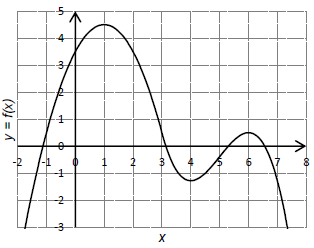
A respeito da função representada no gráfico ao lado, considere as seguintes afirmativas:
1. A função é crescente no intervalo aberto (4,6).
2. A função tem um ponto de máximo em x=1.
3. Esse gráfico representa uma função injetora.
4. Esse gráfico representa uma função polinomial de terceiro grau.
Assinale a alternativa correta.

 Conheça nossos planos