Questões Militares
Para pm-pr
Foram encontradas 865 questões
Resolva questões gratuitamente!
Junte-se a mais de 4 milhões de concurseiros!


Q949294
Química
O níquel é empregado na indústria como catalisador de diversas reações, como
na reação de reforma do etileno glicol, que produz hidrogênio a ser utilizado
como combustível. O processo ocorre num tempo muito menor quando é
utilizado 1 g de níquel em uma forma porosa desse material, em comparação à
reação utilizando uma única peça cúbica de 1 g de níquel. Abaixo está
esquematizada a equação de reforma do etileno glicol e uma imagem de
microscopia eletrônica de uma amostra de níquel na forma porosa.


Nas condições mencionadas, a reação de reforma ocorre num tempo menor quando usado o níquel poroso porque:
Nas condições mencionadas, a reação de reforma ocorre num tempo menor quando usado o níquel poroso porque:
Q949293
Química
A usina de energia de Hellisheidi, na Islândia, vem
testando um novo método para combater o
aquecimento global: transformar o gás carbônico
(CO2) em pedra. O processo ocorre em duas etapas:
primeiro o CO2 é dissolvido em água em altas
pressões (25 bar) e depois injetado no solo numa
temperatura de 230 oC. A mineralização do gás
carbônico ocorre de maneira rápida, devido à
reatividade e composição do solo da região, rica em
ferro, cálcio e magnésio. As duas etapas da remoção
de CO2 estão esquematizadas de maneira simplificada
ao lado.
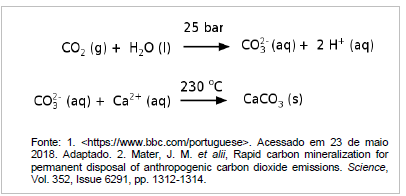
A remoção desse gás da atmosfera ocorre por:
A remoção desse gás da atmosfera ocorre por:
Q949292
Química
Nos relógios mostrados a seguir, as posições, que são originalmente ocupadas por números, foram substituídas por
símbolos de elementos químicos, cujos números atômicos correspondem ao numeral original do relógio. Considere
que o ponteiro menor (das horas) aponta para o ânion mais estável do elemento e o ponteiro maior (dos minutos)
aponta para o cátion mais estável do elemento:
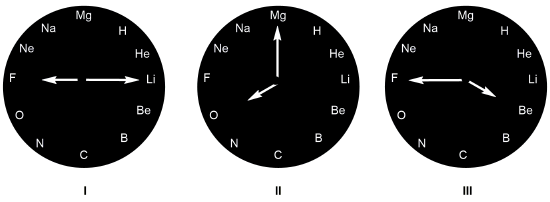
As substâncias neutras formadas a partir da leitura das horas marcadas nos relógios I, II e III são, respectivamente:
As substâncias neutras formadas a partir da leitura das horas marcadas nos relógios I, II e III são, respectivamente:
Q949291
História
Em 5 de outubro de 1988 foi promulgada a Constituição que se encontra em vigência no Brasil. A respeito da história
da construção e da aplicação dessa Constituição, considere as seguintes afirmativas:
1. Essa Constituição ampliou os direitos civis, políticos e sociais, tais como a previdência social, a proteção à maternidade e à infância e a garantia ao acesso universal à educação e à saúde. 2. Após 30 anos da promulgação dessa constituição, comemora-se o cumprimento do item III do artigo 3º da Constituição: “erradicar a pobreza e a marginalização e reduzir as desigualdades sociais e regionais”. 3. Essa Constituição foi elaborada por uma Assembleia Nacional Constituinte eleita por voto indireto em colégio eleitoral, por conta da rejeição da emenda das “Diretas Já” pelo Congresso Nacional. 4. Essa Constituição foi elaborada com a finalidade de romper com o período da ditadura civil-militar (1964-1985) e atender ao processo de redemocratização.
Assinale a alternativa correta.
1. Essa Constituição ampliou os direitos civis, políticos e sociais, tais como a previdência social, a proteção à maternidade e à infância e a garantia ao acesso universal à educação e à saúde. 2. Após 30 anos da promulgação dessa constituição, comemora-se o cumprimento do item III do artigo 3º da Constituição: “erradicar a pobreza e a marginalização e reduzir as desigualdades sociais e regionais”. 3. Essa Constituição foi elaborada por uma Assembleia Nacional Constituinte eleita por voto indireto em colégio eleitoral, por conta da rejeição da emenda das “Diretas Já” pelo Congresso Nacional. 4. Essa Constituição foi elaborada com a finalidade de romper com o período da ditadura civil-militar (1964-1985) e atender ao processo de redemocratização.
Assinale a alternativa correta.
Q949290
História
Considere o excerto abaixo sobre o livro Utopia, do escritor inglês Thomas Morus (1478-1535), lançado entre 1516 e
1518:
[...] Em sua obra Utopia, Morus descreve a vida numa ilha em formato de lua crescente, na qual tudo é dividido de maneira equânime entre as pessoas, onde não existe injustiça e violência e se vive confortavelmente. [...] na ilha de Utopia, o problema da exclusão social, tema candente de seu tempo, [...] seria resolvido de uma vez por todas. E de que maneira? Pela aplicação de todos ao trabalho [...]”. (LOPES, M. A. Uma História da ideia de utopia: o real e o imaginário no pensamento político de Thomas Morus. História: Questões & Debates, Curitiba, n. 40, 2004, p. 141-142.)
A partir do trecho acima e dos conhecimentos sobre o início da Idade Moderna (1453-1789), é correto afirmar que a obra de Morus pertenceu ao:
[...] Em sua obra Utopia, Morus descreve a vida numa ilha em formato de lua crescente, na qual tudo é dividido de maneira equânime entre as pessoas, onde não existe injustiça e violência e se vive confortavelmente. [...] na ilha de Utopia, o problema da exclusão social, tema candente de seu tempo, [...] seria resolvido de uma vez por todas. E de que maneira? Pela aplicação de todos ao trabalho [...]”. (LOPES, M. A. Uma História da ideia de utopia: o real e o imaginário no pensamento político de Thomas Morus. História: Questões & Debates, Curitiba, n. 40, 2004, p. 141-142.)
A partir do trecho acima e dos conhecimentos sobre o início da Idade Moderna (1453-1789), é correto afirmar que a obra de Morus pertenceu ao:
Q949289
Atualidades
A seleção de futebol da França, campeã da Copa de 2018, possui mais da metade dos seus jogadores de origem
africana e/ou árabe. Desde 1998, a seleção francesa é conhecida em seu país como equipe “black-blanc-beur” (negra,
branca e árabe). Uma razão histórica do aumento da diversidade étnica, racial e religiosa na Europa, presente nos dias
atuais é:
Q949288
História
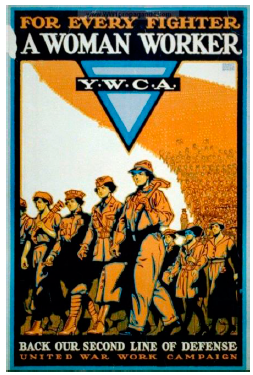
Considere o cartaz produzido durante a Primeira Guerra Mundial (1914-
1918), lançado em 1918 nos Estados Unidos pela Associação Cristã de
Moças (Y.W.C.A.). No cartaz está escrito: “Para cada soldado, uma
mulher trabalhadora – Apoie nossa segunda linha de defesa (Y.W.C.A.) –
Campanha para o Trabalho Unido da Guerra”.
Considerando esse documento, os conhecimentos sobre a Primeira
Guerra Mundial e sobre a condição das mulheres no mundo do trabalho
na virada do século XIX para o século XX, identifique como
verdadeiras (V) ou falsas (F) as seguintes afirmativas:
( ) A Primeira Guerra Mundial foi marcada por uso limitado de propaganda, dirigindo-se a setores específicos das sociedades em guerra para mobilizar seu apoio. ( ) Após o término da guerra, as mulheres que ocuparam os postos de trabalho foram incentivadas a deixá-los para que retomassem seus papéis de mãe e esposa. ( ) O cartaz demonstra uma realidade vivida pelos Estados Unidos, enquanto os demais países da Tríplice Entente não incentivaram o trabalho feminino. ( ) O trabalho feminino em indústrias e setor de serviços já era uma realidade conhecida antes da Primeira Guerra, em decorrência da Revolução Industrial.
Assinale a alternativa que apresenta a sequência correta, de cima para baixo.
( ) A Primeira Guerra Mundial foi marcada por uso limitado de propaganda, dirigindo-se a setores específicos das sociedades em guerra para mobilizar seu apoio. ( ) Após o término da guerra, as mulheres que ocuparam os postos de trabalho foram incentivadas a deixá-los para que retomassem seus papéis de mãe e esposa. ( ) O cartaz demonstra uma realidade vivida pelos Estados Unidos, enquanto os demais países da Tríplice Entente não incentivaram o trabalho feminino. ( ) O trabalho feminino em indústrias e setor de serviços já era uma realidade conhecida antes da Primeira Guerra, em decorrência da Revolução Industrial.
Assinale a alternativa que apresenta a sequência correta, de cima para baixo.
Q949287
História
Leia o trecho abaixo, retirado de uma carta escrita entre 830 e 840 pelo aristocrata franco Eginhardo, em favor de
camponeses:
Ao nosso mui querido amigo, o glorioso conde Hatton, Eginhardo, saudação eterna do Senhor. Um dos vossos servos, de nome Huno, veio à igreja dos santos mártires Marcelino e Pedro pedir mercê* pela falta que cometeu contraindo casamento sem o vosso consentimento [...]. Vimos, pois, solicitar a vossa bondade para que em nosso favor useis de indulgência em relação a este homem, se julgais que a sua falta pode ser perdoada. Desejo-vos boa saúde com a graça do Senhor. ((Cartas de Eginhardo. Tradução de Ricardo da Costa. Extratos de documentos medievais sobre o campesinato (sécs. V-XV). Disponível em: <https://www.ricardocosta.com/extratos-de-documentos-medievais-sobre-o-campesinato-secs-v-xv#footnoteref19_nuc8key>. Acesso em 11 de agosto de 2018.) *pedir mercê = pedir intercessão
No extrato acima, encontramos elementos da vida social e econômica do período medieval europeu (Alta Idade Média). Esse documento insere-se em qual sistema social, político e econômico predominante nesse contexto?
Ao nosso mui querido amigo, o glorioso conde Hatton, Eginhardo, saudação eterna do Senhor. Um dos vossos servos, de nome Huno, veio à igreja dos santos mártires Marcelino e Pedro pedir mercê* pela falta que cometeu contraindo casamento sem o vosso consentimento [...]. Vimos, pois, solicitar a vossa bondade para que em nosso favor useis de indulgência em relação a este homem, se julgais que a sua falta pode ser perdoada. Desejo-vos boa saúde com a graça do Senhor. ((Cartas de Eginhardo. Tradução de Ricardo da Costa. Extratos de documentos medievais sobre o campesinato (sécs. V-XV). Disponível em: <https://www.ricardocosta.com/extratos-de-documentos-medievais-sobre-o-campesinato-secs-v-xv#footnoteref19_nuc8key>. Acesso em 11 de agosto de 2018.) *pedir mercê = pedir intercessão
No extrato acima, encontramos elementos da vida social e econômica do período medieval europeu (Alta Idade Média). Esse documento insere-se em qual sistema social, político e econômico predominante nesse contexto?
Q949286
História
Leia o trecho abaixo, escrito por Agostinho de Hipona (354-430) em 410, sobre a devastação de Roma:
Não, irmãos, não nego o que ocorreu em Roma. Coisas horríveis nos são anunciadas: devastação, incêndios, rapinas, mortes e tormentos de homens. É verdade. Ouvimos muitos relatos, gememos e muito choramos por tudo isso, não podemos consolarnos ante tantas desgraças que se abateram sobre a cidade. (Santo Agostinho. Sermão sobre a devastação de Roma. Tradução de Jean Lauand. Disponível em: <http://www.hottopos.com/mp5/agostinho1.htm#_ftn2>. Acesso em 11 de agosto de 2018.)
Considerando os conhecimentos sobre a história do Império Romano (27 a.C. – 476 d.C.) e as informações do trecho acima, assinale a alternativa que situa o contexto histórico em que ocorreram os problemas relatados sobre Roma e a sua consequência para o Império, entre os séculos IV e V.
Não, irmãos, não nego o que ocorreu em Roma. Coisas horríveis nos são anunciadas: devastação, incêndios, rapinas, mortes e tormentos de homens. É verdade. Ouvimos muitos relatos, gememos e muito choramos por tudo isso, não podemos consolarnos ante tantas desgraças que se abateram sobre a cidade. (Santo Agostinho. Sermão sobre a devastação de Roma. Tradução de Jean Lauand. Disponível em: <http://www.hottopos.com/mp5/agostinho1.htm#_ftn2>. Acesso em 11 de agosto de 2018.)
Considerando os conhecimentos sobre a história do Império Romano (27 a.C. – 476 d.C.) e as informações do trecho acima, assinale a alternativa que situa o contexto histórico em que ocorreram os problemas relatados sobre Roma e a sua consequência para o Império, entre os séculos IV e V.
Q949285
História
O ano de 1968 foi um período de tensões sociais e políticas em diferentes partes do mundo. A respeito de alguns
desses movimentos históricos, identifique como verdadeiras (V) ou falsas (F) as seguintes afirmativas:
( ) No Brasil, houve a promulgação do Ato Institucional nº 5 pela ditadura civil-militar, aumentando a repressão a grupos considerados subversivos ou comunistas pelos governantes. ( ) Na Tchecoslováquia, houve a Primavera de Praga, que foi a Reforma do Capitalismo com a ajuda do Bloco Europeu Ocidental. ( ) Na França, houve mobilização de trabalhadores em greves por ampliação de salários e direitos, além da contestação de jovens estudantes contra o autoritarismo no ensino e a ordem vigente. ( ) Nos Estados Unidos, aumentaram as tensões raciais entre negros e brancos com o assassinato do ativista Martin Luther King Jr.
Assinale a alternativa que apresenta a sequência correta, de cima para baixo.
( ) No Brasil, houve a promulgação do Ato Institucional nº 5 pela ditadura civil-militar, aumentando a repressão a grupos considerados subversivos ou comunistas pelos governantes. ( ) Na Tchecoslováquia, houve a Primavera de Praga, que foi a Reforma do Capitalismo com a ajuda do Bloco Europeu Ocidental. ( ) Na França, houve mobilização de trabalhadores em greves por ampliação de salários e direitos, além da contestação de jovens estudantes contra o autoritarismo no ensino e a ordem vigente. ( ) Nos Estados Unidos, aumentaram as tensões raciais entre negros e brancos com o assassinato do ativista Martin Luther King Jr.
Assinale a alternativa que apresenta a sequência correta, de cima para baixo.
Q949284
História
Atualmente, no Brasil, as eleições para os representantes do povo nos poderes legislativo e executivo são decididas
pelo voto obrigatório, direto, secreto e universal. Sobre as eleições e os direitos políticos em nosso território, desde o
período colonial até o século XX, considere as seguintes afirmativas:
1. No período do Império (1822-1889), com a Constituição de 1824, para escolha de representantes políticos legislativos, os homens de todos os grupos sociais podiam votar. 2. No início da República (1891), foi instituído o voto a descoberto, que podia ser conhecido ou declarado, e logo foi apelidado de “voto de cabresto”. 3. Após mobilização do movimento sufragista feminino no início do século XX, as mulheres receberam o direito de votar a partir de 1932. 4. Com o Estado Novo em 1937, as eleições diretas para presidente foram mantidas, por meio de voto censitário.
Assinale a alternativa correta.
1. No período do Império (1822-1889), com a Constituição de 1824, para escolha de representantes políticos legislativos, os homens de todos os grupos sociais podiam votar. 2. No início da República (1891), foi instituído o voto a descoberto, que podia ser conhecido ou declarado, e logo foi apelidado de “voto de cabresto”. 3. Após mobilização do movimento sufragista feminino no início do século XX, as mulheres receberam o direito de votar a partir de 1932. 4. Com o Estado Novo em 1937, as eleições diretas para presidente foram mantidas, por meio de voto censitário.
Assinale a alternativa correta.
Q949283
História
No preâmbulo da Declaração Universal dos Direitos Humanos, lê-se:
“[...] Considerando que o desconhecimento e o desprezo dos direitos do Homem conduziram a atos de barbárie que revoltam a consciência da Humanidade e que o advento de um mundo em que os seres humanos sejam livres de falar e de crer, libertos do terror e da miséria, foi proclamado como a mais alta inspiração do Homem [...]”. (grifo nosso)
A partir dos conhecimentos sobre o contexto histórico dessa declaração, assinale a alternativa que indica os eventos históricos em que ocorreram “atos de barbárie” no século XX, antes da publicação desse documento e que tiveram impacto na sua elaboração.
“[...] Considerando que o desconhecimento e o desprezo dos direitos do Homem conduziram a atos de barbárie que revoltam a consciência da Humanidade e que o advento de um mundo em que os seres humanos sejam livres de falar e de crer, libertos do terror e da miséria, foi proclamado como a mais alta inspiração do Homem [...]”. (grifo nosso)
A partir dos conhecimentos sobre o contexto histórico dessa declaração, assinale a alternativa que indica os eventos históricos em que ocorreram “atos de barbárie” no século XX, antes da publicação desse documento e que tiveram impacto na sua elaboração.
Q1623387
Inglês
Texto associado
Britain bans gasoline and diesel cars starting in 2040
Britain will ban sales of new gasoline and diesel cars starting in 2040 as part of a bid to clean up the country’s air. The decision
to phase out the internal combustion engine heralds a new era of low-emission technologies with major implications for the auto
industry, society and the environment. “We can’t carry on with diesel and petrol cars”, U.K. environment secretary Michael Gove told
the BBC on Wednesday. “There is no alternative to embracing new technology”. Almost 2.7 million new cars were registered in the
U.K. in 2016, making it the second biggest market in Europe after Germany.
Meeting the 2040 deadline will be a heavy lift. British demand for electric and fuel cell cars, as well as plug-in hybrids, grew 40%
in 2015, but they only accounted for less than 3% of the market. Still, experts say sales of clean cars are likely to continue on their
dramatic upward trajectory.
The car industry says that demand for electric vehicles will only reach a tipping point once they're cheaper to own than
conventional vehicles.
The deadline was announced by the government on Wednesday as part of a plan to reduce air pollution. The blueprint
highlighted roughly £1.4 billion in government investment designed to help ensure that every vehicle on the road in Britain produces
zero emissions by 2050.
Gove said action was needed because gasoline and diesel engines contribute to health problems, “accelerate climate change,
do damage to the planet and the next generation”. Roughly 40,000 deaths in Britain each year are attributable to outdoor air pollution,
according to a study published last year by the Royal College of Physicians. Dirty air has been linked to cancer, asthma, stroke and
heart disease, among other health issues.
The problem is especially pronounced in big cities. London surpassed the European Union’s annual limit for nitrogen dioxide
exposure just five days into the new year, according to King’s College. The university estimates that air pollution is responsible for
9,400 premature deaths in the city every year.
The timeline for ending sales of internal combustion engines mirrors one proposed in early July by France. President Emmanuel
Macron has given the auto industry the same deadline to make the switch to cleaner tech.
“We are quite rightly in a position of global leadership when it comes to shaping new technology”, Gove said. But the auto
industry, which supports over 800,000 jobs in the U.K., is wary of hard deadlines.
Other countries have been even more ambitious than the U.K. India is planning to stop selling gas-powered vehicles by 2030.
The German car industry and government officials will meet in early August to discuss the future of diesel engine technology.
Manufacturers are trying to avoid diesel cars being banned from German towns and cities.
Consider the following excerpt taken from the text:
British demand for electric and fuel cell cars, as well as plug-in hybrids, grew 40% in 2015, but they only accounted for less than 3% of the market.
Choose the alternative that conveys the same meaning of the excerpt above.
British demand for electric and fuel cell cars, as well as plug-in hybrids, grew 40% in 2015, but they only accounted for less than 3% of the market.
Choose the alternative that conveys the same meaning of the excerpt above.
Q1623386
Inglês
Texto associado
Britain bans gasoline and diesel cars starting in 2040
Britain will ban sales of new gasoline and diesel cars starting in 2040 as part of a bid to clean up the country’s air. The decision
to phase out the internal combustion engine heralds a new era of low-emission technologies with major implications for the auto
industry, society and the environment. “We can’t carry on with diesel and petrol cars”, U.K. environment secretary Michael Gove told
the BBC on Wednesday. “There is no alternative to embracing new technology”. Almost 2.7 million new cars were registered in the
U.K. in 2016, making it the second biggest market in Europe after Germany.
Meeting the 2040 deadline will be a heavy lift. British demand for electric and fuel cell cars, as well as plug-in hybrids, grew 40%
in 2015, but they only accounted for less than 3% of the market. Still, experts say sales of clean cars are likely to continue on their
dramatic upward trajectory.
The car industry says that demand for electric vehicles will only reach a tipping point once they're cheaper to own than
conventional vehicles.
The deadline was announced by the government on Wednesday as part of a plan to reduce air pollution. The blueprint
highlighted roughly £1.4 billion in government investment designed to help ensure that every vehicle on the road in Britain produces
zero emissions by 2050.
Gove said action was needed because gasoline and diesel engines contribute to health problems, “accelerate climate change,
do damage to the planet and the next generation”. Roughly 40,000 deaths in Britain each year are attributable to outdoor air pollution,
according to a study published last year by the Royal College of Physicians. Dirty air has been linked to cancer, asthma, stroke and
heart disease, among other health issues.
The problem is especially pronounced in big cities. London surpassed the European Union’s annual limit for nitrogen dioxide
exposure just five days into the new year, according to King’s College. The university estimates that air pollution is responsible for
9,400 premature deaths in the city every year.
The timeline for ending sales of internal combustion engines mirrors one proposed in early July by France. President Emmanuel
Macron has given the auto industry the same deadline to make the switch to cleaner tech.
“We are quite rightly in a position of global leadership when it comes to shaping new technology”, Gove said. But the auto
industry, which supports over 800,000 jobs in the U.K., is wary of hard deadlines.
Other countries have been even more ambitious than the U.K. India is planning to stop selling gas-powered vehicles by 2030.
The German car industry and government officials will meet in early August to discuss the future of diesel engine technology.
Manufacturers are trying to avoid diesel cars being banned from German towns and cities.
Com base no texto, considere as seguintes afirmativas:
1. No primeiro parágrafo, a palavra em negrito e sublinhada (“it”) refere-se ao Reino Unido.
2. No segundo parágrafo, a palavra em negrito e sublinhada (“they”) refere-se a “electric, fuel cell and pug-in hybrid cars”.
3. No terceiro parágrafo, a palavra em negrito e sublinhada (“they”) refere-se a “conventional vehicles”.
4. No oitavo parágrafo, a palavra “we” em negrito e sublinhada refere-se ao governo da França.
Assinale a alternativa correta.
1. No primeiro parágrafo, a palavra em negrito e sublinhada (“it”) refere-se ao Reino Unido.
2. No segundo parágrafo, a palavra em negrito e sublinhada (“they”) refere-se a “electric, fuel cell and pug-in hybrid cars”.
3. No terceiro parágrafo, a palavra em negrito e sublinhada (“they”) refere-se a “conventional vehicles”.
4. No oitavo parágrafo, a palavra “we” em negrito e sublinhada refere-se ao governo da França.
Assinale a alternativa correta.
Q1623385
Inglês
Texto associado
Britain bans gasoline and diesel cars starting in 2040
Britain will ban sales of new gasoline and diesel cars starting in 2040 as part of a bid to clean up the country’s air. The decision
to phase out the internal combustion engine heralds a new era of low-emission technologies with major implications for the auto
industry, society and the environment. “We can’t carry on with diesel and petrol cars”, U.K. environment secretary Michael Gove told
the BBC on Wednesday. “There is no alternative to embracing new technology”. Almost 2.7 million new cars were registered in the
U.K. in 2016, making it the second biggest market in Europe after Germany.
Meeting the 2040 deadline will be a heavy lift. British demand for electric and fuel cell cars, as well as plug-in hybrids, grew 40%
in 2015, but they only accounted for less than 3% of the market. Still, experts say sales of clean cars are likely to continue on their
dramatic upward trajectory.
The car industry says that demand for electric vehicles will only reach a tipping point once they're cheaper to own than
conventional vehicles.
The deadline was announced by the government on Wednesday as part of a plan to reduce air pollution. The blueprint
highlighted roughly £1.4 billion in government investment designed to help ensure that every vehicle on the road in Britain produces
zero emissions by 2050.
Gove said action was needed because gasoline and diesel engines contribute to health problems, “accelerate climate change,
do damage to the planet and the next generation”. Roughly 40,000 deaths in Britain each year are attributable to outdoor air pollution,
according to a study published last year by the Royal College of Physicians. Dirty air has been linked to cancer, asthma, stroke and
heart disease, among other health issues.
The problem is especially pronounced in big cities. London surpassed the European Union’s annual limit for nitrogen dioxide
exposure just five days into the new year, according to King’s College. The university estimates that air pollution is responsible for
9,400 premature deaths in the city every year.
The timeline for ending sales of internal combustion engines mirrors one proposed in early July by France. President Emmanuel
Macron has given the auto industry the same deadline to make the switch to cleaner tech.
“We are quite rightly in a position of global leadership when it comes to shaping new technology”, Gove said. But the auto
industry, which supports over 800,000 jobs in the U.K., is wary of hard deadlines.
Other countries have been even more ambitious than the U.K. India is planning to stop selling gas-powered vehicles by 2030.
The German car industry and government officials will meet in early August to discuss the future of diesel engine technology.
Manufacturers are trying to avoid diesel cars being banned from German towns and cities.
The main idea of the text is related to:
Q1623384
Inglês
Texto associado
Britain bans gasoline and diesel cars starting in 2040
Britain will ban sales of new gasoline and diesel cars starting in 2040 as part of a bid to clean up the country’s air. The decision
to phase out the internal combustion engine heralds a new era of low-emission technologies with major implications for the auto
industry, society and the environment. “We can’t carry on with diesel and petrol cars”, U.K. environment secretary Michael Gove told
the BBC on Wednesday. “There is no alternative to embracing new technology”. Almost 2.7 million new cars were registered in the
U.K. in 2016, making it the second biggest market in Europe after Germany.
Meeting the 2040 deadline will be a heavy lift. British demand for electric and fuel cell cars, as well as plug-in hybrids, grew 40%
in 2015, but they only accounted for less than 3% of the market. Still, experts say sales of clean cars are likely to continue on their
dramatic upward trajectory.
The car industry says that demand for electric vehicles will only reach a tipping point once they're cheaper to own than
conventional vehicles.
The deadline was announced by the government on Wednesday as part of a plan to reduce air pollution. The blueprint
highlighted roughly £1.4 billion in government investment designed to help ensure that every vehicle on the road in Britain produces
zero emissions by 2050.
Gove said action was needed because gasoline and diesel engines contribute to health problems, “accelerate climate change,
do damage to the planet and the next generation”. Roughly 40,000 deaths in Britain each year are attributable to outdoor air pollution,
according to a study published last year by the Royal College of Physicians. Dirty air has been linked to cancer, asthma, stroke and
heart disease, among other health issues.
The problem is especially pronounced in big cities. London surpassed the European Union’s annual limit for nitrogen dioxide
exposure just five days into the new year, according to King’s College. The university estimates that air pollution is responsible for
9,400 premature deaths in the city every year.
The timeline for ending sales of internal combustion engines mirrors one proposed in early July by France. President Emmanuel
Macron has given the auto industry the same deadline to make the switch to cleaner tech.
“We are quite rightly in a position of global leadership when it comes to shaping new technology”, Gove said. But the auto
industry, which supports over 800,000 jobs in the U.K., is wary of hard deadlines.
Other countries have been even more ambitious than the U.K. India is planning to stop selling gas-powered vehicles by 2030.
The German car industry and government officials will meet in early August to discuss the future of diesel engine technology.
Manufacturers are trying to avoid diesel cars being banned from German towns and cities.
According to the text, choose the correct alternative.
Q1623383
Inglês
Texto associado
Britain bans gasoline and diesel cars starting in 2040
Britain will ban sales of new gasoline and diesel cars starting in 2040 as part of a bid to clean up the country’s air. The decision
to phase out the internal combustion engine heralds a new era of low-emission technologies with major implications for the auto
industry, society and the environment. “We can’t carry on with diesel and petrol cars”, U.K. environment secretary Michael Gove told
the BBC on Wednesday. “There is no alternative to embracing new technology”. Almost 2.7 million new cars were registered in the
U.K. in 2016, making it the second biggest market in Europe after Germany.
Meeting the 2040 deadline will be a heavy lift. British demand for electric and fuel cell cars, as well as plug-in hybrids, grew 40%
in 2015, but they only accounted for less than 3% of the market. Still, experts say sales of clean cars are likely to continue on their
dramatic upward trajectory.
The car industry says that demand for electric vehicles will only reach a tipping point once they're cheaper to own than
conventional vehicles.
The deadline was announced by the government on Wednesday as part of a plan to reduce air pollution. The blueprint
highlighted roughly £1.4 billion in government investment designed to help ensure that every vehicle on the road in Britain produces
zero emissions by 2050.
Gove said action was needed because gasoline and diesel engines contribute to health problems, “accelerate climate change,
do damage to the planet and the next generation”. Roughly 40,000 deaths in Britain each year are attributable to outdoor air pollution,
according to a study published last year by the Royal College of Physicians. Dirty air has been linked to cancer, asthma, stroke and
heart disease, among other health issues.
The problem is especially pronounced in big cities. London surpassed the European Union’s annual limit for nitrogen dioxide
exposure just five days into the new year, according to King’s College. The university estimates that air pollution is responsible for
9,400 premature deaths in the city every year.
The timeline for ending sales of internal combustion engines mirrors one proposed in early July by France. President Emmanuel
Macron has given the auto industry the same deadline to make the switch to cleaner tech.
“We are quite rightly in a position of global leadership when it comes to shaping new technology”, Gove said. But the auto
industry, which supports over 800,000 jobs in the U.K., is wary of hard deadlines.
Other countries have been even more ambitious than the U.K. India is planning to stop selling gas-powered vehicles by 2030.
The German car industry and government officials will meet in early August to discuss the future of diesel engine technology.
Manufacturers are trying to avoid diesel cars being banned from German towns and cities.
Consider the following numbers:
1. 2.7 million new clean energy cars were registered in the U.K. in 2016.
2. 40,000 of British deaths yearly are said to be caused by pollution related diseases.
3. Car industry in Britain is cautious about having specific dates for banning internal combustion energy cars because it supports over 800.000 jobs in the UK.
Mark the correct alternative.
Q1623382
Inglês
Consider the following excerpt:
Difficulty interpreting what I have come to call ‘Ahorita Time’ is a reflection of different cultural understandings of time. Dr Company explained that if she is giving a talk in Mexico and goes over her allotted time, Mexicans “feel like I am giving them a gift”. In the UK or the US, however, “The audience starts to leave, feeling like I am wasting their time”.
Choose the alternative that conveys the same meaning of the excerpt above.
Difficulty interpreting what I have come to call ‘Ahorita Time’ is a reflection of different cultural understandings of time. Dr Company explained that if she is giving a talk in Mexico and goes over her allotted time, Mexicans “feel like I am giving them a gift”. In the UK or the US, however, “The audience starts to leave, feeling like I am wasting their time”.
Choose the alternative that conveys the same meaning of the excerpt above.
Q1623381
Inglês
Texto associado
The ways Mexicans tell time
Understanding this takes not a fluency in the language but rather a fluency in Mexican culture.
Mexicans are famous in the Spanish-speaking world for their extensive use of the diminutive. While in most Spanish-speaking
countries the addition of the diminutive ‘ita’ to an adverb like ahora (meaning ‘now’) would strengthen it to indicate immediacy (i.e.
‘right now’), this is not the case in Mexico. Dr Company explained that Mexicans instead use the diminutive form to break down the
space between the speaker and the listener and lessen formality. In this case of ‘ahorita’, the addition of the diminutive reduces
urgency rather than increasing it – a difference that can be extremely confusing for foreigners.
(Disponível: <http://www.bbc.com/travel/story/20170725-the-confusing-way-mexicans-tell-time>. Adaptado. Acesso: 26 de julho de 2017.)
The text illustrates:
Q1623380
Inglês
Texto associado
The ways Mexicans tell time
Understanding this takes not a fluency in the language but rather a fluency in Mexican culture.
Mexicans are famous in the Spanish-speaking world for their extensive use of the diminutive. While in most Spanish-speaking
countries the addition of the diminutive ‘ita’ to an adverb like ahora (meaning ‘now’) would strengthen it to indicate immediacy (i.e.
‘right now’), this is not the case in Mexico. Dr Company explained that Mexicans instead use the diminutive form to break down the
space between the speaker and the listener and lessen formality. In this case of ‘ahorita’, the addition of the diminutive reduces
urgency rather than increasing it – a difference that can be extremely confusing for foreigners.
(Disponível: <http://www.bbc.com/travel/story/20170725-the-confusing-way-mexicans-tell-time>. Adaptado. Acesso: 26 de julho de 2017.)
Consider the following affirmatives:
1. The use of the diminutive in Mexico does not follow the same rules for other Spanish speaking countries.
2. Dr Company says that Mexicans use ‘ahorita’ to indicate immediacy.
3. The use of the diminutive in Mexico indicates more proximity between speaker and listener.
4. The ‘ahorita’ example indicates the particular way Mexicans have adapted language to their cultural patterns.
Choose the correct alternative.
1. The use of the diminutive in Mexico does not follow the same rules for other Spanish speaking countries.
2. Dr Company says that Mexicans use ‘ahorita’ to indicate immediacy.
3. The use of the diminutive in Mexico indicates more proximity between speaker and listener.
4. The ‘ahorita’ example indicates the particular way Mexicans have adapted language to their cultural patterns.
Choose the correct alternative.

 Conheça nossos planos