Questões Militares Sobre inglês
Foram encontradas 4.500 questões


Read the comic strip:
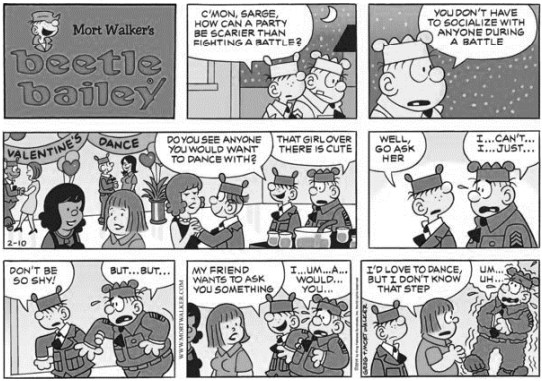
WALKER, M.; WALKER, G. Beetle Bailey. Disponível em: https://www.arcamax.com. Acesso em: 03 set. 2024.
The sentence “That girl over there is cute” shows an example of a feminine noun. Choose the option that correctly shows masculine and feminine equivalent nouns.
I) The preposition “from” in the second paragraph indicates origin or source. ( )
II) The preposition “in” in the second paragraph is also used for cities and countries. ( )
III) The preposition “on” in the second paragraph is also used for seasons and months. ( )
IV) The preposition “in” in the fourth paragraph is also used for days of the week. ( )
V) The fragment “depends on” in the third paragraph could correctly be replaced with “depends of”. ( )
I – All of the fragments in uppercase letters are examples of the Simple Past tense.
II – All of the fragments in uppercase letters refer to past actions in some way.
III – In “have initiated”, the verb tense refers to a recent action at the time the news was written.
IV – None of the fragments in uppercase letters contain a past participle form.
V – The verb “created” is used in this verb tense because it refers to a past action in a specific time.
NCO Academy student: Good morning, Sir
Sergeant Major: Why are you awake in uniform so early? Today is your day off. You can ___(sleep)___ until seven o’clock today. It’s worth ___(stay)___ in bed a little longer to recover from the exhausting week.
NCO Academy student: I enjoy ___(learn)___ foreign languages, so I woke up early ___(study)___ English.
Sergeant Major: I’m really proud of ___(see)___ you working so hard.
“The NCO Academy students ___A___ march ___B___ ___C___ ___D___ ___E___.”
Adverbs:
1. on the parade ground
2. proudly
3. on Independence Day
4. very
5. always
Now the platoon commander of No 3 Platoon is briefing his section commanders:
‘Pay attention and take notes. The Company Commander is not happy with the standard of map reading. So, next Tuesday, 26th October, the whole platoon is going out on a 24-hour exercise, Exercise "Hot Foot". The aim of the exercise is to give the platoon practice in compass marching across country. You will move by day and night. The dress for the exercise will be fighting order. You will not carry weapons and ammunition. You are to draw combat rations for your sections from the stores. Do this at 1600 hours on Monday 25th October. Individuals will be responsible for their own meals during the exercise. Each man is to take a protractor, a compass, map sheet 175, map-case, torch and chinagraph pencils. You are responsible for checking this. The platoon is to parade outside the guardroom at 0730 hours on Tuesday 26th October. We shall travel to the exercise area by 4-tonner but we shall march back to camp. Estimated time of return to camp will be 1030 hours on Wednesday 27th October. Make sure you brief your sections. Right, that's all. Any questions?’
ARNOLD, James & SACCO; Robert. Command English: a course in military English.1ª ed. London: Longman ELT, 1988. p. 62-63.
Which option has the correct statement about what is going on in the comic strip?
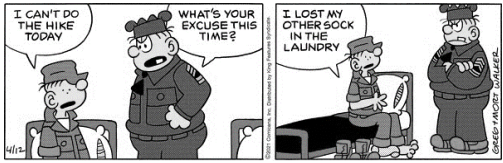
WALKER, M.; WALKER, G. Recruta Zero. Disponível em: https://www.arcamax.com/thefunnies/beetlebailey/. Acesso em: 25 jul. 2024.
Read the text about soccer in Brazil and choose the false statement.
Soccer is the national sport of Brazil. The Brazilian passion for the game leads many observers to describe it as more of a religion than a sport for Brazilians. Intense and often fanatical support of the national team is a force that serves to bridge Brazil's ethnic and class divisions. Its national team is the only team that has played in all nineteen World Cup competitions, the sport's highest level of international play that are held every four years. Brazil is also the only team to win the tournament five times. Males of all classes and backgrounds play soccer. Its popularity stems partly from its limited equipment demands. The poorest of youth play in the streets because soccer requires just a ball (or even a makeshift ball) and some open space. Peladas, or pick-up games, are common occurrences, especially on Sundays. For spectators, national team games draw the attention of the entire nation. Work essentially halts while Brazilians gather to watch the game in homes, offices, bars, and other venues. Wins in international competition can lead to nationwide partying and parades; losses can lead to widespread disappointment and national debate concerning the team's performance and future.
Cultural Orientation: Portuguese-Brazil. Monterey: Defense Language Institute – Foreign Language Center, 2017. p. 45. https://fieldsupport.dliflc.edu/products/portuguese/pq_co/website/default.html?type=chapter%index=1&moduleID=0&taskID=0
Drill Sergeant Mendonça barked orders to the Signal Corps students like a mad dog. Today's training was (demanding) than yesterday's, pushing the will-be NCO’s to their limits. The Signal Corps students are sure they are the (smart) bunch in academic disciplines, but they also needed to excel in their physical training. Mendonça, (mean) as a rattlesnake, kept reminding them of the consequences of failing the fitness test.
The obstacle course was the (bad) of all the exercises. They climbed walls, slogged through mud, and crawled under barbed wire, sweating like pigs. By lunchtime, they were exhausted and (hungry) than wolves. Sergeant Mendonça, however, would not let us rest. "This is not a picnic, gentlemen!" he yelled. The NCO academy is not for the faint of heart in fact, but the students are determined to make it.
DETACHED SENTENCES
1. This firepower increases the Army's ability to engage in fight, provide fire support to ground forces, and suppress enemy positions effectively
2. This has proven instrumental in saving lives during natural disasters, assisting civil authorities in emergency situations, and supporting humanitarian missions
3. In summary, the Brazilian Army's adoption of the Sikorsky UH-60 Black Hawk helicopters has revolutionized its operational capabilities
4. This capability supports the Brazilian Army's tactical and logistical needs with rapid deployment of troops, equipment, and supplies to any location across the country, including remote and inaccessible areas
5. Brazil's vast and varied landscape encompasses dense jungles, rugged mountains, and extensive coastlines
THE BLACK HAWK IN THE BRAZILIAN ARMY AVIATION
The Brazilian Army has successfully incorporated the use of the Sikorsky UH-60 Black Hawk helicopters into its operations. This versatile aircraft has proven to be a game-changer, enhancing the Army's capabilities across various missions and improving the efficiency of its operations.
One of the key advantages of the Black Hawk is its ability to operate in diverse terrains and challenging conditions. ( ). The Black Hawk can navigate with its powerful engines through these different environments. The Black Hawk has demonstrated its agility in Brazil's diverse terrains performing close air support, troop transport, or search and rescue missions.
The helicopter's capacity to carry personnel and cargo is impressive. With its spacious cabin, the Black Hawk can transport 11 equipped soldiers or carry a payload of 2,600 kilograms. ( ).
Furthermore, the Black Hawk's advanced weapon systems and communication equipment enhance the Brazilian Army's combat capabilities. Armed variants of the helicopter can carry and deploy machine guns, rockets, and guided missiles. ( ). Moreover, the integration of modern communication systems ensures seamless coordination between the helicopter crew and ground units, improving situational awareness and mission success.
The use of Black Hawk helicopters has also significantly enhanced the Brazilian Army's search and rescue capabilities. Equipped with advanced sensor systems and night-vision technology, the aircraft can conduct rescue operations in adverse weather conditions, during night-time hours, and in remote areas, where traditional means are often insufficient. ( ).
( ). Its versatility, cargo capacity, firepower, and search and rescue capabilities have proved invaluable in a variety of missions. The Black Hawk's integration into the Army's fleet has strengthened its ability to defend the nation, support peacekeeping efforts, and effectively respond to threats and emergencies, making it an indispensable asset for the Brazilian military

 Conheça nossos planos