Questões Militares Sobre inglês
Foram encontradas 4.500 questões


Ano: 2025
Banca:
Marinha
Órgão:
ESCOLA NAVAL
Prova:
Marinha - 2025 - ESCOLA NAVAL - Aspirante - 1º Dia |
Q3736279
Inglês
Which is the correct option to complete the sentence
below?
Throughout ________ history, ________ narration has been ________ important form of communication, along with being vital in _________ human development.
(Adapted from https://www.skillshare.com)
Throughout ________ history, ________ narration has been ________ important form of communication, along with being vital in _________ human development.
(Adapted from https://www.skillshare.com)
Ano: 2025
Banca:
Marinha
Órgão:
ESCOLA NAVAL
Prova:
Marinha - 2025 - ESCOLA NAVAL - Aspirante - 1º Dia |
Q3736278
Inglês
Which option is grammatically correct?
Ano: 2025
Banca:
Marinha
Órgão:
ESCOLA NAVAL
Prova:
Marinha - 2025 - ESCOLA NAVAL - Aspirante - 1º Dia |
Q3736277
Inglês
Mark the option in which the word in parentheses replaces
the underlined word(s) correctly.
Ano: 2025
Banca:
Marinha
Órgão:
ESCOLA NAVAL
Prova:
Marinha - 2025 - ESCOLA NAVAL - Aspirante - 1º Dia |
Q3736276
Inglês
Read the sentence below.
Queen Elizabeth Il died in 2002.
Which option replaces the underlined verb correctly, without changing the meaning of the sentence?
Queen Elizabeth Il died in 2002.
Which option replaces the underlined verb correctly, without changing the meaning of the sentence?
Ano: 2025
Banca:
Marinha
Órgão:
ESCOLA NAVAL
Prova:
Marinha - 2025 - ESCOLA NAVAL - Aspirante - 1º Dia |
Q3736275
Inglês
Texto associado
TEXT II
Read the text below and answer question.
Chinese divers surrounded by sharks
Jan 03, 2025
[1] Nine Chinese individuals, including seven tourists and
two diving instructors, went missing while diving in Palau
on December 26.
[2] Experienced diving instructor Liu Xin and another diving
guide took seven Chinese tourists to dive on December 26
around 9:30 am. As the dive was coming to an end, Liu
sent a signal to the surface. Typically, after seeing the
signal, the captain would slowly maneuver the boat to
follow the divers, allowing them to board once they floated
off. __________ when they surfaced, they could not locate
the boat.
[3] They couid only float in the sea for nearly three hours,
believing that someone would come to rescue them, but
the ocean current changed direction, and they were swept
by currents into an area between two islands. At that point,
a new threat emerged. The underwater terrain shifted, and
the most physically fit diver among the nine felt as if he had
stepped on something. Liu looked down and noticed that a
bull shark was circling around his feet, along with six other
sharks nearby.
[4] Liu swiftly assembled everyone to make themselves
appear larger as most wild animals typically target
creatures that are smaller and tend to avoid approaching
larger groups. Fortunately, with Liu and the entire team
huddled together, the sharks refrained from acting
aggressively, and they avoided any danger.
[5] By evening, they had gone nearly 11 hours without
food. To conserve their energy, they used their diving
masks to collect rainwater and drank it to stay hydrated.
After spending too much time in the water, they started to
feel cold, so they used their buoyancy devices to hold each
other to stay together and preserve warmth. And, to
prevent falling asleep and risking hypothermia, they took
turns calling out their numbers every 30 minutes to stay
alert.
[6] After drifting in the water for about 27 hours, a rescue
boat located the nine individuals.
[7] "Alli nine Chinese citizens who went missing while diving
in Palau have been rescued and are reported to be in
stable condition", the Chinese Embassy in the Federated
States of Micronesia said on Friday.
[8] Liu said that the key reasons for their safe return
included the selfless assistance from fellow travelers, the
favorable ocean currents that kept them in proximity to
their initial location, and, most importantly, the excellent
physical condition and positive attitude of the group.
"Throughout those 20-plus hours, we maintained a lighthearted atmosphere, chatting and laughing without any
complaints," Liu said.
(Adapted from https://www.globaltimes.cn)
Mark the correct option according to text II.
Ano: 2025
Banca:
Marinha
Órgão:
ESCOLA NAVAL
Prova:
Marinha - 2025 - ESCOLA NAVAL - Aspirante - 1º Dia |
Q3736274
Inglês
Texto associado
TEXT II
Read the text below and answer question.
Chinese divers surrounded by sharks
Jan 03, 2025
[1] Nine Chinese individuals, including seven tourists and
two diving instructors, went missing while diving in Palau
on December 26.
[2] Experienced diving instructor Liu Xin and another diving
guide took seven Chinese tourists to dive on December 26
around 9:30 am. As the dive was coming to an end, Liu
sent a signal to the surface. Typically, after seeing the
signal, the captain would slowly maneuver the boat to
follow the divers, allowing them to board once they floated
off. __________ when they surfaced, they could not locate
the boat.
[3] They couid only float in the sea for nearly three hours,
believing that someone would come to rescue them, but
the ocean current changed direction, and they were swept
by currents into an area between two islands. At that point,
a new threat emerged. The underwater terrain shifted, and
the most physically fit diver among the nine felt as if he had
stepped on something. Liu looked down and noticed that a
bull shark was circling around his feet, along with six other
sharks nearby.
[4] Liu swiftly assembled everyone to make themselves
appear larger as most wild animals typically target
creatures that are smaller and tend to avoid approaching
larger groups. Fortunately, with Liu and the entire team
huddled together, the sharks refrained from acting
aggressively, and they avoided any danger.
[5] By evening, they had gone nearly 11 hours without
food. To conserve their energy, they used their diving
masks to collect rainwater and drank it to stay hydrated.
After spending too much time in the water, they started to
feel cold, so they used their buoyancy devices to hold each
other to stay together and preserve warmth. And, to
prevent falling asleep and risking hypothermia, they took
turns calling out their numbers every 30 minutes to stay
alert.
[6] After drifting in the water for about 27 hours, a rescue
boat located the nine individuals.
[7] "Alli nine Chinese citizens who went missing while diving
in Palau have been rescued and are reported to be in
stable condition", the Chinese Embassy in the Federated
States of Micronesia said on Friday.
[8] Liu said that the key reasons for their safe return
included the selfless assistance from fellow travelers, the
favorable ocean currents that kept them in proximity to
their initial location, and, most importantly, the excellent
physical condition and positive attitude of the group.
"Throughout those 20-plus hours, we maintained a lighthearted atmosphere, chatting and laughing without any
complaints," Liu said.
(Adapted from https://www.globaltimes.cn)
Mark the option that completes the following sentence from
text II correctly: ___________, when they surfaced, they
could not locate the boat." (paragraph 2).
Ano: 2025
Banca:
Marinha
Órgão:
ESCOLA NAVAL
Prova:
Marinha - 2025 - ESCOLA NAVAL - Aspirante - 1º Dia |
Q3736273
Inglês
Texto associado
TEXT II
Read the text below and answer question.
Chinese divers surrounded by sharks
Jan 03, 2025
[1] Nine Chinese individuals, including seven tourists and
two diving instructors, went missing while diving in Palau
on December 26.
[2] Experienced diving instructor Liu Xin and another diving
guide took seven Chinese tourists to dive on December 26
around 9:30 am. As the dive was coming to an end, Liu
sent a signal to the surface. Typically, after seeing the
signal, the captain would slowly maneuver the boat to
follow the divers, allowing them to board once they floated
off. __________ when they surfaced, they could not locate
the boat.
[3] They couid only float in the sea for nearly three hours,
believing that someone would come to rescue them, but
the ocean current changed direction, and they were swept
by currents into an area between two islands. At that point,
a new threat emerged. The underwater terrain shifted, and
the most physically fit diver among the nine felt as if he had
stepped on something. Liu looked down and noticed that a
bull shark was circling around his feet, along with six other
sharks nearby.
[4] Liu swiftly assembled everyone to make themselves
appear larger as most wild animals typically target
creatures that are smaller and tend to avoid approaching
larger groups. Fortunately, with Liu and the entire team
huddled together, the sharks refrained from acting
aggressively, and they avoided any danger.
[5] By evening, they had gone nearly 11 hours without
food. To conserve their energy, they used their diving
masks to collect rainwater and drank it to stay hydrated.
After spending too much time in the water, they started to
feel cold, so they used their buoyancy devices to hold each
other to stay together and preserve warmth. And, to
prevent falling asleep and risking hypothermia, they took
turns calling out their numbers every 30 minutes to stay
alert.
[6] After drifting in the water for about 27 hours, a rescue
boat located the nine individuals.
[7] "Alli nine Chinese citizens who went missing while diving
in Palau have been rescued and are reported to be in
stable condition", the Chinese Embassy in the Federated
States of Micronesia said on Friday.
[8] Liu said that the key reasons for their safe return
included the selfless assistance from fellow travelers, the
favorable ocean currents that kept them in proximity to
their initial location, and, most importantly, the excellent
physical condition and positive attitude of the group.
"Throughout those 20-plus hours, we maintained a lighthearted atmosphere, chatting and laughing without any
complaints," Liu said.
(Adapted from https://www.globaltimes.cn)
Decide if the statements below are true (T) or false (F)
according to text II. Then, mark the option that contains the
right sequence.
( ) The nine people who went missing were inexperienced divers.
( ) Despite the difficulties, the divers were able to collect and drink rainwater.
( ) The divers were surrounded by a dozen sharks.
( ) The sharks did not injure the divers.
( ) After about 27 hours, the divers were finally rescued by the captain of their boat.
( ) The nine people who went missing were inexperienced divers.
( ) Despite the difficulties, the divers were able to collect and drink rainwater.
( ) The divers were surrounded by a dozen sharks.
( ) The sharks did not injure the divers.
( ) After about 27 hours, the divers were finally rescued by the captain of their boat.
Ano: 2025
Banca:
Marinha
Órgão:
ESCOLA NAVAL
Prova:
Marinha - 2025 - ESCOLA NAVAL - Aspirante - 1º Dia |
Q3736272
Inglês
Texto associado
TEXT II
Read the text below and answer question.
Chinese divers surrounded by sharks
Jan 03, 2025
[1] Nine Chinese individuals, including seven tourists and
two diving instructors, went missing while diving in Palau
on December 26.
[2] Experienced diving instructor Liu Xin and another diving
guide took seven Chinese tourists to dive on December 26
around 9:30 am. As the dive was coming to an end, Liu
sent a signal to the surface. Typically, after seeing the
signal, the captain would slowly maneuver the boat to
follow the divers, allowing them to board once they floated
off. __________ when they surfaced, they could not locate
the boat.
[3] They couid only float in the sea for nearly three hours,
believing that someone would come to rescue them, but
the ocean current changed direction, and they were swept
by currents into an area between two islands. At that point,
a new threat emerged. The underwater terrain shifted, and
the most physically fit diver among the nine felt as if he had
stepped on something. Liu looked down and noticed that a
bull shark was circling around his feet, along with six other
sharks nearby.
[4] Liu swiftly assembled everyone to make themselves
appear larger as most wild animals typically target
creatures that are smaller and tend to avoid approaching
larger groups. Fortunately, with Liu and the entire team
huddled together, the sharks refrained from acting
aggressively, and they avoided any danger.
[5] By evening, they had gone nearly 11 hours without
food. To conserve their energy, they used their diving
masks to collect rainwater and drank it to stay hydrated.
After spending too much time in the water, they started to
feel cold, so they used their buoyancy devices to hold each
other to stay together and preserve warmth. And, to
prevent falling asleep and risking hypothermia, they took
turns calling out their numbers every 30 minutes to stay
alert.
[6] After drifting in the water for about 27 hours, a rescue
boat located the nine individuals.
[7] "Alli nine Chinese citizens who went missing while diving
in Palau have been rescued and are reported to be in
stable condition", the Chinese Embassy in the Federated
States of Micronesia said on Friday.
[8] Liu said that the key reasons for their safe return
included the selfless assistance from fellow travelers, the
favorable ocean currents that kept them in proximity to
their initial location, and, most importantly, the excellent
physical condition and positive attitude of the group.
"Throughout those 20-plus hours, we maintained a lighthearted atmosphere, chatting and laughing without any
complaints," Liu said.
(Adapted from https://www.globaltimes.cn)
The word "selfless" (paragraph 8) means:
Ano: 2025
Banca:
Marinha
Órgão:
ESCOLA NAVAL
Prova:
Marinha - 2025 - ESCOLA NAVAL - Aspirante - 1º Dia |
Q3736271
Inglês
Texto associado
TEXT I
Read the text below and answer question.
Is peanut butter a good source of protein? Nutrition
experts explain.
[1] Protein is the macronutrient du jour. Discussions about
nutrition online as of late are all about making sure you're
consuming enough protein every day.
[2] The Recommended Dietary Allowance (RDA) for
protein is currently 0.36 grams of protein per pound,
according to Harvard Health, or about 54 grams daily for a
person who weighs 150 pounds.
[3] But diet experts are increasingly pushing for consuming
higher amounts of protein: upwards of 60 to 90 grams
daily. Registered dietitian Jamie Nadeau previously told
USA TODAY that she recommends getting "at least 20
grams of protein per meal for satiety," though she notes
everyone has different needs.
[4] To what extent can peanut butter help you reach those
goals? Nutrition experts explain.
[5] A two-tablespoon serving of peanut butter contains
about 7 grams of protein, according to the U.S.
Department of Agriculture's (USDA) food database.
[6] That doesn't mean you shouldn't eat peanut butter -
experts say it just means peanut butter is meant to be a
small part of more well-rounded meals. Thomason
suggests pairing a serving of peanut butter with a carb,
protein and a fruit or vegetable. Some favorite combos
include peanut butter and an apple, peanut butter and
banana toast and a smoothie or oatmeal with peanut
butter.
[7] "Those things are going to help you balance it out and
not feel like it's easy to overeat,"she says.
[8] To hit that recommended 20-gram goal, you'd have to
eat about 6 tablespoons - nearly three servings of peanut
butter - which amounts to nearly 600 calories. While
experts say eating more than the serving size isn't harmful,
per se, there are much easier (and less calorie-dense)
food options to get more protein.
(Adapted from https://www.usatoday.com)
According to text I:
Ano: 2025
Banca:
Marinha
Órgão:
ESCOLA NAVAL
Prova:
Marinha - 2025 - ESCOLA NAVAL - Aspirante - 1º Dia |
Q3736270
Inglês
Texto associado
TEXT I
Read the text below and answer question.
Is peanut butter a good source of protein? Nutrition
experts explain.
[1] Protein is the macronutrient du jour. Discussions about
nutrition online as of late are all about making sure you're
consuming enough protein every day.
[2] The Recommended Dietary Allowance (RDA) for
protein is currently 0.36 grams of protein per pound,
according to Harvard Health, or about 54 grams daily for a
person who weighs 150 pounds.
[3] But diet experts are increasingly pushing for consuming
higher amounts of protein: upwards of 60 to 90 grams
daily. Registered dietitian Jamie Nadeau previously told
USA TODAY that she recommends getting "at least 20
grams of protein per meal for satiety," though she notes
everyone has different needs.
[4] To what extent can peanut butter help you reach those
goals? Nutrition experts explain.
[5] A two-tablespoon serving of peanut butter contains
about 7 grams of protein, according to the U.S.
Department of Agriculture's (USDA) food database.
[6] That doesn't mean you shouldn't eat peanut butter -
experts say it just means peanut butter is meant to be a
small part of more well-rounded meals. Thomason
suggests pairing a serving of peanut butter with a carb,
protein and a fruit or vegetable. Some favorite combos
include peanut butter and an apple, peanut butter and
banana toast and a smoothie or oatmeal with peanut
butter.
[7] "Those things are going to help you balance it out and
not feel like it's easy to overeat,"she says.
[8] To hit that recommended 20-gram goal, you'd have to
eat about 6 tablespoons - nearly three servings of peanut
butter - which amounts to nearly 600 calories. While
experts say eating more than the serving size isn't harmful,
per se, there are much easier (and less calorie-dense)
food options to get more protein.
(Adapted from https://www.usatoday.com)
The pronoun "it" in the sentence "Those things are going to
help you balance it out and not feel like it's easy to overeat,
[...]" (paragraph 7) refers to:
Ano: 2025
Banca:
Exército
Órgão:
IME
Prova:
Exército - 2025 - IME - Oficial Engenheiro - Português/Inglês |
Q3692556
Inglês
Texto associado
Text 2
- The Impact of Electric Vehicles on the Automotive Industry Looking at the environmental, economical, and political impact of electric vehicles.
By Patrick Peterson of GoodCar
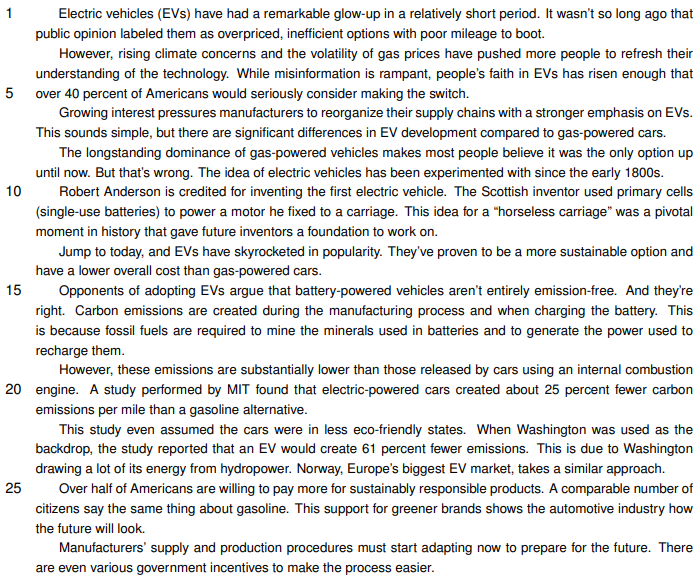
Adapted from: unsustainable in
In the statement "This support for greener brands shows the automotive industry how the future will look" (lines 26 and
27), what does the term "greener" most precisely imply?
Ano: 2025
Banca:
Exército
Órgão:
IME
Prova:
Exército - 2025 - IME - Oficial Engenheiro - Português/Inglês |
Q3692555
Inglês
Texto associado
Text 2
- The Impact of Electric Vehicles on the Automotive Industry Looking at the environmental, economical, and political impact of electric vehicles.
By Patrick Peterson of GoodCar
Adapted from: unsustainable in
What is the closest meaning of the word “volatile” as used in the phrase “the volatility of gas prices” (line 3)?
Ano: 2025
Banca:
Exército
Órgão:
IME
Prova:
Exército - 2025 - IME - Oficial Engenheiro - Português/Inglês |
Q3692554
Inglês
Texto associado
Text 2
- The Impact of Electric Vehicles on the Automotive Industry Looking at the environmental, economical, and political impact of electric vehicles.
By Patrick Peterson of GoodCar
Adapted from: unsustainable in
According to the text, mark the correct option about the role of geography in the environmental impact of EVs:
Ano: 2025
Banca:
Exército
Órgão:
IME
Prova:
Exército - 2025 - IME - Oficial Engenheiro - Português/Inglês |
Q3692553
Inglês
Texto associado
Text 2
- The Impact of Electric Vehicles on the Automotive Industry Looking at the environmental, economical, and political impact of electric vehicles.
By Patrick Peterson of GoodCar
Adapted from: unsustainable in
According to the text, mark the option that most accurately reflects the relationship between public perception and
electric vehicle adoption:
Ano: 2025
Banca:
Exército
Órgão:
IME
Prova:
Exército - 2025 - IME - Oficial Engenheiro - Português/Inglês |
Q3692552
Inglês
Texto associado
Text 2
- The Impact of Electric Vehicles on the Automotive Industry Looking at the environmental, economical, and political impact of electric vehicles.
By Patrick Peterson of GoodCar
Adapted from: unsustainable in
In the sentence “However, rising climate concerns and the volatility of gas prices have pushed more people to refresh
their understanding of the technology” (lines 3 and 4), the verb tense “have pushed” indicates:
Ano: 2025
Banca:
Exército
Órgão:
IME
Prova:
Exército - 2025 - IME - Oficial Engenheiro - Português/Inglês |
Q3692551
Inglês
Texto associado
Text 2
- The Impact of Electric Vehicles on the Automotive Industry Looking at the environmental, economical, and political impact of electric vehicles.
By Patrick Peterson of GoodCar
Adapted from: unsustainable in
Mark the option that shows the most accurate meaning of the highlighted word in the sentence below: “Electric vehicles
(EVs) have had a remarkable glow-up in a relatively short period.” (line 1)
Ano: 2025
Banca:
Exército
Órgão:
IME
Prova:
Exército - 2025 - IME - Oficial Engenheiro - Português/Inglês |
Q3692550
Inglês
Texto associado
Text 2
- The Impact of Electric Vehicles on the Automotive Industry Looking at the environmental, economical, and political impact of electric vehicles.
By Patrick Peterson of GoodCar
Adapted from: unsustainable in
Mark the option that best captures the author's tone throughout the article:
Ano: 2025
Banca:
Exército
Órgão:
IME
Prova:
Exército - 2025 - IME - Oficial Engenheiro - Português/Inglês |
Q3692549
Inglês
Texto associado
Text 1
ChatGPT May Be Eroding Critical Thinking Skills, According to a New MIT Study
By Andrew R. Chow
The study divided 54 subjects — 18 to 39 year-olds from the Boston area — into three groups, and asked them to
write several SAT essays using OpenAl's ChatGPT, Google’s search engine, and nothing at all, respectively. Researchers used an (electroencephalogram) EEG to record the writers’ brain activity across 32 regions, and found that of the
three groups, ChatGPT users had the lowest brain engagement and “consistently underperformed at neural, linguistic,
and behavioral levels.” Over the course of several months, ChatGPT users got lazier with each subsequent essay, often
resorting to copy-and-paste by the end of the study.
The paper suggests that the usage of (Large Language Model) LLMs could actually harm learning, especially for
younger users. The paper has not yet been peer reviewed, and its sample size is relatively small. But its paper’s main
author Nataliya Kosmyna felt it was important to release the findings to elevate concerns that as society increasingly
relies upon LLMs for immediate convenience, long-term brain development may be sacrificed in the process.
The group that wrote essays using ChatGPT all delivered extremely similar essays that lacked original thought,
relying on the same expressions and ideas. Two English teachers who assessed the essays called them largely
“soulless” The EEGs revealed low executive control and attentional engagement. And by their third essay, many of
the writers simply gave the prompt to ChatGPT and had it do almost all of the work. “It was more like, ‘just give me the
essay, refine this sentence, edit it, and 'm done,” Kosmyna says.
The brain-only group, conversely, showed the highest neural connectivity, especially in alpha, theta and delta bands,
which are associated with creativity ideation, memory load, and semantic processing. Researchers found this group
was more engaged and curious, and claimed ownership and expressed higher satisfaction with their essays.
The third group, which used Google Search, also expressed high satisfaction and active brain function. The
difference here is notable because many people now search for information within Al chatbots as opposed to Google
Search.
After writing the three essays, the subjects were then asked to re-write one of their previous efforts—but the
ChatGPT group had to do so without the tool, while the brain-only group could now use ChatGPT. The first group
remembered little of their own essays, and showed weaker alpha and theta brain waves, which likely reflected a
bypassing of deep memory processes.
The second group, in contrast, performed well, exhibiting a significant increase in brain connectivity across all EEG
frequency bands. This gives rise to the hope that Al, if used properly, could enhance learning as opposed to diminishing it.
Adapted from: TIME in [Accessed on 15th July 2025].
Why did the researchers mention the small sample size?
Ano: 2025
Banca:
Exército
Órgão:
IME
Prova:
Exército - 2025 - IME - Oficial Engenheiro - Português/Inglês |
Q3692548
Inglês
Texto associado
Text 1
ChatGPT May Be Eroding Critical Thinking Skills, According to a New MIT Study
By Andrew R. Chow
The study divided 54 subjects — 18 to 39 year-olds from the Boston area — into three groups, and asked them to
write several SAT essays using OpenAl's ChatGPT, Google’s search engine, and nothing at all, respectively. Researchers used an (electroencephalogram) EEG to record the writers’ brain activity across 32 regions, and found that of the
three groups, ChatGPT users had the lowest brain engagement and “consistently underperformed at neural, linguistic,
and behavioral levels.” Over the course of several months, ChatGPT users got lazier with each subsequent essay, often
resorting to copy-and-paste by the end of the study.
The paper suggests that the usage of (Large Language Model) LLMs could actually harm learning, especially for
younger users. The paper has not yet been peer reviewed, and its sample size is relatively small. But its paper’s main
author Nataliya Kosmyna felt it was important to release the findings to elevate concerns that as society increasingly
relies upon LLMs for immediate convenience, long-term brain development may be sacrificed in the process.
The group that wrote essays using ChatGPT all delivered extremely similar essays that lacked original thought,
relying on the same expressions and ideas. Two English teachers who assessed the essays called them largely
“soulless” The EEGs revealed low executive control and attentional engagement. And by their third essay, many of
the writers simply gave the prompt to ChatGPT and had it do almost all of the work. “It was more like, ‘just give me the
essay, refine this sentence, edit it, and 'm done,” Kosmyna says.
The brain-only group, conversely, showed the highest neural connectivity, especially in alpha, theta and delta bands,
which are associated with creativity ideation, memory load, and semantic processing. Researchers found this group
was more engaged and curious, and claimed ownership and expressed higher satisfaction with their essays.
The third group, which used Google Search, also expressed high satisfaction and active brain function. The
difference here is notable because many people now search for information within Al chatbots as opposed to Google
Search.
After writing the three essays, the subjects were then asked to re-write one of their previous efforts—but the
ChatGPT group had to do so without the tool, while the brain-only group could now use ChatGPT. The first group
remembered little of their own essays, and showed weaker alpha and theta brain waves, which likely reflected a
bypassing of deep memory processes.
The second group, in contrast, performed well, exhibiting a significant increase in brain connectivity across all EEG
frequency bands. This gives rise to the hope that Al, if used properly, could enhance learning as opposed to diminishing it.
Adapted from: TIME in [Accessed on 15th July 2025].
Researchers highlighted the following main difference between using Google Search and Al chatbots for information
gathering:
Ano: 2025
Banca:
Exército
Órgão:
IME
Prova:
Exército - 2025 - IME - Oficial Engenheiro - Português/Inglês |
Q3692547
Inglês
Texto associado
Text 1
ChatGPT May Be Eroding Critical Thinking Skills, According to a New MIT Study
By Andrew R. Chow
The study divided 54 subjects — 18 to 39 year-olds from the Boston area — into three groups, and asked them to
write several SAT essays using OpenAl's ChatGPT, Google’s search engine, and nothing at all, respectively. Researchers used an (electroencephalogram) EEG to record the writers’ brain activity across 32 regions, and found that of the
three groups, ChatGPT users had the lowest brain engagement and “consistently underperformed at neural, linguistic,
and behavioral levels.” Over the course of several months, ChatGPT users got lazier with each subsequent essay, often
resorting to copy-and-paste by the end of the study.
The paper suggests that the usage of (Large Language Model) LLMs could actually harm learning, especially for
younger users. The paper has not yet been peer reviewed, and its sample size is relatively small. But its paper’s main
author Nataliya Kosmyna felt it was important to release the findings to elevate concerns that as society increasingly
relies upon LLMs for immediate convenience, long-term brain development may be sacrificed in the process.
The group that wrote essays using ChatGPT all delivered extremely similar essays that lacked original thought,
relying on the same expressions and ideas. Two English teachers who assessed the essays called them largely
“soulless” The EEGs revealed low executive control and attentional engagement. And by their third essay, many of
the writers simply gave the prompt to ChatGPT and had it do almost all of the work. “It was more like, ‘just give me the
essay, refine this sentence, edit it, and 'm done,” Kosmyna says.
The brain-only group, conversely, showed the highest neural connectivity, especially in alpha, theta and delta bands,
which are associated with creativity ideation, memory load, and semantic processing. Researchers found this group
was more engaged and curious, and claimed ownership and expressed higher satisfaction with their essays.
The third group, which used Google Search, also expressed high satisfaction and active brain function. The
difference here is notable because many people now search for information within Al chatbots as opposed to Google
Search.
After writing the three essays, the subjects were then asked to re-write one of their previous efforts—but the
ChatGPT group had to do so without the tool, while the brain-only group could now use ChatGPT. The first group
remembered little of their own essays, and showed weaker alpha and theta brain waves, which likely reflected a
bypassing of deep memory processes.
The second group, in contrast, performed well, exhibiting a significant increase in brain connectivity across all EEG
frequency bands. This gives rise to the hope that Al, if used properly, could enhance learning as opposed to diminishing it.
Adapted from: TIME in [Accessed on 15th July 2025].
Based on the brain-only group’s later use of ChatGPT, researchers expressed the following hope:

 Conheça nossos planos