Questões Militares
Sobre interpretação de texto | reading comprehension em inglês
Foram encontradas 2.325 questões


Q512574
Inglês
Texto associado
INSTRUCTIONS – Read the following text carefully and then choose the correct alternatives that answer the question.
SOUTHERN HUMPBACK WHALE
INTRODUCTION
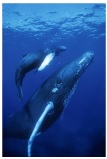
During the Australian winter, these ocean leviathans journey 3,100 miles north from their Antarctic feeding grounds to the warm tropical waters near Australia´s Whitsunday Islands. At the southern edge of the Great Barrier Reef, the 40-ton female humpbacks give birth to calves measuring 14 feet long and weighing over one ton. The Whitsundays´ sheltered bays keep the calves warm and safe from predators. During the next few months, the whales rest, sing, play and mate. The calves nurse, but the one thing the adult whales don´t do while in the tropical seas is eat. By winter´s end, adults are famished, and they head south. This life cycle is repeated throughout the Southern Hemisphere: one group migrates along the western coast of Australia, others to southern Africa and South America.
SIGHT UNSEEN
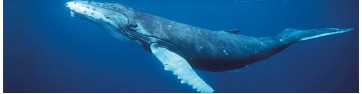
Underneath the blue Australian ocean, film crews captured the elegant rituals of southern humpbacks as they swim, sing, nurse, and play. A mother humpback whale supported her young calf from underneath, so it could breathe easier near the surface. Calves drink 130 gallons of milk a day! While baby grows fat, the mother starves for five months, her blubber stores depleting daily. Unlike the cold Antarctic waters, the seas here don´t grow rich with krill that humpbacks filer through their baleen plates. But she provides her calf with rich milk that contains some of the highest fat content of any mammal´s milk – 45 percent.
UNIQUE BEHAVIOR
Humpback males sing a unique melody, full of high-pitched chirps and whistles interspersed with deeper gurgles and moans. Each male repeats his song for hours, which likely plays a role in courtship. The song may change over time, with males singing a modified melody in consecutive years.
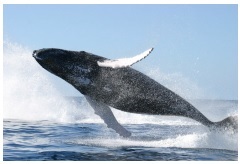
Whale-watching tours take advantage of the humpback´s playful and curious nature. They often approach boats and put on quite a show. As whales journey south along the eastern coast of Australia, many stop in sheltered Platypus Bay around Fraser Island – a World Heritage Site – where they display the charismatic behaviors loved by whale-watchers. The crystal blue waters give a perfect window to watch the whales twist, roll and swim upside down, emerging to breathe, slap their tails or pectoral fins on the water´s surface. Breaching whales jump nearly all the way out of the water. “Spyhopping" means their head emerges, and they peer at the surroundings with their large eyes.
STATUS/CONSERVATION
Commercial hunting in the 19th and 20th centuries decimated most whale species. Because they migrate close to shore and swim slowly, humpbacks became a popular whalers´ target, and were hunted down to a few hundred animals in the Southern Hemisphere. The International Whaling Commission (IWC) implemented a moratorium on harvesting all species starting in 1986, and in 1994, declared Antarctica´s Southern Ocean a whale sanctuary. Now numbering over 10,000 in the Southern Hemisphere, humpbacks have shown incredible resilience, but their numbers still remain a fraction of their historic abundance. Recovery of regional populations varies, and the World Conservation Union (IUCN) lists the humpback as vulnerable.
Humpbacks also have two Northern Hemisphere populations that number around 11,500 in the North Atlantic and 6,000 in the North Pacific. Northern humpbacks are genetically differentiated from the Southern Hemisphere population, and have dark bellies, while the southern humpbacks have all-white bellies. They don´t interbreed, because while the southern populations are mating and calving in the warm tropical seas, northern populations are near the polar Arctic.
OUTLOOK
The International Whaling Commission (IWC) allows hunting by indigenous cultures but bans hunting of humpback whales. Japan has long engaged in IWC-sanctioned “scientific whaling" of minke and other whales, and plans to start hunting humpbacks in 2007. “We are all concerned about Japan´s plans to add this species to the scientific whaling quota", says Dr. Scott Baker, a renowned cetacean conservation biologist. Iceland also just started commercial whaling in 2006.
Some Asian countries allow the sale of whale meat from incidental bycatch, and a whale´s value of $100,000 provides incentive for illegal harvest. Baker and colleagues used DNA to show that the whale meat being sold in South Korean shops did not match that reported to the IWC. Illegal harvest and sale of whale meat is occurring.
Australia and New Zealand have petitioned the IWC to create a South Pacific Sanctuary adjoining the Southern Ocean Sanctuary where whaling would be illegal. Thus far, it has not been approved by IWC.
http://dsc.discovery.com/convergence/planet-earth/...
INSTRUCTIONS – Read the following text carefully and then choose the correct alternatives that answer the question.
SOUTHERN HUMPBACK WHALE
INTRODUCTION
During the Australian winter, these ocean leviathans journey 3,100 miles north from their Antarctic feeding grounds to the warm tropical waters near Australia´s Whitsunday Islands. At the southern edge of the Great Barrier Reef, the 40-ton female humpbacks give birth to calves measuring 14 feet long and weighing over one ton. The Whitsundays´ sheltered bays keep the calves warm and safe from predators. During the next few months, the whales rest, sing, play and mate. The calves nurse, but the one thing the adult whales don´t do while in the tropical seas is eat. By winter´s end, adults are famished, and they head south. This life cycle is repeated throughout the Southern Hemisphere: one group migrates along the western coast of Australia, others to southern Africa and South America.
SIGHT UNSEEN
Underneath the blue Australian ocean, film crews captured the elegant rituals of southern humpbacks as they swim, sing, nurse, and play. A mother humpback whale supported her young calf from underneath, so it could breathe easier near the surface. Calves drink 130 gallons of milk a day! While baby grows fat, the mother starves for five months, her blubber stores depleting daily. Unlike the cold Antarctic waters, the seas here don´t grow rich with krill that humpbacks filer through their baleen plates. But she provides her calf with rich milk that contains some of the highest fat content of any mammal´s milk – 45 percent.
UNIQUE BEHAVIOR
Humpback males sing a unique melody, full of high-pitched chirps and whistles interspersed with deeper gurgles and moans. Each male repeats his song for hours, which likely plays a role in courtship. The song may change over time, with males singing a modified melody in consecutive years.
Whale-watching tours take advantage of the humpback´s playful and curious nature. They often approach boats and put on quite a show. As whales journey south along the eastern coast of Australia, many stop in sheltered Platypus Bay around Fraser Island – a World Heritage Site – where they display the charismatic behaviors loved by whale-watchers. The crystal blue waters give a perfect window to watch the whales twist, roll and swim upside down, emerging to breathe, slap their tails or pectoral fins on the water´s surface. Breaching whales jump nearly all the way out of the water. “Spyhopping" means their head emerges, and they peer at the surroundings with their large eyes.
STATUS/CONSERVATION
Commercial hunting in the 19th and 20th centuries decimated most whale species. Because they migrate close to shore and swim slowly, humpbacks became a popular whalers´ target, and were hunted down to a few hundred animals in the Southern Hemisphere. The International Whaling Commission (IWC) implemented a moratorium on harvesting all species starting in 1986, and in 1994, declared Antarctica´s Southern Ocean a whale sanctuary. Now numbering over 10,000 in the Southern Hemisphere, humpbacks have shown incredible resilience, but their numbers still remain a fraction of their historic abundance. Recovery of regional populations varies, and the World Conservation Union (IUCN) lists the humpback as vulnerable.
Humpbacks also have two Northern Hemisphere populations that number around 11,500 in the North Atlantic and 6,000 in the North Pacific. Northern humpbacks are genetically differentiated from the Southern Hemisphere population, and have dark bellies, while the southern humpbacks have all-white bellies. They don´t interbreed, because while the southern populations are mating and calving in the warm tropical seas, northern populations are near the polar Arctic.
OUTLOOK
The International Whaling Commission (IWC) allows hunting by indigenous cultures but bans hunting of humpback whales. Japan has long engaged in IWC-sanctioned “scientific whaling" of minke and other whales, and plans to start hunting humpbacks in 2007. “We are all concerned about Japan´s plans to add this species to the scientific whaling quota", says Dr. Scott Baker, a renowned cetacean conservation biologist. Iceland also just started commercial whaling in 2006.
Some Asian countries allow the sale of whale meat from incidental bycatch, and a whale´s value of $100,000 provides incentive for illegal harvest. Baker and colleagues used DNA to show that the whale meat being sold in South Korean shops did not match that reported to the IWC. Illegal harvest and sale of whale meat is occurring.
Australia and New Zealand have petitioned the IWC to create a South Pacific Sanctuary adjoining the Southern Ocean Sanctuary where whaling would be illegal. Thus far, it has not been approved by IWC.
http://dsc.discovery.com/convergence/planet-earth/...
At the southern edge of the Great Barrier Reef, adult humpbacks whales do all this, EXCEPT:
Ano: 2014
Banca:
BIO-RIO
Órgão:
ETAM
Prova:
BIO-RIO - 2014 - ETAM - Curso de Formação de Técnicos - 1ª Semestre de 2015 |
Q508829
Inglês
Texto associado
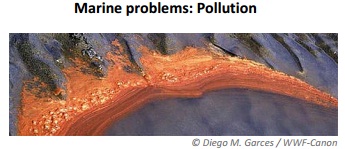
Almost every marine organism, from the tiniest plankton to whales and polar bears, is contaminated with man-made chemicals, such as pesticides and chemicals used in common consumer products.
Some of these chemicals enter the sea through deliberate dumping. For centuries, the oceans have been a convenient dumping ground for waste generated on land. This continued until the 1970s, with dumping at sea the accepted practise for disposal of nearly.
everything, including toxic material such as pesticides, chemical weapons, and radioactive waste […]
Chemicals also enter the sea from land-based activities. Chemicals can escape into water, soil, and air during their manufacture, use, or disposal, as well as from accidental leaks or fires in products containing these chemicals. Once in the environment, they can travel for long distances in air and water, including ocean currents.
People once assumed that the ocean was so large that all pollutants would be diluted and dispersed to safe levels. But in reality, they have not disappeared - and some toxic man-made chemicals have even become more concentrated as they have entered the food chain.
Tiny animals at the bottom of the food chain, such as plankton in the oceans, absorb the chemicals as they feed. Because they do not break down easily, the chemicals accumulate in these organisms, becoming much more concentrated in their bodies than in the surrounding water or soil. These organisms are eaten by small animals, and the concentration rises again. These animals are in turn eaten by larger animals, which can travel large distances with their even further increased chemical load.
Animals higher up the food chain, such as seals, can have contamination levels millions of times higher than the water in which they live. And polar bears, which feed on seals, can have contamination levels up to 3 billion times higher than their environment.
People become contaminated either directly from household products or by eating contaminated seafood and animal fats.
Evidence is mounting that a number of man-made chemicals can cause serious health problems - including cancer, damage to the immune system, behavioural problems, and reduced
fertility.
(http://wwf.panda.org/about_our_earth/blue_planet/p...)
Almost every marine organism, from the tiniest plankton to whales and polar bears, is contaminated with man-made chemicals, such as pesticides and chemicals used in common consumer products.
Some of these chemicals enter the sea through deliberate dumping. For centuries, the oceans have been a convenient dumping ground for waste generated on land. This continued until the 1970s, with dumping at sea the accepted practise for disposal of nearly.
everything, including toxic material such as pesticides, chemical weapons, and radioactive waste […]
Chemicals also enter the sea from land-based activities. Chemicals can escape into water, soil, and air during their manufacture, use, or disposal, as well as from accidental leaks or fires in products containing these chemicals. Once in the environment, they can travel for long distances in air and water, including ocean currents.
People once assumed that the ocean was so large that all pollutants would be diluted and dispersed to safe levels. But in reality, they have not disappeared - and some toxic man-made chemicals have even become more concentrated as they have entered the food chain.
Tiny animals at the bottom of the food chain, such as plankton in the oceans, absorb the chemicals as they feed. Because they do not break down easily, the chemicals accumulate in these organisms, becoming much more concentrated in their bodies than in the surrounding water or soil. These organisms are eaten by small animals, and the concentration rises again. These animals are in turn eaten by larger animals, which can travel large distances with their even further increased chemical load.
Animals higher up the food chain, such as seals, can have contamination levels millions of times higher than the water in which they live. And polar bears, which feed on seals, can have contamination levels up to 3 billion times higher than their environment.
People become contaminated either directly from household products or by eating contaminated seafood and animal fats.
Evidence is mounting that a number of man-made chemicals can cause serious health problems - including cancer, damage to the immune system, behavioural problems, and reduced
fertility.
(http://wwf.panda.org/about_our_earth/blue_planet/p...)
A expressão sublinhada em “These animals are in turn eaten by larger animals ” responde à pergunta:
Ano: 2014
Banca:
BIO-RIO
Órgão:
ETAM
Prova:
BIO-RIO - 2014 - ETAM - Curso de Formação de Técnicos - 1ª Semestre de 2015 |
Q508828
Inglês
Texto associado
Almost every marine organism, from the tiniest plankton to whales and polar bears, is contaminated with man-made chemicals, such as pesticides and chemicals used in common consumer products.
Some of these chemicals enter the sea through deliberate dumping. For centuries, the oceans have been a convenient dumping ground for waste generated on land. This continued until the 1970s, with dumping at sea the accepted practise for disposal of nearly.
everything, including toxic material such as pesticides, chemical weapons, and radioactive waste […]
Chemicals also enter the sea from land-based activities. Chemicals can escape into water, soil, and air during their manufacture, use, or disposal, as well as from accidental leaks or fires in products containing these chemicals. Once in the environment, they can travel for long distances in air and water, including ocean currents.
People once assumed that the ocean was so large that all pollutants would be diluted and dispersed to safe levels. But in reality, they have not disappeared - and some toxic man-made chemicals have even become more concentrated as they have entered the food chain.
Tiny animals at the bottom of the food chain, such as plankton in the oceans, absorb the chemicals as they feed. Because they do not break down easily, the chemicals accumulate in these organisms, becoming much more concentrated in their bodies than in the surrounding water or soil. These organisms are eaten by small animals, and the concentration rises again. These animals are in turn eaten by larger animals, which can travel large distances with their even further increased chemical load.
Animals higher up the food chain, such as seals, can have contamination levels millions of times higher than the water in which they live. And polar bears, which feed on seals, can have contamination levels up to 3 billion times higher than their environment.
People become contaminated either directly from household products or by eating contaminated seafood and animal fats.
Evidence is mounting that a number of man-made chemicals can cause serious health problems - including cancer, damage to the immune system, behavioural problems, and reduced
fertility.
(http://wwf.panda.org/about_our_earth/blue_planet/p...)
Almost every marine organism, from the tiniest plankton to whales and polar bears, is contaminated with man-made chemicals, such as pesticides and chemicals used in common consumer products.
Some of these chemicals enter the sea through deliberate dumping. For centuries, the oceans have been a convenient dumping ground for waste generated on land. This continued until the 1970s, with dumping at sea the accepted practise for disposal of nearly.
everything, including toxic material such as pesticides, chemical weapons, and radioactive waste […]
Chemicals also enter the sea from land-based activities. Chemicals can escape into water, soil, and air during their manufacture, use, or disposal, as well as from accidental leaks or fires in products containing these chemicals. Once in the environment, they can travel for long distances in air and water, including ocean currents.
People once assumed that the ocean was so large that all pollutants would be diluted and dispersed to safe levels. But in reality, they have not disappeared - and some toxic man-made chemicals have even become more concentrated as they have entered the food chain.
Tiny animals at the bottom of the food chain, such as plankton in the oceans, absorb the chemicals as they feed. Because they do not break down easily, the chemicals accumulate in these organisms, becoming much more concentrated in their bodies than in the surrounding water or soil. These organisms are eaten by small animals, and the concentration rises again. These animals are in turn eaten by larger animals, which can travel large distances with their even further increased chemical load.
Animals higher up the food chain, such as seals, can have contamination levels millions of times higher than the water in which they live. And polar bears, which feed on seals, can have contamination levels up to 3 billion times higher than their environment.
People become contaminated either directly from household products or by eating contaminated seafood and animal fats.
Evidence is mounting that a number of man-made chemicals can cause serious health problems - including cancer, damage to the immune system, behavioural problems, and reduced
fertility.
(http://wwf.panda.org/about_our_earth/blue_planet/p...)
O verbo “can” em “they can travel” indica:
Ano: 2014
Banca:
BIO-RIO
Órgão:
ETAM
Prova:
BIO-RIO - 2014 - ETAM - Curso de Formação de Técnicos - 1ª Semestre de 2015 |
Q508827
Inglês
Texto associado
Almost every marine organism, from the tiniest plankton to whales and polar bears, is contaminated with man-made chemicals, such as pesticides and chemicals used in common consumer products.
Some of these chemicals enter the sea through deliberate dumping. For centuries, the oceans have been a convenient dumping ground for waste generated on land. This continued until the 1970s, with dumping at sea the accepted practise for disposal of nearly.
everything, including toxic material such as pesticides, chemical weapons, and radioactive waste […]
Chemicals also enter the sea from land-based activities. Chemicals can escape into water, soil, and air during their manufacture, use, or disposal, as well as from accidental leaks or fires in products containing these chemicals. Once in the environment, they can travel for long distances in air and water, including ocean currents.
People once assumed that the ocean was so large that all pollutants would be diluted and dispersed to safe levels. But in reality, they have not disappeared - and some toxic man-made chemicals have even become more concentrated as they have entered the food chain.
Tiny animals at the bottom of the food chain, such as plankton in the oceans, absorb the chemicals as they feed. Because they do not break down easily, the chemicals accumulate in these organisms, becoming much more concentrated in their bodies than in the surrounding water or soil. These organisms are eaten by small animals, and the concentration rises again. These animals are in turn eaten by larger animals, which can travel large distances with their even further increased chemical load.
Animals higher up the food chain, such as seals, can have contamination levels millions of times higher than the water in which they live. And polar bears, which feed on seals, can have contamination levels up to 3 billion times higher than their environment.
People become contaminated either directly from household products or by eating contaminated seafood and animal fats.
Evidence is mounting that a number of man-made chemicals can cause serious health problems - including cancer, damage to the immune system, behavioural problems, and reduced
fertility.
(http://wwf.panda.org/about_our_earth/blue_planet/p...)
Almost every marine organism, from the tiniest plankton to whales and polar bears, is contaminated with man-made chemicals, such as pesticides and chemicals used in common consumer products.
Some of these chemicals enter the sea through deliberate dumping. For centuries, the oceans have been a convenient dumping ground for waste generated on land. This continued until the 1970s, with dumping at sea the accepted practise for disposal of nearly.
everything, including toxic material such as pesticides, chemical weapons, and radioactive waste […]
Chemicals also enter the sea from land-based activities. Chemicals can escape into water, soil, and air during their manufacture, use, or disposal, as well as from accidental leaks or fires in products containing these chemicals. Once in the environment, they can travel for long distances in air and water, including ocean currents.
People once assumed that the ocean was so large that all pollutants would be diluted and dispersed to safe levels. But in reality, they have not disappeared - and some toxic man-made chemicals have even become more concentrated as they have entered the food chain.
Tiny animals at the bottom of the food chain, such as plankton in the oceans, absorb the chemicals as they feed. Because they do not break down easily, the chemicals accumulate in these organisms, becoming much more concentrated in their bodies than in the surrounding water or soil. These organisms are eaten by small animals, and the concentration rises again. These animals are in turn eaten by larger animals, which can travel large distances with their even further increased chemical load.
Animals higher up the food chain, such as seals, can have contamination levels millions of times higher than the water in which they live. And polar bears, which feed on seals, can have contamination levels up to 3 billion times higher than their environment.
People become contaminated either directly from household products or by eating contaminated seafood and animal fats.
Evidence is mounting that a number of man-made chemicals can cause serious health problems - including cancer, damage to the immune system, behavioural problems, and reduced
fertility.
(http://wwf.panda.org/about_our_earth/blue_planet/p...)
Com relação ao texto, assinale V para a afirmativa verdadeira e F para a falsa.
( ) A contaminação dos animais no topo da cadeia alimentar é maior do que a do meio-ambiente.
( ) Somente alguns organismos marinhos vêm sofrendo contaminação por produtos químicos.
( ) Peixes e outros frutos do mar contaminam mais o ser humano do que produtos de limpeza.
As afirmativas são, respectivamente,
( ) A contaminação dos animais no topo da cadeia alimentar é maior do que a do meio-ambiente.
( ) Somente alguns organismos marinhos vêm sofrendo contaminação por produtos químicos.
( ) Peixes e outros frutos do mar contaminam mais o ser humano do que produtos de limpeza.
As afirmativas são, respectivamente,
Ano: 2014
Banca:
BIO-RIO
Órgão:
ETAM
Prova:
BIO-RIO - 2014 - ETAM - Curso de Formação de Técnicos - 1ª Semestre de 2015 |
Q508826
Inglês
Texto associado
Almost every marine organism, from the tiniest plankton to whales and polar bears, is contaminated with man-made chemicals, such as pesticides and chemicals used in common consumer products.
Some of these chemicals enter the sea through deliberate dumping. For centuries, the oceans have been a convenient dumping ground for waste generated on land. This continued until the 1970s, with dumping at sea the accepted practise for disposal of nearly.
everything, including toxic material such as pesticides, chemical weapons, and radioactive waste […]
Chemicals also enter the sea from land-based activities. Chemicals can escape into water, soil, and air during their manufacture, use, or disposal, as well as from accidental leaks or fires in products containing these chemicals. Once in the environment, they can travel for long distances in air and water, including ocean currents.
People once assumed that the ocean was so large that all pollutants would be diluted and dispersed to safe levels. But in reality, they have not disappeared - and some toxic man-made chemicals have even become more concentrated as they have entered the food chain.
Tiny animals at the bottom of the food chain, such as plankton in the oceans, absorb the chemicals as they feed. Because they do not break down easily, the chemicals accumulate in these organisms, becoming much more concentrated in their bodies than in the surrounding water or soil. These organisms are eaten by small animals, and the concentration rises again. These animals are in turn eaten by larger animals, which can travel large distances with their even further increased chemical load.
Animals higher up the food chain, such as seals, can have contamination levels millions of times higher than the water in which they live. And polar bears, which feed on seals, can have contamination levels up to 3 billion times higher than their environment.
People become contaminated either directly from household products or by eating contaminated seafood and animal fats.
Evidence is mounting that a number of man-made chemicals can cause serious health problems - including cancer, damage to the immune system, behavioural problems, and reduced
fertility.
(http://wwf.panda.org/about_our_earth/blue_planet/p...)
Almost every marine organism, from the tiniest plankton to whales and polar bears, is contaminated with man-made chemicals, such as pesticides and chemicals used in common consumer products.
Some of these chemicals enter the sea through deliberate dumping. For centuries, the oceans have been a convenient dumping ground for waste generated on land. This continued until the 1970s, with dumping at sea the accepted practise for disposal of nearly.
everything, including toxic material such as pesticides, chemical weapons, and radioactive waste […]
Chemicals also enter the sea from land-based activities. Chemicals can escape into water, soil, and air during their manufacture, use, or disposal, as well as from accidental leaks or fires in products containing these chemicals. Once in the environment, they can travel for long distances in air and water, including ocean currents.
People once assumed that the ocean was so large that all pollutants would be diluted and dispersed to safe levels. But in reality, they have not disappeared - and some toxic man-made chemicals have even become more concentrated as they have entered the food chain.
Tiny animals at the bottom of the food chain, such as plankton in the oceans, absorb the chemicals as they feed. Because they do not break down easily, the chemicals accumulate in these organisms, becoming much more concentrated in their bodies than in the surrounding water or soil. These organisms are eaten by small animals, and the concentration rises again. These animals are in turn eaten by larger animals, which can travel large distances with their even further increased chemical load.
Animals higher up the food chain, such as seals, can have contamination levels millions of times higher than the water in which they live. And polar bears, which feed on seals, can have contamination levels up to 3 billion times higher than their environment.
People become contaminated either directly from household products or by eating contaminated seafood and animal fats.
Evidence is mounting that a number of man-made chemicals can cause serious health problems - including cancer, damage to the immune system, behavioural problems, and reduced
fertility.
(http://wwf.panda.org/about_our_earth/blue_planet/p...)
A frase “For centuries, the oceans have been a convenient dumping ground for waste generated on land” implica que o ser humano tem agido de forma:
Ano: 2014
Banca:
BIO-RIO
Órgão:
ETAM
Prova:
BIO-RIO - 2014 - ETAM - Curso de Formação de Técnicos - 1ª Semestre de 2015 |
Q508825
Inglês
Texto associado
Almost every marine organism, from the tiniest plankton to whales and polar bears, is contaminated with man-made chemicals, such as pesticides and chemicals used in common consumer products.
Some of these chemicals enter the sea through deliberate dumping. For centuries, the oceans have been a convenient dumping ground for waste generated on land. This continued until the 1970s, with dumping at sea the accepted practise for disposal of nearly.
everything, including toxic material such as pesticides, chemical weapons, and radioactive waste […]
Chemicals also enter the sea from land-based activities. Chemicals can escape into water, soil, and air during their manufacture, use, or disposal, as well as from accidental leaks or fires in products containing these chemicals. Once in the environment, they can travel for long distances in air and water, including ocean currents.
People once assumed that the ocean was so large that all pollutants would be diluted and dispersed to safe levels. But in reality, they have not disappeared - and some toxic man-made chemicals have even become more concentrated as they have entered the food chain.
Tiny animals at the bottom of the food chain, such as plankton in the oceans, absorb the chemicals as they feed. Because they do not break down easily, the chemicals accumulate in these organisms, becoming much more concentrated in their bodies than in the surrounding water or soil. These organisms are eaten by small animals, and the concentration rises again. These animals are in turn eaten by larger animals, which can travel large distances with their even further increased chemical load.
Animals higher up the food chain, such as seals, can have contamination levels millions of times higher than the water in which they live. And polar bears, which feed on seals, can have contamination levels up to 3 billion times higher than their environment.
People become contaminated either directly from household products or by eating contaminated seafood and animal fats.
Evidence is mounting that a number of man-made chemicals can cause serious health problems - including cancer, damage to the immune system, behavioural problems, and reduced
fertility.
(http://wwf.panda.org/about_our_earth/blue_planet/p...)
Almost every marine organism, from the tiniest plankton to whales and polar bears, is contaminated with man-made chemicals, such as pesticides and chemicals used in common consumer products.
Some of these chemicals enter the sea through deliberate dumping. For centuries, the oceans have been a convenient dumping ground for waste generated on land. This continued until the 1970s, with dumping at sea the accepted practise for disposal of nearly.
everything, including toxic material such as pesticides, chemical weapons, and radioactive waste […]
Chemicals also enter the sea from land-based activities. Chemicals can escape into water, soil, and air during their manufacture, use, or disposal, as well as from accidental leaks or fires in products containing these chemicals. Once in the environment, they can travel for long distances in air and water, including ocean currents.
People once assumed that the ocean was so large that all pollutants would be diluted and dispersed to safe levels. But in reality, they have not disappeared - and some toxic man-made chemicals have even become more concentrated as they have entered the food chain.
Tiny animals at the bottom of the food chain, such as plankton in the oceans, absorb the chemicals as they feed. Because they do not break down easily, the chemicals accumulate in these organisms, becoming much more concentrated in their bodies than in the surrounding water or soil. These organisms are eaten by small animals, and the concentration rises again. These animals are in turn eaten by larger animals, which can travel large distances with their even further increased chemical load.
Animals higher up the food chain, such as seals, can have contamination levels millions of times higher than the water in which they live. And polar bears, which feed on seals, can have contamination levels up to 3 billion times higher than their environment.
People become contaminated either directly from household products or by eating contaminated seafood and animal fats.
Evidence is mounting that a number of man-made chemicals can cause serious health problems - including cancer, damage to the immune system, behavioural problems, and reduced
fertility.
(http://wwf.panda.org/about_our_earth/blue_planet/p...)
O objetivo do texto é:
Q504248
Inglês
Para a questão, marque a alternativa CORRETA.
Q504245
Inglês
Texto associado
Born on October 23, 1940, in Três Corações, Brazil, soccer legend Pelé became a superstar with his performance in the 1958 World Cup. Pelé played professionally in Brazil for two decades, (35)__________ three World Cups along the way, before joining the New York Cosmos late in his career. Named FIFA co-Player of the Century in 1999, he is a global ambassador for soccer and other (36)____________ causes.
The world was officially introduced to Pelé in the 1958 World Cup in Sweden. Displaying (37)_____________ speed, athleticism and field vision, the 17-year-old erupted to score three goals in a 5-2 semifinal win over France, then netted two more in the finals, a 5-2 win over the host country.
Retirement did little to diminish the public profile of Pelé, who (38)______________ a popular pitchman and active in many professional arenas.
In 1978, Pelé was awarded the International Peace Award for his work with UNICEF. He has also served (39) __________ Brazil's Extraordinary Minister for Sport and a United Nations ambassador for ecology and the environment.

The world was officially introduced to Pelé in the 1958 World Cup in Sweden. Displaying (37)_____________ speed, athleticism and field vision, the 17-year-old erupted to score three goals in a 5-2 semifinal win over France, then netted two more in the finals, a 5-2 win over the host country.
Retirement did little to diminish the public profile of Pelé, who (38)______________ a popular pitchman and active in many professional arenas.
In 1978, Pelé was awarded the International Peace Award for his work with UNICEF. He has also served (39) __________ Brazil's Extraordinary Minister for Sport and a United Nations ambassador for ecology and the environment.
Para a questão, escolha a alternativa que complete a sentença CORRETAMENTE
Q504237
Inglês
There are many forms of prejudice and oppression, __________ based on race, but on gender, class, sexual orientation, etc.
Q504231
Inglês
Texto associado
Text 2
What’s in a name?
Henry Louis Gates Jr. (1989)
The question of color takes up much space in these pages, but the question of color, especially in this country, operates to hide the graver questions of the self.
- James Baldwin, 1961
… blood, darky, Tar baby, Kaffir, shine… moor, blackamoor, Jim Crow, spook… quadroon, meriney, red bone, high yellow… Mammy, porch monkey, home, homeboy, George… spearchucker, Leroy, Smokey…mouli, buck, Ethiopian, brother, sistah…
- Trey Ellis, 1989
I had forgotten the incident completely, until I read Trey Elli’s essay, “Remember My Name,” in a recent issue of the Village Voice (June 13, 1989). But there, in the middle of an extended italicized list of the bynames of “the race” (“the race” or “our people” being the terms my parents used in polite or reverential discourse, “jigaboo” or “nigger” more commonly used in anger, jest, or pure disgust), it was: “George”. Now the events of that very brief exchange return to my mind so vividly that I wonder why I had forgotten it.
My father and I were walking home at dusk from his second job. He “moonlighted” as a janitor in the evenings for the telephone company. Every day, but Saturday, he would come home at 3:30 from his regular job at the paper Mill, wash up, eat supper, then at 4:30 head downtown to his second job. He used to make jokes frequently about a union official who moonlighted. I never got the joke, but he and his friends thought it was hilarious. All I knew was that my family always ate well, that my brother and I had new clothes to wear, and that all of the white people in Piedmont, West Virginia, treated my parents with an odd mixture of resentment and respect that even we understood at the time had something directly to do with a small but certain measure of financial security.
He had left a little early that evening because I was with him and I had to be in bed early. I could not have been more than five or six, and we had stopped off at the Cut-Rate Drug Store (where no black person in town but my father could sit down to eat, and eat off real plates with real silverware) so that I could buy some caramel ice cream, two scoops in a wafer cone, please, which I was busy licking when Mr. Wilson walked by.
Mr. Wilson was a very quiet man, whose stony, brooding, silent manner seemed designed to scare off any overtures of friendship, even from white people. He was Irish as was one-third of our village (another third being Italian), the more affluent among whom sent their children to “Catholic School” across the bridge in Maryland. He had white straight hair, like my Uncle Joe, whom he uncannily resembled, and he carried a black worn metal lunch pail, the kind that Riley carried on the television show. My father always spoke to him, and for reasons that we never did understand, he always spoke to my father.
“Hello, Mr. Wilson,” I heard my father say.
“Hello, George.” I stopped licking my ice cream cone, and asked my Dad in a loud voice why Mr. Wilson had called him “George.”
“Doesn’t he know your name, Daddy? Why don’t you tell him your name? Your name isn’t George.”
For a moment I tried to think of who Mr. Wilson was mixing Pop up with. But we didn’t have any Georges among the colored people in Piedmont; nor were there colored Georges living in the neighboring towns and working at the Mill.
“Tell him your name, Daddy.”
“He knows my name, boy,” my father said after a long pause. “He calls all colored people George.” A long silence ensued. It was “one of those things”, as my Mom would put it. Even then, that early, I knew when I was in the presence of “one of those things”, one of those things that provided a glimpse, through a rent curtain, at another world that we could not affect but that affected us. There would be a painful moment of silence, and you would wait for it to give way to a discussion of a black superstar such as Sugar Ray or Jackie Robinson.
“Nobody hits better in a clutch than Jackie Robinson.”
“That’s right. Nobody.”
I never again looked Mr. Wilson in the eye.
What’s in a name?
Henry Louis Gates Jr. (1989)
The question of color takes up much space in these pages, but the question of color, especially in this country, operates to hide the graver questions of the self.
- James Baldwin, 1961
… blood, darky, Tar baby, Kaffir, shine… moor, blackamoor, Jim Crow, spook… quadroon, meriney, red bone, high yellow… Mammy, porch monkey, home, homeboy, George… spearchucker, Leroy, Smokey…mouli, buck, Ethiopian, brother, sistah…
- Trey Ellis, 1989
I had forgotten the incident completely, until I read Trey Elli’s essay, “Remember My Name,” in a recent issue of the Village Voice (June 13, 1989). But there, in the middle of an extended italicized list of the bynames of “the race” (“the race” or “our people” being the terms my parents used in polite or reverential discourse, “jigaboo” or “nigger” more commonly used in anger, jest, or pure disgust), it was: “George”. Now the events of that very brief exchange return to my mind so vividly that I wonder why I had forgotten it.
My father and I were walking home at dusk from his second job. He “moonlighted” as a janitor in the evenings for the telephone company. Every day, but Saturday, he would come home at 3:30 from his regular job at the paper Mill, wash up, eat supper, then at 4:30 head downtown to his second job. He used to make jokes frequently about a union official who moonlighted. I never got the joke, but he and his friends thought it was hilarious. All I knew was that my family always ate well, that my brother and I had new clothes to wear, and that all of the white people in Piedmont, West Virginia, treated my parents with an odd mixture of resentment and respect that even we understood at the time had something directly to do with a small but certain measure of financial security.
He had left a little early that evening because I was with him and I had to be in bed early. I could not have been more than five or six, and we had stopped off at the Cut-Rate Drug Store (where no black person in town but my father could sit down to eat, and eat off real plates with real silverware) so that I could buy some caramel ice cream, two scoops in a wafer cone, please, which I was busy licking when Mr. Wilson walked by.
Mr. Wilson was a very quiet man, whose stony, brooding, silent manner seemed designed to scare off any overtures of friendship, even from white people. He was Irish as was one-third of our village (another third being Italian), the more affluent among whom sent their children to “Catholic School” across the bridge in Maryland. He had white straight hair, like my Uncle Joe, whom he uncannily resembled, and he carried a black worn metal lunch pail, the kind that Riley carried on the television show. My father always spoke to him, and for reasons that we never did understand, he always spoke to my father.
“Hello, Mr. Wilson,” I heard my father say.
“Hello, George.” I stopped licking my ice cream cone, and asked my Dad in a loud voice why Mr. Wilson had called him “George.”
“Doesn’t he know your name, Daddy? Why don’t you tell him your name? Your name isn’t George.”
For a moment I tried to think of who Mr. Wilson was mixing Pop up with. But we didn’t have any Georges among the colored people in Piedmont; nor were there colored Georges living in the neighboring towns and working at the Mill.
“Tell him your name, Daddy.”
“He knows my name, boy,” my father said after a long pause. “He calls all colored people George.” A long silence ensued. It was “one of those things”, as my Mom would put it. Even then, that early, I knew when I was in the presence of “one of those things”, one of those things that provided a glimpse, through a rent curtain, at another world that we could not affect but that affected us. There would be a painful moment of silence, and you would wait for it to give way to a discussion of a black superstar such as Sugar Ray or Jackie Robinson.
“Nobody hits better in a clutch than Jackie Robinson.”
“That’s right. Nobody.”
I never again looked Mr. Wilson in the eye.
According to Gates’ description in text 2, we can say that Mr Wilson was
Q504230
Inglês
Texto associado
Text 2
What’s in a name?
Henry Louis Gates Jr. (1989)
The question of color takes up much space in these pages, but the question of color, especially in this country, operates to hide the graver questions of the self.
- James Baldwin, 1961
… blood, darky, Tar baby, Kaffir, shine… moor, blackamoor, Jim Crow, spook… quadroon, meriney, red bone, high yellow… Mammy, porch monkey, home, homeboy, George… spearchucker, Leroy, Smokey…mouli, buck, Ethiopian, brother, sistah…
- Trey Ellis, 1989
I had forgotten the incident completely, until I read Trey Elli’s essay, “Remember My Name,” in a recent issue of the Village Voice (June 13, 1989). But there, in the middle of an extended italicized list of the bynames of “the race” (“the race” or “our people” being the terms my parents used in polite or reverential discourse, “jigaboo” or “nigger” more commonly used in anger, jest, or pure disgust), it was: “George”. Now the events of that very brief exchange return to my mind so vividly that I wonder why I had forgotten it.
My father and I were walking home at dusk from his second job. He “moonlighted” as a janitor in the evenings for the telephone company. Every day, but Saturday, he would come home at 3:30 from his regular job at the paper Mill, wash up, eat supper, then at 4:30 head downtown to his second job. He used to make jokes frequently about a union official who moonlighted. I never got the joke, but he and his friends thought it was hilarious. All I knew was that my family always ate well, that my brother and I had new clothes to wear, and that all of the white people in Piedmont, West Virginia, treated my parents with an odd mixture of resentment and respect that even we understood at the time had something directly to do with a small but certain measure of financial security.
He had left a little early that evening because I was with him and I had to be in bed early. I could not have been more than five or six, and we had stopped off at the Cut-Rate Drug Store (where no black person in town but my father could sit down to eat, and eat off real plates with real silverware) so that I could buy some caramel ice cream, two scoops in a wafer cone, please, which I was busy licking when Mr. Wilson walked by.
Mr. Wilson was a very quiet man, whose stony, brooding, silent manner seemed designed to scare off any overtures of friendship, even from white people. He was Irish as was one-third of our village (another third being Italian), the more affluent among whom sent their children to “Catholic School” across the bridge in Maryland. He had white straight hair, like my Uncle Joe, whom he uncannily resembled, and he carried a black worn metal lunch pail, the kind that Riley carried on the television show. My father always spoke to him, and for reasons that we never did understand, he always spoke to my father.
“Hello, Mr. Wilson,” I heard my father say.
“Hello, George.” I stopped licking my ice cream cone, and asked my Dad in a loud voice why Mr. Wilson had called him “George.”
“Doesn’t he know your name, Daddy? Why don’t you tell him your name? Your name isn’t George.”
For a moment I tried to think of who Mr. Wilson was mixing Pop up with. But we didn’t have any Georges among the colored people in Piedmont; nor were there colored Georges living in the neighboring towns and working at the Mill.
“Tell him your name, Daddy.”
“He knows my name, boy,” my father said after a long pause. “He calls all colored people George.” A long silence ensued. It was “one of those things”, as my Mom would put it. Even then, that early, I knew when I was in the presence of “one of those things”, one of those things that provided a glimpse, through a rent curtain, at another world that we could not affect but that affected us. There would be a painful moment of silence, and you would wait for it to give way to a discussion of a black superstar such as Sugar Ray or Jackie Robinson.
“Nobody hits better in a clutch than Jackie Robinson.”
“That’s right. Nobody.”
I never again looked Mr. Wilson in the eye.
What’s in a name?
Henry Louis Gates Jr. (1989)
The question of color takes up much space in these pages, but the question of color, especially in this country, operates to hide the graver questions of the self.
- James Baldwin, 1961
… blood, darky, Tar baby, Kaffir, shine… moor, blackamoor, Jim Crow, spook… quadroon, meriney, red bone, high yellow… Mammy, porch monkey, home, homeboy, George… spearchucker, Leroy, Smokey…mouli, buck, Ethiopian, brother, sistah…
- Trey Ellis, 1989
I had forgotten the incident completely, until I read Trey Elli’s essay, “Remember My Name,” in a recent issue of the Village Voice (June 13, 1989). But there, in the middle of an extended italicized list of the bynames of “the race” (“the race” or “our people” being the terms my parents used in polite or reverential discourse, “jigaboo” or “nigger” more commonly used in anger, jest, or pure disgust), it was: “George”. Now the events of that very brief exchange return to my mind so vividly that I wonder why I had forgotten it.
My father and I were walking home at dusk from his second job. He “moonlighted” as a janitor in the evenings for the telephone company. Every day, but Saturday, he would come home at 3:30 from his regular job at the paper Mill, wash up, eat supper, then at 4:30 head downtown to his second job. He used to make jokes frequently about a union official who moonlighted. I never got the joke, but he and his friends thought it was hilarious. All I knew was that my family always ate well, that my brother and I had new clothes to wear, and that all of the white people in Piedmont, West Virginia, treated my parents with an odd mixture of resentment and respect that even we understood at the time had something directly to do with a small but certain measure of financial security.
He had left a little early that evening because I was with him and I had to be in bed early. I could not have been more than five or six, and we had stopped off at the Cut-Rate Drug Store (where no black person in town but my father could sit down to eat, and eat off real plates with real silverware) so that I could buy some caramel ice cream, two scoops in a wafer cone, please, which I was busy licking when Mr. Wilson walked by.
Mr. Wilson was a very quiet man, whose stony, brooding, silent manner seemed designed to scare off any overtures of friendship, even from white people. He was Irish as was one-third of our village (another third being Italian), the more affluent among whom sent their children to “Catholic School” across the bridge in Maryland. He had white straight hair, like my Uncle Joe, whom he uncannily resembled, and he carried a black worn metal lunch pail, the kind that Riley carried on the television show. My father always spoke to him, and for reasons that we never did understand, he always spoke to my father.
“Hello, Mr. Wilson,” I heard my father say.
“Hello, George.” I stopped licking my ice cream cone, and asked my Dad in a loud voice why Mr. Wilson had called him “George.”
“Doesn’t he know your name, Daddy? Why don’t you tell him your name? Your name isn’t George.”
For a moment I tried to think of who Mr. Wilson was mixing Pop up with. But we didn’t have any Georges among the colored people in Piedmont; nor were there colored Georges living in the neighboring towns and working at the Mill.
“Tell him your name, Daddy.”
“He knows my name, boy,” my father said after a long pause. “He calls all colored people George.” A long silence ensued. It was “one of those things”, as my Mom would put it. Even then, that early, I knew when I was in the presence of “one of those things”, one of those things that provided a glimpse, through a rent curtain, at another world that we could not affect but that affected us. There would be a painful moment of silence, and you would wait for it to give way to a discussion of a black superstar such as Sugar Ray or Jackie Robinson.
“Nobody hits better in a clutch than Jackie Robinson.”
“That’s right. Nobody.”
I never again looked Mr. Wilson in the eye.
Which of the following conclusions can be drawn from text 2?
Q504228
Inglês
Texto associado
Text 1
Luis Suárez joins anti-racism calls after Dani Alves banana incident
The Barcelona defender Dani Alves has sparked a social media campaign against racism in football as support flooded in from fellow professionals for his decision to eat a banana thrown at him by an opposition fan.
Luis Suárez, Neymar, Hulk, Mario Balotelli and Sergio Agüero were among those who posted pictures of themselves taking bites out of bananas in tribute to Alves' actions in his side's La Liga match at Villarreal on Sunday.
The Fifa president Joseph Blatter has branded the abuse directed at Alves an "outrage" and promised zero tolerance towards discrimination at the World Cup, while Villarreal took swift action by identifying the culprit and handing him a lifetime stadium ban.
Alves' response to the banana being thrown on to the pitch in front of him as he prepared to take a corner was to nonchalantly pick it up, peel it and take a bite before continuing with the game. The 30-year- old, who has been the victim of racist abuse before during his time in La Liga, said: "You need to take these situations with a dose of humour."
Players across Europe paid homage on Twitter and Instagram, including Suárez, who served an eight-match ban for racially abusing Patrice Evra.
Alves's Barça and Brazil team-mate Neymar led the way after posting a picture on Instagram of himself holding a banana, while writing "We are all monkeys". Balotelli, Milan's former Manchester City striker, posted a picture of himself in a similar pose.
Suárez posted a picture on Twitter of himself and Liverpool team-mate Philippe Coutinho taking bites out of bananas, along with the words: "#SayNoToRacism #WeAreAllMonkeys."
(...)
Barça gave their player their "complete support and solidarity" and thanked Villarreal for their "immediate condemnation" of the incident. Villarreal later revealed they had, with the help of fans, found out who the culprit was, had withdrawn his season ticket and banned him from the El Madrigal stadium for life.

Luis Suárez joins anti-racism calls after Dani Alves banana incident
The Barcelona defender Dani Alves has sparked a social media campaign against racism in football as support flooded in from fellow professionals for his decision to eat a banana thrown at him by an opposition fan.
Luis Suárez, Neymar, Hulk, Mario Balotelli and Sergio Agüero were among those who posted pictures of themselves taking bites out of bananas in tribute to Alves' actions in his side's La Liga match at Villarreal on Sunday.
The Fifa president Joseph Blatter has branded the abuse directed at Alves an "outrage" and promised zero tolerance towards discrimination at the World Cup, while Villarreal took swift action by identifying the culprit and handing him a lifetime stadium ban.
Alves' response to the banana being thrown on to the pitch in front of him as he prepared to take a corner was to nonchalantly pick it up, peel it and take a bite before continuing with the game. The 30-year- old, who has been the victim of racist abuse before during his time in La Liga, said: "You need to take these situations with a dose of humour."
Players across Europe paid homage on Twitter and Instagram, including Suárez, who served an eight-match ban for racially abusing Patrice Evra.
Alves's Barça and Brazil team-mate Neymar led the way after posting a picture on Instagram of himself holding a banana, while writing "We are all monkeys". Balotelli, Milan's former Manchester City striker, posted a picture of himself in a similar pose.
Suárez posted a picture on Twitter of himself and Liverpool team-mate Philippe Coutinho taking bites out of bananas, along with the words: "#SayNoToRacism #WeAreAllMonkeys."
(...)
Barça gave their player their "complete support and solidarity" and thanked Villarreal for their "immediate condemnation" of the incident. Villarreal later revealed they had, with the help of fans, found out who the culprit was, had withdrawn his season ticket and banned him from the El Madrigal stadium for life.
In text 2, “What’s in a name?”, we can infer that the narrator is
Q504224
Inglês
Texto associado
Text 1
Luis Suárez joins anti-racism calls after Dani Alves banana incident
The Barcelona defender Dani Alves has sparked a social media campaign against racism in football as support flooded in from fellow professionals for his decision to eat a banana thrown at him by an opposition fan.
Luis Suárez, Neymar, Hulk, Mario Balotelli and Sergio Agüero were among those who posted pictures of themselves taking bites out of bananas in tribute to Alves' actions in his side's La Liga match at Villarreal on Sunday.
The Fifa president Joseph Blatter has branded the abuse directed at Alves an "outrage" and promised zero tolerance towards discrimination at the World Cup, while Villarreal took swift action by identifying the culprit and handing him a lifetime stadium ban.
Alves' response to the banana being thrown on to the pitch in front of him as he prepared to take a corner was to nonchalantly pick it up, peel it and take a bite before continuing with the game. The 30-year- old, who has been the victim of racist abuse before during his time in La Liga, said: "You need to take these situations with a dose of humour."
Players across Europe paid homage on Twitter and Instagram, including Suárez, who served an eight-match ban for racially abusing Patrice Evra.
Alves's Barça and Brazil team-mate Neymar led the way after posting a picture on Instagram of himself holding a banana, while writing "We are all monkeys". Balotelli, Milan's former Manchester City striker, posted a picture of himself in a similar pose.
Suárez posted a picture on Twitter of himself and Liverpool team-mate Philippe Coutinho taking bites out of bananas, along with the words: "#SayNoToRacism #WeAreAllMonkeys."
(...)
Barça gave their player their "complete support and solidarity" and thanked Villarreal for their "immediate condemnation" of the incident. Villarreal later revealed they had, with the help of fans, found out who the culprit was, had withdrawn his season ticket and banned him from the El Madrigal stadium for life.
Luis Suárez joins anti-racism calls after Dani Alves banana incident
The Barcelona defender Dani Alves has sparked a social media campaign against racism in football as support flooded in from fellow professionals for his decision to eat a banana thrown at him by an opposition fan.
Luis Suárez, Neymar, Hulk, Mario Balotelli and Sergio Agüero were among those who posted pictures of themselves taking bites out of bananas in tribute to Alves' actions in his side's La Liga match at Villarreal on Sunday.
The Fifa president Joseph Blatter has branded the abuse directed at Alves an "outrage" and promised zero tolerance towards discrimination at the World Cup, while Villarreal took swift action by identifying the culprit and handing him a lifetime stadium ban.
Alves' response to the banana being thrown on to the pitch in front of him as he prepared to take a corner was to nonchalantly pick it up, peel it and take a bite before continuing with the game. The 30-year- old, who has been the victim of racist abuse before during his time in La Liga, said: "You need to take these situations with a dose of humour."
Players across Europe paid homage on Twitter and Instagram, including Suárez, who served an eight-match ban for racially abusing Patrice Evra.
Alves's Barça and Brazil team-mate Neymar led the way after posting a picture on Instagram of himself holding a banana, while writing "We are all monkeys". Balotelli, Milan's former Manchester City striker, posted a picture of himself in a similar pose.
Suárez posted a picture on Twitter of himself and Liverpool team-mate Philippe Coutinho taking bites out of bananas, along with the words: "#SayNoToRacism #WeAreAllMonkeys."
(...)
Barça gave their player their "complete support and solidarity" and thanked Villarreal for their "immediate condemnation" of the incident. Villarreal later revealed they had, with the help of fans, found out who the culprit was, had withdrawn his season ticket and banned him from the El Madrigal stadium for life.
Text 2
What’s in a name?
Henry Louis Gates Jr. (1989)
The question of color takes up much space in these pages, but the question of color, especially in this country, operates to hide the graver questions of the self.
- James Baldwin, 1961 … blood, darky, Tar baby, Kaffir, shine… moor, blackamoor, Jim Crow, spook… quadroon, meriney, red bone, high yellow… Mammy, porch monkey, home, homeboy, George… spearchucker, Leroy, Smokey…mouli, buck, Ethiopian, brother, sistah…
- Trey Ellis, 1989
I had forgotten the incident completely, until I read Trey Elli’s essay, “Remember My Name,” in a recent issue of the Village Voice (June 13, 1989). But there, in the middle of an extended italicized list of the bynames of “the race” (“the race” or “our people” being the terms my parents used in polite or reverential discourse, “jigaboo” or “nigger” more commonly used in anger, jest, or pure disgust), it was: “George”. Now the events of that very brief exchange return to my mind so vividly that I wonder why I had forgotten it. My father and I were walking home at dusk from his second job. He “moonlighted” as a janitor in the evenings for the telephone company. Every day, but Saturday, he would come home at 3:30 from his regular job at the paper Mill, wash up, eat supper, then at 4:30 head downtown to his second job. He used to make jokes frequently about a union official who moonlighted. I never got the joke, but he and his friends thought it was hilarious. All I knew was that my family always ate well, that my brother and I had new clothes to wear, and that all of the white people in Piedmont, West Virginia, treated my parents with an odd mixture of resentment and respect that even we understood at the time had something directly to do with a small but certain measure of financial security. He had left a little early that evening because I was with him and I had to be in bed early. I could not have been more than five or six, and we had stopped off at the Cut-Rate Drug Store (where no black person in town but my father could sit down to eat, and eat off real plates with real silverware) so that I could buy some caramel ice cream, two scoops in a wafer cone, please, which I was busy licking when Mr. Wilson walked by. Mr. Wilson was a very quiet man, whose stony, brooding, silent manner seemed designed to scare off any overtures of friendship, even from white people. He was Irish as was one-third of our village (another third being Italian), the more affluent among whom sent their children to “Catholic School” across the bridge in Maryland. He had white straight hair, like my Uncle Joe, whom he uncannily resembled, and he carried a black worn metal lunch pail, the kind that Riley carried on the television show. My father always spoke to him, and for reasons that we never did understand, he always spoke to my father. “Hello, Mr. Wilson,” I heard my father say. “Hello, George.”
I stopped licking my ice cream cone, and asked my Dad in a loud voice why Mr. Wilson had called him “George.” “Doesn’t he know your name, Daddy? Why don’t you tell him your name? Your name isn’t George.” For a moment I tried to think of who Mr. Wilson was mixing Pop up with. But we didn’t have any Georges among the colored people in Piedmont; nor were there colored Georges living in the neighboring towns and working at the Mill. “Tell him your name, Daddy.” “He knows my name, boy,” my father said after a long pause. “He calls all colored people George.” A long silence ensued. It was “one of those things”, as my Mom would put it. Even then, that early, I knew when I was in the presence of “one of those things”, one of those things that provided a glimpse, through a rent curtain, at another world that we could not affect but that affected us. There would be a painful moment of silence, and you would wait for it to give way to a discussion of a black superstar such as Sugar Ray or Jackie Robinson. “Nobody hits better in a clutch than Jackie Robinson.” “That’s right. Nobody.” I never again looked Mr. Wilson in the eye.
Texts 1 and 2 deal with the same theme: racism. From text 1, we can infer that
What’s in a name?
Henry Louis Gates Jr. (1989)
The question of color takes up much space in these pages, but the question of color, especially in this country, operates to hide the graver questions of the self.
- James Baldwin, 1961 … blood, darky, Tar baby, Kaffir, shine… moor, blackamoor, Jim Crow, spook… quadroon, meriney, red bone, high yellow… Mammy, porch monkey, home, homeboy, George… spearchucker, Leroy, Smokey…mouli, buck, Ethiopian, brother, sistah…
- Trey Ellis, 1989
I had forgotten the incident completely, until I read Trey Elli’s essay, “Remember My Name,” in a recent issue of the Village Voice (June 13, 1989). But there, in the middle of an extended italicized list of the bynames of “the race” (“the race” or “our people” being the terms my parents used in polite or reverential discourse, “jigaboo” or “nigger” more commonly used in anger, jest, or pure disgust), it was: “George”. Now the events of that very brief exchange return to my mind so vividly that I wonder why I had forgotten it. My father and I were walking home at dusk from his second job. He “moonlighted” as a janitor in the evenings for the telephone company. Every day, but Saturday, he would come home at 3:30 from his regular job at the paper Mill, wash up, eat supper, then at 4:30 head downtown to his second job. He used to make jokes frequently about a union official who moonlighted. I never got the joke, but he and his friends thought it was hilarious. All I knew was that my family always ate well, that my brother and I had new clothes to wear, and that all of the white people in Piedmont, West Virginia, treated my parents with an odd mixture of resentment and respect that even we understood at the time had something directly to do with a small but certain measure of financial security. He had left a little early that evening because I was with him and I had to be in bed early. I could not have been more than five or six, and we had stopped off at the Cut-Rate Drug Store (where no black person in town but my father could sit down to eat, and eat off real plates with real silverware) so that I could buy some caramel ice cream, two scoops in a wafer cone, please, which I was busy licking when Mr. Wilson walked by. Mr. Wilson was a very quiet man, whose stony, brooding, silent manner seemed designed to scare off any overtures of friendship, even from white people. He was Irish as was one-third of our village (another third being Italian), the more affluent among whom sent their children to “Catholic School” across the bridge in Maryland. He had white straight hair, like my Uncle Joe, whom he uncannily resembled, and he carried a black worn metal lunch pail, the kind that Riley carried on the television show. My father always spoke to him, and for reasons that we never did understand, he always spoke to my father. “Hello, Mr. Wilson,” I heard my father say. “Hello, George.”
I stopped licking my ice cream cone, and asked my Dad in a loud voice why Mr. Wilson had called him “George.” “Doesn’t he know your name, Daddy? Why don’t you tell him your name? Your name isn’t George.” For a moment I tried to think of who Mr. Wilson was mixing Pop up with. But we didn’t have any Georges among the colored people in Piedmont; nor were there colored Georges living in the neighboring towns and working at the Mill. “Tell him your name, Daddy.” “He knows my name, boy,” my father said after a long pause. “He calls all colored people George.” A long silence ensued. It was “one of those things”, as my Mom would put it. Even then, that early, I knew when I was in the presence of “one of those things”, one of those things that provided a glimpse, through a rent curtain, at another world that we could not affect but that affected us. There would be a painful moment of silence, and you would wait for it to give way to a discussion of a black superstar such as Sugar Ray or Jackie Robinson. “Nobody hits better in a clutch than Jackie Robinson.” “That’s right. Nobody.” I never again looked Mr. Wilson in the eye.
Texts 1 and 2 deal with the same theme: racism. From text 1, we can infer that
Ano: 2014
Banca:
Aeronáutica
Órgão:
EEAR
Prova:
Aeronáutica - 2014 - EEAR - Sargento da Aeronáutica - Controle de Tráfego Aéreo - ME |
Q494115
Inglês
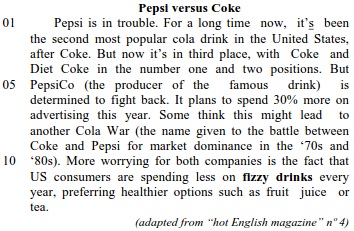
According to the text, it’s correct to say that in the U.S.A., Pepsi
Ano: 2014
Banca:
Aeronáutica
Órgão:
EEAR
Prova:
Aeronáutica - 2014 - EEAR - Sargento da Aeronáutica - Controle de Tráfego Aéreo - ME |
Q494110
Inglês

“Trick or treat”, in bold type, in the text, means
Ano: 2014
Banca:
Aeronáutica
Órgão:
EEAR
Prova:
Aeronáutica - 2014 - EEAR - Sargento da Aeronáutica - Controle de Tráfego Aéreo - ME |
Q494103
Inglês
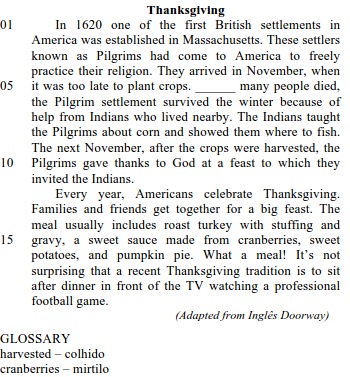
According to the text, we can infer that
Ano: 2014
Banca:
Aeronáutica
Órgão:
EEAR
Prova:
Aeronáutica - 2014 - EEAR - Sargento da Aeronáutica - Controle de Tráfego Aéreo - ME |
Q494101
Inglês
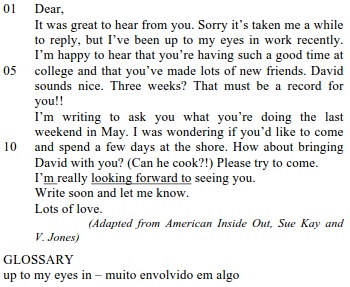
According to the text, we can infer that, the letter wasn’t replied immediately, because
Ano: 2014
Banca:
Aeronáutica
Órgão:
EEAR
Prova:
Aeronáutica - 2014 - EEAR - Sargento da Aeronáutica - Controle de Tráfego Aéreo - ME |
Q494100
Inglês
According to the text, all alternatives are correct, except:
Ano: 2014
Banca:
Aeronáutica
Órgão:
EEAR
Prova:
Aeronáutica - 2014 - EEAR - Sargento da Aeronáutica - Controle de Tráfego Aéreo - ME |
Q494099
Inglês
According to the text, we can infer that all alternatives are correct, except:
Ano: 2014
Banca:
Aeronáutica
Órgão:
EEAR
Prova:
Aeronáutica - 2014 - EEAR - Sargento da Aeronáutica - Controle de Tráfego Aéreo - ME |
Q494096
Inglês

According to the text,

 Conheça nossos planos