Questões Militares
Sobre interpretação de texto | reading comprehension em inglês
Foram encontradas 2.325 questões


What’s your sign?
Neil J. Anderson
Thousands of years ago, the ancient people of Babylon and Egypt studied the stars in the sky and created the zodiac. It was first used to keep track of time. Later, many used the stars to describe a person’s personality and to say what would happen in the future. A person’s zodiac sign is connected to his or her birth date. Some believe this sign can tell us about a person’s personality.(...) In Asia, a person’s blood type is also used to describe personality. People with the blood type A are calm and serious, but they can be selfish. Type Bs are independent but can be lazy. ABs are honest, and type Os are loving and talkative. Not everybody believes that your blood type or birth sign describes your personality. In fact, some people disapprove of using the zodiac; they say it is just foolishness. (...)
Active Skills for Reading, 2nd Edition, Student Book 1.
According to the text, write T for true and F for false to the statements related to the zodiac. After, choose the alternative with the right sequence.
( ) It was originally created to reveal the future. ( ) It is linked to the day a person was born. ( ) It is considered silly by some people. ( ) It was created to name the stars.
According to the chart, write T for true and F for false, then choose the right alternative.
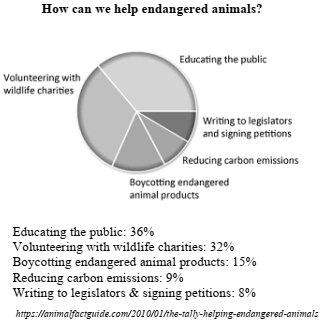
( ) Even if people wanted to help, there wouldn’t be much they could do.
( ) People help when they don’t purchase goods made out of animals’ fur.
( ) Few people believe education is the main key to help endangered animals.
( ) Many people believe that giving some of your time to work for charities help endangered animals.
According to the text, Mariko Okada
( ) can be considered an extrovert person. ( ) spent more than eleven months in a foreign country. ( ) thinks that she would speak more if she weren’t so shy. ( ) regrets investing her time and money on a trip to an English-speaking country.
According to the text, Carla Fonseca
( ) expected London to be a bigger place. ( ) didn’t feel confident about her English. ( ) sounds disappointed at her experience abroad. ( ) felt lonely because she had to live abroad on her own.
According to the text, Alvin Chen
( ) sounds disappointed at his experience abroad. ( ) had a good time abroad, despite studying hard. ( ) was able to make written notes about his daily routine. ( ) doesn’t think that he had enough English speaking practice.
Read the text below and answer the question.
COVID Airborne Transmission v. Monkeypox: Key Differences between viruses
By Aristos Georgiou
More than 1,000 cases of monkeypox have been confirmed around the world in several countries where the disease is not usually found - including the United States - raising questions about how the virus is spreading. But can monkeypox, a rare disease that is usually restricted to parts of Central and West Africa, spread via airborne transmission like the SARS-CoV-2 virus?
Some infectious diseases can spread through airborne transmission via tiny respiratory droplets known as aerosols that can become suspended in the air. These droplets are produced when an individual exhales, sneezes, coughs, talks, or sings, for example. These droplets can contain live viruses or other pathogens that can potentially infect healthy people if they land in the eyes, nose or mouth.
Airborne transmission does not require face-toface contact, and, in fact, an infected person does not even have to be in the same room as another individual to infect them because the droplets can linger in the air for some time,
Several diseases spread through airborne transmission, including measles and chickenpox. Others, meanwhile, can spread via larger respiratory droplets that do not float in the air as easily and fall to the ground faster.
SARS-CoV-2' spreads through exposure to respiratory fluids containirig the infectious virus, and, while it was not clear if the early stages of the: "CÓVID-19 pandemic, we now kriow that this can include âerosols. poa tt
(Adapted from https://www.neiuswesk com)
Read the text below and answer the question.
COVID Airborne Transmission v. Monkeypox: Key Differences between viruses
By Aristos Georgiou
More than 1,000 cases of monkeypox have been confirmed around the world in several countries where the disease is not usually found - including the United States - raising questions about how the virus is spreading. But can monkeypox, a rare disease that is usually restricted to parts of Central and West Africa, spread via airborne transmission like the SARS-CoV-2 virus?
Some infectious diseases can spread through airborne transmission via tiny respiratory droplets known as aerosols that can become suspended in the air. These droplets are produced when an individual exhales, sneezes, coughs, talks, or sings, for example. These droplets can contain live viruses or other pathogens that can potentially infect healthy people if they land in the eyes, nose or mouth.
Airborne transmission does not require face-toface contact, and, in fact, an infected person does not even have to be in the same room as another individual to infect them because the droplets can linger in the air for some time,
Several diseases spread through airborne transmission, including measles and chickenpox. Others, meanwhile, can spread via larger respiratory droplets that do not float in the air as easily and fall to the ground faster.
SARS-CoV-2' spreads through exposure to respiratory fluids containirig the infectious virus, and, while it was not clear if the early stages of the: "CÓVID-19 pandemic, we now kriow that this can include âerosols. poa tt
(Adapted from https://www.neiuswesk com)
Read the text below and answer the question..
Unmanned Vessel Plans Need Improvement, Agency Says
By Geoff Ziezulewicz
While the U.S. Navy is steaming full speed ahead in developing unmanned surface and undersea drones to augment the fleet of the future, the information technology and the artificial intelligence that will drive these platforms remain a work in progress. The sea service needs to better map out its efforts, according to a recent government watchdog report.
Navy shipbuilding plans call for spending more than $4 billion on such drones over the next five years, but that plan “does not account for the full costs to develop and operate these systems,” a Government Accountability Office report found.
Replacing crews requires IT and Al capabilities that the Navy has just begun to examine.
GAO's audit, which began in October 2020, found that the Navy is “only beginning to assess (unmanned systems”) effects on existing shipbuilding plans.”
“While the Navy has outlined a plan to spend $4.3 billion on uncrewed maritime systems in its shipbuilding plan, we found that this understates the costs associated with these systems because it does not account for all costs - specifically operations and sustainment, and the digital infrastructure necessary to enable them," the report states.
Funding unmanned development could also come under pressure from competing shipbuilding demands. The report found that the Navy has yet to stand up criteria for evaluating prototypes or developing better schedules for such prototype efforts.
The Navy is looking to introduce several unmanned systems into the fleet in the coming decades, according to GAO, and while some software will be unique to each platform, the Navy also wants to have a lot of common digital infrastructure among these vehicles.
This digital infrastructure would involve Al capabilities built over time to better help the platforms communicate, sense their surroundings and manage reams of data, the report states.
Navy officials told GAO that the sea service needs a host of technologies, including simulation software, software for autonomy and mission planning, large datasets for machine learning, as well as commercial tech and software that can be quickly bought and melded into Navy systems.
Among its recommendations, the report states that the Navy should provide Congress with a cost estimate for the full scope of work that will be required to make unmanned systems part of the fleet, while developing an approach to refine this estimate in the next shipbuilding plan.
The service should also establish an “uncrewed maritime systems portfolio” and offer more detail about how it intends to reach its unmanned objectives.
(Adapted from Navy Times. May 2022, p. 15.https://www .navytimes.com/)
Read the text below and answer the question..
Unmanned Vessel Plans Need Improvement, Agency Says
By Geoff Ziezulewicz
While the U.S. Navy is steaming full speed ahead in developing unmanned surface and undersea drones to augment the fleet of the future, the information technology and the artificial intelligence that will drive these platforms remain a work in progress. The sea service needs to better map out its efforts, according to a recent government watchdog report.
Navy shipbuilding plans call for spending more than $4 billion on such drones over the next five years, but that plan “does not account for the full costs to develop and operate these systems,” a Government Accountability Office report found.
Replacing crews requires IT and Al capabilities that the Navy has just begun to examine.
GAO's audit, which began in October 2020, found that the Navy is “only beginning to assess (unmanned systems”) effects on existing shipbuilding plans.”
“While the Navy has outlined a plan to spend $4.3 billion on uncrewed maritime systems in its shipbuilding plan, we found that this understates the costs associated with these systems because it does not account for all costs - specifically operations and sustainment, and the digital infrastructure necessary to enable them," the report states.
Funding unmanned development could also come under pressure from competing shipbuilding demands. The report found that the Navy has yet to stand up criteria for evaluating prototypes or developing better schedules for such prototype efforts.
The Navy is looking to introduce several unmanned systems into the fleet in the coming decades, according to GAO, and while some software will be unique to each platform, the Navy also wants to have a lot of common digital infrastructure among these vehicles.
This digital infrastructure would involve Al capabilities built over time to better help the platforms communicate, sense their surroundings and manage reams of data, the report states.
Navy officials told GAO that the sea service needs a host of technologies, including simulation software, software for autonomy and mission planning, large datasets for machine learning, as well as commercial tech and software that can be quickly bought and melded into Navy systems.
Among its recommendations, the report states that the Navy should provide Congress with a cost estimate for the full scope of work that will be required to make unmanned systems part of the fleet, while developing an approach to refine this estimate in the next shipbuilding plan.
The service should also establish an “uncrewed maritime systems portfolio” and offer more detail about how it intends to reach its unmanned objectives.
(Adapted from Navy Times. May 2022, p. 15.https://www .navytimes.com/)

 Conheça nossos planos