Foram encontradas 75.369 questões
Resolva questões gratuitamente!
Junte-se a mais de 4 milhões de concurseiros!


Sabendo-se que o determinante da matriz A é 7, então m + n é um número
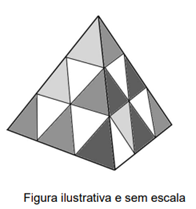
Nessas condições, se um Pyraminx possui 6 cm de altura, então a área de cada pequeno triângulo em suas faces é, em cm2 , igual a
A velocidade constante v, em km/h, é igual a
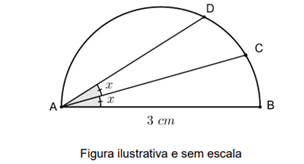
Sabendo-se que
 então a medida do segmento BD, em cm, é igual a
 Na figura I, a região hachurada de extremidades A e E corresponde a um semicírculo de raio r cm, enquanto o setor circular ABD possui o mesmo raio r desse semicírculo hachurado.
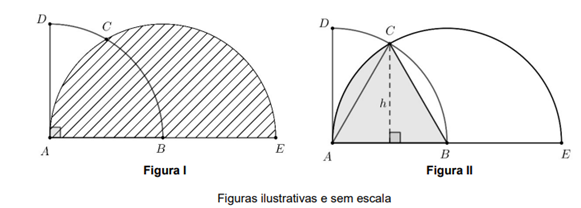
Sabendo-se que a altura h do triângulo ABC é igual a 3√3 cm, então a área do setor circular BAC destacada em cor cinza na figura II é, em cm2 , igual a
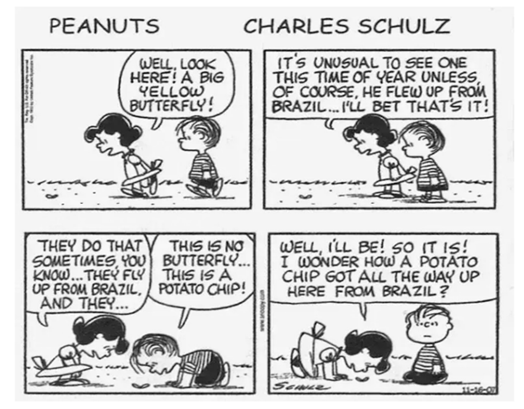
Disponível em: https://ingles-para-todos1.webnode.page/charges/. Acesso em: 9 dez. 2025.
What does the expression “Well, I’ll be!”, used by the girl, convey?
Deciding to adopt a pet is an enormous responsibility. As such, many people choose to foster these pets as the shelters search for a permanent home. If you yourself choose to adopt permanently, be sure you are financially stable enough to support a living creature, have enough space for the pet to be comfortable, and that all other living creatures in the house (other pets, children, adults) are willing for such a big change.
With publicly available data from the American Society for the Prevention of Cruelty to Animals, the Humane Society and People for the Ethical Treatment of Animals, we can better understand the unfortunate circumstances so many pets find themselves in, to better improve their short lives.
Disponível em: https://www.thezebra.com. Acesso em: 9 dez. 2025.
De acordo com o texto, o que deve ser considerado por alguém interessado na adoção de um animal de estimação?
It is in this context that the so-called “weight-loss pens” are gaining increasing traction. These are injectable medications that mimic the action of the intestinal hormone GLP-1 (and, in some cases, also GIP), increasing satiety and improving glycemic control. Initially developed for the treatment of type 2 diabetes, these drugs are also now among the main approved therapies for obesity treatment.
GLP-1 agonists are medications that mimic the action of the body’s natural hormone called GLP-1 (glucagon‐like peptide‐1), which plays a role in blood sugar control. They bind to receptors on cells – like fitting into a “lock” – and activate these receptors to produce effects similar to those the hormone itself would cause. This is the case with semaglutide.
Dual agonists work similarly but act on two different receptors simultaneously: in addition to GLP-1, they also act on GIP, an acronym for gastric inhibitory polypeptide. This is the case with tirzepatide, which acts on the brain and gastrointestinal tract to reduce appetite, increase satiety, and slow gastric emptying.
Although effective for weight loss, the rapid weight reduction promoted by these medications is not limited to the loss of body fat. Part of the weight lost can also come from lean mass, which is composed of muscles, bones, and organs.
Disponível em: https://myminerva.minervafoods.com. Acesso em: 9 dez. 2025.
Com base no texto, analise as asserções.
I. De acordo com o Atlas Mundial da Obesidade de 2025, estima-se que os índices de obesidade terão mais que o dobro do crescimento entre 2010 e 2030.
II. A maioria dos países possui estratégias e políticas eficazes para combater as crescentes taxas de obesidade.
III. As chamadas “canetas emagrecedoras” atuam na mimetização dos hormônios do intestino, tais como o GLP-1 e, em alguns casos, o GIP.
IV. Os agentes agonistas ou imitadores, tais como a tirzepatida, atuam em dois receptores hormonais simultaneamente.
V. A perda de peso causada por esses medicamentos impacta na diminuição da gordura corporal e não reduz a massa magra.
Assinale a alternativa que apresenta apenas asserções corretas.
“We got up on stage with Steve Jobs at Macworld and we talked about it there,” co-creator Marcus Lehto remembered in an interview with Kent State Magazine […]
Looking for studios and exclusives to bulk up its Xbox launch slate, Microsoft eventually called the studio, which was at that point in a spiky financial situation. “And then Microsoft said, ‘Steve Jobs can't have that. We're going to buy you and move you all to the Pacific Northwest, and then we're going to have you build this game for the Xbox.’”
I'm guessing that was creative, incomplete paraphrasing on Lehto's part, but imagining Bill Gates and Steve Jobs embroiled in some kind of tech billionaire civil war over the rights to Halo does bring a smile to my face. The rest is history, though – Halo: Combat Evolved launched alongside the OG Xbox and the series has become synonymous with Microsoft's consoles ever since.
Disponível em: https://tech.yahoo.com. Acesso em: 9 dez. 2025.
According to the text, why did Microsoft decide to secure Halo for itself?
Disponível em: https://www.britannica.com/story/what-does-the-rosetta-stone-say. Acesso em: 23 nov. 2025.
Fill in the blanks with the words which best complete the text. Choose the correct answer.
Nuvens telhados ramagens e Dezembro
Apaixonada estou dentro do tempo
Que me abriga com canto e com imagens
Tão abrigada estou dentro da hora
Que nem lamento já a tarde antiga
Tudo se torna presente e se demora
Será que o dia me pede que eu o diga?
ANDRESEN, S. de M. B. Coral e outros poemas. São Paulo: Companhia das Letras, 2018. p. 185.
No poema Dia, o sujeito poético de Sophia de Mello Breyner Andresen
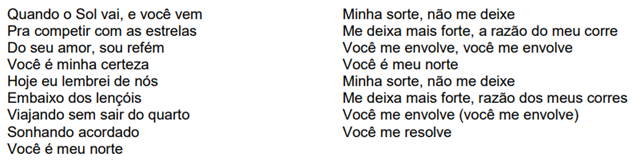
LEMBREI de nós. Intérpretes: João Gomes; Mestrinho; Jota.pê. Compositores: Kaique Carneiro; Kinho Compositor; Luizinho Compositor; Rian Luca. In: DOMINGUINHO [S. l.: s. n.], 2025. 1 recurso sonoro em linha, faixa 1.
Assinale a alternativa que descreve corretamente o efeito das rimas e repetições na letra da canção Lembrei de nós, interpretada por João Gomes, Mestrinho e Jota.pê.
Filho (para os homens-coiotes, objetivo): Vamos.
Os homens-coiotes atravessam a pequena praça junto com o filho do verdugo. Quando estão saindo, um foco de luz violenta incide sobre as mãos dos homens-coiotes. As mãos estão cruzadas na altura dos rins, e deve ser visto claramente que são patas de lobo com grandes garras.
HILST, H. O verdugo seguido de A morte do patriarca. Porto Alegre: L&PM Pocket, p. 70. (Teatro Completo, v. 2).
Texto II
Hilst também consegue desenhar um tom poético em suas didascálias, [...] ou seja, opera indicações subjetivas, tanto para o leitor quanto para o ator/diretor [...] transforma as indicações em algo muito particular, pois é a imaginação, a sensação, a criação imagética da autora transposta poeticamente na indicação das didascálias.
Disponível em: https://periodicosonline.uems.br/REV/article/view/3143. Acesso em: 11 dez. 2025.
A didascália do texto I apresenta uma função poética, conforme descrito no texto II, pois
De um pavão misterioso
Que levantou vôo na Grécia
Com um rapaz corajoso
Raptando uma condessa
Filha de um conde orgulhoso.
REZENDE, J. C. M. O romance do pavão misterioso. Fortaleza: Academia Brasileira de Cordel; Tupynanquim Editora, 2011.
Os versos correspondem à primeira estrofe de O romance do pavão misterioso, um dos cordéis mais influentes do século XX. Considerando a importância do cordel para a literatura e a cultura brasileira, analise as asserções.
I. “Raptando uma condessa/filha de um conde orgulhoso” evidencia que os cordéis tratam exclusivamente de conflitos da elite europeia, descendente de nobres, afastando-se de temas populares ou do cotidiano sertanejo.
II. A estrofe apresenta uma característica presente na maioria dos cordéis: uma estrutura fixa em sextilha, cuja métrica e esquema de rimas favorecem a musicalidade e a oralização próprias da poesia popular.
III. A influência do cordel em outras manifestações artísticas evidencia sua forte presença na cultura brasileira; o folheto O romance do pavão misterioso, por exemplo, inspirou a canção Pavão mysteriozo, composta por Ednardo em 1974.
IV. O espaço citado na estrofe, Grécia, um país europeu, caracteriza a maior parte dos cordéis brasileiros, que tradicionalmente privilegiam figuras mitológicas em detrimento de ambientações nordestinas.
Assinale a alternativa que apresenta apenas asserções corretas.
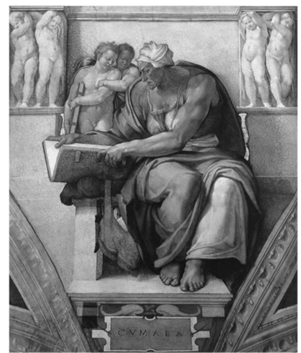
Disponível em: https://pt.wikipedia.org/wiki/Sibila_de_Cumas#/media/Ficheiro:CumaeanSibylByMichelangelo.jpg. Acesso em: 10 dez. 2025.
Considerando a relação intertextual entre a pintura e o romance A sibila, de Agustina Bessa-Luís, assinale a alternativa correta.
Eu digo que tudo que escrevo, seja de um ponto de vista crítico, como pesquisadora, ou de um ponto de vista da criação literária, é profundamente marcado pela minha condição de mulher negra na sociedade brasileira. O que tenho percebido é o seguinte: essa “escrevivência” tem ajudado outras mulheres a se perceberem. Percebo cada vez mais que, na medida em que essas mulheres se encontram nos meus textos e encontram os meus textos, elas se apossam da vida com muito mais certeza. Acho que a minha escrita tem possibilitado que essas mulheres acreditem mais em si mesmas, que se reconheçam, que sabemos ser muito difícil. A literatura que nós conhecemos, essa literatura canônica, ela não nos representa e quando nos representa é sempre de uma maneira limitada, de uma maneira estereotipada. Então o meu texto é um lugar onde as mulheres se sentem em casa, se sentem reconhecidas de verdade.
Disponível em: https://medium.com/mulheres-que-escrevem/mulheres-que-escrevem-entrevista-conceicao-evaristo-fa243ff84284. Acesso em: 6 jan. 2026.
Na entrevista, a escritora, poetisa, professora e pesquisadora brasileira Conceição Evaristo usa o termo “escrevivência” para se referir ao processo de
Atualmente, estamos enfrentando a questão das inteligências artificiais (IAs), particularmente em seu uso como companheiras digitais ou como mediadoras de psicoterapias.
Em um curto período, já podemos perceber seu impacto, transformando a maneira pela qual os jovens aprendem e se relacionam. IAs podem oferecer suporte imediato, auxiliar na organização de informações e até servir como uma ponte para a expressão emocional de jovens em sofrimento psíquico ou com dificuldades de socialização.
Disponível em: https://veja.abril.com.br/coluna/letra-de-medico/o-dilema-das-companhias-artificiais-na-adolescencia/. Acesso em: 13 nov. 2025.
Texto II
Alicie Camargo, publicitária de 27 anos, conta que usa o ChatGPT em momentos de ansiedade. Ela avalia que a interação é em geral positiva — por exemplo quando a ferramenta a ajuda a acertar o tom de uma mensagem que deseja enviar a alguém e não sabe como, quando indica exercícios de respiração em momentos de crise e quando aponta algo que ela não enxergaria sozinha em uma situação.
"Mas eu entendo as limitações", diz ela, citando sugestões oferecidas pela IA que não condizem com a sua personalidade. "Se o problema for cobrar alguém, óbvio que ele [ChatGPT] vai dar a solução de cobrar a atitude, mas emocionalmente eu não estaria pronta para isso. Então o conselho não me serviu de nada." [...]
L., jornalista e redatora publicitária de 21 anos que não quis se identificar, conta que conseguiu contornar o problema das respostas genéricas da tecnologia de forma prática [...] ela diz que desenvolveu técnicas para aprimorar os comandos e, consequentemente, as respostas do robô.
A jovem começou a usar o chatbot para suporte emocional durante um período de luto, após a psicóloga com quem se consultava havia cinco anos morrer. Ela diz ser consciente dos riscos que a IA pode trazer, mas conta que na época foi o único recurso que se via capaz de utilizar, já que não conseguia procurar outro terapeuta. Depois de quatro meses usando a ferramenta, L. diz que se sentiu bem o suficiente para procurar tratamento psicológico e psiquiátrico, retomado há três meses.
Disponível em: https://www1.folha.uol.com.br/equilibrio/2025/01/pessoas-buscam-inteligencia-artificial-para-conversar-e-aliviarsofrimento-psiquico.shtml. Acesso em: 6 jan. 2026.
Considerando o uso de estratégias argumentativas, assinale a alternativa que evidencia a correta relação entre os textos.
"Sapato Florido". Uma história em três linhas. "Uma formiguinha atravessa, em diagonal, a página ainda em branco. Mas ele, aquela noite, não escreveu nada. Para quê? Se por ali já havia passado o frêmito e o mistério da vida…" A poesia, para Quintana, é isso: o frêmito e o mistério da vida. Em todos os quintanares se sente que passou a formiguinha.
Já transcrevi duas coisas do "Sapato Florido". Poderia transcrever muitas outras, quase todas. É o livro de Quintana em que talvez haja mais o "humour" quintanesco, tão impregnado de ternura, de "far niente", de pueris milagres.
Disponível em: https://www1.folha.uol.com.br/folha-105-anos/2025/11/manuel-bandeira-escreveu-sobre-a-obra-e-a-timidez-de-marioquintana.shtml. Acesso em: 28 nov. 2025.
Sobre as expressões em negrito no texto, assinale a alternativa correta.
“Quando cruzamos esses dados socioeconômicos com os indicadores de violência, vemos com mais nitidez como a desigualdade molda o risco e a permanência das mulheres em ciclos de agressão. Isso mostra que a autonomia econômica não é apenas uma condição desejável, mas uma política estratégica de enfrentamento”, ressalta a diretora executiva da Associação Gênero e Número, Vitória Régia da Silva.
Segundo a líder de Políticas Públicas pelo Fim da Violência Contra Mulheres e Meninas no Instituto Natura, a pesquisa deixa clara a necessidade de implementação de políticas públicas que promovam a independência financeira e qualificação profissional das mulheres.
“O que precisamos é de políticas integrais, que articulem segurança pública, saúde, assistência, educação e renda, e que ofereçam respostas reais que dialoguem com demandas e vulnerabilidades diversas. Não podemos continuar transferindo para as mulheres a tarefa de superar, sozinhas, estruturas que são coletivas”, disse.
Disponível em: https://agenciabrasil.ebc.com.br/direitos-humanos/noticia/2025-11/mulher-fora-do-trabalho-tem-3-vezes-mais-chancesde-sofrer-violencia. Acesso em: 28 nov. 2025.
Assinale a alternativa em que o termo em negrito introduz uma informação que, de acordo com a gramática normativa, restringe e limita o sentido do termo antecedente a que se refere.
"O Encanto e a Maquinária" (Jasper Okan) se vale do sintetizador para antecipar a entrada dos metais que vêm com tudo. Arrepiante! A percussão atiça o clima. O pau quebra! Logo os versos chamam a atenção do ouvinte para a questão do racismo ambiental, aquele que aponta como "aceitáveis" os desastres ambientais desde que atinjam mais os pobres do que os ricos.
“Ponta a Ponta” (Sthe Araujo) trata dos desafios de viver numa cidade múltipla como São Paulo. A letra de Araujo revela sua vivência de mulher negra que cresceu no extremo sul da cidade e circulou em busca do sonho de se realizar como artista. O arranjo é poderoso: a cara da Funmilayo. O grave do sax barítono se destaca no naipe dos metais. Soando adequada à harmonia, a melodia vem com tudo. Meu Deus!
Enquanto o grito libertário soa impulsionado pelo talento de vozes e acordes iluminados, energéticas, as canções demonstram plena noção de sua força, envoltas que estão por uma profunda fé na vida.
Disponível em: https://immub.org/noticias/a-orquestra-das-mulheres-fantasticas. Acesso em: 10 dez. 2025.
O texto configura-se como um(a)

 Conheça nossos planos