Questões de Vestibular
Sobre vocabulário | vocabulary em inglês
Foram encontradas 574 questões


TEXTO
Brazil has declared an end to its public health emergency over the Zika virus, 18 months after a surge in cases drew headlines around the world.
The mosquito-borne virus was not considered a major health threat until the 2015 outbreak revealed that Zika can lead to severe birth defects. One of those defects, microcephaly, causes babies to be born with skulls much smaller than expected.
Photos of babies with the defect spread panic around the globe as the virus was reported in dozens of countries. Many would-be travellers cancelled their trips to Zika-infected places. The concern spread even more widely when health officials said it could also be transmitted through sexual contact with an infected person.
The health scare came just as Brazil, the epicentre of the outbreak, was preparing to host the 2016 Olympics, fuelling concerns the Games could help spread the virus. One athlete, a Spanish wind surfer, said she got Zika while training in Brazil ahead of the Games.
In response to the outbreak, Brazil launched a mosquito-eradication campaign. The health ministry said those efforts have helped to dramatically reduce cases of Zika. Between January and mid-April, 95% fewer cases were recorded than during the same period last year. The incidence of microcephaly has fallen as well.
The World Health Organization (WHO) lifted its own international emergency in November, even while saying the virus remained a threat.
“The end of the emergency doesn’t mean the end of surveillance or assistance” to affected families, said Adeilson Cavalcante, the secretary for health surveillance at Brazil’s health ministry. “The health ministry and other organisations involved in this area will maintain a policy of fighting Zika, dengue and chikungunya.”
All three diseases are carried by the Aedes aegypti mosquito.
But the WHO has warned that Zika is “here to stay,” even when cases of it fall off, and that fighting the disease will be an ongoing battle.
(Fonte: Associated Press, Friday 12 May 2017 10.18 BST.
Last modified on Friday 12 May 2017 22.00 BST)
Texto 2



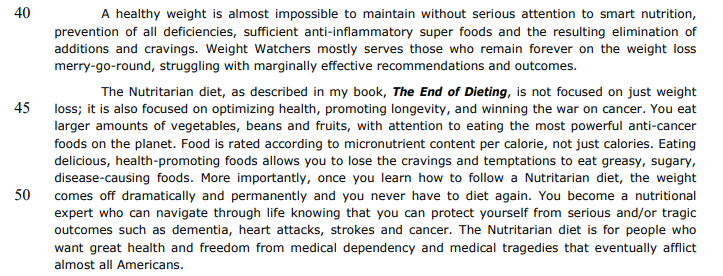
By Dr. Joel Fuhrman
Retrieved and adapted from https://www.drfuhrman.com/learn/library/articles/46/weight-watchers-focuses-onweight-not-health
Access on April 26, 2017.
By Dr. Joel Fuhrman
Retrieved and adapted from https://www.drfuhrman.com/learn/library/articles/46/weight-watchers-focuses-onweight-not-health
Access on April 26, 2017.
By Dr. Joel Fuhrman
Retrieved and adapted from https://www.drfuhrman.com/learn/library/articles/46/weight-watchers-focuses-onweight-not-health
Access on April 26, 2017.
A questão referem-se ao quadrinho
abaixo.

A questao refere-se ao texto abaixo.

Read TEXT 1 below and answer question
TEXT 1
World Health Officials Describe Progress Against Tetanus, H.I.V. and Malaria
Infant and maternal tetanus was officially eliminated from the Americas this year, the Pan American Health Organization
announced on Thursday. At one time, the infection killed about 10,000 newborns annually in the Western Hemisphere; tetanus
still kills about 35,000 infants around the world. It was one of several significant global health advances, including new programs
against malaria and H.I.V., announced last week in conjunction with the meeting of the United Nations General Assembly in
New York.
Haiti was the last country in the Americas to eliminate neonatal tetanus. That does not mean complete eradication,
because the bacteria that cause tetanus exist everywhere in soil and animal droppings. Rather, elimination means that
thanks to vaccination of mothers and clean birth procedures — less than one case occurs per 1,000 live births.
The Americas have generally led the world in eliminating diseases for which vaccines exist. In this hemisphere, smallpox
was eliminated in 1971, polio in 1994, rubella in 2015 and measles in 2016 (the diseases are sometimes reintroduced, as
measles was at Disneyland in 2014, but outbreaks are usually brought quickly under control).
Also this week, the President’s Malaria Initiative said it would expand its work to new countries in West and Central
Africa, protecting 90 million more people. The initiative, founded in 2005 as part of the United States Agency for International
Development, has been a major force in driving down worldwide malaria deaths by about 40 percent in the past decade. The
disease most often kills young children and pregnant women. The expansion in Cameroon, Ivory Coast, Niger, Sierra Leone
and Burkina Faso was made possible because Congress increased funding for the initiative in fiscal year 2017, a representativ
said
In his speech to the United Nations on Tuesday, President Trump praised the malaria initiative and the President’s
Emergency Plan for AIDS Relief as examples of leadership in humanitarian assistance by the United States.
A combination of aid agencies, drug companies and g
cocktail to treat H.I.V. would soon be available to 92 countries, including virtually all of Africa, for about $75 a year. The new AIDS cocktail is the first available in poor countries to contain dolutegravir, which is widely used in wealthy countries because it is highly effective and has few side effects. The pill also contains lamivudine, an older but still effective drug, and tenof
disoproxil fumarate, another modern drug whose inclus
effects and resistance.
Almost 37 million people in the world have H.I.V., according to Unaids, the U.N.’s AIDS-fighting agency, but fewer than 20 million are now on antiretroviral medicine, which not only saves their lives but prevents them from passing on the disease.
McNEIL Jr., Donald. Disponível em: < https://www.nytimes.com/2017/09/22/health/world-health-tetanus-infants.html?mcubz=1>. Acesso em: 22/09/2017.
Text1
Autism's Drug Problem
Many people on the spectrum take multiple medications, which can lead to serious side effects and may not even be effective
Connor was diagnosed with autism early — when he was just 18 months old. His condition was already obvious by then. “He
was lining things up, switching lights on and off, on and off,” says his mother, Melissa. He was bright, but he didn’t speak much
until age 3, and he was easily frustrated. Once he started school, he couldn’t sit still in class, called out answers without raising
his hand and got visibly upset when he couldn’t master a math concept or a handwriting task quickly enough. “One time, he
rolled himself up into the carpet like a burrito and wouldn’t come out until I got there,” Melissa recalls. (All families in this story
are identified by first name only, to protect their privacy.)
Connor was prescribed his first psychiatric drug, methylphenidate (Ritalin), at age 6. That didn’t last long, but when he was 7,
his parents tried again. A psychiatrist suggested a low dose of amphetamine and dextroamphetamine (Adderall), a stimulant
commonly used to treat attention deficit hyperactivity disorder (ADHD). The drug seemed to improve his time at school: He was
able to sit still for longer periods of time and focus on what his teachers were saying. His chicken-scratch handwriting became
legible. Then, it became neat. Then perfect. And then it became something Connor began to obsess over.
“We were told that these are the gives and takes; if it’s helping him enough to get through school, you have to decide if it’s worth
it,” Melissa says. It was worth it — for a while.
But when the Adderall wore off each day, Connor had a tougher time than ever. He spent afternoons crying and refusing to do
much of anything. The stimulant made it difficult for him to fall asleep at night. So after a month or two, his psychiatrist added a
second medication — guanfacine (Intuniv), which is commonly prescribed for ADHD, anxiety and hypertension, but can also
help with insomnia. The psychiatrist hoped it might both ease Connor’s afternoons and help him sleep.
In some ways, it had the opposite effect. His afternoons did get slightly better, but Connor developed intense mood swings and
was so irritable that every evening was a struggle. Rather than simply tossing and turning in bed, he refused to even get under
the covers. “He wouldn’t go to bed because he was always angry about something,” Melissa says. “He was getting himself all
wound up, carrying on, getting upset at night and crying.”
wound up, carrying on, getting upset at night and crying.”
After seven months, his parents declared the combination unsustainable. They swapped guanfacine for over-the-counter
melatonin, which helped Connor fall asleep with no noticeable side effects. But within a year, he had acquired a tolerance for
Adderall. Connor’s psychiatrist increased his dosage and that, in turn, triggered tics: Connor began jerking his head and
snorting. Finally, at his 9-year physical, his doctor discovered that he’d only grown a few inches since age 7. He also hadn’t
gained any weight in two years; he’d dropped from the 50th percentile in weight to the 5th.
That was the end of all the experiments. His parents took him off all prescription drugs, and today, at almost 13 years old,
Connor is still medication-free. His tics have mostly disappeared. Although he has trouble maintaining focus in class, his mother
says that the risk-benefit ratio of trying another drug doesn’t seem worth it. “Right now we’re able to handle life without it, so we
do.”
(...)
For Connor, eliminating prescription drugs was difficult, but doable. For others, multiple medications may seem indispensable.
It’s not unusual for children with autism to take two, three, even four medications at once. Many adults with the condition do so,
too. Data are scant in both populations, but what little information there is suggests multiple prescriptions are even more
common among adults with autism than in children. Clinicians are particularly concerned about children with the condition
because psychiatric medications can have long-lasting effects on their developing brains, and yet are rarely tested in children.
In general, polypharmacy — most often defined as taking more than one prescription medication at once — is commonplace in
people with autism. In one study of more than 33,000 people under age 21 with the condition, at least 35 percent had taken two
psychotropic medications simultaneously; 15 percent had taken three.
“Psychotropic medications are used pretty extensively in people with autism because there aren’t a lot of treatments available,”
says Lisa Croen, director of the Autism Research Program at Kaiser Permanente in Oakland, California. “Is heavy drug use
bad? That’s the question. We don’t know; it hasn’t been studied.”
Disponível em: <https://www.scientificamerican.com/article/autisms-drug-problem/>. Texto adaptado.

Updated 0212 GMT (1012 HKT) March 19, 2017
A post on the St. Charles County police Facebook page said officers responded to a medical emergency at the residence around 12:40 p.m. (1:40 p.m. ET) Saturday and found an unresponsive man inside. Resuscitation efforts failed.
“The St. Charles County Police Department sadly confirms the death of Charles Edward Anderson Berry Sr., better known as legendary musician Chuck Berry.”
A musical legend
Berry wrote and recorded “Johnny B. Goode” and “Sweet Little Sixteen” -- songs every garage band and fledgling guitarist had to learn if they wanted to enter the rock ‘n’ roll fellowship.
Berry took all-night hamburger stands, brown-eyed handsome men and V-8 Fords and turned them into the stuff of American poetry. By doing so, he gave rise to followers beyond number, bar-band disciples of the electric guitar, who carried his musical message to the far corners of the Earth.
Some of his most famous followers praised him on social media.
Bruce Springsteen tweeted: “Chuck Berry was rock’s greatest practitioner, guitarist, and the greatest pure rock ‘n’ roll writer who ever lived.”
Chuck Berry was rock’s greatest practitioner, guitarist, and the greatest pure rock ‘n’ roll writer who ever lived.
The Rolling Stones posted on their website: “The Rolling Stones are deeply saddened to hear of the passing of Chuck Berry. He was a true pioneer of rock ‘n’ roll and a massive influence on us. Chuck was not only a brilliant guitarist, singer and performer, but most importantly, he was a master craftsman as a songwriter. His songs will live forever. “
But it was perhaps John Lennon -- who died in 1980 -- who put it most succinctly. “If you tried to give rock and roll another name, you might call it ‘Chuck Berry.’”
The list of Berry’s classics is as well-known as his distinctive, chiming “Chuck Berry riff”: “Maybellene.” “Around and Around.” “Brown-Eyed Handsome Man.” “School Days.” “Memphis.” “Nadine.” “No Particular Place to Go.”
They were deceptively simple tunes, many constructed with simple chord progressions and classic verse-chorus-verse formats, but their hearts could be as big as teenage hopes on a Saturday night.
His music even went into outer space. When the two Voyager spacecrafts were launched in 1977, each was accompanied on its journey to the outer reaches of the solar system by a phonograph record that contained sounds of Earth -- including “Johnny B. Goode.”
The alternative which lists only words used as adjectives in the text is
Pseudoscientific claims that music helps plants grow have been made for decades, despite evidence that is shaky at best. Yet new research suggests some flora may be capable of sensing sounds, such as the gurgle of water through a pipe or the buzzing of insects.
In a recent study, Monica Gagliano, an evolutionary biologist at the University of Western Australia, and her colleagues placed pea seedlings in pots shaped like an upside-down Y. One arm of each pot was placed in either a tray of water or a coiled plastic tube through which water flowed; the other arm had dry soil. The roots grew toward the arm of the pipe with the fluid, regardless of whether it was easily accessible or hidden inside the tubing. “They just knew the water was there, even if the only thing to detect was the sound of it flowing inside the pipe,” Gagliano says. Yet when the seedlings were given a choice between the water tube and some moistened soil, their roots favored the latter. She hypothesizes that these plants use sound waves to detect water at a distance but follow moisture gradients to home in on their target when it is closer.
The research, reported earlier this year in Oecologia, is not the first to suggest flora can detect and interpret sounds. A 2014 study showed the rock cress Arabidopsis can distinguish between caterpillar chewing sounds and wind vibrations – the plant produced more chemical toxins after “hearing” a recording of feeding insects. “We tend to underestimate plants because their responses are usually less visible to us. But leaves turn out to be extremely sensitive vibration detectors,” says lead study author Heidi M. Appel, an environmental scientist now at the University of Toledo.
Read the text below and answer the following questions based on it.
In 2017 the protestant church is celebrating an important event: the 500th anniversary of the Reformation
The 500th Reformation anniversary also means a great deal to Heidelberg. The then capital of the Kurpfalz (the Electoral Palatinate) played an important role in the spreading of the new doctrine. On April 26, 1518, Martin Luther visited Heidelberg, residence of the Elector Princes. As in Wittenberg, he proclaimed his 95 theses and defended himself before the General Chapter of the Augustine monks at the famous Heidelberg Defense. The commemorative Luther plaque marks where the Augustine abbey once stood. In 1563 the famous Heidelberg Catechism was formulated, the most significant confessional document in the reformed Christian faith the world over.
INSTRUÇÃO: a questão deve ser respondida com base no texto a seguir.


Adapted from:< http://www.psychologicalscience.org/index.php/news/releases/consumerism-and-its-antisocial-effects-can-beturned-onor-off.html> and < http://grist.org/living/consumerism-plays-a-huge-role-in-climate-change/>Acessed on September 1st, 2016.
TEXTO I
HOW TO TRICK YOUR BRAIN INTO HEALTHY EATING
Charles Spence and Jozef Youssef


 Conheça nossos planos