Questões de Vestibular
Sobre sinônimos | synonyms em inglês
Foram encontradas 332 questões


Considere as seguintes propostas de reescrita para o trecho But a slippery, porous slate no school-room or cottage roof could find use for (l. 36-38).
I - But a slippery, porous slate for which no school-room or cottage could find use
II - But a slippery, porous slate that no school-room or cottage could find use for
III- But a slippery, porous slate who no school-room or cottage could find use for
Quais poderiam substituir o segmento destacado, sem prejuízo do sentido literal e da correção gramatical?
Associe as palavras da coluna da esquerda aos seus respectivos sinônimos, na coluna da direita, de acordo com o sentido com que estão empregadas no texto.
( ) vile (l. 12)
( ) meagre (l. 30)
( ) unceasing (l. 42)
1. ashamed
2. continuum
3. untidy
4. exiguous
5. despicable
6. continual
A sequência correta de preenchimento dos parênteses, de cima para baixo, é

The time has gone, the song is over (ℓ. 22)
The expression has gone refers to an action that can be described as:

The global health community has largely come to realize that public health preparedness is crucial (ℓ. 23-24)
Another word from the text that may replace the underlined one above without significant change in meaning is:

In today’s political climate, it sometimes feels like we can’t even agree on basic facts. We bombard each other with statistics and figures, hoping that more data will make a difference. A progressive person might show you the same climate change graphs over and over while a conservative person might point to the trillions of dollars of growing national debt. We’re left wondering, “Why can’t they just see? It’s so obvious!”
Certain myths are so pervasive that no matter how many experts disprove them, they only seem to grow in popularity. There’s no shortage of serious studies showing no link between autism and vaccines, for example, but these are no match for an emotional appeal to parents worried for their young children.
Tali Sharot, a cognitive neuroscientist at University College London, studies how our minds work and how we process new information. In her upcoming book, The Influential Mind, she explores why we ignore facts and how we can get people to actually listen to the truth. Tali shows that we’re open to new information – but only if it confirms our existing beliefs. We find ways to ignore facts that challenge our ideals. And as neuroscientist Bahador Bahrami and colleagues have found, we weigh all opinions as equally valid, regardless of expertise.
So, having the data on your side is not always enough. For better or for worse, Sharot says, emotions may be the key to changing minds.
(Shankar Vedantam. www.npr.org. Adaptado.)
Opportunity Cost
This phenomenon goes by the name of ‘opportunity cost,’ since by not investing in more equipment and a more rigid production flow, the company is forgoing the opportunity to earn increased profits. These costs are every bite as real as the payment of dollars out-of-pocket.
This notion _______ opportunity cost can be reinforced _________ a famous saying ______ Benjamin Franklin, no slouch himself _________ operations management. To make the point, however, we must make a brief excursion into logic. One truth of logic is the validity of the so-called contrapositive, which says simply that if the statement “If A, then B” is true, then it is also true that “If not B, then not A.” That is, of every time A occurs B follows, then we can be sure that if B does not occur, then A did not occur as well. Enough logic then, and back to Ben Franklin.
One of his Poor Richard sayings is that “A penny saved is a penny earned.” We have all recognized the truth of that since childhood, but I assert that by this saying Ben showed us he knows everything about opportunity cost. After all, what is the contrapositive of “A penny not earned is a penny not saved (i.e., a penny sent). All we are saying by this notion of opportunity cost is that “a penny not earned (an opportunity forgone) is a penny spent.” We shall often have occasion to consider opportunity costs, in analyzing and deciding various operations issues.
SCHMENNER, Roger W. Production/Operations Management. 5th
Edition. Prentice-Hall, 1993.
Opportunity Cost
This phenomenon goes by the name of ‘opportunity cost,’ since by not investing in more equipment and a more rigid production flow, the company is forgoing the opportunity to earn increased profits. These costs are every bite as real as the payment of dollars out-of-pocket.
This notion _______ opportunity cost can be reinforced _________ a famous saying ______ Benjamin Franklin, no slouch himself _________ operations management. To make the point, however, we must make a brief excursion into logic. One truth of logic is the validity of the so-called contrapositive, which says simply that if the statement “If A, then B” is true, then it is also true that “If not B, then not A.” That is, of every time A occurs B follows, then we can be sure that if B does not occur, then A did not occur as well. Enough logic then, and back to Ben Franklin.
One of his Poor Richard sayings is that “A penny saved is a penny earned.” We have all recognized the truth of that since childhood, but I assert that by this saying Ben showed us he knows everything about opportunity cost. After all, what is the contrapositive of “A penny not earned is a penny not saved (i.e., a penny sent). All we are saying by this notion of opportunity cost is that “a penny not earned (an opportunity forgone) is a penny spent.” We shall often have occasion to consider opportunity costs, in analyzing and deciding various operations issues.
SCHMENNER, Roger W. Production/Operations Management. 5th
Edition. Prentice-Hall, 1993.
Opportunity Cost
This phenomenon goes by the name of ‘opportunity cost,’ since by not investing in more equipment and a more rigid production flow, the company is forgoing the opportunity to earn increased profits. These costs are every bite as real as the payment of dollars out-of-pocket.
This notion _______ opportunity cost can be reinforced _________ a famous saying ______ Benjamin Franklin, no slouch himself _________ operations management. To make the point, however, we must make a brief excursion into logic. One truth of logic is the validity of the so-called contrapositive, which says simply that if the statement “If A, then B” is true, then it is also true that “If not B, then not A.” That is, of every time A occurs B follows, then we can be sure that if B does not occur, then A did not occur as well. Enough logic then, and back to Ben Franklin.
One of his Poor Richard sayings is that “A penny saved is a penny earned.” We have all recognized the truth of that since childhood, but I assert that by this saying Ben showed us he knows everything about opportunity cost. After all, what is the contrapositive of “A penny not earned is a penny not saved (i.e., a penny sent). All we are saying by this notion of opportunity cost is that “a penny not earned (an opportunity forgone) is a penny spent.” We shall often have occasion to consider opportunity costs, in analyzing and deciding various operations issues.
SCHMENNER, Roger W. Production/Operations Management. 5th
Edition. Prentice-Hall, 1993.
Opportunity Cost
This phenomenon goes by the name of ‘opportunity cost,’ since by not investing in more equipment and a more rigid production flow, the company is forgoing the opportunity to earn increased profits. These costs are every bite as real as the payment of dollars out-of-pocket.
This notion _______ opportunity cost can be reinforced _________ a famous saying ______ Benjamin Franklin, no slouch himself _________ operations management. To make the point, however, we must make a brief excursion into logic. One truth of logic is the validity of the so-called contrapositive, which says simply that if the statement “If A, then B” is true, then it is also true that “If not B, then not A.” That is, of every time A occurs B follows, then we can be sure that if B does not occur, then A did not occur as well. Enough logic then, and back to Ben Franklin.
One of his Poor Richard sayings is that “A penny saved is a penny earned.” We have all recognized the truth of that since childhood, but I assert that by this saying Ben showed us he knows everything about opportunity cost. After all, what is the contrapositive of “A penny not earned is a penny not saved (i.e., a penny sent). All we are saying by this notion of opportunity cost is that “a penny not earned (an opportunity forgone) is a penny spent.” We shall often have occasion to consider opportunity costs, in analyzing and deciding various operations issues.
SCHMENNER, Roger W. Production/Operations Management. 5th
Edition. Prentice-Hall, 1993.
Opportunity Cost
This phenomenon goes by the name of ‘opportunity cost,’ since by not investing in more equipment and a more rigid production flow, the company is forgoing the opportunity to earn increased profits. These costs are every bite as real as the payment of dollars out-of-pocket.
This notion _______ opportunity cost can be reinforced _________ a famous saying ______ Benjamin Franklin, no slouch himself _________ operations management. To make the point, however, we must make a brief excursion into logic. One truth of logic is the validity of the so-called contrapositive, which says simply that if the statement “If A, then B” is true, then it is also true that “If not B, then not A.” That is, of every time A occurs B follows, then we can be sure that if B does not occur, then A did not occur as well. Enough logic then, and back to Ben Franklin.
One of his Poor Richard sayings is that “A penny saved is a penny earned.” We have all recognized the truth of that since childhood, but I assert that by this saying Ben showed us he knows everything about opportunity cost. After all, what is the contrapositive of “A penny not earned is a penny not saved (i.e., a penny sent). All we are saying by this notion of opportunity cost is that “a penny not earned (an opportunity forgone) is a penny spent.” We shall often have occasion to consider opportunity costs, in analyzing and deciding various operations issues.
SCHMENNER, Roger W. Production/Operations Management. 5th
Edition. Prentice-Hall, 1993.
Match the words in column 1 to their definitions in column 2:
Column 1 Words
1. profits
2. slouch
3. issue(s)
4. flow
5. validity
Column 2 Definitions
( ) the continuous production or supply of something.
( ) the state of being legally or officially acceptable.
( ) the money you make in business or by selling things.
( ) to stand, sit or move in a lazy way, often with your shoulders and head bent forward.
( ) important topics that people are discussing or arguing about.
Choose the alternative that presents the correct
sequence, from top to bottom.
Text
A French art expert believes a charcoal drawing kept in a collection for more than 150 years may be a preparatory sketch made by Leonardo da Vinci of the Mona Lisa.
The black-and-white drawing of a woman, nude from the waist up, known as the Monna Vanna, was previously attributed to Leonardo’s studio, suggesting it was done in his style by a pupil or follower, not by the master himself.
But after preliminary tests at the Louvre Museum, experts believe the sketch may well have been drawn by Leonardo.
Among the signs, according to curator Mathieu Deldicque, are the fact the drawing was made during the same period as the Mona Lisa, the paper is from the same region of Italy, and the technique is very similar to that of the Mona Lisa.
“We know the drawing was made during the lifetime of Leonardo da Vinci, we know that the paper was made in Italy, between Venice and Florence, and the third discovery is the high quality of this drawing in the face of the Monna Vanna and in her arms,” Deldicque told reporters.
“That’s very interesting because the arms are the same as the Mona Lisa‘s.”
Leonardo, who lived from 1452 to 1519, was an engineer, scientist, inventor and sculptor, as well as one of the finest artists of the Italian Renaissance.
He painted the Mona Lisa, also known as La Gioconda and regarded as the world’s most valuable artwork, at the beginning of the 16th century. It is believed to depict Lisa Gherardini, the wife of a successful merchant.
EXCITING
The charcoal portrait, in which the woman is holding a similar pose to the Mona Lisa but with her body more side-on and her head turned further over her left shoulder, has been held in a collection at the Conde Museum at the Palace of Chantilly, north of Paris, since 1862.
The Mona Lisa and Monna Vanna hold their hands in very similar ways, the right hand across the left and resting on the forearm, the fingers gently extended.
Deldicque said that while it was exciting to think the charcoal drawing was created by Leonardo, there were more tests to be done.
“We have one more month of analysis and then a very slow process of history of art with a collection of analysts and advice by specialists,” he said.
It is possible that process will determine that the authorship is the same. But it may also be inconclusive, he said, adding:
“Maybe the mystery will remain.”
(Source: adapted from http://www.reuters.com/article/us-france-monalisa-sketch/is-16th-century-charcoal-sketch-a-naked-mona-lisa-idUSKCN1C42LD, retrieved on October 1, 2017)
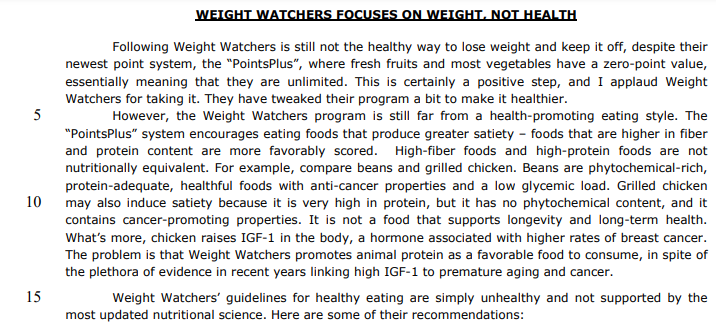
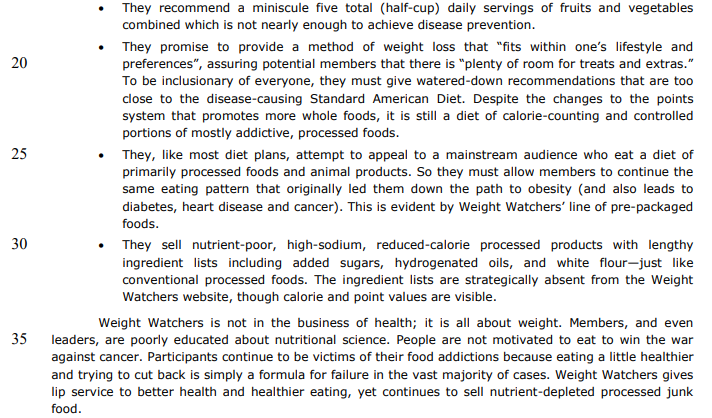
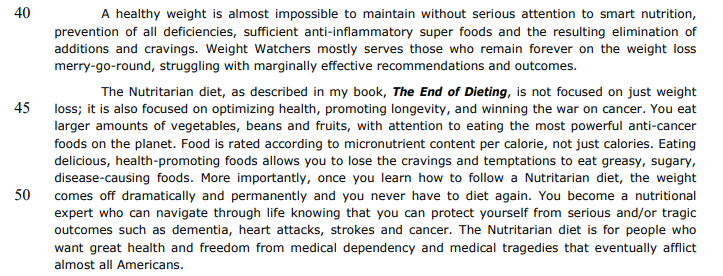
By Dr. Joel Fuhrman
Retrieved and adapted from https://www.drfuhrman.com/learn/library/articles/46/weight-watchers-focuses-onweight-not-health
Access on April 26, 2017.
By Dr. Joel Fuhrman
Retrieved and adapted from https://www.drfuhrman.com/learn/library/articles/46/weight-watchers-focuses-onweight-not-health
Access on April 26, 2017.
The true potential of technology to change behavior
Technology could successfully change behaviours where decades of campaigns and legislation have failed. With the quantified self already walking among us and the internet of things within easy reach, digital technology is creating unprecedented opportunities to encourage, enable and empower more sustainable behaviours.
If we are to unlock the power of technology we must be more ambitious than simply digitising analogue strategies or creating another communications channel.
The true potential of technology lies in its ability to do things that nothing else can do. In behaviour change terms, the potential to succeed where decades of education programmes, awareness campaigns and product innovation have failed; to make a difference where government policy and legislation has had limited impact.
Using behavioural insights, it is possible to highlight the bottlenecks, drop out points and achilles heels of traditional behaviour change efforts — the reasons why we have failed in the past — and apply the unique possibilities of technology to these specific challenges.
Overcoming our limitations
Luckily, the history of the human race is almost defined by its ability to invent stuff that bolsters its feeble capabilities. That stuff is, of course, what we generically refer to as 'technology'. And in the same way that the internal combustion engine and the light bulb allow us to overcome our relatively feeble powers of motion and perception, so digital technology can be directed to overcoming our relatively feeble powers of reasoning, selfcontrol, motivation, self-awareness and agency—the factors that make behaviour change so difficult.
Herein lies the true potential of technology: not in the laboratory or the workshop, but in an understanding of the behavioural dynamics that define the human condition, both generally and within the context of a specific user-group, market segment or community.
Fonte: JOHNSON, Steven. Recognising the true potential of technology to change behaviour. Disponível em:<https://www.theguardian.com/sustainablebusiness/behavioural-insights/true-potential-technology-change-behaviour>
Read TEXT 1 below and answer question
TEXT 1
World Health Officials Describe Progress Against Tetanus, H.I.V. and Malaria
Infant and maternal tetanus was officially eliminated from the Americas this year, the Pan American Health Organization
announced on Thursday. At one time, the infection killed about 10,000 newborns annually in the Western Hemisphere; tetanus
still kills about 35,000 infants around the world. It was one of several significant global health advances, including new programs
against malaria and H.I.V., announced last week in conjunction with the meeting of the United Nations General Assembly in
New York.
Haiti was the last country in the Americas to eliminate neonatal tetanus. That does not mean complete eradication,
because the bacteria that cause tetanus exist everywhere in soil and animal droppings. Rather, elimination means that
thanks to vaccination of mothers and clean birth procedures — less than one case occurs per 1,000 live births.
The Americas have generally led the world in eliminating diseases for which vaccines exist. In this hemisphere, smallpox
was eliminated in 1971, polio in 1994, rubella in 2015 and measles in 2016 (the diseases are sometimes reintroduced, as
measles was at Disneyland in 2014, but outbreaks are usually brought quickly under control).
Also this week, the President’s Malaria Initiative said it would expand its work to new countries in West and Central
Africa, protecting 90 million more people. The initiative, founded in 2005 as part of the United States Agency for International
Development, has been a major force in driving down worldwide malaria deaths by about 40 percent in the past decade. The
disease most often kills young children and pregnant women. The expansion in Cameroon, Ivory Coast, Niger, Sierra Leone
and Burkina Faso was made possible because Congress increased funding for the initiative in fiscal year 2017, a representativ
said
In his speech to the United Nations on Tuesday, President Trump praised the malaria initiative and the President’s
Emergency Plan for AIDS Relief as examples of leadership in humanitarian assistance by the United States.
A combination of aid agencies, drug companies and g
cocktail to treat H.I.V. would soon be available to 92 countries, including virtually all of Africa, for about $75 a year. The new AIDS cocktail is the first available in poor countries to contain dolutegravir, which is widely used in wealthy countries because it is highly effective and has few side effects. The pill also contains lamivudine, an older but still effective drug, and tenof
disoproxil fumarate, another modern drug whose inclus
effects and resistance.
Almost 37 million people in the world have H.I.V., according to Unaids, the U.N.’s AIDS-fighting agency, but fewer than 20 million are now on antiretroviral medicine, which not only saves their lives but prevents them from passing on the disease.
McNEIL Jr., Donald. Disponível em: < https://www.nytimes.com/2017/09/22/health/world-health-tetanus-infants.html?mcubz=1>. Acesso em: 22/09/2017.
Text1
Autism's Drug Problem
Many people on the spectrum take multiple medications, which can lead to serious side effects and may not even be effective
Connor was diagnosed with autism early — when he was just 18 months old. His condition was already obvious by then. “He
was lining things up, switching lights on and off, on and off,” says his mother, Melissa. He was bright, but he didn’t speak much
until age 3, and he was easily frustrated. Once he started school, he couldn’t sit still in class, called out answers without raising
his hand and got visibly upset when he couldn’t master a math concept or a handwriting task quickly enough. “One time, he
rolled himself up into the carpet like a burrito and wouldn’t come out until I got there,” Melissa recalls. (All families in this story
are identified by first name only, to protect their privacy.)
Connor was prescribed his first psychiatric drug, methylphenidate (Ritalin), at age 6. That didn’t last long, but when he was 7,
his parents tried again. A psychiatrist suggested a low dose of amphetamine and dextroamphetamine (Adderall), a stimulant
commonly used to treat attention deficit hyperactivity disorder (ADHD). The drug seemed to improve his time at school: He was
able to sit still for longer periods of time and focus on what his teachers were saying. His chicken-scratch handwriting became
legible. Then, it became neat. Then perfect. And then it became something Connor began to obsess over.
“We were told that these are the gives and takes; if it’s helping him enough to get through school, you have to decide if it’s worth
it,” Melissa says. It was worth it — for a while.
But when the Adderall wore off each day, Connor had a tougher time than ever. He spent afternoons crying and refusing to do
much of anything. The stimulant made it difficult for him to fall asleep at night. So after a month or two, his psychiatrist added a
second medication — guanfacine (Intuniv), which is commonly prescribed for ADHD, anxiety and hypertension, but can also
help with insomnia. The psychiatrist hoped it might both ease Connor’s afternoons and help him sleep.
In some ways, it had the opposite effect. His afternoons did get slightly better, but Connor developed intense mood swings and
was so irritable that every evening was a struggle. Rather than simply tossing and turning in bed, he refused to even get under
the covers. “He wouldn’t go to bed because he was always angry about something,” Melissa says. “He was getting himself all
wound up, carrying on, getting upset at night and crying.”
wound up, carrying on, getting upset at night and crying.”
After seven months, his parents declared the combination unsustainable. They swapped guanfacine for over-the-counter
melatonin, which helped Connor fall asleep with no noticeable side effects. But within a year, he had acquired a tolerance for
Adderall. Connor’s psychiatrist increased his dosage and that, in turn, triggered tics: Connor began jerking his head and
snorting. Finally, at his 9-year physical, his doctor discovered that he’d only grown a few inches since age 7. He also hadn’t
gained any weight in two years; he’d dropped from the 50th percentile in weight to the 5th.
That was the end of all the experiments. His parents took him off all prescription drugs, and today, at almost 13 years old,
Connor is still medication-free. His tics have mostly disappeared. Although he has trouble maintaining focus in class, his mother
says that the risk-benefit ratio of trying another drug doesn’t seem worth it. “Right now we’re able to handle life without it, so we
do.”
(...)
For Connor, eliminating prescription drugs was difficult, but doable. For others, multiple medications may seem indispensable.
It’s not unusual for children with autism to take two, three, even four medications at once. Many adults with the condition do so,
too. Data are scant in both populations, but what little information there is suggests multiple prescriptions are even more
common among adults with autism than in children. Clinicians are particularly concerned about children with the condition
because psychiatric medications can have long-lasting effects on their developing brains, and yet are rarely tested in children.
In general, polypharmacy — most often defined as taking more than one prescription medication at once — is commonplace in
people with autism. In one study of more than 33,000 people under age 21 with the condition, at least 35 percent had taken two
psychotropic medications simultaneously; 15 percent had taken three.
“Psychotropic medications are used pretty extensively in people with autism because there aren’t a lot of treatments available,”
says Lisa Croen, director of the Autism Research Program at Kaiser Permanente in Oakland, California. “Is heavy drug use
bad? That’s the question. We don’t know; it hasn’t been studied.”
Disponível em: <https://www.scientificamerican.com/article/autisms-drug-problem/>. Texto adaptado.
Drinking coffee could help you live longer Coffee not only helps you feel full of beans, it might add years to your life as well, two major studies have shown. Scientists in Europe and the US have uncovered the clearest evidence yet that drinking coffee reduces the risk of death.
One study of more than half a million people from 10 European countries found that men who downed at least three cups of coffee a day were 18% less likely to die from any cause than non-coffee drinkers. Women drinking the same amount benefited less, but still experienced an 8% reduction in mortality over the period measured.
Similar results were reported by American scientists who conducted a separate investigation, recruiting 185855 participants from different ethnic backgrounds. Irrespective of ethnicity, people who drank two to three cups of coffee daily had an 18% reduced risk of death.
Each of the studies, both published in the journal Annals of Internal Medicine, showed no advantage from drinking either caffeinated or decaffeinated coffee. Experts believe the antioxidant plant compounds in coffee rather than caffeine are responsible for the life-extending effect. Previous research has suggested that drinking coffee can reduce the risk of heart disease, diabetes, liver disease, and some cancers.
Dr Marc Gunter, from the International Agency for Research on Cancer, who led the European study with colleagues from Imperial College London, said: “We found that higher coffee consumption was associated with a lower risk of death from any cause and specifically for circulatory diseases and digestive diseases. Importantly, these results were similar across all of the 10 European countries, with variable coffee drinking habits and customs. Our study also offers important insights into the possible mechanisms for the beneficial health effects of coffee.”
(www.huffingtonpost.co.uk, 11.07.2017. Adaptado.)

 Conheça nossos planos