Questões de Vestibular
Sobre sinônimos | synonyms em inglês
Foram encontradas 332 questões


Read the text below and answer the question.
Advancing gender equity in medicine
[…]
The problem of gender inequity in medical leadership is not the result of too few candidates who are not men with the appropriate experience and training to fulfill leadership roles, nor can it be explained by merely suggesting that different genders do not have the same aspirations as men. Gender inequity is largely underpinned by socially constructed gender norms, roles and relations. For example, gender roles explain why female clinicians with children spend 100.2 minutes more per day on household activities and child care than their male counterparts. This makes it more challenging for female clinicians with children to get ahead. Gender norms explain why more men are given leadership opportunities and have stronger letters of reference than other genders. Furthermore, gender relations explain why men have fewer consequences for uncivil behaviour or for harassment in the workplace compared with other genders. A recent observational study of operating room culture evaluated the prevalence and predictors of exposure to disruptive behaviour in the operating room. Disruptive behaviour was described as a range of unacceptable workplace behaviours, including incivility, bullying and harassment. A further definition provided is “interpersonal behaviour (i.e., directed toward others or occurring in the presence of others) that results in a perceived threat to victims and/or witnesses and violates a reasonable person’s standard of respectful behaviour.” The study found that clinicians who are women report more exposure to disruptive behaviour and are substantially less confident or empowered to take action to address incivility in their hospital and university settings. Gender and sexual harassment may be associated with environments that exhibit gender inequity in pay, opportunity and promotion. Disruptive behaviour and overt harassment likely endure within our medical institutions because the offenders are often considered invaluable to the organization for their stature, leadership, productivity or reputation, and are largely not held unaccountable for their actions, which further amplifies gender inequities.
Ensuring gender equity in medicine is an issue of justice and rights. Having more physicians who are women and more women in health policy leadership also appears to enhance the provision of high-quality patient care. Large, well-conducted observational studies have shown that patients of female clinicians experience better quality of care for diabetes, and significantly lower rates of mortality, hospital readmissions and emergency department visits than those treated by male clinicians. One study considered that reasons for this may include that women spend more time with their patients, are more patient-centred in their approach and provide more evidence-based care. Two recent opinion pieces discuss research showing that female representation on corporate boards, such as hospital boards, results in more socially thoughtful decisions and less corruption. Without gender equity, we risk extinguishing creative solutions to complex health problems and, most importantly, limiting patient access to the best care.
From: https://www.ncbi.nlm.nih.gov/pmc/articles/PMC8034331/ CMAJ. 2021 Feb 16; 193(7): E244–E250.
Essential reading on, and beyond, Indigenous Peoples Day

to acknowledge what is working in our communities and in our movements. (l. 31)
The underlined word may be substituted, without significant change in meaning, by the one below:

Considering dental assessments, machine learning tools should:
Leia a tira para responder à questão.
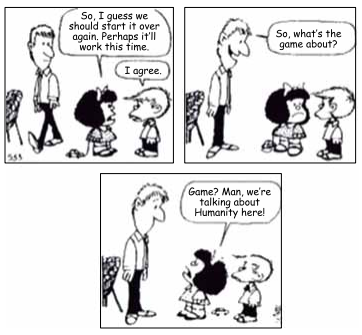
(https://thebrickinthesky.wordpress.com)
If you take a look at my smartphone, you’ll know that I like to order out. But am I helping the small local businesses? You would think that if you own a restaurant you’d be thrilled to have an outsourced service that would take care of your delivery operations while leveraging their marketing might to expand your businesses’ brand. However, restaurant owners have complained of lack of quality control once their food goes out the door. They don’t like that the delivery people are the face of their product when it gets into the customer’s hand. Some of the delivery services have been accused of listing restaurants on their apps without the owners’ permission, and oftentimes publish menu items and prices that are incorrect or out of date.
But there is another reason why restaurant owners aren’t fond of delivery services. It’s the costs, which, for some, are becoming unsustainable. Even with the increased revenues from the delivery services, the fees wind up killing a restaurant’s margins to the extent that it’s at best marginally profitable. Therefore, some restaurants are pushing harder to drive orders from their own websites and offering special deals for customers that use their in-house delivery people.
The simple fact is that these delivery apps are here to stay. They are enormously popular and have significantly grown. I believe that restaurant owners that resist these apps are hurting their brands by missing out on potential customers. The good news is that the delivery platforms are not as evil as some would portray them. They have some skin in the game. They are competing against other services. They want their listed restaurants to profit. Maybe instead of fighting, the nation’s restaurant industry needs to proactively embrace the delivery service industry and figure out ways to profitably work together.
The Guardian. 02 December, 2020. Adaptado.

PAUL SIMON and ART GARFUNKEL
Adaptado de genius.com.
PAUL SIMON and ART GARFUNKEL
Adaptado de genius.com.
PAUL SIMON and ART GARFUNKEL
Adaptado de genius.com.
How things have changed.
Now disagreements feel deadly serious. Like when your colleague pronounces that wearing a face mask in public is a threat to his liberty. Or when you see that one of your friends has just tweeted that, actually, all lives matter. Before you know it, you’re feeling angry and forming harsh new judgments about your colleagues and friends. Let’s take a collective pause and breathe: there are some ways we can all try to have more civil disagreements in this febrile age of culture wars.
1. ‘Coupling’ and ‘decoupling’
The first is to consider how inclined people are to ‘couple’ or ‘decouple’ topics involving wider political and social factors. Swedish data analyst John Nerst has used the terms to describe the contrasting ways in which people approach contentious issues. Those of us more inclined to ‘couple’ see them as inextricably related to a broader matrix of factors, whereas those more predisposed to ‘decouple’ prefer to consider an issue in isolation. To take a crude example, a decoupler might consider in isolation the question of whether a vaccine provides a degree of immunity to a virus; a coupler, by contrast, would immediately see the issue as inextricably entangled in a mesh of factors, such as pharmaceutical industry power and parental choice.
2.____________________
A study at Arizona State University, U.S., analysed more than 100,000 comments on a forum where users post their views on an issue and invite others to persuade them to change their mind. The researchers found that regardless of the kind of topic, people were more likely to change their mind when confronted with more evidence-based arguments. “Our work may suggest that while attitude change is hard-won, providing facts, statistics and citations for one’s arguments can convince people to change their minds,” they concluded.
3. Just be nicer?
Finally, it’s easier said than done, but let’s all try to be more respectful of and attentive to each other’s positions. We should do this not just for virtuous reasons, but because the more we create that kind of a climate, the more open-minded and intellectually flexible we will all be inclined to be. And then hopefully, collectively, we can start having more constructive disagreements — even in our present very difficult times.


Text 1
What is Distance Learning and Why Is It So Important?



 Conheça nossos planos