Questões de Vestibular Sobre inglês
Foram encontradas 6.367 questões


Questão

This phenomenon is known as unihemispheric slow-wave sleep, and it’s seen in marine animals and some birds. This is the first study to suggest that the human brain may also be hard-wired to function in a similar way, although on a smaller scale. Humans, unlike sparrows, don’t usually sleep with one eye open. However, when in new surroundings, one hemisphere of the brain may stay at least a little bit awake – great for waking quickly if an intruder shows up, but with a resulting groggy feeling the next morning.
The group of researchers recruited sleep study participants, and conducted neuroimaging along with polysomnography, a standard test used in sleep labs to monitor brain waves, oxygen level in blood, heart rate, breathing, and eye and leg movements. They discovered that only the brain’s right hemisphere was consistently engaged in slow-wave, or deep, sleep. The left hemisphere – the side responsible for logical thinking and reasoning – had what the researchers called “enhanced vigilance”, which also made the entire brain more responsive to sound.
The researchers tried a test where they targeted sounds to the left and right ear. They found that on the first night, 80 percent of the arousals from deep sleep occurred when sound was made to target the right ear (the brain’s left hemisphere). On day two, that number dropped to about 50 percent.
Questão
This phenomenon is known as unihemispheric slow-wave sleep, and it’s seen in marine animals and some birds. This is the first study to suggest that the human brain may also be hard-wired to function in a similar way, although on a smaller scale. Humans, unlike sparrows, don’t usually sleep with one eye open. However, when in new surroundings, one hemisphere of the brain may stay at least a little bit awake – great for waking quickly if an intruder shows up, but with a resulting groggy feeling the next morning.
The group of researchers recruited sleep study participants, and conducted neuroimaging along with polysomnography, a standard test used in sleep labs to monitor brain waves, oxygen level in blood, heart rate, breathing, and eye and leg movements. They discovered that only the brain’s right hemisphere was consistently engaged in slow-wave, or deep, sleep. The left hemisphere – the side responsible for logical thinking and reasoning – had what the researchers called “enhanced vigilance”, which also made the entire brain more responsive to sound.
The researchers tried a test where they targeted sounds to the left and right ear. They found that on the first night, 80 percent of the arousals from deep sleep occurred when sound was made to target the right ear (the brain’s left hemisphere). On day two, that number dropped to about 50 percent.
Questão
This phenomenon is known as unihemispheric slow-wave sleep, and it’s seen in marine animals and some birds. This is the first study to suggest that the human brain may also be hard-wired to function in a similar way, although on a smaller scale. Humans, unlike sparrows, don’t usually sleep with one eye open. However, when in new surroundings, one hemisphere of the brain may stay at least a little bit awake – great for waking quickly if an intruder shows up, but with a resulting groggy feeling the next morning.
The group of researchers recruited sleep study participants, and conducted neuroimaging along with polysomnography, a standard test used in sleep labs to monitor brain waves, oxygen level in blood, heart rate, breathing, and eye and leg movements. They discovered that only the brain’s right hemisphere was consistently engaged in slow-wave, or deep, sleep. The left hemisphere – the side responsible for logical thinking and reasoning – had what the researchers called “enhanced vigilance”, which also made the entire brain more responsive to sound.
The researchers tried a test where they targeted sounds to the left and right ear. They found that on the first night, 80 percent of the arousals from deep sleep occurred when sound was made to target the right ear (the brain’s left hemisphere). On day two, that number dropped to about 50 percent.
Questão
This phenomenon is known as unihemispheric slow-wave sleep, and it’s seen in marine animals and some birds. This is the first study to suggest that the human brain may also be hard-wired to function in a similar way, although on a smaller scale. Humans, unlike sparrows, don’t usually sleep with one eye open. However, when in new surroundings, one hemisphere of the brain may stay at least a little bit awake – great for waking quickly if an intruder shows up, but with a resulting groggy feeling the next morning.
The group of researchers recruited sleep study participants, and conducted neuroimaging along with polysomnography, a standard test used in sleep labs to monitor brain waves, oxygen level in blood, heart rate, breathing, and eye and leg movements. They discovered that only the brain’s right hemisphere was consistently engaged in slow-wave, or deep, sleep. The left hemisphere – the side responsible for logical thinking and reasoning – had what the researchers called “enhanced vigilance”, which also made the entire brain more responsive to sound.
The researchers tried a test where they targeted sounds to the left and right ear. They found that on the first night, 80 percent of the arousals from deep sleep occurred when sound was made to target the right ear (the brain’s left hemisphere). On day two, that number dropped to about 50 percent.
The study mentioned in the text says that, when we sleep in a new location,
( ) half of our brain may remain alert.
( ) we behave exactly like sparrows.
( ) the left hemisphere of our brain is less asleep than the right.
( ) our brain’s vigilance is a way to protect us from unknown dangers.
The correct sequence, from top to bottom, is
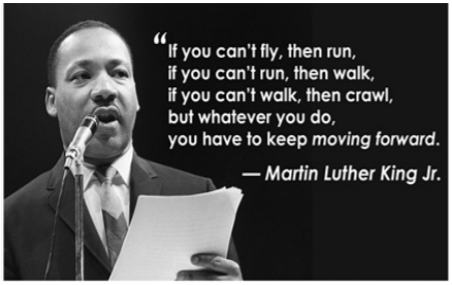 Disponível em: <https://www.goodreads.com/quotes/26963-if-you-can-t-flythen-run-if-you-can-t-run>. Acesso em: set. 2018.
According to this quote by Martin Luther King Jr.

Com base no texto, considere verdadeiras (V) ou falsas (F) as afirmações que seguem.
( ) A maioria dos catadores é autônomo e coleta lixo das ruas para vender aos depósitos de sucatas, geralmente a preços baixos.
( ) Grafiteiros são artistas que somente pintam muros nas grandes capitais.
( ) Os catadores são invisíveis, exclusivamente, na sociedade brasileira.
Marque a alternativa que preenche corretamente os parênteses, de cima para baixo.
Sobre o texto, fazem-se as seguintes afirmações.
I- Os super-heróis também existem na vida real.
II- Os catadores brasileiros não são essenciais à população.
III- A desigualdade social, o desemprego e o lixo em abundância fizeram surgir a ocupação de catadores no Brasil.
Marque a alternativa correta.
Read the graph below and answer the following question.

Adaptado de: <https://brainly.com/question/2608462>
Read the comic strip below and answer the following question based on it.

Disponível em:< http://www.guysports.com/funny/doctor_cartoon.htm>. Acessado em 5 de abril de
2018.
Read the illustration below and answer the following question based on it.

Disponível em:<
https://i.pinimg.com/originals/33/82/af/3382af7d4f90bbed0e333770
abbc317e.jpg>. Acessado em 2 de abril de 2018
Read the text below and answer the following question based on it.
More than half your body is not human
Human cells make up only 43% of the body's total cell count. The rest are microscopic colonists.
Understanding this hidden half of ourselves - our microbiome - is rapidly transforming understanding of diseases from allergy to Parkinson's.
No matter how well you wash, nearly every nook and cranny of your body is covered in microscopic creatures.
This includes bacteria, viruses, fungi and archaea (organisms originally misclassified as bacteria). The greatest concentration of this microscopic life is in the dark murky depths of our oxygen-deprived bowels.
The human genome - the full set of genetic instructions for a human being - is made up of 20,000 instructions called genes.
But add all the genes in our microbiome together and the figure comes out between two and 20 million microbial genes.
Prof Sarkis Mazmanian, a microbiologist from Caltech, argues: "We don't have just one genome, the genes of our microbiome present essentially a second genome which augment the activity of our own.
Science is rapidly uncovering the role the microbiome plays in digestion, regulating the immune system, protecting against disease and manufacturing vital vitamins.
It is a new way of thinking about the microbial world. To date, our relationship with microbes has largely been one of warfare.
Antibiotics and vaccines have been the weapons unleashed against the likes of smallpox, Mycobacterium tuberculosis or MRSA.
That's been a good thing and has saved large numbers of lives.
But some researchers are concerned that our assault on the bad guys has done untold damage to our "good bacteria".
Prof Knight has performed experiments on mice that were born in the most sanitised world imaginable.
He says: "We were able to show that if you take lean and obese humans and take their faeces and transplant the bacteria into mice you can make the mouse thinner or fatter depending on whose microbiome it got."
"This is pretty amazing right, but the question now is will this be translatable to humans"
This is the big hope for the field, that microbes could be a new form of medicine. It is known as using "bugs as drugs".
Adaptado de: < http://www.bbc.com/news/health-43674270> Acessado em 13 de abril de 2018.

 Conheça nossos planos