Questões de Vestibular Sobre inglês
Foram encontradas 6.365 questões


Ano: 2010
Banca:
CESPE / CEBRASPE
Órgão:
UNB
Prova:
CESPE - 2010 - UNB - Vestibular 2° Semestre 2010 - Primeiro Dia |
Q216050
Inglês
Texto associado

According to the text above, judge the following items.
According to the text above, judge the following items.
The word “straightforward” in the fragment “This appears straightforward enough” (L.31) is synonymous with clear-cut.
Ano: 2010
Banca:
CESPE / CEBRASPE
Órgão:
UNB
Prova:
CESPE - 2010 - UNB - Vestibular 2° Semestre 2010 - Primeiro Dia |
Q216049
Inglês
Texto associado
According to the text above, judge the following items.
According to the text above, judge the following items.
Irrespective of how death is defined in each culture, all of them understand it as a total cessation of life.
Ano: 2010
Banca:
CESPE / CEBRASPE
Órgão:
UNB
Prova:
CESPE - 2010 - UNB - Vestibular 2° Semestre 2010 - Primeiro Dia |
Q216048
Inglês
Texto associado
According to the text above, judge the following items.
According to the text above, judge the following items.
The actual meaning and conceptualization of death differ widely across cultures.
Ano: 2010
Banca:
CESPE / CEBRASPE
Órgão:
UNB
Prova:
CESPE - 2010 - UNB - Vestibular 2° Semestre 2010 - Primeiro Dia |
Q216047
Inglês
Texto associado
According to the text above, judge the following items.
According to the text above, judge the following items.
For the majority of people in the world, death involves different conditions such as sleep, illness and age.
Q215699
Inglês
In Text II, the cartoon shows people from different continents, consequently from different cultures, interacting in real time on the internet. Mark the excerpt from Text I which may establish a link with Text II.
Q215698
Inglês
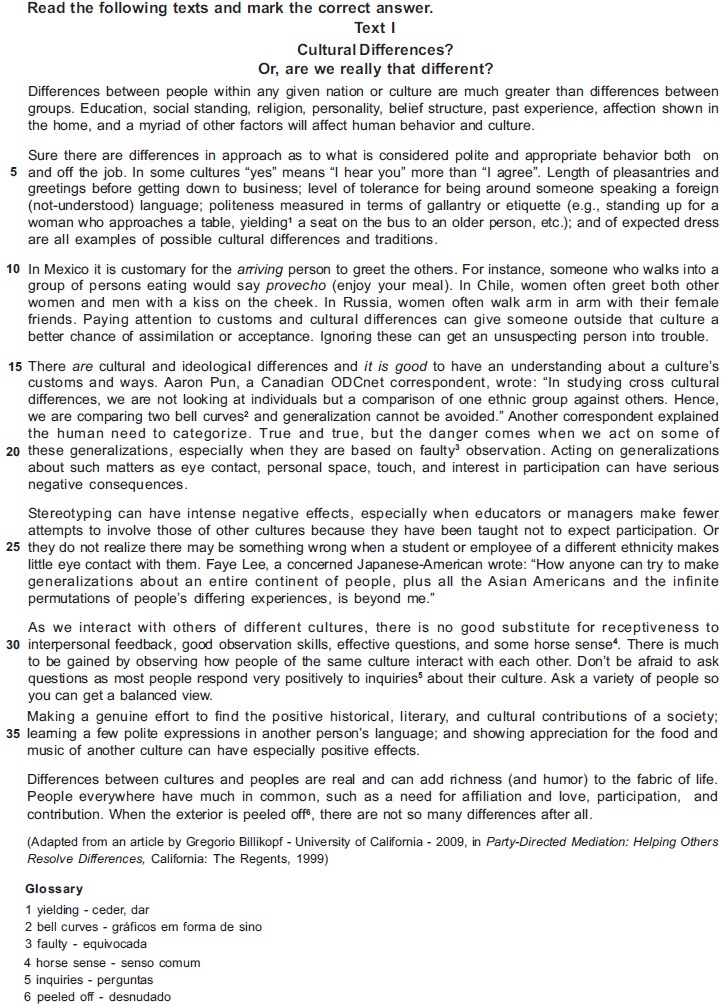
EXEMPLIFICATION is used by the author of the text to develop his argumentation. In paragraph 7, through the use of exemplification, the author
Q215697
Inglês
In “There is much to be gained by observing how people of the same culture interact with each other” (lines 30-31), the expression in bold could be replaced by
Q215696
Inglês
Discourse markers are used to provide cohesion to the text. In the excerpt “Hence, we are comparing two bell curves and generalization cannot be avoided” (lines 17-18), the discourse marker in bold expresses the following semantic relation:
Q215695
Inglês
According to what is stated in the 2nd paragraph, offering a seat on the bus to an older person is an example of
Q215694
Inglês
The meaning of unsuspecting (line 14) is
Q215693
Inglês
According to Text I, in order to interact successfully with people from a different culture, one must
Q215692
Inglês
The title of Text I reflects the author’s position regarding culture. Choose the statement in which this position is best conveyed.
Ano: 2010
Banca:
VUNESP
Órgão:
UNIFESP
Prova:
VUNESP - 2010 - UNIFESP - Vestibular - Língua Portuguesa, Língua Estrangeira e Redação |
Q215447
Inglês
Texto associado
Instrução: Leia o texto para responder às questões de números 40 a 45.
To Scientists, Laughter Is No Joke - It’s Serious
March 31, 2010.
(www.nytimes.com. Adaptado.)
To Scientists, Laughter Is No Joke - It’s Serious
March 31, 2010.
So a scientist walks into a shopping mall to watch people laugh. There’s no punchline. Laughter is a serious scientific subject, one that researchers are still trying to figure out. Laughing is primal, our first way of communicating. Apes laugh. So do dogs and rats. Babies laugh long before they speak. No one teaches you how to laugh. You just do. And often you laugh involuntarily, in a specific rhythm and in certain spots in conversation.
You may laugh at a prank on April Fools’ Day. But surprisingly, only 10 to 15 percent of laughter is the result of someone making a joke, said Baltimore neuroscientist Robert Provine, who has studied laughter for decades. Laughter is mostly about social responses rather than reaction to a joke. “Laughter above all else is a social thing,’’ Provine said. “The requirement for laughter is another person.’’
Over the years, Provine, a professor with the University of Maryland Baltimore County, has boiled laughter down to its basics. “All language groups laugh ‘ha-ha-ha’ basically the same way,’’ he said. “Whether you speak Mandarin, French or English, everyone will understand laughter. ... There’s a pattern generator in our brain that produces this sound.’’
Each “ha’’ is about one-15th of a second, repeated every fifth of a second, he said. Laugh faster or slower than that and it sounds more like panting or something else. Deaf people laugh without hearing, and people on cell phones laugh without seeing, illustrating that laughter isn’t dependent on a single sense but on social interactions, said Provine, author of the book “Laughter: A Scientific Investigation.’’
“It’s joy, it’s positive engagement with life,’’ said Jaak Panksepp, a Bowling Green University psychology professor. “It’s deeply social.’’ And it’s not just a people thing either. Chimps tickle each other and even laugh when another chimp pretends to tickle them. By studying rats, Panksepp and other scientists can figure out what’s going on in the brain during laughter. And it holds promise for human ills.
Northwestern biomedical engineering professor Jeffrey Burgdorf has found that laughter in rats produces an insulin-like growth factor chemical that acts as an antidepressant and anxietyreducer. He thinks the same thing probably happens in humans, too. This would give doctors a new chemical target in the brain in their effort to develop drugs that fight depression and anxiety in people. Even so, laughter itself hasn’t been proven to be the best medicine, experts said.
You may laugh at a prank on April Fools’ Day. But surprisingly, only 10 to 15 percent of laughter is the result of someone making a joke, said Baltimore neuroscientist Robert Provine, who has studied laughter for decades. Laughter is mostly about social responses rather than reaction to a joke. “Laughter above all else is a social thing,’’ Provine said. “The requirement for laughter is another person.’’
Over the years, Provine, a professor with the University of Maryland Baltimore County, has boiled laughter down to its basics. “All language groups laugh ‘ha-ha-ha’ basically the same way,’’ he said. “Whether you speak Mandarin, French or English, everyone will understand laughter. ... There’s a pattern generator in our brain that produces this sound.’’
Each “ha’’ is about one-15th of a second, repeated every fifth of a second, he said. Laugh faster or slower than that and it sounds more like panting or something else. Deaf people laugh without hearing, and people on cell phones laugh without seeing, illustrating that laughter isn’t dependent on a single sense but on social interactions, said Provine, author of the book “Laughter: A Scientific Investigation.’’
“It’s joy, it’s positive engagement with life,’’ said Jaak Panksepp, a Bowling Green University psychology professor. “It’s deeply social.’’ And it’s not just a people thing either. Chimps tickle each other and even laugh when another chimp pretends to tickle them. By studying rats, Panksepp and other scientists can figure out what’s going on in the brain during laughter. And it holds promise for human ills.
Northwestern biomedical engineering professor Jeffrey Burgdorf has found that laughter in rats produces an insulin-like growth factor chemical that acts as an antidepressant and anxietyreducer. He thinks the same thing probably happens in humans, too. This would give doctors a new chemical target in the brain in their effort to develop drugs that fight depression and anxiety in people. Even so, laughter itself hasn’t been proven to be the best medicine, experts said.
(www.nytimes.com. Adaptado.)
No trecho do quarto parágrafo – Laugh faster or slower than that and it sounds more like panting or something else. – a palavra like indica
Ano: 2010
Banca:
VUNESP
Órgão:
UNIFESP
Prova:
VUNESP - 2010 - UNIFESP - Vestibular - Língua Portuguesa, Língua Estrangeira e Redação |
Q215446
Inglês
Texto associado
Instrução: Leia o texto para responder às questões de números 40 a 45.
To Scientists, Laughter Is No Joke - It’s Serious
March 31, 2010.
(www.nytimes.com. Adaptado.)
To Scientists, Laughter Is No Joke - It’s Serious
March 31, 2010.
So a scientist walks into a shopping mall to watch people laugh. There’s no punchline. Laughter is a serious scientific subject, one that researchers are still trying to figure out. Laughing is primal, our first way of communicating. Apes laugh. So do dogs and rats. Babies laugh long before they speak. No one teaches you how to laugh. You just do. And often you laugh involuntarily, in a specific rhythm and in certain spots in conversation.
You may laugh at a prank on April Fools’ Day. But surprisingly, only 10 to 15 percent of laughter is the result of someone making a joke, said Baltimore neuroscientist Robert Provine, who has studied laughter for decades. Laughter is mostly about social responses rather than reaction to a joke. “Laughter above all else is a social thing,’’ Provine said. “The requirement for laughter is another person.’’
Over the years, Provine, a professor with the University of Maryland Baltimore County, has boiled laughter down to its basics. “All language groups laugh ‘ha-ha-ha’ basically the same way,’’ he said. “Whether you speak Mandarin, French or English, everyone will understand laughter. ... There’s a pattern generator in our brain that produces this sound.’’
Each “ha’’ is about one-15th of a second, repeated every fifth of a second, he said. Laugh faster or slower than that and it sounds more like panting or something else. Deaf people laugh without hearing, and people on cell phones laugh without seeing, illustrating that laughter isn’t dependent on a single sense but on social interactions, said Provine, author of the book “Laughter: A Scientific Investigation.’’
“It’s joy, it’s positive engagement with life,’’ said Jaak Panksepp, a Bowling Green University psychology professor. “It’s deeply social.’’ And it’s not just a people thing either. Chimps tickle each other and even laugh when another chimp pretends to tickle them. By studying rats, Panksepp and other scientists can figure out what’s going on in the brain during laughter. And it holds promise for human ills.
Northwestern biomedical engineering professor Jeffrey Burgdorf has found that laughter in rats produces an insulin-like growth factor chemical that acts as an antidepressant and anxietyreducer. He thinks the same thing probably happens in humans, too. This would give doctors a new chemical target in the brain in their effort to develop drugs that fight depression and anxiety in people. Even so, laughter itself hasn’t been proven to be the best medicine, experts said.
You may laugh at a prank on April Fools’ Day. But surprisingly, only 10 to 15 percent of laughter is the result of someone making a joke, said Baltimore neuroscientist Robert Provine, who has studied laughter for decades. Laughter is mostly about social responses rather than reaction to a joke. “Laughter above all else is a social thing,’’ Provine said. “The requirement for laughter is another person.’’
Over the years, Provine, a professor with the University of Maryland Baltimore County, has boiled laughter down to its basics. “All language groups laugh ‘ha-ha-ha’ basically the same way,’’ he said. “Whether you speak Mandarin, French or English, everyone will understand laughter. ... There’s a pattern generator in our brain that produces this sound.’’
Each “ha’’ is about one-15th of a second, repeated every fifth of a second, he said. Laugh faster or slower than that and it sounds more like panting or something else. Deaf people laugh without hearing, and people on cell phones laugh without seeing, illustrating that laughter isn’t dependent on a single sense but on social interactions, said Provine, author of the book “Laughter: A Scientific Investigation.’’
“It’s joy, it’s positive engagement with life,’’ said Jaak Panksepp, a Bowling Green University psychology professor. “It’s deeply social.’’ And it’s not just a people thing either. Chimps tickle each other and even laugh when another chimp pretends to tickle them. By studying rats, Panksepp and other scientists can figure out what’s going on in the brain during laughter. And it holds promise for human ills.
Northwestern biomedical engineering professor Jeffrey Burgdorf has found that laughter in rats produces an insulin-like growth factor chemical that acts as an antidepressant and anxietyreducer. He thinks the same thing probably happens in humans, too. This would give doctors a new chemical target in the brain in their effort to develop drugs that fight depression and anxiety in people. Even so, laughter itself hasn’t been proven to be the best medicine, experts said.
(www.nytimes.com. Adaptado.)
No trecho do terceiro parágrafo – Whether you speak Mandarin, French or English, everyone will understand laughter. – a palavra whether pode ser substituída, sem alteração de sentido, por
Ano: 2010
Banca:
VUNESP
Órgão:
UNIFESP
Prova:
VUNESP - 2010 - UNIFESP - Vestibular - Língua Portuguesa, Língua Estrangeira e Redação |
Q215445
Inglês
Texto associado
Instrução: Leia o texto para responder às questões de números 40 a 45.
To Scientists, Laughter Is No Joke - It’s Serious
March 31, 2010.
(www.nytimes.com. Adaptado.)
To Scientists, Laughter Is No Joke - It’s Serious
March 31, 2010.
So a scientist walks into a shopping mall to watch people laugh. There’s no punchline. Laughter is a serious scientific subject, one that researchers are still trying to figure out. Laughing is primal, our first way of communicating. Apes laugh. So do dogs and rats. Babies laugh long before they speak. No one teaches you how to laugh. You just do. And often you laugh involuntarily, in a specific rhythm and in certain spots in conversation.
You may laugh at a prank on April Fools’ Day. But surprisingly, only 10 to 15 percent of laughter is the result of someone making a joke, said Baltimore neuroscientist Robert Provine, who has studied laughter for decades. Laughter is mostly about social responses rather than reaction to a joke. “Laughter above all else is a social thing,’’ Provine said. “The requirement for laughter is another person.’’
Over the years, Provine, a professor with the University of Maryland Baltimore County, has boiled laughter down to its basics. “All language groups laugh ‘ha-ha-ha’ basically the same way,’’ he said. “Whether you speak Mandarin, French or English, everyone will understand laughter. ... There’s a pattern generator in our brain that produces this sound.’’
Each “ha’’ is about one-15th of a second, repeated every fifth of a second, he said. Laugh faster or slower than that and it sounds more like panting or something else. Deaf people laugh without hearing, and people on cell phones laugh without seeing, illustrating that laughter isn’t dependent on a single sense but on social interactions, said Provine, author of the book “Laughter: A Scientific Investigation.’’
“It’s joy, it’s positive engagement with life,’’ said Jaak Panksepp, a Bowling Green University psychology professor. “It’s deeply social.’’ And it’s not just a people thing either. Chimps tickle each other and even laugh when another chimp pretends to tickle them. By studying rats, Panksepp and other scientists can figure out what’s going on in the brain during laughter. And it holds promise for human ills.
Northwestern biomedical engineering professor Jeffrey Burgdorf has found that laughter in rats produces an insulin-like growth factor chemical that acts as an antidepressant and anxietyreducer. He thinks the same thing probably happens in humans, too. This would give doctors a new chemical target in the brain in their effort to develop drugs that fight depression and anxiety in people. Even so, laughter itself hasn’t been proven to be the best medicine, experts said.
You may laugh at a prank on April Fools’ Day. But surprisingly, only 10 to 15 percent of laughter is the result of someone making a joke, said Baltimore neuroscientist Robert Provine, who has studied laughter for decades. Laughter is mostly about social responses rather than reaction to a joke. “Laughter above all else is a social thing,’’ Provine said. “The requirement for laughter is another person.’’
Over the years, Provine, a professor with the University of Maryland Baltimore County, has boiled laughter down to its basics. “All language groups laugh ‘ha-ha-ha’ basically the same way,’’ he said. “Whether you speak Mandarin, French or English, everyone will understand laughter. ... There’s a pattern generator in our brain that produces this sound.’’
Each “ha’’ is about one-15th of a second, repeated every fifth of a second, he said. Laugh faster or slower than that and it sounds more like panting or something else. Deaf people laugh without hearing, and people on cell phones laugh without seeing, illustrating that laughter isn’t dependent on a single sense but on social interactions, said Provine, author of the book “Laughter: A Scientific Investigation.’’
“It’s joy, it’s positive engagement with life,’’ said Jaak Panksepp, a Bowling Green University psychology professor. “It’s deeply social.’’ And it’s not just a people thing either. Chimps tickle each other and even laugh when another chimp pretends to tickle them. By studying rats, Panksepp and other scientists can figure out what’s going on in the brain during laughter. And it holds promise for human ills.
Northwestern biomedical engineering professor Jeffrey Burgdorf has found that laughter in rats produces an insulin-like growth factor chemical that acts as an antidepressant and anxietyreducer. He thinks the same thing probably happens in humans, too. This would give doctors a new chemical target in the brain in their effort to develop drugs that fight depression and anxiety in people. Even so, laughter itself hasn’t been proven to be the best medicine, experts said.
(www.nytimes.com. Adaptado.)
The excerpt of the first paragraph – You just do. – means that
Ano: 2010
Banca:
VUNESP
Órgão:
UNIFESP
Prova:
VUNESP - 2010 - UNIFESP - Vestibular - Língua Portuguesa, Língua Estrangeira e Redação |
Q215444
Inglês
Texto associado
Instrução: Leia o texto para responder às questões de números 40 a 45.
To Scientists, Laughter Is No Joke - It’s Serious
March 31, 2010.
(www.nytimes.com. Adaptado.)
To Scientists, Laughter Is No Joke - It’s Serious
March 31, 2010.
So a scientist walks into a shopping mall to watch people laugh. There’s no punchline. Laughter is a serious scientific subject, one that researchers are still trying to figure out. Laughing is primal, our first way of communicating. Apes laugh. So do dogs and rats. Babies laugh long before they speak. No one teaches you how to laugh. You just do. And often you laugh involuntarily, in a specific rhythm and in certain spots in conversation.
You may laugh at a prank on April Fools’ Day. But surprisingly, only 10 to 15 percent of laughter is the result of someone making a joke, said Baltimore neuroscientist Robert Provine, who has studied laughter for decades. Laughter is mostly about social responses rather than reaction to a joke. “Laughter above all else is a social thing,’’ Provine said. “The requirement for laughter is another person.’’
Over the years, Provine, a professor with the University of Maryland Baltimore County, has boiled laughter down to its basics. “All language groups laugh ‘ha-ha-ha’ basically the same way,’’ he said. “Whether you speak Mandarin, French or English, everyone will understand laughter. ... There’s a pattern generator in our brain that produces this sound.’’
Each “ha’’ is about one-15th of a second, repeated every fifth of a second, he said. Laugh faster or slower than that and it sounds more like panting or something else. Deaf people laugh without hearing, and people on cell phones laugh without seeing, illustrating that laughter isn’t dependent on a single sense but on social interactions, said Provine, author of the book “Laughter: A Scientific Investigation.’’
“It’s joy, it’s positive engagement with life,’’ said Jaak Panksepp, a Bowling Green University psychology professor. “It’s deeply social.’’ And it’s not just a people thing either. Chimps tickle each other and even laugh when another chimp pretends to tickle them. By studying rats, Panksepp and other scientists can figure out what’s going on in the brain during laughter. And it holds promise for human ills.
Northwestern biomedical engineering professor Jeffrey Burgdorf has found that laughter in rats produces an insulin-like growth factor chemical that acts as an antidepressant and anxietyreducer. He thinks the same thing probably happens in humans, too. This would give doctors a new chemical target in the brain in their effort to develop drugs that fight depression and anxiety in people. Even so, laughter itself hasn’t been proven to be the best medicine, experts said.
You may laugh at a prank on April Fools’ Day. But surprisingly, only 10 to 15 percent of laughter is the result of someone making a joke, said Baltimore neuroscientist Robert Provine, who has studied laughter for decades. Laughter is mostly about social responses rather than reaction to a joke. “Laughter above all else is a social thing,’’ Provine said. “The requirement for laughter is another person.’’
Over the years, Provine, a professor with the University of Maryland Baltimore County, has boiled laughter down to its basics. “All language groups laugh ‘ha-ha-ha’ basically the same way,’’ he said. “Whether you speak Mandarin, French or English, everyone will understand laughter. ... There’s a pattern generator in our brain that produces this sound.’’
Each “ha’’ is about one-15th of a second, repeated every fifth of a second, he said. Laugh faster or slower than that and it sounds more like panting or something else. Deaf people laugh without hearing, and people on cell phones laugh without seeing, illustrating that laughter isn’t dependent on a single sense but on social interactions, said Provine, author of the book “Laughter: A Scientific Investigation.’’
“It’s joy, it’s positive engagement with life,’’ said Jaak Panksepp, a Bowling Green University psychology professor. “It’s deeply social.’’ And it’s not just a people thing either. Chimps tickle each other and even laugh when another chimp pretends to tickle them. By studying rats, Panksepp and other scientists can figure out what’s going on in the brain during laughter. And it holds promise for human ills.
Northwestern biomedical engineering professor Jeffrey Burgdorf has found that laughter in rats produces an insulin-like growth factor chemical that acts as an antidepressant and anxietyreducer. He thinks the same thing probably happens in humans, too. This would give doctors a new chemical target in the brain in their effort to develop drugs that fight depression and anxiety in people. Even so, laughter itself hasn’t been proven to be the best medicine, experts said.
(www.nytimes.com. Adaptado.)
Jeffrey Burgdorf discovered that
Ano: 2010
Banca:
VUNESP
Órgão:
UNIFESP
Prova:
VUNESP - 2010 - UNIFESP - Vestibular - Língua Portuguesa, Língua Estrangeira e Redação |
Q215443
Inglês
Texto associado
Instrução: Leia o texto para responder às questões de números 40 a 45.
To Scientists, Laughter Is No Joke - It’s Serious
March 31, 2010.
(www.nytimes.com. Adaptado.)
To Scientists, Laughter Is No Joke - It’s Serious
March 31, 2010.
So a scientist walks into a shopping mall to watch people laugh. There’s no punchline. Laughter is a serious scientific subject, one that researchers are still trying to figure out. Laughing is primal, our first way of communicating. Apes laugh. So do dogs and rats. Babies laugh long before they speak. No one teaches you how to laugh. You just do. And often you laugh involuntarily, in a specific rhythm and in certain spots in conversation.
You may laugh at a prank on April Fools’ Day. But surprisingly, only 10 to 15 percent of laughter is the result of someone making a joke, said Baltimore neuroscientist Robert Provine, who has studied laughter for decades. Laughter is mostly about social responses rather than reaction to a joke. “Laughter above all else is a social thing,’’ Provine said. “The requirement for laughter is another person.’’
Over the years, Provine, a professor with the University of Maryland Baltimore County, has boiled laughter down to its basics. “All language groups laugh ‘ha-ha-ha’ basically the same way,’’ he said. “Whether you speak Mandarin, French or English, everyone will understand laughter. ... There’s a pattern generator in our brain that produces this sound.’’
Each “ha’’ is about one-15th of a second, repeated every fifth of a second, he said. Laugh faster or slower than that and it sounds more like panting or something else. Deaf people laugh without hearing, and people on cell phones laugh without seeing, illustrating that laughter isn’t dependent on a single sense but on social interactions, said Provine, author of the book “Laughter: A Scientific Investigation.’’
“It’s joy, it’s positive engagement with life,’’ said Jaak Panksepp, a Bowling Green University psychology professor. “It’s deeply social.’’ And it’s not just a people thing either. Chimps tickle each other and even laugh when another chimp pretends to tickle them. By studying rats, Panksepp and other scientists can figure out what’s going on in the brain during laughter. And it holds promise for human ills.
Northwestern biomedical engineering professor Jeffrey Burgdorf has found that laughter in rats produces an insulin-like growth factor chemical that acts as an antidepressant and anxietyreducer. He thinks the same thing probably happens in humans, too. This would give doctors a new chemical target in the brain in their effort to develop drugs that fight depression and anxiety in people. Even so, laughter itself hasn’t been proven to be the best medicine, experts said.
You may laugh at a prank on April Fools’ Day. But surprisingly, only 10 to 15 percent of laughter is the result of someone making a joke, said Baltimore neuroscientist Robert Provine, who has studied laughter for decades. Laughter is mostly about social responses rather than reaction to a joke. “Laughter above all else is a social thing,’’ Provine said. “The requirement for laughter is another person.’’
Over the years, Provine, a professor with the University of Maryland Baltimore County, has boiled laughter down to its basics. “All language groups laugh ‘ha-ha-ha’ basically the same way,’’ he said. “Whether you speak Mandarin, French or English, everyone will understand laughter. ... There’s a pattern generator in our brain that produces this sound.’’
Each “ha’’ is about one-15th of a second, repeated every fifth of a second, he said. Laugh faster or slower than that and it sounds more like panting or something else. Deaf people laugh without hearing, and people on cell phones laugh without seeing, illustrating that laughter isn’t dependent on a single sense but on social interactions, said Provine, author of the book “Laughter: A Scientific Investigation.’’
“It’s joy, it’s positive engagement with life,’’ said Jaak Panksepp, a Bowling Green University psychology professor. “It’s deeply social.’’ And it’s not just a people thing either. Chimps tickle each other and even laugh when another chimp pretends to tickle them. By studying rats, Panksepp and other scientists can figure out what’s going on in the brain during laughter. And it holds promise for human ills.
Northwestern biomedical engineering professor Jeffrey Burgdorf has found that laughter in rats produces an insulin-like growth factor chemical that acts as an antidepressant and anxietyreducer. He thinks the same thing probably happens in humans, too. This would give doctors a new chemical target in the brain in their effort to develop drugs that fight depression and anxiety in people. Even so, laughter itself hasn’t been proven to be the best medicine, experts said.
(www.nytimes.com. Adaptado.)
According to the text,
Ano: 2010
Banca:
VUNESP
Órgão:
UNIFESP
Prova:
VUNESP - 2010 - UNIFESP - Vestibular - Língua Portuguesa, Língua Estrangeira e Redação |
Q215442
Inglês
Texto associado
Instrução: Leia o texto para responder às questões de números 40 a 45.
To Scientists, Laughter Is No Joke - It’s Serious
March 31, 2010.
(www.nytimes.com. Adaptado.)
To Scientists, Laughter Is No Joke - It’s Serious
March 31, 2010.
So a scientist walks into a shopping mall to watch people laugh. There’s no punchline. Laughter is a serious scientific subject, one that researchers are still trying to figure out. Laughing is primal, our first way of communicating. Apes laugh. So do dogs and rats. Babies laugh long before they speak. No one teaches you how to laugh. You just do. And often you laugh involuntarily, in a specific rhythm and in certain spots in conversation.
You may laugh at a prank on April Fools’ Day. But surprisingly, only 10 to 15 percent of laughter is the result of someone making a joke, said Baltimore neuroscientist Robert Provine, who has studied laughter for decades. Laughter is mostly about social responses rather than reaction to a joke. “Laughter above all else is a social thing,’’ Provine said. “The requirement for laughter is another person.’’
Over the years, Provine, a professor with the University of Maryland Baltimore County, has boiled laughter down to its basics. “All language groups laugh ‘ha-ha-ha’ basically the same way,’’ he said. “Whether you speak Mandarin, French or English, everyone will understand laughter. ... There’s a pattern generator in our brain that produces this sound.’’
Each “ha’’ is about one-15th of a second, repeated every fifth of a second, he said. Laugh faster or slower than that and it sounds more like panting or something else. Deaf people laugh without hearing, and people on cell phones laugh without seeing, illustrating that laughter isn’t dependent on a single sense but on social interactions, said Provine, author of the book “Laughter: A Scientific Investigation.’’
“It’s joy, it’s positive engagement with life,’’ said Jaak Panksepp, a Bowling Green University psychology professor. “It’s deeply social.’’ And it’s not just a people thing either. Chimps tickle each other and even laugh when another chimp pretends to tickle them. By studying rats, Panksepp and other scientists can figure out what’s going on in the brain during laughter. And it holds promise for human ills.
Northwestern biomedical engineering professor Jeffrey Burgdorf has found that laughter in rats produces an insulin-like growth factor chemical that acts as an antidepressant and anxietyreducer. He thinks the same thing probably happens in humans, too. This would give doctors a new chemical target in the brain in their effort to develop drugs that fight depression and anxiety in people. Even so, laughter itself hasn’t been proven to be the best medicine, experts said.
You may laugh at a prank on April Fools’ Day. But surprisingly, only 10 to 15 percent of laughter is the result of someone making a joke, said Baltimore neuroscientist Robert Provine, who has studied laughter for decades. Laughter is mostly about social responses rather than reaction to a joke. “Laughter above all else is a social thing,’’ Provine said. “The requirement for laughter is another person.’’
Over the years, Provine, a professor with the University of Maryland Baltimore County, has boiled laughter down to its basics. “All language groups laugh ‘ha-ha-ha’ basically the same way,’’ he said. “Whether you speak Mandarin, French or English, everyone will understand laughter. ... There’s a pattern generator in our brain that produces this sound.’’
Each “ha’’ is about one-15th of a second, repeated every fifth of a second, he said. Laugh faster or slower than that and it sounds more like panting or something else. Deaf people laugh without hearing, and people on cell phones laugh without seeing, illustrating that laughter isn’t dependent on a single sense but on social interactions, said Provine, author of the book “Laughter: A Scientific Investigation.’’
“It’s joy, it’s positive engagement with life,’’ said Jaak Panksepp, a Bowling Green University psychology professor. “It’s deeply social.’’ And it’s not just a people thing either. Chimps tickle each other and even laugh when another chimp pretends to tickle them. By studying rats, Panksepp and other scientists can figure out what’s going on in the brain during laughter. And it holds promise for human ills.
Northwestern biomedical engineering professor Jeffrey Burgdorf has found that laughter in rats produces an insulin-like growth factor chemical that acts as an antidepressant and anxietyreducer. He thinks the same thing probably happens in humans, too. This would give doctors a new chemical target in the brain in their effort to develop drugs that fight depression and anxiety in people. Even so, laughter itself hasn’t been proven to be the best medicine, experts said.
(www.nytimes.com. Adaptado.)
Segundo o texto, a risada
Ano: 2010
Banca:
VUNESP
Órgão:
UNIFESP
Prova:
VUNESP - 2010 - UNIFESP - Vestibular - Língua Portuguesa, Língua Estrangeira e Redação |
Q215441
Inglês
Texto associado
(www.demos.co.uk. Adaptado.)
Instrução: Leia o texto para responder às questões de números 31 a 39.
Brazil: the natural knowledge economy
Kirsten Bound – THE ATLAS OF IDEAS
If you grew up in Europe or North America you will no doubt have been taught in school that the Wright Brothers from Ohio invented and flew the first aeroplane – the Kitty Hawk – in 1903. But if you grew up in Brazil you will have been taught that the real inventor was in fact a Brazilian from Minas Gerais called
Alberto Santos Dumont, whose 14-bis aeroplane took to the skies in 1906. This fierce historical debate, which turns on definitions of ‘practical airplanes’, the ability to launch unaided, length of time spent in the air and the credibility of witnesses, will not be resolved here. Yet it is a striking example of the lack of global recognition for Brazil’s achievements in innovation.
Almost a century later, in 2005, Santos Dumont’s intellectual heirs, the company Empresa Brasileira de Aeronáutica (EMBRAER), made aviation history of a different kind when they unveiled the Ipanema, the world’s first commercially produced aircraft to run solely on biofuels. This time, the world
was watching. Scientific American credited it as one of the most important inventions of the year. The attention paid to the Ipanema reflects the growing interest in biofuels as a potential solution to climate change and rising energy demand. To their advocates, biofuels – most commonly bioethanol or biodiesel – offer a more secure, sustainable energy supply that can reduce carbon emissions by 50–60 per cent compared to fossil fuels.
From learning to fly to learning to cope with the environmental costs of flight, biofuel innovations like the Ipanema reflect some of the tensions of modern science, in which expanding the frontiers of human ingenuity goes hand in hand with managing the consequences. The recent backlash against biofuels, which has seen them blamed for global food shortages as land is reportedly diverted from food crops, points to a growing interdependence between the science and innovation systems of different countries, and between innovation, economics and environmental sustainability.
The debates now raging over biofuels reflect some of the wider dynamics in Brazil’s innovation system. They remind us that Brazil’s current strengths and achievements have deeper historical roots than is sometimes imagined. They reflect the fact that Brazil’s natural resources and assets are a key area of opportunity for science and innovation – a focus that leads us to characterise Brazil as a ‘natural knowledge economy’. Most importantly, they highlight the propitious timing of Brazil’s growing strength in these areas at a time when climate change, the environment, food scarcity and rising worldwide energy demand are at the forefront of global consciousness. What changed between the maiden flight of the 14-bis and the maiden flight of the Ipanema is not just Brazil’s capacity for technological and scientific innovation, but the rest of the world’s appreciation of the potential of that innovation to address some of the pressing challenges that confront us all.
Brazil: the natural knowledge economy
Kirsten Bound – THE ATLAS OF IDEAS
If you grew up in Europe or North America you will no doubt have been taught in school that the Wright Brothers from Ohio invented and flew the first aeroplane – the Kitty Hawk – in 1903. But if you grew up in Brazil you will have been taught that the real inventor was in fact a Brazilian from Minas Gerais called
Alberto Santos Dumont, whose 14-bis aeroplane took to the skies in 1906. This fierce historical debate, which turns on definitions of ‘practical airplanes’, the ability to launch unaided, length of time spent in the air and the credibility of witnesses, will not be resolved here. Yet it is a striking example of the lack of global recognition for Brazil’s achievements in innovation.
Almost a century later, in 2005, Santos Dumont’s intellectual heirs, the company Empresa Brasileira de Aeronáutica (EMBRAER), made aviation history of a different kind when they unveiled the Ipanema, the world’s first commercially produced aircraft to run solely on biofuels. This time, the world
was watching. Scientific American credited it as one of the most important inventions of the year. The attention paid to the Ipanema reflects the growing interest in biofuels as a potential solution to climate change and rising energy demand. To their advocates, biofuels – most commonly bioethanol or biodiesel – offer a more secure, sustainable energy supply that can reduce carbon emissions by 50–60 per cent compared to fossil fuels.
From learning to fly to learning to cope with the environmental costs of flight, biofuel innovations like the Ipanema reflect some of the tensions of modern science, in which expanding the frontiers of human ingenuity goes hand in hand with managing the consequences. The recent backlash against biofuels, which has seen them blamed for global food shortages as land is reportedly diverted from food crops, points to a growing interdependence between the science and innovation systems of different countries, and between innovation, economics and environmental sustainability.
The debates now raging over biofuels reflect some of the wider dynamics in Brazil’s innovation system. They remind us that Brazil’s current strengths and achievements have deeper historical roots than is sometimes imagined. They reflect the fact that Brazil’s natural resources and assets are a key area of opportunity for science and innovation – a focus that leads us to characterise Brazil as a ‘natural knowledge economy’. Most importantly, they highlight the propitious timing of Brazil’s growing strength in these areas at a time when climate change, the environment, food scarcity and rising worldwide energy demand are at the forefront of global consciousness. What changed between the maiden flight of the 14-bis and the maiden flight of the Ipanema is not just Brazil’s capacity for technological and scientific innovation, but the rest of the world’s appreciation of the potential of that innovation to address some of the pressing challenges that confront us all.
(www.demos.co.uk. Adaptado.)
An example of the pressing challenges mentioned in last lines of the text – the pressing challenges that confront us all. – is
Ano: 2010
Banca:
VUNESP
Órgão:
UNIFESP
Prova:
VUNESP - 2010 - UNIFESP - Vestibular - Língua Portuguesa, Língua Estrangeira e Redação |
Q215440
Inglês
Texto associado
(www.demos.co.uk. Adaptado.)
Instrução: Leia o texto para responder às questões de números 31 a 39.
Brazil: the natural knowledge economy
Kirsten Bound – THE ATLAS OF IDEAS
If you grew up in Europe or North America you will no doubt have been taught in school that the Wright Brothers from Ohio invented and flew the first aeroplane – the Kitty Hawk – in 1903. But if you grew up in Brazil you will have been taught that the real inventor was in fact a Brazilian from Minas Gerais called
Alberto Santos Dumont, whose 14-bis aeroplane took to the skies in 1906. This fierce historical debate, which turns on definitions of ‘practical airplanes’, the ability to launch unaided, length of time spent in the air and the credibility of witnesses, will not be resolved here. Yet it is a striking example of the lack of global recognition for Brazil’s achievements in innovation.
Almost a century later, in 2005, Santos Dumont’s intellectual heirs, the company Empresa Brasileira de Aeronáutica (EMBRAER), made aviation history of a different kind when they unveiled the Ipanema, the world’s first commercially produced aircraft to run solely on biofuels. This time, the world
was watching. Scientific American credited it as one of the most important inventions of the year. The attention paid to the Ipanema reflects the growing interest in biofuels as a potential solution to climate change and rising energy demand. To their advocates, biofuels – most commonly bioethanol or biodiesel – offer a more secure, sustainable energy supply that can reduce carbon emissions by 50–60 per cent compared to fossil fuels.
From learning to fly to learning to cope with the environmental costs of flight, biofuel innovations like the Ipanema reflect some of the tensions of modern science, in which expanding the frontiers of human ingenuity goes hand in hand with managing the consequences. The recent backlash against biofuels, which has seen them blamed for global food shortages as land is reportedly diverted from food crops, points to a growing interdependence between the science and innovation systems of different countries, and between innovation, economics and environmental sustainability.
The debates now raging over biofuels reflect some of the wider dynamics in Brazil’s innovation system. They remind us that Brazil’s current strengths and achievements have deeper historical roots than is sometimes imagined. They reflect the fact that Brazil’s natural resources and assets are a key area of opportunity for science and innovation – a focus that leads us to characterise Brazil as a ‘natural knowledge economy’. Most importantly, they highlight the propitious timing of Brazil’s growing strength in these areas at a time when climate change, the environment, food scarcity and rising worldwide energy demand are at the forefront of global consciousness. What changed between the maiden flight of the 14-bis and the maiden flight of the Ipanema is not just Brazil’s capacity for technological and scientific innovation, but the rest of the world’s appreciation of the potential of that innovation to address some of the pressing challenges that confront us all.
Brazil: the natural knowledge economy
Kirsten Bound – THE ATLAS OF IDEAS
If you grew up in Europe or North America you will no doubt have been taught in school that the Wright Brothers from Ohio invented and flew the first aeroplane – the Kitty Hawk – in 1903. But if you grew up in Brazil you will have been taught that the real inventor was in fact a Brazilian from Minas Gerais called
Alberto Santos Dumont, whose 14-bis aeroplane took to the skies in 1906. This fierce historical debate, which turns on definitions of ‘practical airplanes’, the ability to launch unaided, length of time spent in the air and the credibility of witnesses, will not be resolved here. Yet it is a striking example of the lack of global recognition for Brazil’s achievements in innovation.
Almost a century later, in 2005, Santos Dumont’s intellectual heirs, the company Empresa Brasileira de Aeronáutica (EMBRAER), made aviation history of a different kind when they unveiled the Ipanema, the world’s first commercially produced aircraft to run solely on biofuels. This time, the world
was watching. Scientific American credited it as one of the most important inventions of the year. The attention paid to the Ipanema reflects the growing interest in biofuels as a potential solution to climate change and rising energy demand. To their advocates, biofuels – most commonly bioethanol or biodiesel – offer a more secure, sustainable energy supply that can reduce carbon emissions by 50–60 per cent compared to fossil fuels.
From learning to fly to learning to cope with the environmental costs of flight, biofuel innovations like the Ipanema reflect some of the tensions of modern science, in which expanding the frontiers of human ingenuity goes hand in hand with managing the consequences. The recent backlash against biofuels, which has seen them blamed for global food shortages as land is reportedly diverted from food crops, points to a growing interdependence between the science and innovation systems of different countries, and between innovation, economics and environmental sustainability.
The debates now raging over biofuels reflect some of the wider dynamics in Brazil’s innovation system. They remind us that Brazil’s current strengths and achievements have deeper historical roots than is sometimes imagined. They reflect the fact that Brazil’s natural resources and assets are a key area of opportunity for science and innovation – a focus that leads us to characterise Brazil as a ‘natural knowledge economy’. Most importantly, they highlight the propitious timing of Brazil’s growing strength in these areas at a time when climate change, the environment, food scarcity and rising worldwide energy demand are at the forefront of global consciousness. What changed between the maiden flight of the 14-bis and the maiden flight of the Ipanema is not just Brazil’s capacity for technological and scientific innovation, but the rest of the world’s appreciation of the potential of that innovation to address some of the pressing challenges that confront us all.
(www.demos.co.uk. Adaptado.)
No trecho do terceiro parágrafo – which has seen them blamed for global food shortages as land is reportedly diverted from food crops – a palavra as introduz

 Conheça nossos planos