Questões de Vestibular Sobre inglês
Foram encontradas 6.365 questões


Read the text below and answer the following questions based on it.
In 2017 the protestant church is celebrating an important event: the 500th anniversary of the Reformation
The 500th Reformation anniversary also means a great deal to Heidelberg. The then capital of the Kurpfalz (the Electoral Palatinate) played an important role in the spreading of the new doctrine. On April 26, 1518, Martin Luther visited Heidelberg, residence of the Elector Princes. As in Wittenberg, he proclaimed his 95 theses and defended himself before the General Chapter of the Augustine monks at the famous Heidelberg Defense. The commemorative Luther plaque marks where the Augustine abbey once stood. In 1563 the famous Heidelberg Catechism was formulated, the most significant confessional document in the reformed Christian faith the world over.
Read the text below and answer the following questions based on it.
In 2017 the protestant church is celebrating an important event: the 500th anniversary of the Reformation
The 500th Reformation anniversary also means a great deal to Heidelberg. The then capital of the Kurpfalz (the Electoral Palatinate) played an important role in the spreading of the new doctrine. On April 26, 1518, Martin Luther visited Heidelberg, residence of the Elector Princes. As in Wittenberg, he proclaimed his 95 theses and defended himself before the General Chapter of the Augustine monks at the famous Heidelberg Defense. The commemorative Luther plaque marks where the Augustine abbey once stood. In 1563 the famous Heidelberg Catechism was formulated, the most significant confessional document in the reformed Christian faith the world over.
Read the text below and answer the following question based on it.
Death of The Death Care Industry
Death is a dying industry with an economic phenomenon. As Americans perceived value of “traditional” funerals diminish, the cost of funerals have increased nearly 1,328% in just four decades. In 1960 the average cost of a funeral was $706 when only 3.56% of bodies were cremated. Today the average traditional funeral costs between $8,000 and $10,000, and about 42% of people are cremated. The US funeral industry accounts for about $20 billion in annual economic activity, with around 130,000 employees that make a living on the 1.5 million people that go to rest each year.
Many communities have turned a blind eye to what goes on inside funeral homes, as many people prefer not to know the ins and out of the business. In addition, grieving customers in need of funeral goods and services may not be in a healthy state of mind to make financial decisions. Grief has similar side effects of alcohol consumption, such as numbness, guilt, and depression, resulting in less alert and price sensitive customers. In addition, the funeral industry is somewhat taboo in the sense that communities in general don’t communicate with one another about what are acceptable practices in this industry.
Some funeral service providers have taken advantage of this by encouraging the lack of transparency in the industry, charging exorbitant prices for funeral goods and services and charging people who appear to be wealthy higher prices. After Jessica Mitford published The American Way of Death in 1963, to expose the abuses in the funeral industry, a groundswell of support for government intervention followed. Under President Ronald Reagan The Funeral Rule was first enacted to protect consumers from deceptive practices, but the rule has yet to put the nail in the coffin.
Adaptado de: <https://www.forbes.com/sites/perianneboring/2014/04/25/the-death-of-the-death-care-industry-and-eternal-life-online/#389398011c1a>Acessado em 13 de outubro de 2017
Read the text below and answer the following question based on it.
Death of The Death Care Industry
Death is a dying industry with an economic phenomenon. As Americans perceived value of “traditional” funerals diminish, the cost of funerals have increased nearly 1,328% in just four decades. In 1960 the average cost of a funeral was $706 when only 3.56% of bodies were cremated. Today the average traditional funeral costs between $8,000 and $10,000, and about 42% of people are cremated. The US funeral industry accounts for about $20 billion in annual economic activity, with around 130,000 employees that make a living on the 1.5 million people that go to rest each year.
Many communities have turned a blind eye to what goes on inside funeral homes, as many people prefer not to know the ins and out of the business. In addition, grieving customers in need of funeral goods and services may not be in a healthy state of mind to make financial decisions. Grief has similar side effects of alcohol consumption, such as numbness, guilt, and depression, resulting in less alert and price sensitive customers. In addition, the funeral industry is somewhat taboo in the sense that communities in general don’t communicate with one another about what are acceptable practices in this industry.
Some funeral service providers have taken advantage of this by encouraging the lack of transparency in the industry, charging exorbitant prices for funeral goods and services and charging people who appear to be wealthy higher prices. After Jessica Mitford published The American Way of Death in 1963, to expose the abuses in the funeral industry, a groundswell of support for government intervention followed. Under President Ronald Reagan The Funeral Rule was first enacted to protect consumers from deceptive practices, but the rule has yet to put the nail in the coffin.
Adaptado de: <https://www.forbes.com/sites/perianneboring/2014/04/25/the-death-of-the-death-care-industry-and-eternal-life-online/#389398011c1a>Acessado em 13 de outubro de 2017
1) costs of funerals have gone up a lot over the last 40 years. 2) traditional funeral costs cannot be any higher than $10,000. 3) more people were cremated in the past than they are now. 4) 1.5 million dead people make it possible for many to make a living. 5) more than a hundred thousand people work in the funeral industry.
The correct alternatives are only:
Read the comic strip below and answer the following
question based on it.

Disponível em: http://laughtershub.blogspot.com.br/2013/02/comicstrips-with-doctor.html Acessado em 20 de outubro de 2015.
Can the movement achieve lasting change?
A movement to protect and expand girls' rights around the world is gaining support from governments, international donors and advocacy groups. Improving girls' lives is not only a moral issue — research shows it also speeds economic development. Activists are pushing to end child marriage, educate all girls, improve their reproductive health and reduce violence and discrimination against them. Although girls' mortality and school enrollment rates have been improving, obstacles remain. Nearly 120 million girls do not attend primary school, and 15 million girls under 18 marry each year, often under duress, ending their schooling and putting them at risk for domestic violence and health complications. In some countries girls' progress is threatened by religious extremists, such as the Taliban in Afghanistan and Pakistan, Islamic State in Iraq and Syria and Boko Haram in Nigeria. Activists say that to have lasting effects, girls' rights campaigns must establish effective onthe-ground programs that change societal attitudes as well as local policies.
Can the movement achieve lasting change?
A movement to protect and expand girls' rights around the world is gaining support from governments, international donors and advocacy groups. Improving girls' lives is not only a moral issue — research shows it also speeds economic development. Activists are pushing to end child marriage, educate all girls, improve their reproductive health and reduce violence and discrimination against them. Although girls' mortality and school enrollment rates have been improving, obstacles remain. Nearly 120 million girls do not attend primary school, and 15 million girls under 18 marry each year, often under duress, ending their schooling and putting them at risk for domestic violence and health complications. In some countries girls' progress is threatened by religious extremists, such as the Taliban in Afghanistan and Pakistan, Islamic State in Iraq and Syria and Boko Haram in Nigeria. Activists say that to have lasting effects, girls' rights campaigns must establish effective onthe-ground programs that change societal attitudes as well as local policies.
Can the movement achieve lasting change?
A movement to protect and expand girls' rights around the world is gaining support from governments, international donors and advocacy groups. Improving girls' lives is not only a moral issue — research shows it also speeds economic development. Activists are pushing to end child marriage, educate all girls, improve their reproductive health and reduce violence and discrimination against them. Although girls' mortality and school enrollment rates have been improving, obstacles remain. Nearly 120 million girls do not attend primary school, and 15 million girls under 18 marry each year, often under duress, ending their schooling and putting them at risk for domestic violence and health complications. In some countries girls' progress is threatened by religious extremists, such as the Taliban in Afghanistan and Pakistan, Islamic State in Iraq and Syria and Boko Haram in Nigeria. Activists say that to have lasting effects, girls' rights campaigns must establish effective onthe-ground programs that change societal attitudes as well as local policies.
Read the text below and answer the following questions based on it.
Is an unstoppable global pandemic possible?
From the deadly Ebola outbreak in West Africa to a mysterious new illness that killed a Kansas farmer last summer, emerging infectious diseases — illnesses never seen before or that reappear in new places or with new severity — threaten people around the world. About five new infections emerge in humans each year, typically three crossing over from animals. Many new kinds of infections also strike wild and domestic animals. Fifty years ago many medical scientists believed widespread use of antibiotics and vaccines would all but eliminate infectious disease. But factors such as environmental change, population growth, poverty and globalization are spurring new, often deadly, infections. Disease scientists urge policymakers to pay much more attention to animal health and to boost funding for public-health agencies here and abroad, but many conservatives say more money is not the answer. Meanwhile, scientists are gaining new insights into the genetic makeup of disease-causing microbes, giving them hope of discovering more ways to prevent or fight infections.
Read the text below and answer the following questions based on it.
Is an unstoppable global pandemic possible?
From the deadly Ebola outbreak in West Africa to a mysterious new illness that killed a Kansas farmer last summer, emerging infectious diseases — illnesses never seen before or that reappear in new places or with new severity — threaten people around the world. About five new infections emerge in humans each year, typically three crossing over from animals. Many new kinds of infections also strike wild and domestic animals. Fifty years ago many medical scientists believed widespread use of antibiotics and vaccines would all but eliminate infectious disease. But factors such as environmental change, population growth, poverty and globalization are spurring new, often deadly, infections. Disease scientists urge policymakers to pay much more attention to animal health and to boost funding for public-health agencies here and abroad, but many conservatives say more money is not the answer. Meanwhile, scientists are gaining new insights into the genetic makeup of disease-causing microbes, giving them hope of discovering more ways to prevent or fight infections.
Are too many with psychiatric problems behind bars?
Thousands of people with schizophrenia, severe depression, delusional disorders or other mental problems are locked up, often in solitary confinement. While some committed violent crimes and remain a threat to themselves or other inmates and prison staff, many are incarcerated for minor offenses, simply because there is no place to send them for treatment. The number of mentally ill inmates has mushroomed in recent years as states have closed their psychiatric hospitals in favor of outpatient community mental health centers that typically are underfunded and overcrowded. In an attempt to reduce the influx of mentally ill inmates, some 300 specialized mental health courts have diverted them into court-monitored treatment instead of jail. Yet, many participants re-offend, and some experts say psychiatric treatment alone won't prevent criminal behavior. Meanwhile, courts in more than a half-dozen states have declared solitary confinement unconstitutional for those with mental illness. However, some corrections officials say solitary is necessary to separate dangerous prisoners.
Are too many with psychiatric problems behind bars?
Thousands of people with schizophrenia, severe depression, delusional disorders or other mental problems are locked up, often in solitary confinement. While some committed violent crimes and remain a threat to themselves or other inmates and prison staff, many are incarcerated for minor offenses, simply because there is no place to send them for treatment. The number of mentally ill inmates has mushroomed in recent years as states have closed their psychiatric hospitals in favor of outpatient community mental health centers that typically are underfunded and overcrowded. In an attempt to reduce the influx of mentally ill inmates, some 300 specialized mental health courts have diverted them into court-monitored treatment instead of jail. Yet, many participants re-offend, and some experts say psychiatric treatment alone won't prevent criminal behavior. Meanwhile, courts in more than a half-dozen states have declared solitary confinement unconstitutional for those with mental illness. However, some corrections officials say solitary is necessary to separate dangerous prisoners.

The universal language, English is indeed the most prevalent language in the world. Looking at its largest number of speakers, it is acknowledged as the primary language, internationally. English has become the chief language today, for the global trade, social media networks and websites, science and research centers, educational institutions and for maximum number of immigrants and travelers all over the world. In today’s modern era of higher learning and overweening ambitions, when everyone is shooting for a booming and fruitful career, the English language has occupied a more significant position among all the languages of the world. This is due to the fact that it is the globally accepted language and extremely useful for a professional in dealing with the international clients. English language is rapidly spreading worldwide for several crucial purposes and there are multiple reasons why one must learn English.
file:///j:/top%2010%20reasons%20why%20learning%20english%20is%20mus t%20_%20lists%20trivia.html
A expressão que denota o sentido de liderança da Língua
Inglesa globalizada é


file:///J:/English%20as%20an%20Internacional%20Language%20-20%Leel%20A%20-%Tecaher%20Len.html
A figura do Uncle Sam sempre está relacionada à convocação de soldados americanos para a guerra. As duas figuras acima estão fazendo essa convocação, porém de maneiras diferentes. Considerando que os dois cartazes indicam uma ordem, a expressão utilizada em um desses cartazes que torna a ordem mais educada é
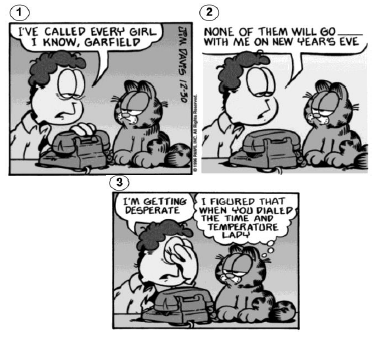
http://garfield.dale.ro/garfield-1996-december-30.html
Muitos verbos em inglês consistem em duas partes: um verbo
“base” (tais como bring, take, go, come) acompanhados de uma
preposição ou de uma partícula adverbial (tais como up, down,
out, in, off). No segundo quadro da tirinha, foi retirada a palavra
que acompanha o verbo GO. A preposição que completa o
sentido do verbo na fala do personagem é
Leia o texto para responder à questão.

(Claire Marshall. www.bbc.com, 15.05.2019. Adaptado.)
Leia o texto para responder à questão.
(Claire Marshall. www.bbc.com, 15.05.2019. Adaptado.)
Leia o texto para responder à questão.
(Claire Marshall. www.bbc.com, 15.05.2019. Adaptado.)
Leia o texto para responder à questão.
(Claire Marshall. www.bbc.com, 15.05.2019. Adaptado.)


I. O primeiro texto apresenta argumentos de diferentes fontes, tendo um caráter dissertativo-expositivo. II. As Figuras 1 e 2 têm como objetivo realizar uma crítica geral à sociedade cada vez mais dependente de tecnologias. III. Todos os textos tratam de um tema afim, mas usam recursos comunicativos diferentes.
Quais estão corretas?

 Conheça nossos planos