Questões de Vestibular Sobre inglês
Foram encontradas 6.365 questões


Com base no texto, considere verdadeiras (V) ou falsas (F) as afirmações que seguem.
( ) A maioria dos catadores é autônomo e coleta lixo das ruas para vender aos depósitos de sucatas, geralmente a preços baixos.
( ) Grafiteiros são artistas que somente pintam muros nas grandes capitais.
( ) Os catadores são invisíveis, exclusivamente, na sociedade brasileira.
Marque a alternativa que preenche corretamente os parênteses, de cima para baixo.
Sobre o texto, fazem-se as seguintes afirmações.
I- Os super-heróis também existem na vida real.
II- Os catadores brasileiros não são essenciais à população.
III- A desigualdade social, o desemprego e o lixo em abundância fizeram surgir a ocupação de catadores no Brasil.
Marque a alternativa correta.
Read the text below and answer following four
questions according to it.
How stress affects your health
Stress: We've all felt it. Sometimes stress can be a positive force, motivating you to perform well at your piano recital or job interview. But often — like when you're stuck in traffic — it's a negative force. If you experience stress over a prolonged period of time, it could become chronic — unless you take action.
Even short-lived, minor stress can have an impact. You might get a stomach-ache before you have to give a presentation, for example. More major acute stress, whether caused by a fight with your spouse or an event like an earthquake or terrorist attack, can have an even bigger impact.
Multiple studies have shown that these sudden emotional stresses — especially anger — can trigger heart attacks, arrhythmias and even sudden death.
When stress starts interfering with your ability to live a normal life for an extended period, it becomes even more dangerous. The longer the stress lasts, the worse it is for both your mind and body. You might feel fatigued, unable to concentrate or irritable for no good reason, for example. But chronic stress causes wear and tear on your body, too.
Stress can make existing problems worse. In one study, for example, about half the participants saw improvements in chronic headaches after learning how to stop the stressproducing habit of “catastrophizing,” or constantly thinking negative thoughts about their pain. Chronic stress may also cause disease, either because of changes in your body or the overeating, smoking and other bad habits people use to cope with stress. Other forms of chronic stress, such as depression and low levels of social support, have also been implicated in increased cardiovascular risk. And once you're sick, stress can also make it harder to recover. One analysis of past studies, for instance, suggests that cardiac patients with so-called “Type D” personalities — characterized by chronic distress — face higher risks of bad outcomes.
Adaptado de: <http://www.apa.org/helpcenter/stress.aspx>
Read the text below and answer following four
questions according to it.
How stress affects your health
Stress: We've all felt it. Sometimes stress can be a positive force, motivating you to perform well at your piano recital or job interview. But often — like when you're stuck in traffic — it's a negative force. If you experience stress over a prolonged period of time, it could become chronic — unless you take action.
Even short-lived, minor stress can have an impact. You might get a stomach-ache before you have to give a presentation, for example. More major acute stress, whether caused by a fight with your spouse or an event like an earthquake or terrorist attack, can have an even bigger impact.
Multiple studies have shown that these sudden emotional stresses — especially anger — can trigger heart attacks, arrhythmias and even sudden death.
When stress starts interfering with your ability to live a normal life for an extended period, it becomes even more dangerous. The longer the stress lasts, the worse it is for both your mind and body. You might feel fatigued, unable to concentrate or irritable for no good reason, for example. But chronic stress causes wear and tear on your body, too.
Stress can make existing problems worse. In one study, for example, about half the participants saw improvements in chronic headaches after learning how to stop the stressproducing habit of “catastrophizing,” or constantly thinking negative thoughts about their pain. Chronic stress may also cause disease, either because of changes in your body or the overeating, smoking and other bad habits people use to cope with stress. Other forms of chronic stress, such as depression and low levels of social support, have also been implicated in increased cardiovascular risk. And once you're sick, stress can also make it harder to recover. One analysis of past studies, for instance, suggests that cardiac patients with so-called “Type D” personalities — characterized by chronic distress — face higher risks of bad outcomes.
Adaptado de: <http://www.apa.org/helpcenter/stress.aspx>
Read the text below and answer following four
questions according to it.
How stress affects your health
Stress: We've all felt it. Sometimes stress can be a positive force, motivating you to perform well at your piano recital or job interview. But often — like when you're stuck in traffic — it's a negative force. If you experience stress over a prolonged period of time, it could become chronic — unless you take action.
Even short-lived, minor stress can have an impact. You might get a stomach-ache before you have to give a presentation, for example. More major acute stress, whether caused by a fight with your spouse or an event like an earthquake or terrorist attack, can have an even bigger impact.
Multiple studies have shown that these sudden emotional stresses — especially anger — can trigger heart attacks, arrhythmias and even sudden death.
When stress starts interfering with your ability to live a normal life for an extended period, it becomes even more dangerous. The longer the stress lasts, the worse it is for both your mind and body. You might feel fatigued, unable to concentrate or irritable for no good reason, for example. But chronic stress causes wear and tear on your body, too.
Stress can make existing problems worse. In one study, for example, about half the participants saw improvements in chronic headaches after learning how to stop the stressproducing habit of “catastrophizing,” or constantly thinking negative thoughts about their pain. Chronic stress may also cause disease, either because of changes in your body or the overeating, smoking and other bad habits people use to cope with stress. Other forms of chronic stress, such as depression and low levels of social support, have also been implicated in increased cardiovascular risk. And once you're sick, stress can also make it harder to recover. One analysis of past studies, for instance, suggests that cardiac patients with so-called “Type D” personalities — characterized by chronic distress — face higher risks of bad outcomes.
Adaptado de: <http://www.apa.org/helpcenter/stress.aspx>
Read the text below and answer following four
questions according to it.
How stress affects your health
Stress: We've all felt it. Sometimes stress can be a positive force, motivating you to perform well at your piano recital or job interview. But often — like when you're stuck in traffic — it's a negative force. If you experience stress over a prolonged period of time, it could become chronic — unless you take action.
Even short-lived, minor stress can have an impact. You might get a stomach-ache before you have to give a presentation, for example. More major acute stress, whether caused by a fight with your spouse or an event like an earthquake or terrorist attack, can have an even bigger impact.
Multiple studies have shown that these sudden emotional stresses — especially anger — can trigger heart attacks, arrhythmias and even sudden death.
When stress starts interfering with your ability to live a normal life for an extended period, it becomes even more dangerous. The longer the stress lasts, the worse it is for both your mind and body. You might feel fatigued, unable to concentrate or irritable for no good reason, for example. But chronic stress causes wear and tear on your body, too.
Stress can make existing problems worse. In one study, for example, about half the participants saw improvements in chronic headaches after learning how to stop the stressproducing habit of “catastrophizing,” or constantly thinking negative thoughts about their pain. Chronic stress may also cause disease, either because of changes in your body or the overeating, smoking and other bad habits people use to cope with stress. Other forms of chronic stress, such as depression and low levels of social support, have also been implicated in increased cardiovascular risk. And once you're sick, stress can also make it harder to recover. One analysis of past studies, for instance, suggests that cardiac patients with so-called “Type D” personalities — characterized by chronic distress — face higher risks of bad outcomes.
Adaptado de: <http://www.apa.org/helpcenter/stress.aspx>
Read the demographics below and answer the following question based on it.
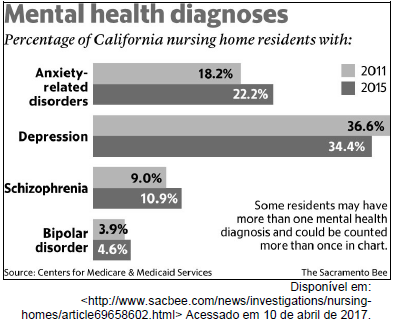
As regards the California nursing home residents
demographics above it is true to state that
Read the text below and answer the following questions based on it.
The Healing Power of Music
What better “medicine” than a “treatment” that has only positive side effects and “therapy” that is actually enjoyable? Music is shown to have the ability to help organize the brain; especially vital to those who are afflicted with Alzheimer’s.
Studies have shown that the results of a musical therapy session last for several hours afterward. Positive results include elevated mood, increased socialization and appetite and reduction in agitation. These benefits are attributed to the stimulation the brain receives during a music therapy session, a sort of “cognitive workout”.
As speech, writing and traditional forms of communication are compromised, music provides an alternative means of maintaining a connection, thereby helping to normalize interaction between caregiver and patient. Music used therapeutically creates an environment where the patient can be nurtured and cared for in a way that is safe, gentle and appropriate. Music is central to maintaining human bonds when those with dementia have lost the ability to initiate communication or to respond verbally.
The powers of music when focused and used therapeutically are many. Critical to maintaining quality of life for those with Alzheimer’s is management of emotions and preserving the connection with others. Music is conducive to keeping those connections strong as long as possible while helping the participant to focus, increase awareness and orient to the environment. A number of research studies have looked at music therapy as an important adjunct to medical treatment and findings suggest a possible link between the use of music and slowing the progression of dementia.
Music is primal to life and expressed by each of us every day whether through dancing to a favorite tune, keeping rhythm with a pencil or remembering a special time when hearing a forgotten melody. It is central to our lives and is embedded in our culture, defining how we acknowledge milestones, rites of passage and celebrations as well as providing comfort, transformation and inspiration.
Read the text below and answer the following questions based on it.
The Healing Power of Music
What better “medicine” than a “treatment” that has only positive side effects and “therapy” that is actually enjoyable? Music is shown to have the ability to help organize the brain; especially vital to those who are afflicted with Alzheimer’s.
Studies have shown that the results of a musical therapy session last for several hours afterward. Positive results include elevated mood, increased socialization and appetite and reduction in agitation. These benefits are attributed to the stimulation the brain receives during a music therapy session, a sort of “cognitive workout”.
As speech, writing and traditional forms of communication are compromised, music provides an alternative means of maintaining a connection, thereby helping to normalize interaction between caregiver and patient. Music used therapeutically creates an environment where the patient can be nurtured and cared for in a way that is safe, gentle and appropriate. Music is central to maintaining human bonds when those with dementia have lost the ability to initiate communication or to respond verbally.
The powers of music when focused and used therapeutically are many. Critical to maintaining quality of life for those with Alzheimer’s is management of emotions and preserving the connection with others. Music is conducive to keeping those connections strong as long as possible while helping the participant to focus, increase awareness and orient to the environment. A number of research studies have looked at music therapy as an important adjunct to medical treatment and findings suggest a possible link between the use of music and slowing the progression of dementia.
Music is primal to life and expressed by each of us every day whether through dancing to a favorite tune, keeping rhythm with a pencil or remembering a special time when hearing a forgotten melody. It is central to our lives and is embedded in our culture, defining how we acknowledge milestones, rites of passage and celebrations as well as providing comfort, transformation and inspiration.
Read the text below and answer the following questions based on it.
The Healing Power of Music
What better “medicine” than a “treatment” that has only positive side effects and “therapy” that is actually enjoyable? Music is shown to have the ability to help organize the brain; especially vital to those who are afflicted with Alzheimer’s.
Studies have shown that the results of a musical therapy session last for several hours afterward. Positive results include elevated mood, increased socialization and appetite and reduction in agitation. These benefits are attributed to the stimulation the brain receives during a music therapy session, a sort of “cognitive workout”.
As speech, writing and traditional forms of communication are compromised, music provides an alternative means of maintaining a connection, thereby helping to normalize interaction between caregiver and patient. Music used therapeutically creates an environment where the patient can be nurtured and cared for in a way that is safe, gentle and appropriate. Music is central to maintaining human bonds when those with dementia have lost the ability to initiate communication or to respond verbally.
The powers of music when focused and used therapeutically are many. Critical to maintaining quality of life for those with Alzheimer’s is management of emotions and preserving the connection with others. Music is conducive to keeping those connections strong as long as possible while helping the participant to focus, increase awareness and orient to the environment. A number of research studies have looked at music therapy as an important adjunct to medical treatment and findings suggest a possible link between the use of music and slowing the progression of dementia.
Music is primal to life and expressed by each of us every day whether through dancing to a favorite tune, keeping rhythm with a pencil or remembering a special time when hearing a forgotten melody. It is central to our lives and is embedded in our culture, defining how we acknowledge milestones, rites of passage and celebrations as well as providing comfort, transformation and inspiration.
Read the text below and answer the following questions based on it.
Abstract
Skipping breakfast can be potentially harmful because breakfast consumption is considered one of the important health-related behaviors that benefit physical and mental health. As the rate of depression has increased recently, we investigated the association between the frequency of eating breakfast and depression in adults. We obtained the data from the 2013 Korean Community Health Survey; a total of 207,710 survey participants aged 20 years or over were studied. Participants were categorized into three groups by the frequency of breakfast consumption as follows: “seldom,” “sometimes,” and “always.” We performed a multiple logistic regression to investigate the association between breakfast consumption and depressive mood. Subgroup analyses were conducted by stratifying socioeconomic variables controlling for variables known to be associated with depressive symptoms. Participants who had breakfast seldom or sometimes had higher depressive symptoms than those who always ate breakfast (“seldom”: OR = 1.43, 95% CI 1.36–1.52; “sometimes”: OR = 1.32, 95% CI 1.23–1.40). Subgroup analyses showed that this association was more marked in those who were 80 years or older, those who had low household income, or those with elementary school education level or less. The result of this study suggests that lack of breakfast consumption is associated with depression among adults with different socioeconomic factors.
Adaptado de:
Read the text below and answer the following questions based on it.
Abstract
Skipping breakfast can be potentially harmful because breakfast consumption is considered one of the important health-related behaviors that benefit physical and mental health. As the rate of depression has increased recently, we investigated the association between the frequency of eating breakfast and depression in adults. We obtained the data from the 2013 Korean Community Health Survey; a total of 207,710 survey participants aged 20 years or over were studied. Participants were categorized into three groups by the frequency of breakfast consumption as follows: “seldom,” “sometimes,” and “always.” We performed a multiple logistic regression to investigate the association between breakfast consumption and depressive mood. Subgroup analyses were conducted by stratifying socioeconomic variables controlling for variables known to be associated with depressive symptoms. Participants who had breakfast seldom or sometimes had higher depressive symptoms than those who always ate breakfast (“seldom”: OR = 1.43, 95% CI 1.36–1.52; “sometimes”: OR = 1.32, 95% CI 1.23–1.40). Subgroup analyses showed that this association was more marked in those who were 80 years or older, those who had low household income, or those with elementary school education level or less. The result of this study suggests that lack of breakfast consumption is associated with depression among adults with different socioeconomic factors.
Adaptado de:
Read the text below and answer the following question based on it.
Yellow Fever — Once Again on the Radar Screen in the Americas
Over the past several weeks, a fifth arbovirus, yellow fever virus, has broken out in Brazil, with the majority of the infections occurring in rural areas of the country. These are referred to as sylvatic, or jungle, cases, since the typical transmission cycle occurs between forest mosquitoes and forest-dwelling nonhuman primates, with humans serving only as incidental hosts. In this ongoing outbreak, health authorities have reported 234 confirmed infections and 80 confirmed deaths as of February 2017. Confirmed infections have occurred in the Brazilian states of Minas Gerais, Espírito Santo, and São Paulo, and hundreds of additional cases remain under investigation. The high number of cases is out of proportion to the number reported in a typical year in these areas.
Although there is currently no evidence that human-tohuman transmission through Aedes aegypti mosquitoes (urban transmission) has occurred, the outbreak is affecting areas in close proximity to major urban centers where yellow fever vaccine is not routinely administered. This proximity raises concern that, for the first time in decades, urban transmission of yellow fever will occur in Brazil.
Yellow fever is the most severe arbovirus ever to circulate in the Americas, and although vaccination campaigns and vector-control efforts have eliminated it from many areas, sylvatic transmission cycles continue to occur in endemic tropical regions. The most recent outbreak in Brazil highlights this phenomenon. If the current outbreak leads to urban spread through A. aegypti mosquitoes, clinicians should adopt a high index of suspicion for yellow fever, particularly in travelers returning from affected regions. As with all potentially reemerging infectious diseases, public health awareness and preparedness are essential to prevent a resurgence of this historical threat.
Adaptado de:
Read the text below and answer the following question based on it.
Yellow Fever — Once Again on the Radar Screen in the Americas
Over the past several weeks, a fifth arbovirus, yellow fever virus, has broken out in Brazil, with the majority of the infections occurring in rural areas of the country. These are referred to as sylvatic, or jungle, cases, since the typical transmission cycle occurs between forest mosquitoes and forest-dwelling nonhuman primates, with humans serving only as incidental hosts. In this ongoing outbreak, health authorities have reported 234 confirmed infections and 80 confirmed deaths as of February 2017. Confirmed infections have occurred in the Brazilian states of Minas Gerais, Espírito Santo, and São Paulo, and hundreds of additional cases remain under investigation. The high number of cases is out of proportion to the number reported in a typical year in these areas.
Although there is currently no evidence that human-tohuman transmission through Aedes aegypti mosquitoes (urban transmission) has occurred, the outbreak is affecting areas in close proximity to major urban centers where yellow fever vaccine is not routinely administered. This proximity raises concern that, for the first time in decades, urban transmission of yellow fever will occur in Brazil.
Yellow fever is the most severe arbovirus ever to circulate in the Americas, and although vaccination campaigns and vector-control efforts have eliminated it from many areas, sylvatic transmission cycles continue to occur in endemic tropical regions. The most recent outbreak in Brazil highlights this phenomenon. If the current outbreak leads to urban spread through A. aegypti mosquitoes, clinicians should adopt a high index of suspicion for yellow fever, particularly in travelers returning from affected regions. As with all potentially reemerging infectious diseases, public health awareness and preparedness are essential to prevent a resurgence of this historical threat.
Adaptado de:
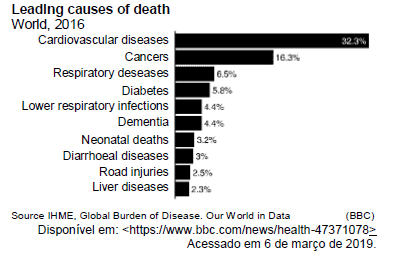
According to the graph above we can assert that
Read the cartoon below and answer the next questions based on it.
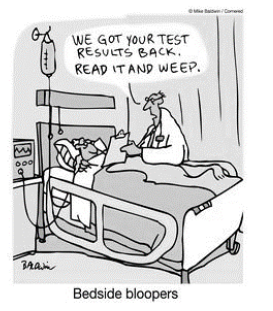
Disponível em: <https://www.greetingcarduniverse.com/holidaycards/nurses-day-cards/humor/greeting-card-607707> Acessado em 27 de fevereiro de 2019.
According to the cartoon above it is true to assert that the doctor

 Conheça nossos planos